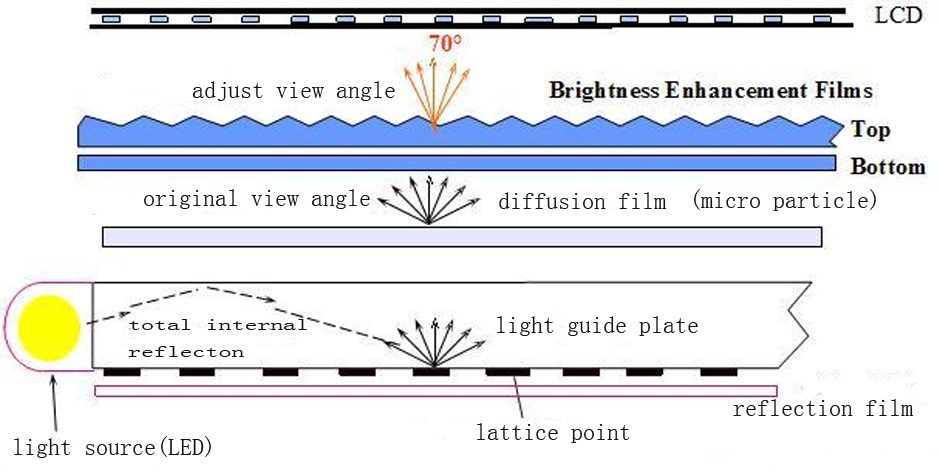
BEF which is abbreviated for Brightness Enhancement Film and is also called Prism Sheet. It is the key component of backlight module and occupy the highest proportion of the cost in the backlight module. It not only can concentrate the scattering light within a 70-degree angle in the front, but also can make the light outside the view angle reuse by its precision micro-structure optical film. Typically, one BEF can increase 40-60% brightness, it will be much better if two BEF are placed in vertical.
The classification of brightness enhancement film
It can be divided into normal prism sheet, multi-functional prism sheet, micro-lens film prism Sheet and reflective polarizer prism sheet.
1. Normal Prism Sheet
The main function of normal prism sheet is going to guide the light angle and increase the luminous efficiency. Currently, the famous normal prism sheet suppliers are 3M, Mitsubishi Rayon, LG Electronics, MNTech, Shinhwha, DNP, LGS, Gamma (Taiwan Cartwright), E-fun (Taiwan Ying-hui), Suntech, SKC Haas, Samsung Cheil and so on.
2. Multi-Functional Prism Sheet
It is a higher-level product that integrates with prism sheet and diffusion film. It has better luminous efficiency than normal prism sheet. The major suppliers are 3M, Shinhwha, MNTech, Samsung Cheil, E-fun and LG Electronics. It seems that panel manufacturers from South Korean employ multi-functional prism sheet a lot faster than their competitors in Japan and Taiwan.
3. Micro-Lens Film Prism Sheet
Micro-Lens Film Prism Sheet is composed of several architecture prism sheets and diffusion films which are the same as Multi-Functional Prism Sheet. Many LCD panels have adopted the structure of two Micro-Lens Films instead of the structure of two Micro-Lens Films and the prim sheet in the middle. So far, it is applied in 32”, 37” and 40” LCD TV panels. The main suppliers are the South Korean companies such as MNTech, SKC Hass, Shinwha, LG Chemical and LG Micron.
4. Reflective Polarizer Prism Sheet
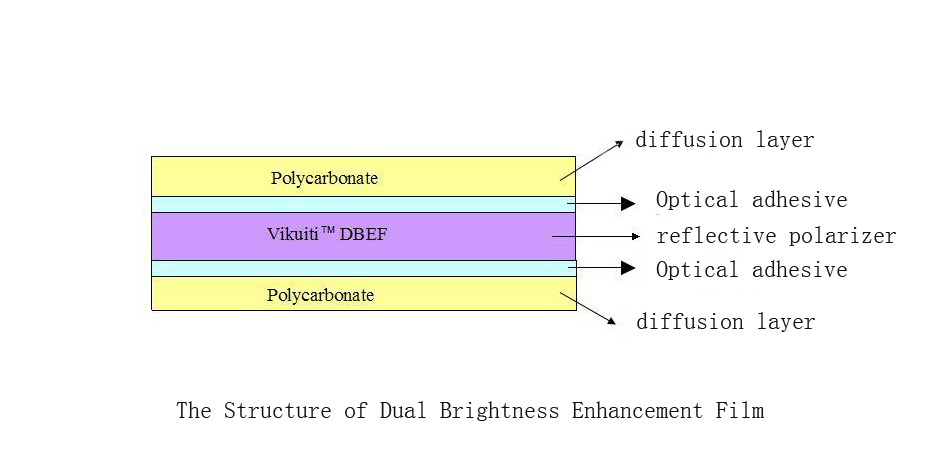
It is also called DBEF (Dual Brightness Enhancement Film) which is a unique patented product of 3M. It is the most important.
Brightness enhancement film which is a reflective polarizer. It reuses the light of the backlight unit by utilizing the mechanism of recycling light, which makes the light pass through optical material layers with more than 800 different refractive indexes and fully reflect. It can easily enhance the brightness of the light by 1.6 times. But now some South Korean and Japanese companies have also launched some products with similar function such as NPRF(MNTech), Shinwha (CLC and Woongjin) and Zeonor(Zeno).
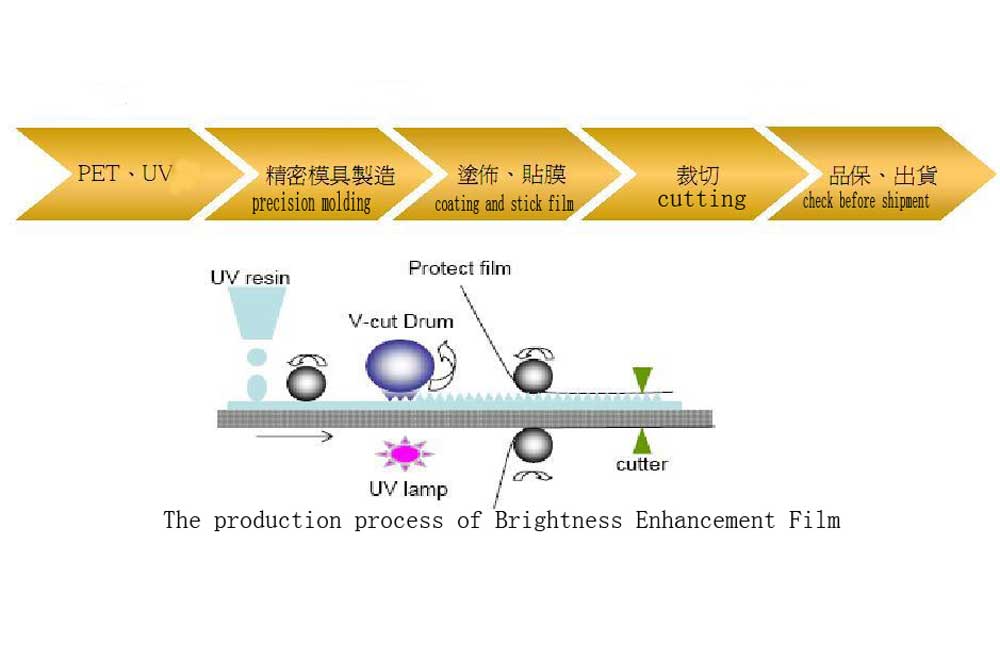
The production process of brightness enhancement film
Diffusion film achieves the function of diffusing light by the microparticles (beads) which attach at the surface of the optical film material. Meanwhile, the brightness enhancement film (prism sheet) not only can redistribute the light and improve the light transmittance, but also can increase the brightness and viewing angle of the light by transparent optical micro stripes (raster).
The production process of BEF (prism sheet) includes optical design, precision molding, chemical formulations and coating. The international advanced method is to realize the micro-optical structure by the molding roller which is solidified by UV adhesive processing technology. The most critical technology of BEF is that carving the molding roller prism pattern.