FAQ
Can the replacement work without changing our existing software or driver?
That is the design goal for our complete legacy display redesign service. We evaluate the original interface, communication protocol, display behavior and mechanical requirements, then redesign the LCD and board for compatibility. Final compatibility and any required changes are confirmed through sample evaluation and testing in the original system.
Do you sell single controller boards for personal projects?
No. Our controller-board services are for OEM and bulk-production projects. We do not offer single-unit retail boards, personal DIY screen conversions or one-off repair services.
Do you normally supply both the LCD and its controller board?
Yes. We regularly supply both the LCD and matched electronics for new product development and complete legacy display replacement. New product development is our most common and generally most straightforward route.
Can you develop a driver board for an LCD from another supplier?
Board-only development for an LCD you source elsewhere is considered selectively and typically requires several thousand sets. Even 1,000-set development orders are rarely accepted; the exact MOQ must be confirmed. This is different from complete legacy display replacement, a regular service in which we redesign and supply both the LCD and driver board using your original assembly as a reference sample.
What is the minimum order quantity?
Any project involving driver-board or control-PCBA development typically requires several thousand sets, including new product development, complete legacy display redesign and board-only development for customer-supplied LCDs. Even 1,000-set development orders are rarely accepted and are not our standard MOQ. The exact MOQ is confirmed after project review. Existing-board supply without development is assessed separately; single-unit retail sales are not available.
What is an LCD Controller Board?
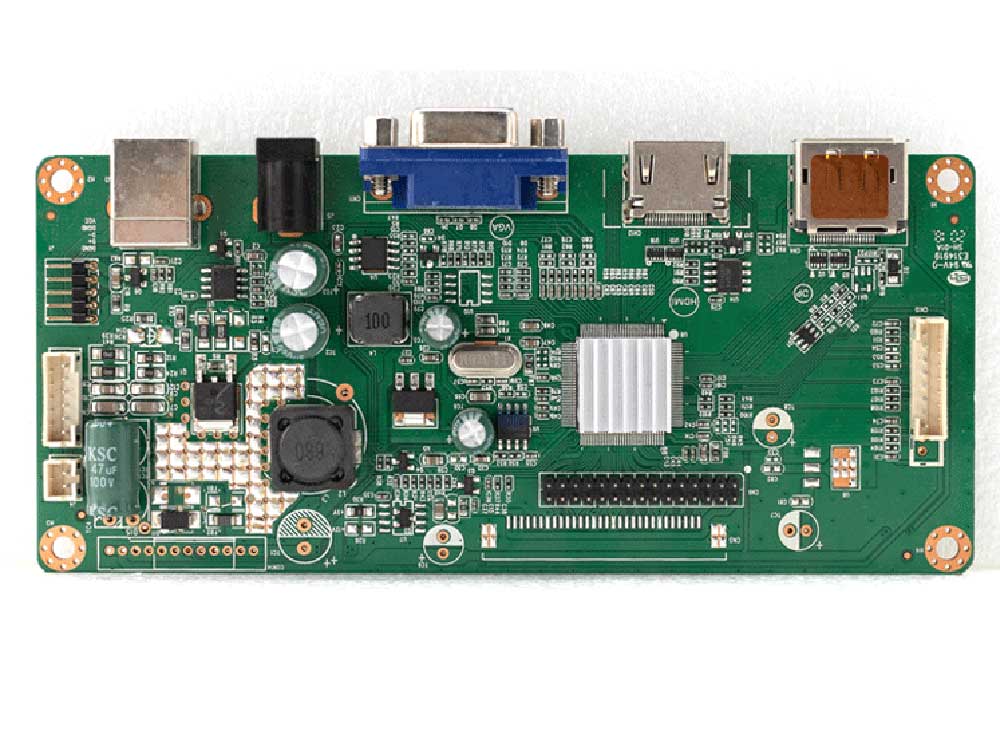
An LCD Controller Board is an electronic board used to drive an LCD panel and connect it with a host system. It may handle signal input, signal conversion, timing, power and backlight control.
Is an LCD Controller Board the same as an LCD panel?
No. The LCD panel is the display itself. The controller board is the electronics used to drive or connect the panel.
Can one controller board work with any LCD panel?
No. The board must match the exact panel interface, resolution, timing, voltage, backlight and connector definition.
Why is the LCD panel model number required?
The exact panel model and datasheet are needed because panels with the same size and resolution may still use different timing, pinout, voltage, interface and backlight requirements.
Can you provide HDMI LCD Controller Boards?
Yes. HDMI controller-board directions can be reviewed according to the panel model, resolution, panel interface and backlight requirement.
Can you provide LVDS LCD Controller Boards?
Yes. LVDS controller boards can be reviewed for many TFT LCD panels, industrial displays, commercial screens and replacement projects.
Can you provide eDP Controller Boards?
eDP solutions can be reviewed by project. They depend strongly on the panel model, host signal, link configuration, timing and resolution.
Can you provide MIPI LCD Controller Boards?
MIPI solutions require project-based engineering review because the panel initialization, lane configuration, timing and host system are highly panel-specific.
What is the difference between the input interface and the LCD interface?
The input interface comes from the host system, such as HDMI, VGA, DP or Type-C. The LCD interface connects the controller board to the panel, such as LVDS, RGB, eDP or MIPI.
Can the board support multiple input interfaces?
Selected boards can support HDMI, VGA, DP, Type-C or other combinations. Final availability depends on the board design and required panel output.
Can the board support touch?
Selected projects can support USB touch or touch-interface integration. The touch panel, controller IC, host system and operating system must be reviewed together.
Can the controller board control LCD brightness?
Brightness control can be reviewed through PWM, voltage control, OSD or project-based methods depending on the backlight and controller design.
Can you provide a backlight driver board only?
Yes. A separate Backlight Control Board can be reviewed when only LED voltage, current, PWM or dimming control is required.
Can the controller board support high-brightness LCD panels?
Yes. High-brightness projects can be reviewed with panel timing, backlight current, voltage, thermal design and dimming requirements together.
Can you customize the board size and mounting holes?
Custom dimensions and mounting-hole positions can be reviewed for OEM projects, subject to quantity, circuit complexity and engineering feasibility.
Can firmware or OSD be customized?
Firmware, startup logo, OSD language, keypad functions and selected menu items can be reviewed according to the board platform and project quantity.
Can you replace an old LCD controller board?
Yes. Complete legacy display replacement is a regular service. Provide the original LCD and driver-board assembly as a reference sample and the available technical information. We can redesign both parts with the goal of retaining the existing host system. These projects typically require several thousand sets, with the exact MOQ and compatibility confirmed through project review and testing.
What is the difference between an LCD Controller Board and an Android Board?
An LCD Controller Board mainly drives the display and converts signals. An Android Board runs an operating system and application software.
What is the difference between an LCD Controller Board and a Backlight Driver Board?
The LCD Controller Board handles image signal and panel control. The Backlight Driver Board only drives the LED backlight side.
What information is needed for quotation?
Please provide the panel model, datasheet, size, resolution, panel interface, input signal, backlight voltage and current, power input, touch requirement, OSD, cables, board-size limit, mounting holes, operating temperature, EMC or ESD requirement, quantity and application.