
Develop circular, curved, polygonal and architectural display concepts around suitable transparent LED platforms. DisplayMan reviews module layout, custom frames, mounting and content mapping to match your design and installation requirements.
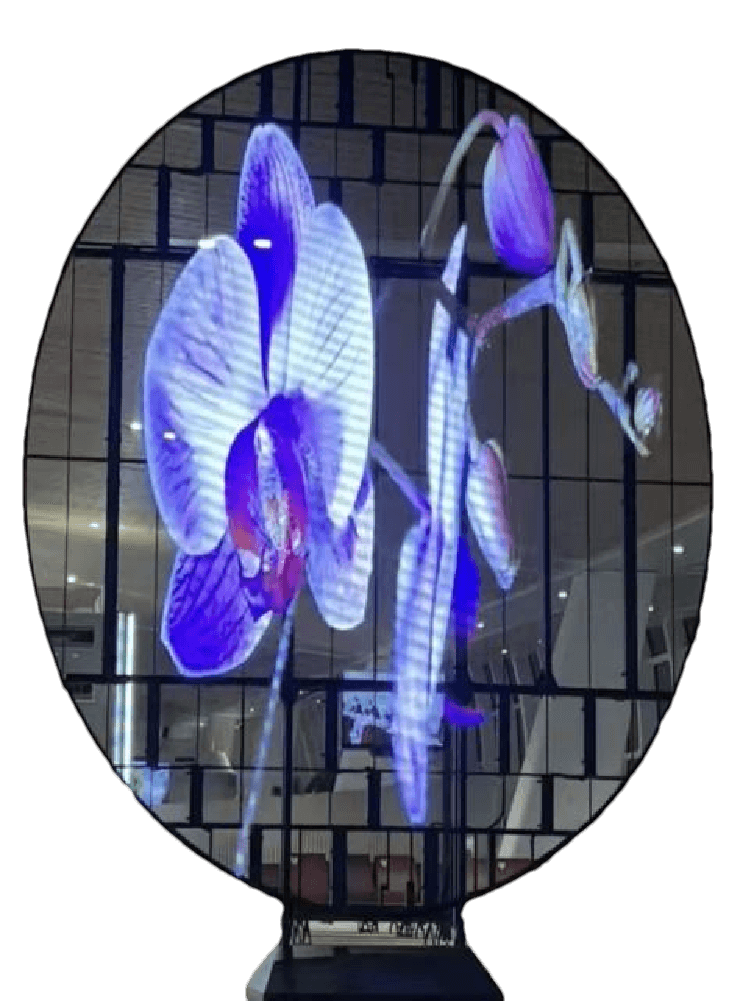
Explore circular, hexagonal, cylindrical and suspended transparent LED design directions. These examples show how digital content and custom structures can create a distinctive Creative Transparent LED Display for retail spaces, corporate lobbies, exhibitions and architectural installations.
These images illustrate custom design directions and should not be treated as guaranteed standard products or identical completed references. Each project requires feasibility review around its shape, active area, viewing environment, structure and installation. Transparency and visual performance depend on the selected LED platform, module spacing, frame and content.
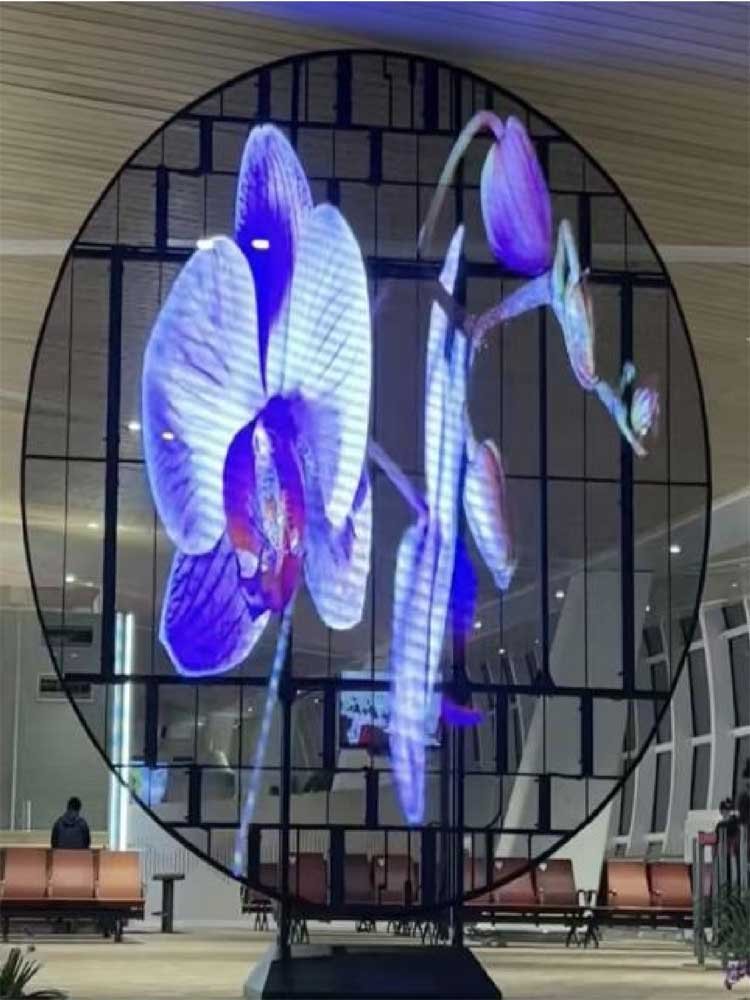
A circular display creates a focal point for digital art in a lobby, museum or transport setting. The open display structure retains views through portions of the installation; the frame and LED components remain physically present when the content is off.
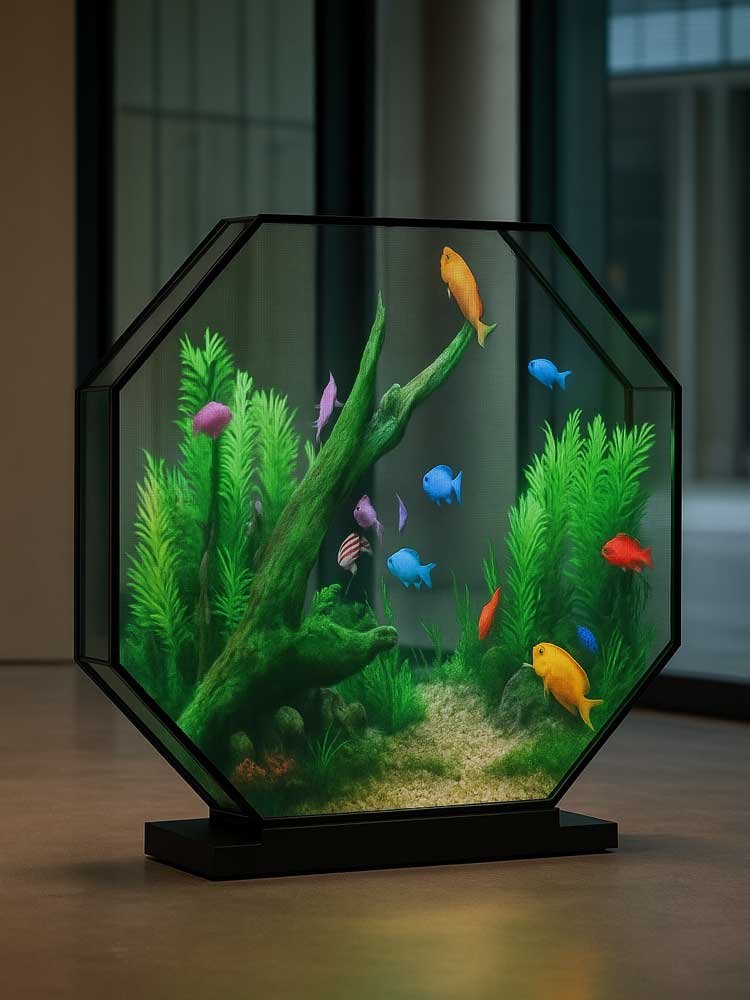
A hexagonal form combines aquarium-themed content with an architectural display structure. Its multi-sided layout offers a distinctive presentation for exhibitions and interior spaces, with content mapping coordinated around the viewing angles.
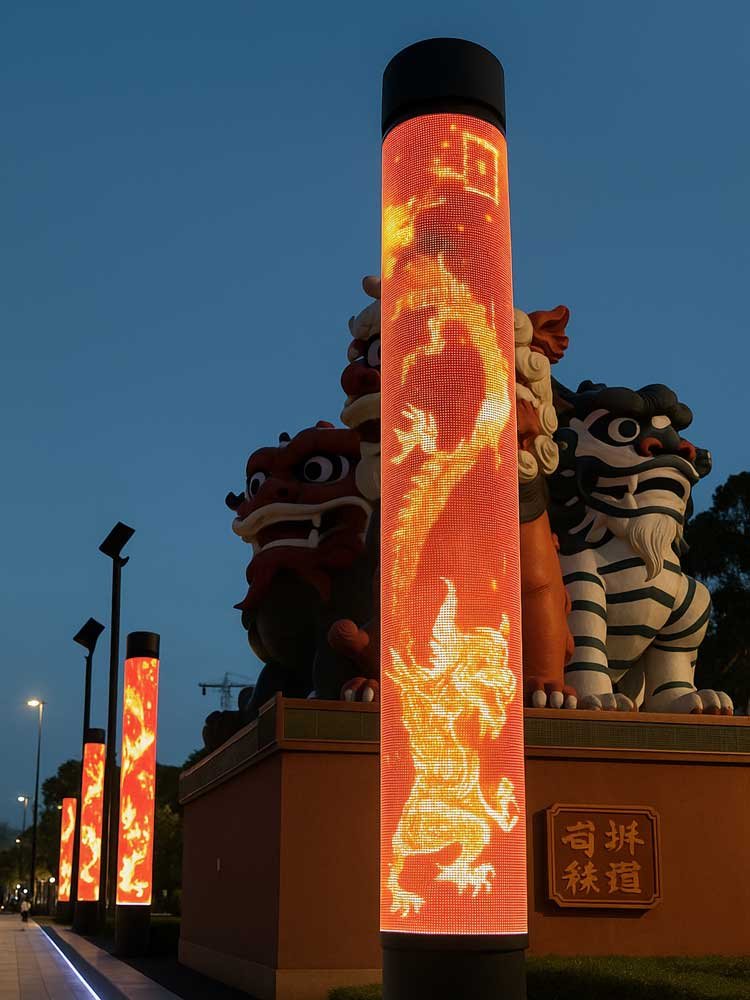
Cylindrical columns present red and gold dragon imagery beside traditional guardian lion statues. The design combines cultural storytelling with a contemporary media surface; outdoor configurations require site-specific weather and structural review.
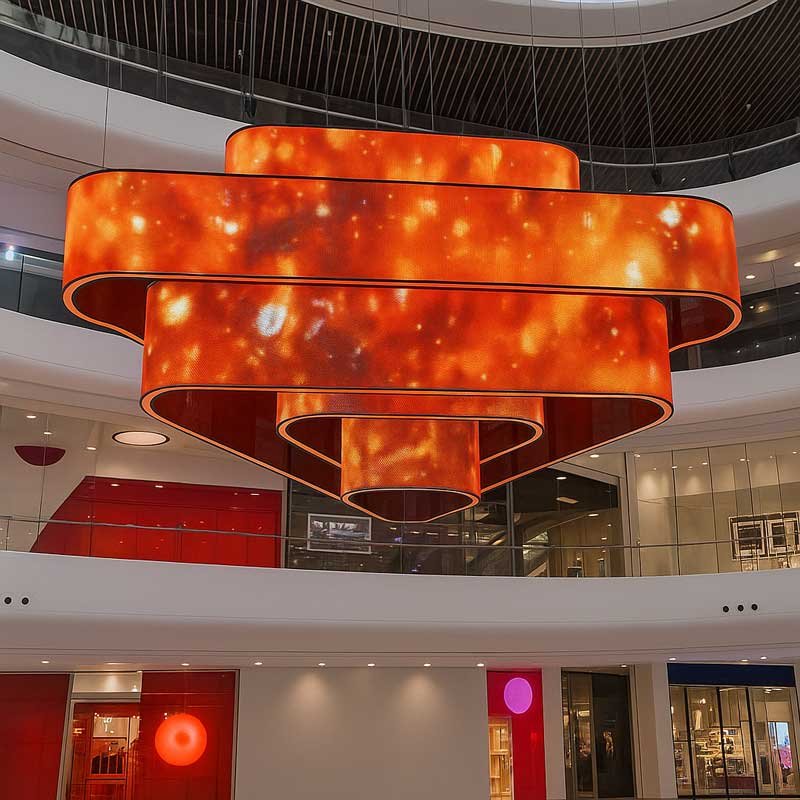
Layered ribbons carry orange and gold visuals above a shopping mall atrium, creating an overhead digital-art feature. Custom framing, suspension points and content mapping are coordinated around the ribbon geometry.
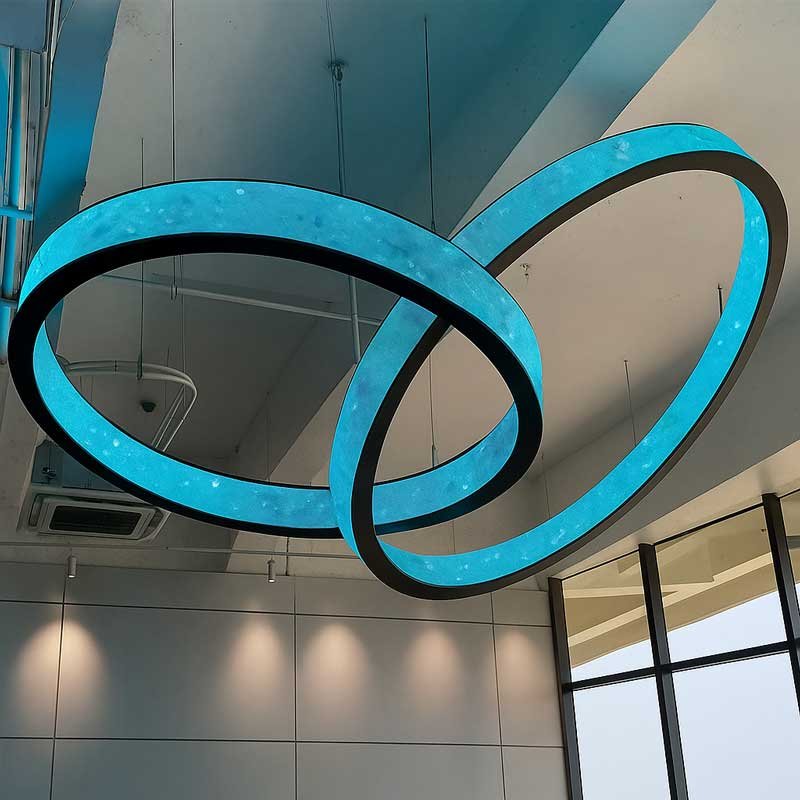
Interlocking rings create an overhead composition with aqua-blue visuals. The curved forms provide a distinctive direction for showrooms, offices and art spaces, with module layout and support structures selected for the required geometry.
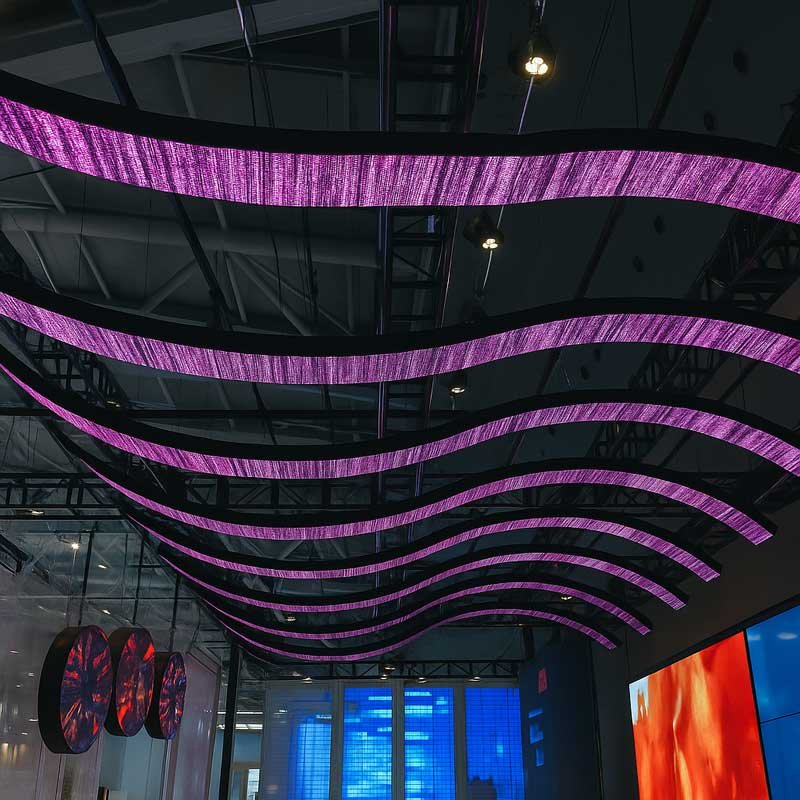
Wave-shaped panels extend across the ceiling to create depth and rhythm with purple imagery. This design direction suits exhibition halls and flagship interiors, with curvature, maintenance access and viewing positions considered during engineering.
A Custom Transparent LED Display is usually a special-shape or project-structure display system built around an existing Transparent LED technology platform.
The most common requests are circular, oval, polygonal, arched, curved, ring-shaped, cylindrical or artistic display forms—not completely new LED electronics.
Most projects keep an existing LED module, strip, pixel pitch and control architecture, then customize the visible outline, metal frame, support, base, installation method, dimensions, cable routing, controller placement and maintenance access.
For most customers, “custom Transparent LED” means custom shape, custom structure and project integration based on an existing LED platform—not a completely new LED platform developed from zero.
The outer shape is custom, but the underlying display technology should normally come from a proven product platform.
| Product Direction | Custom-shape Role | Typical Applications |
|---|---|---|
| Transparent LED Film Display | Flat or segmented glass-supported layouts using existing film modules | Retail windows, glass walls and large flat artistic displays |
| Flexible Transparent LED Film Display | Curved and cylindrical layouts supported by glass or another suitable surface | Columns, arcs, curved glass and creative interiors |
| Holographic Transparent LED Display | Lightweight framed, hanging or glass-supported artistic shapes | Circular, polygonal, display-cabinet and premium visual installations |
| Transparent LED Glass Display | Project-specific coordination with architectural glass and permanent structure | Building entrances, curtain walls and architectural objects |
| Indoor Transparent LED Display | Structured modular displays inside custom metal frames | Malls, atriums, freestanding structures and large indoor installations |
| Outdoor Transparent LED Mesh Display | Large outdoor custom outlines on engineered facade or steel structures | Building facades, public art and landmark media |
| Rental Transparent LED Display | Reusable curved, segmented and creative event layouts | Stages, concerts, exhibitions and product launches |
The correct custom solution normally begins by selecting an existing LED technology, then designing the shape, frame, support and system around it.
Special-shape projects use Transparent LED because the screen must become part of an artistic object, product display, interior installation or architectural feature.
Round visual installations for museums, airports, hotels, malls, showrooms and artistic media.
Vertical or horizontal oval frames for decorative, branded and spatial installations.
Hexagonal, octagonal and other geometric forms for display cabinets and product installations.
Arc walls, arched entrances and creative screens following architectural or interior lines.
Open-center circles, suspended rings and halo-style installations with mapped content.
Transparent visuals around columns, vertical structures and freestanding installations.
Separated display zones arranged around products, architecture or empty visual space.
Transparent LED integrated with showcases, retail furniture, glass cabinets and branded equipment.
Media sculptures and spatial structures reviewed from sketches, CAD or 3D concepts.
Most irregular screens are not created by redesigning every LED pixel. They combine an existing display platform with project-specific mechanical design and control mapping.
A proven Film, Flexible, Holographic, Indoor Cabinet, Outdoor Mesh or Rental platform is selected first.
Existing modules or LED strips are arranged within the required overall outline.
The circular, polygonal, arched or artistic visible shape is created by a custom frame or border.
Frame, mask or inactive edge zones define the final outline when required.
Floor-standing, hanging, wall-mounted, embedded or cabinet-integrated support is designed.
The controller and content canvas are mapped to the real active LED area.
Power supplies, cards and cables are hidden inside the frame, base or nearby structure.
Modules, cards, power supplies and connectors remain accessible after installation.
Animation is created or masked for circular, polygonal, ring-shaped or segmented canvases.
A display can have a circular or polygonal visible form even when the internal LED electronics remain modular. The frame, active-area layout and content mapping create the final shape together.
| Engineering Route | How It Works | Commercial Position |
|---|---|---|
| Frame-defined Special Shape | Existing modules or strips are installed inside a custom circle, oval, polygon, arch or artistic frame. The frame and content mask define the visible shape. | The normal and most economical route. |
| Layout-defined Special Shape | Standard modules or strips are arranged in stepped, segmented or partial layouts to follow the outline more closely. | Common when module-grid boundaries are acceptable. |
| True Edge-to-edge Custom Active Area | New PCB, LED layout, module shape, carrier, power distribution and mechanical design are developed specifically for the outline. | Deep development with paid NRE, tooling, MOQ and validation. |
For many applications, a custom circular frame around a proven modular LED platform provides a better balance of cost, reliability, lead time and serviceability.
Flat glass, curved glass, architectural glass, a frame, steel structure, truss or no existing support.
Environment determines waterproofing, structure, brightness, handling and maintenance requirements.
Close, medium and long viewing require different pitch, screen scale and product directions.
Clarify whether transparency, image detail, brightness, minimal obstruction, outdoor strength or budget matters most.
Fixed and rental screens require different cabinets, locks, packaging, maintenance and safety planning.
Retail playback, facade CMS, synchronized screens and live events require different control systems.
Power, cables, controller, structure, access and local installation responsibility must be defined early.
Match the technical solution with project value, shipping, installation and long-term operation.
| Viewing Condition | Possible Direction | Main Priority |
|---|---|---|
| Premium Close Viewing | Holographic Invisible Screen, premium transparent panel technologies or selected fine-pitch configurations | Detail, low obstruction and refined structure |
| Retail and Medium-distance Viewing | Film Screen, Flexible Film Screen, Indoor Transparent LED or selected Holographic solutions | Glass integration, brightness, openness and advertising impact |
| Large Indoor Commercial Viewing | Indoor Transparent LED Display | Structured modular installation and large visual scale |
| Long-distance Outdoor Viewing | Outdoor Transparent LED Mesh Display or architectural Glass Screen | Brightness, weather resistance, facade scale and structure |
| Event Audience and Cameras | Rental Transparent LED Display | Rental operation, refresh, rigging, transparency and transport |
A retail visitor standing near a screen, a driver viewing a facade and an audience watching a stage should not receive the same Transparent LED recommendation.
| Level | Typical Work | Commercial Reality |
|---|---|---|
| 1. Project Configuration | Select an existing platform and configure overall size, module quantity, controller, power, content map, cables and accessories. | The normal route for almost all commercial projects. |
| 2. Shape and Structural Customization | Develop a circular, oval, polygonal, curved, ring-shaped or artistic frame; customize the base, support, border, mounting and integration. | The most common form of Custom Transparent LED Display. |
| 3. Deep Platform Development | Evaluate a new LED layout, pixel pitch, PCB, module, cabinet platform, optical structure, waterproof architecture or complete hardware system. | Feasibility is not guaranteed; paid engineering, tooling, MOQ and validation are required. |
The following requests are not normal shape-customization projects. They are complete product-development programs.
New PCB outline, LED arrangement, driver architecture, mechanics, connectors and manufacturing process.
New electrical, optical, thermal, scanning, signal-integrity and production validation work.
New die-cast or fabricated cabinet, locking, power box, service method, tooling and reliability testing.
New film, glass, strip, mesh or supporting architecture with dedicated process development.
New display electronics, control, mechanical, optical, thermal and manufacturing platform developed from zero.
Tooling, pilot production, test fixtures, certifications, validation and mass-production preparation.
New modules, new pitches and new hardware platforms require solution-company participation and multidisciplinary engineering. Industrial design, mechanical, structural, electronic, PCB, optical, thermal, firmware, control, manufacturing and validation engineers may all be involved. Detailed development begins only after the customer approves and pays the engineering or NRE fee.
Detailed design cannot be supported as a free quotation exercise when a new platform is required.
PCB, molds, fixtures, samples, structural prototypes and validation create substantial upfront cost.
A new platform must have enough production volume to justify engineering and supply-chain setup.
Deep development is normally considered only for exceptionally large projects or long-term programs with major commercial value.
Concept, design, tooling, prototype, debugging, validation and production require multiple stages.
The customer, solution company, engineering team, manufacturer and local integrator must work as one program.
Without an exceptionally large order value, committed volume and paid R&D budget, the commercially correct route is almost always an existing LED platform combined with custom shape, frame and project integration.
Circle, oval, polygon, arch, ring, curve, column, segmented or artistic forms, subject to platform and structural feasibility.
Width, height, depth, visible border, active area and installation clearance.
Frame profile, border thickness, finish, color and hidden service structure.
Floor-standing base, wall support, hanging points, embedded structure or cabinet integration.
Glass-mounted, hanging, floor-standing, wall-mounted, recessed, stacked or truss-mounted.
Pixel canvas, non-rectangular content mask, screen segmentation and synchronized playback.
Power-supply position, cable length, hidden routing, connectors and control-box location.
Access panels, module replacement, controller access and spare-parts strategy.
Wooden cases, protective frames, split shipping, site assembly and installation documents.
There is no single universal specification table because the final values depend on the selected underlying LED platform and the required custom structure.
| Item | What Must Be Confirmed |
|---|---|
| Visible Shape | Circle, oval, polygon, arch, ring, curve, column, segmented or artistic outline, subject to feasibility |
| Outer Dimensions | Overall width, height, depth, frame border and installation clearance |
| Active Display Area | True active area, masked area, inactive edges and visible outline |
| Underlying Platform | Film, Flexible, Holographic, Glass, Indoor, Outdoor Mesh or Rental |
| Pixel Pitch | Normally selected from an existing platform according to viewing distance and image detail |
| Frame and Structure | Metal frame, base, hanging, wall support, cabinet, glass or architectural integration |
| Environment | Indoor, outdoor, protected, retail, exhibition or event operation |
| Control Mapping | Pixel map, non-rectangular canvas, segmentation and content mask |
| Power and Signal | Load, power-supply position, controller, cable route, connectors and hidden equipment |
| Maintenance | Module, power, card, cable and access-panel service method |
| Commercial Scope | Quantity, budget, development fee, MOQ, prototype, destination and schedule |
A new PCB, module, pitch or platform cannot be evaluated as a normal per-square-meter quotation. It requires a paid development scope, engineering milestones, tooling, validation and production commitment.
A round frame with flowers, animals, digital art or branded visual content.
Transparent LED integrated into an octagonal, hexagonal or custom showcase.
An open-center suspended structure for malls, exhibitions and spatial installations.
A flexible display following an arc, round column or shaped glass surface.
A custom base, frame and transparent canvas designed as one object.
A display following an entrance, ceiling curve or interior architectural line.
Transparent LED combined with a cabinet, machine, retail fixture or branded equipment.
Multiple transparent screen areas positioned around products or open space.
A paid program for a new module or platform when volume, budget and long-term demand justify it.
Film, flexible film, lightweight, framed, mesh, glass and rental structures are different products.
Pitch cannot solve an incorrect surface, environment, structure or installation method.
Outdoor projects require weather protection, wind engineering, cable protection and safe maintenance.
Film-type products need a suitable glass or smooth surface and sufficient installation access.
Power, control, modules, cables and connectors must remain serviceable after installation.
Most Transparent LED products are large-format visual media rather than close-reading displays.
Glass, structure, lifting, electrical work and building approval usually require local teams.
Different structures include different hardware, protection, packaging and engineering costs.
Late discovery of structural, cable or maintenance problems creates avoidable project risk.
A rectangular video placed inside a circular or polygonal screen wastes the value of the special shape. Content should be created or masked for the exact canvas.
Small text, long paragraphs, detailed documents, dense menus, thin lines and content that depends on a conventional rectangular frame.
| Installation Route | Key Checks |
|---|---|
| Glass-mounted Film | Flatness, cleanliness, glass condition, heat, condensation, cable route, power location and maintenance |
| Flexible or Curved Surface | Bending radius, surface shape, attachment, module direction, seams, power and service access |
| Lightweight Holographic Structure | Viewing distance, suspension or fixing, cable hiding, visible rear side and background conditions |
| Indoor Framed Screen | Depth, hanging or frame support, cabinet layout, glass divisions, ventilation and front or rear service |
| Outdoor Mesh or Glass Facade | Wind, waterproofing, sunlight, structure, anchoring, grounding, drainage, cable protection and safe access |
| Rental and Event Screen | Rigging, stacking, total weight, fast locks, refresh, cameras, transport cases, spares and dismantling |
Confirm that damaged display sections can be reached and replaced.
Equipment should be hidden where necessary but not permanently inaccessible.
Signal, power and waterproof connectors need practical inspection routes.
Indoor, daytime, nighttime and camera-facing operation may need different settings.
CMS, media players, schedules and remote updates require clear operating responsibility.
Plan modules, power supplies, cards and cables according to project size and access difficulty.
Review structure, seals, corrosion, drainage, cables and grounding periodically.
Check cabinets, locks, connectors, cables, cases and accessories before and after every event.
A screen that cannot be maintained safely is not a practical project solution.
When the project requires a new module, pitch, cabinet or complete hardware architecture, detailed engineering starts only after the development scope, NRE fee, milestones, IP responsibility, MOQ and production plan are agreed.
| Related Page | When to Visit |
|---|---|
| Transparent LED Displays | Overview of the complete Transparent LED product family |
| Transparent LED Solutions | Application-based comparison of Transparent LED technologies |
| Transparent LED Film Display | Flat indoor glass and storefront advertising |
| Flexible Transparent LED Film Display | Curved glass, columns and creative surfaces |
| Holographic Transparent LED Display | Lightweight premium transparent visual effects |
| Transparent LED Glass Display | Architectural glass and permanent facade integration |
| Indoor Transparent LED Display | Framed indoor malls, lobbies and curtain-wall interiors |
| Outdoor Transparent LED Mesh Display | Exposed outdoor facades and building media |
| Rental Transparent LED Display | Concerts, exhibitions and repeated temporary use |
| Transparent LED Retail Window Solution | Retail glass and storefront project planning |
| Transparent LED Facade Solution | Commercial facade technology selection |
| Transparent LED Event Backdrop Solution | Stage, exhibition and event planning |
| OEM/ODM Display Engineering & Prototyping | Custom structures, samples and engineering support |
It is a project-specific Transparent LED system that normally combines a proven LED platform with a creative outer shape, custom metal frame, base or suspension structure, tailored dimensions, installation integration, content mapping, cable routing and maintenance planning.
Yes. Most circular projects use an existing module or strip system together with a custom circular frame or mask, project-specific support and mapped content rather than a completely new electronic platform.
Circular, oval, polygonal, arched, curved, ring-shaped, cylindrical, column-shaped, segmented and other artistic forms can be reviewed.
Not automatically. Many special-shape displays use a frame or mask around an existing modular layout. A true edge-to-edge irregular active area may require a new PCB, module and tooling.
Customers normally select an existing pitch. A new pitch may be evaluated only as a paid platform-development program covering electronics, PCB, optics, thermal design, tooling, samples and validation; feasibility is not guaranteed.
It may be possible after a formal feasibility review, but it is a deep product-development program rather than a normal quotation. It requires paid NRE, tooling, suitable MOQ, prototypes and a realistic validation schedule.
It requires industrial design, mechanical, structural, electronic, PCB, optical, thermal, firmware, control, manufacturing and validation resources. The cost is too high for most one-off or small-volume projects.
Normally only when the customer has a very large strategic project, clear specifications, paid development budget, suitable MOQ and a realistic mass-production plan.
Normal product selection and preliminary review can be supported. New module, PCB, cabinet or platform development requires a separate paid engineering agreement before detailed design begins.
Yes. Custom metal frames, supports, bases, hanging structures, floor-standing structures, embedded structures and integration with glass, cabinets or spatial installations are common customization items.
Yes. Media players, HDMI or PC input, synchronous or asynchronous control, video processors, CMS, remote updates, synchronization and customer-system integration can be reviewed.
No. Film products normally need glass or another suitable surface. Framed, hanging, floor-standing, outdoor mesh and rental structures can use their own supporting systems.
It depends on viewing distance, size, environment, transparency, depth and whether the display is fixed or rental. Holographic, Indoor, Film or a project-specific framed system may be reviewed.
Selected shapes may be feasible outdoors when based on an outdoor-rated LED platform. The frame, waterproofing, wind load, drainage, cable protection, corrosion protection, maintenance route and local approvals must all be engineered for the site.
The controller uses a project-specific pixel map or canvas. Content is designed or masked to match the visible shape, active LED area and any non-display zones.
Large high-contrast animation, digital art, products, flowers, fish, particles, logos and short messages designed for the actual outline work best.
Provide the shape, dimensions, active area, viewing distance, environment, drawings or reference images, installation method, support, content, control, maintenance, quantity, budget, destination and schedule.
Use an existing LED module, strip or cabinet platform, then customize the shape, frame, support, dimensions, control mapping, cables and packaging.
Send us the reference image or drawing, required shape, dimensions, viewing distance, installation method, environment, support structure, content, control method, maintenance access, quantity, budget, destination and schedule.
We will first determine whether the project can use an existing Transparent LED platform with a custom frame and structure. Deep module or hardware development will be reviewed separately as a paid engineering program.
The most practical custom route is usually: proven LED platform + custom shape + custom metal frame + project-specific support + control mapping + installation integration.