Design with the Silhouette
Use the physical form as part of the composition instead of treating the vase as a distorted rectangular video wall.

DisplayMan develops vase-shaped LED displays that combine decorative silhouettes with programmable digital art. Changing diameters, compound curves, module segmentation, internal structure and content mapping are reviewed together for cultural exhibitions, premium interiors and architectural centerpieces.
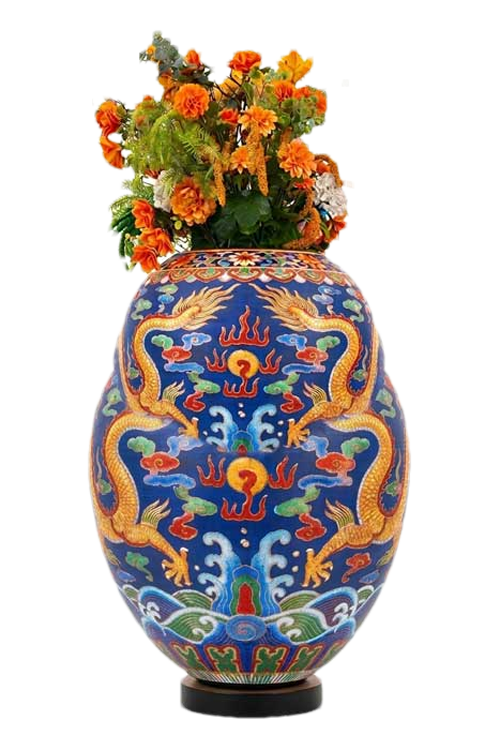
A Vase-Shaped LED Display is a custom Creative LED structure designed around a continuously changing 3D profile rather than a flat wall or constant-radius cylinder. The display can narrow at the base, expand through the body, transition across the shoulder and contract again through the neck — turning the physical LED structure itself into a digital sculpture.
This makes Vase LED especially suitable for hotels, museums, cultural exhibitions, tea houses, corporate lobbies, flagship spaces, art installations and cultural-tourism projects where the display should function as part of the interior or architectural identity.
A Vase LED is not simply a flexible LED cylinder with a decorative shell. The changing diameter can require different module widths, PCB geometries, curvature zones, masks, carriers and structural rings from the base to the neck.
Creative freedom does not mean unlimited miniaturization. A vase needs enough physical size for the changing curves to be divided into practical LED zones. For fully customized Vase LED projects, approximately 2 meters and above is the normal direction; around 1.5 meters should be treated as a special compact configuration.
| Vase Direction | Reference Height | Typical Applications | Engineering Logic |
|---|---|---|---|
| Special Compact Vase | Approx. 1.5 m | Premium retail, gallery, boutique hospitality, compact exhibitions | Engineering review only; shape complexity, pitch and module segmentation determine whether the silhouette can be reproduced smoothly |
| Standard Custom Vase | Approx. 2–3 m | Hotels, museums, corporate lobbies, cultural exhibitions, flagship spaces | Normal Creative LED direction with more room for changing-radius module zones, internal structure and service access |
| Large Artistic Vase | Approx. 3–5 m+ | Large lobbies, atriums, cultural landmarks, commercial centers, public art | Structure, modular transport, installation and multi-zone content mapping become major design factors |
| Architectural / Landmark Vase | Project-based | Large cultural projects, digital landmarks, public interiors, destination spaces | Custom structural engineering, on-site assembly, power distribution and long-term maintenance dominate |
| Outdoor Vase Sculpture | Project-based | Outdoor public art, plazas, cultural tourism and commercial landmarks | Outdoor modules, brightness, sealing, drainage, wind load, anchoring, thermal management and service access must be engineered together |
| Pitch Direction | Viewing Direction | Typical Vase LED Use |
|---|---|---|
| P1.5–P2.0 class | Premium close indoor viewing | Fine artistic patterns, detailed cultural graphics, close-view exhibitions and luxury spaces where custom module geometry supports the selected pitch |
| P2.0–P2.5 class | Close-to-medium indoor viewing | Museums, hotels, corporate lobbies, commercial installations and general custom Vase LED projects |
| P3–P4 class | Medium-to-long indoor viewing | Larger vase sculptures, atriums, events and architectural installations |
| P4+ class | Outdoor / long-distance viewing | Large outdoor or landmark vase directions where scale and brightness matter more than very fine pixel density |
As the overall height decreases, fewer module or PCB segments are available to reproduce the body, shoulder and neck smoothly. The result can become visibly faceted while custom tooling and development cost remain high. DisplayMan therefore normally recommends approximately 2 m+ for fully custom Vase LED projects, with around 1.5 m reviewed only as a special compact direction.
The most important engineering input is not only overall height and maximum diameter. DisplayMan needs the complete vertical profile — how the diameter changes from the base through the body, shoulder and neck. That profile determines module geometry, structure, mapping and cost.
| Engineering Factor | Why It Matters |
|---|---|
| Overall Height | Height determines the number of structural and LED zones, shipping strategy, service access and final visual scale. |
| Diameter Profile | A vase changes diameter continuously from base to body, shoulder and neck. The width profile at each height is the starting point for module segmentation. |
| Base Geometry | The base must provide structural stability, cable entry and electronics/service access while preserving the intended artistic silhouette. |
| Body / Belly Curve | The widest body often carries the largest LED area. Curvature, module size and frame roundness must remain consistent across this zone. |
| Shoulder Transition | The transition from body to neck can create strong compound curvature and is often one of the most difficult module-layout zones. |
| Neck Diameter | A narrow neck may require smaller or specially shaped PCB/module segments than the main body. |
| Lip / Rim | The upper opening, rim or decorative top can be LED, structural or non-display depending on viewing angle and design intent. |
| Module Segmentation | Different vertical zones may require different trapezoidal, tapered, flexible or custom PCB module geometries. |
| Internal Skeleton | The structure controls every radial section of the vase and must maintain the intended 3D profile while supporting LED modules and electronics. |
| Vertical / Curved Seams | Module boundaries should be distributed to minimize visible discontinuity and avoid concentrating distortion in the primary viewing direction. |
| Power & Control | Receiving cards, power supplies and cabling must fit into the changing internal volume without blocking ventilation or service access. |
| Content Mapping | The final content canvas must match the varying circumference of each height zone rather than treating the vase as a simple rectangular or cylindrical screen. |
| Serviceability | Module replacement and electronics access should be planned before the decorative exterior and structural sections are frozen. |
| Transport & Assembly | Large vases may need to be separated into vertical or ring-like structural sections for shipping and reassembled on site with controlled alignment. |
The silhouette is part of the product. A Vase-Shaped LED Display should still read clearly as the intended vase form before animation begins. The LED segmentation, metal structure and content map should therefore be developed from the same 3D profile.
There is no single universal Vase LED module. Different profiles require different combinations of flexible modules, tapered modules, custom PCBs and structural zones.
| Segmentation Direction | How It Works | Engineering Trade-Off |
|---|---|---|
| Zone-Based Flexible Modules | Use flexible LED modules in local areas where the curvature is compatible, while changing module count or width from one height zone to another. | Can reduce tooling but works best when the local curvature remains within standard flexible-module limits |
| Tapered / Trapezoidal Modules | Use different tapered PCB/module widths to follow the changing circumference from base to shoulder and neck. | Better shape fidelity but may require several unique module types |
| Custom Multi-Size PCB Modules | Develop multiple module geometries for body, shoulder, neck and other complex transitions. | Highest shape accuracy but increases tooling, NRE, spare-parts and assembly complexity |
| Hybrid Structure + Decorative Zones | Use LED only on the primary visible body while selected rim, neck or base details remain structural or decorative. | Can simplify engineering when full LED coverage is not necessary for the visual concept |
Reducing the number of unique modules lowers tooling, assembly and spare-parts complexity, but too much simplification can make the body or shoulder look faceted. The engineering goal is to achieve the required vase silhouette with the smallest practical number of unique module types.
A custom Vase LED project is priced as an engineered 3D product, not only by LED display area. Development work can include custom PCB/module layouts, masks, carriers, metal structure, assembly fixtures, mapping and prototype validation.
Tooling and engineering costs do not disappear when the quantity is one. A larger production quantity spreads NRE across more units, while a one-off artistic vase carries most of the development cost in a single system.
The finished product should be engineered and quoted as a complete Creative LED sculpture rather than only as LED module area.
| System Layer | Typical Scope |
|---|---|
| LED Surface | Flexible, tapered, trapezoidal or project-specific LED modules forming the vase body |
| 3D Structural Skeleton | Custom metal frame defining the complete changing-diameter vase profile |
| Module Carriers / Masks | Project-specific fixing, mask and support system matching each LED zone |
| Power & Control | Power supplies, receiving cards, sending/controller system and optional media player |
| Vase Pixel Map | Zone-based content canvas matched to the actual circumference and resolution of each height |
| Installation Base | Structural base, anchoring, cable entry and service access |
| Transport Package | Sectional structure, alignment references, fasteners and protective packaging for shipment |
| Maintenance Package | Module removal method, electronics access, spare module strategy and service documentation |
Vase LED is especially strong when the content respects the physical form. Floral graphics, porcelain-inspired patterns, landscapes, abstract light and vertical storytelling can use the body, shoulder and neck as one sculptural canvas.
| Content Direction | Mapping Strategy |
|---|---|
| Traditional / Cultural Patterns | Artwork can follow the body like ceramic decoration, with motion added without losing the overall vase silhouette. |
| Floral & Botanical Motion | Branches, flowers, vines, petals and flowing nature imagery work naturally with the upward profile of a vase. |
| Abstract Light & Shadow | Vertical gradients, flowing particles and radial motion can emphasize the changing diameter and sculptural volume. |
| Brand / Event Graphics | Reserve clear hero zones for logos, event themes or cultural branding where the vase has enough local circumference and pixel density. |
| 360° Panoramic Artwork | Create a full wrap-around canvas so the display remains intentional from multiple viewing directions. |
| Vertical Storytelling | Use the height of the vase as a narrative axis, moving content from base to body, shoulder and neck. |
| Seam-Aware Content | Avoid important text or logos across high-distortion module transitions or primary structural seams. |
| Multi-Vase Synchronization | Several vases can form a coordinated installation, color sequence or cultural-art series using synchronized or independent content. |
Use the physical form as part of the composition instead of treating the vase as a distorted rectangular video wall.
Branches, light, particles and visual stories can move naturally from the base toward the neck and reinforce the height of the object.
Text and fine decorative patterns should only be used where the local circumference and pixel density provide enough readable resolution.
The vase silhouette remains physical when the screen is off, but porcelain-like surface decoration, printed off-state artwork or other special decorative finishing should be treated as a separate project requirement and confirmed before quotation.
| Installation Method | Engineering Considerations |
|---|---|
| Floor-Standing Base | Most common direction for hotels, museums, galleries, exhibitions and commercial interiors; base must control stability, cable entry and service access. |
| Integrated Plinth / Pedestal | Useful when the vase is presented as a premium digital sculpture or museum object with controlled viewing distance. |
| Architectural Integration | The vase can become part of a lobby, atrium or themed interior; finish interfaces, safety clearance and maintenance must be coordinated with the space. |
| Segmented On-Site Assembly | Large vases can be transported in structural sections and assembled vertically on site; alignment and module continuity must be planned before production. |
| Outdoor Structural Base | Requires project-specific wind-load, anchoring, drainage, weather sealing, UV/temperature review and safe service planning. |
A visually beautiful 3 m or larger vase is not useful if it cannot pass through the loading route. Shipping section size, site access, lifting points, alignment and reassembly should be confirmed while the structure is still being engineered.
Vase LED is strongest where the display should feel like a digital sculpture or decorative architectural object rather than conventional signage.
Use a vase-shaped digital sculpture as a lobby centerpiece, decorative media object or ambient visual installation.
Combine traditional forms with dynamic historical, artistic or cultural content in a recognizable sculptural object.
Vase-inspired forms work naturally in interiors that reference porcelain, traditional craft or botanical aesthetics.
Create a premium artistic landmark with brand colors, abstract content or cultural storytelling without relying on a rectangular screen.
Use a large digital vase as a high-visibility centerpiece, seasonal visual object or themed commercial installation.
Build a temporary or reusable creative landmark that can display changing campaigns, cultural themes and event media.
Treat the LED surface as part of a digital sculpture where form, motion and surrounding architecture work together.
Large vase-inspired forms can become digital landmarks in visitor centers, cultural attractions and destination interiors.
| Factor | Vase-Shaped LED Display | Cylindrical LED Display |
|---|---|---|
| Geometry | Changing diameter with base, belly, shoulder and neck | Constant-radius cylindrical surface |
| Curvature | Multi-zone / compound or changing curvature | Single-axis constant-radius curvature |
| Module Strategy | May require several tapered, trapezoidal or custom PCB/module geometries | Usually standard flexible LED modules |
| Tooling / NRE | Can be substantial for a new fully custom vase profile | Normally much lower for a simple cylinder |
| Minimum Size Logic | Generally benefits from larger scale; approx. 2 m+ is the normal custom direction | Controlled mainly by the bending radius of the selected flexible LED module |
| Content Mapping | Changing-circumference vase map | Panoramic cylindrical canvas |
| Best Fit | Digital sculpture, cultural display, artistic landmark | Columns, pillars and general 360° media |
| Factor | Vase-Shaped LED Display | Bottle / Product Replica LED |
|---|---|---|
| Primary Goal | Create an artistic / decorative digital sculpture based on a vase form | Replicate a branded bottle, beverage or commercial package |
| Shape Priority | Aesthetic silhouette, body curve, shoulder and neck proportions | Accuracy to the real commercial package or brand object |
| Content | Art, cultural graphics, floral motion, ambient media and storytelling | Packaging artwork, logos, product animation and promotional content |
| Brand Dependency | Can be completely non-branded and form-driven | Usually linked to a specific product or brand identity |
| Engineering | Custom shape segmentation driven by artistic geometry | Custom segmentation driven by real package geometry |
| Best Fit | Hotels, museums, cultural venues, galleries, artistic interiors | Retail launches, brand activations, product events and flagship displays |
| Factor | Vase-Shaped LED Display | Sphere LED Display |
|---|---|---|
| Geometry | Rotational form with continuously changing diameter along the vertical axis | True spherical geometry with compound curvature and polar convergence |
| Segmentation Logic | Can be divided into base/body/shoulder/neck zones with different circumferences | Must converge from equator toward both poles |
| Visual Identity | Recognizable vase silhouette and vertical profile | Perfect or near-perfect spherical volume |
| Content Mapping | Changing-radius vertical artwork map | Sphere-specific latitude/longitude or custom spherical map |
| Installation | Usually floor-standing | Floor-standing, suspended or architectural |
| Best Fit | Cultural art, decorative sculpture, hospitality, museums | Digital Earth, science visualization, globes and spherical landmarks |
Choose Cylindrical LED when the surface is a simple constant-radius wrap. Choose Bottle / Product Replica LED when the display must reproduce a commercial package. Choose Sphere LED when true spherical geometry is essential. Choose Vase-Shaped LED when the changing artistic silhouette is part of the experience.
Vase-Shaped LED is one featured direction within DisplayMan’s broader Custom / Creative LED engineering capability. These eight product families are common entry points, not a limit on the shapes that can be developed.
DisplayMan can also review rings, flowers, torches, crowns, branded objects, sculptures and other project-specific forms. Use Custom LED Displays when the final geometry is still at concept stage.
Vase LED projects can begin from the desired sculptural form, from the custom-engineering challenge, or simply from the venue and visual objective. Continue from the route that best matches the current stage of the project.
Choose a product page when the display form or technology direction is already clear.
Custom LED DisplaysParent Custom / Creative LED family for sculptural, artistic, branded and project-specific 3D LED forms.Cylindrical LED DisplayUse when the surface is a simple constant-radius wrap that can be built from standard flexible LED modules.Can-Shaped LED DisplayChoose when the changing profile is driven by a real commercial bottle, can or product package rather than an artistic vase form.Sphere LED DisplayTrue compound-curved spherical LED for globes, digital Earth, science visualization and landmark installations.Mascot & Character Shaped LED DisplayCharacter-like 3D LED platform where digital mapping creates different mascots, identities and branded personalities.Flexible LED DisplaysCurved walls, columns, cylinders and arcs using standard flexible modules when the geometry does not require full Custom LED segmentation.Rental LED DisplaysModular event LED walls for changing screen sizes, repeated assembly and stage / touring workflows.Portable Foldable LED Poster DisplaysFoldable vertical LED posters for exhibitions, roadshows and product launches when a compact mobile finished display is more practical.Choose a solution page when the changing-radius structure, module/tooling or prototype challenge is clearer than the final configuration.
Bespoke & Custom Display SolutionsFor changing-radius structures, unusual sculptural profiles, installation constraints and project-specific system integration.OEM / ODM Display Engineering & PrototypingFeasibility, module segmentation, PCB/tooling review, structure and prototype development for new Vase LED forms.All Display SolutionsBrowse DisplayMan engineering and integration routes across LED, LCD, touch and custom display systems.Choose an application page when the venue or visual objective is known but the final display form is still being selected.
Exhibition, Events & ShowroomsDigital sculptures, exhibition landmarks, experiential spaces and artistic event installations.Corporate & Office EnvironmentsCorporate lobbies, luxury hospitality, visitor centers and premium interior landmarks.Outdoor & Public Display SystemsOutdoor artistic structures where wind, drainage, anchoring, sealing, thermal design and long-term service must be reviewed.All Display ApplicationsBrowse DisplayMan applications by venue and use case before fixing the final physical form.A target height alone is not enough. The most useful input is a drawing, CAD model or dimensioned side profile showing how the diameter changes from base to body, shoulder and neck. DisplayMan can then review module segmentation, tooling, structure, mapping and the most practical project size.
A Vase-Shaped LED Display is a custom Creative LED structure whose display surface follows the changing diameter and sculptural silhouette of a vase, including body, shoulder, neck and base zones.
No. A cylinder has a constant radius and can usually use standard flexible LED modules. A vase changes diameter along its height and may require several different module geometries or custom PCB segmentation.
Not exactly. Bottle-Shaped LED is usually product-replica driven and follows a specific commercial package. Vase-Shaped LED is more often artistic, decorative or cultural, although the engineering methods can overlap.
For fully customized Creative LED vase projects, approximately 2 meters and above is the normal direction. Around 1.5 meters can be reviewed as a special compact configuration. Smaller sizes depend heavily on pitch, module segmentation and the complexity of the vase profile.
A larger vase provides more LED and PCB segments to reproduce the changing curves smoothly. When the shape becomes too small, the body, shoulder and neck can become visibly faceted and the cost of custom module development becomes difficult to justify.
It can only be reviewed case by case. A compact design may work if the geometry is simple and a suitable module system already exists, but DisplayMan does not treat sub-1.5-meter fully custom Vase LED as a standard product.
Pixel pitch depends on viewing distance, overall size, content detail and the module geometries required by the vase. Fine indoor pitches can be used for close viewing when the custom segmentation supports them.
Often yes. A fully custom vase may require several PCB/module shapes, masks or carriers, assembly fixtures and a dedicated metal structure. The exact tooling scope depends on the profile and whether existing module geometries can be reused.
They can be used in local zones where the curvature is compatible, but a complete vase normally changes diameter too much to be built as one simple constant-radius flexible LED wrap.
There is no fixed number. The engineering goal is to achieve the required shape with the fewest practical unique module types. More complex shoulders, necks and organic transitions usually increase the number of module geometries.
It can be reviewed, but it is not always necessary. In many designs the body is the primary LED surface while the top rim, opening or selected details remain structural or decorative.
The physical silhouette will remain vase-shaped when powered off. Any special decorative surface treatment, printed finish or off-state artwork requires separate engineering review and should not be assumed as a standard feature.
Yes. Cultural patterns, floral motion, landscapes, abstract light and other artistic content can be mapped to the vase surface. The content should be adapted to the changing circumference and module zones.
Yes, but standard rectangular video should be reformatted for the final vase pixel map so important elements are not distorted by changing circumference or module transitions.
Yes. Multiple Vase LED Displays can be configured as a coordinated installation or series, subject to the selected control architecture.
Outdoor projects can be reviewed with suitable LED modules, weather sealing, drainage, wind-load, anchoring, thermal management and electrical protection.
Large vase structures can be divided into ring-like or vertical structural sections for transport and then aligned and assembled on site.
Maintenance can use front-removable modules, dedicated service zones, removable structural sections or base access depending on the module geometry and final structure.
Tooling, PCB/module development, structure, assembly fixtures, content mapping and prototype validation are non-recurring engineering costs. When only one unit is ordered, those costs are concentrated into a single product.
Provide target height, maximum diameter, neck diameter, reference vase photo/drawing/3D model, indoor/outdoor environment, viewing distance, preferred pitch if known, installation method, quantity, content concept and project schedule.
Send the vase drawing, target height, maximum diameter, viewing distance and installation environment. DisplayMan can review the practical module segmentation, structure, pixel pitch, mapping and tooling direction.
A Vase-Shaped LED Display should be designed from the 3D silhouette outward. Body curvature, shoulder transition, neck geometry, module segmentation, structure, content mapping and installation all need to work as one engineered Creative LED product.