No Universal Minimum Radius
Do not apply one radius such as 250 mm to every Flexible LED module. The safe minimum radius depends on the selected module design, pitch, bend direction, PCB / substrate structure and mounting method.

Build smooth indoor LED surfaces with standard flexible modules and a support structure engineered to your project’s radius, viewing distance and service access.
Explore P1.25–P2.5 reference directions and share your curve drawing with DisplayMan for a project review.
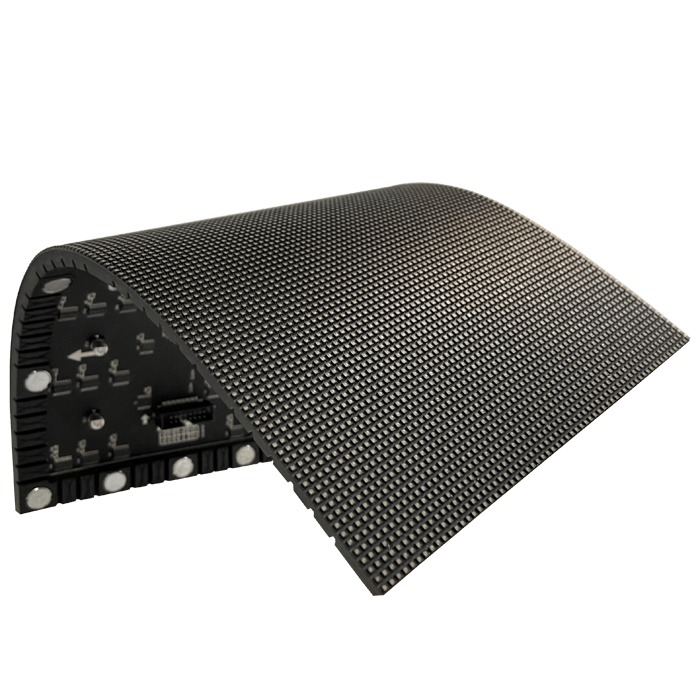
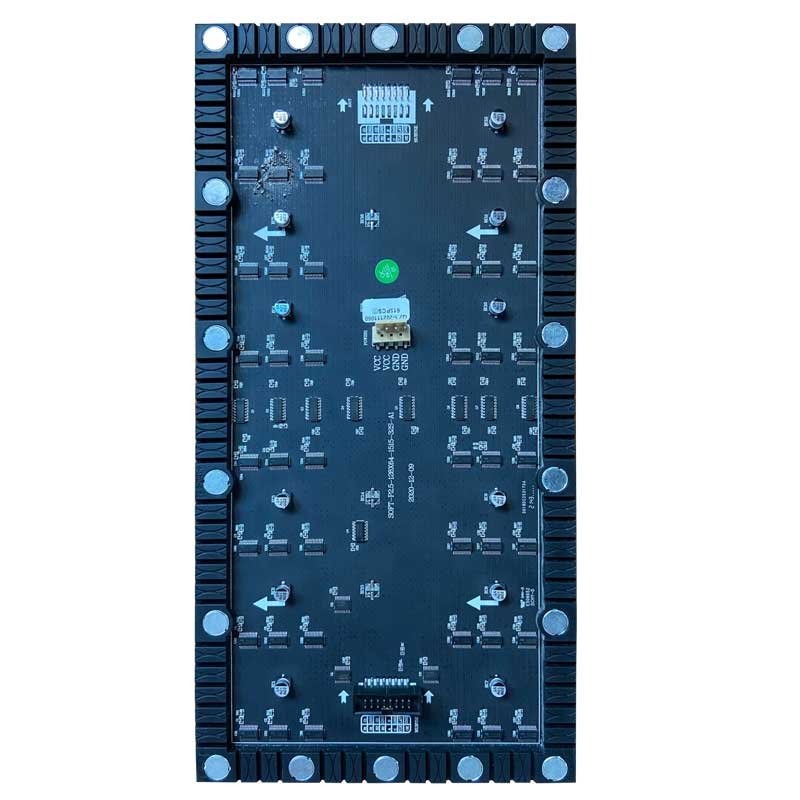
Explore the illuminated curved surface, module construction and rear PCB details. Final module choice and bending radius are reviewed against the project structure.
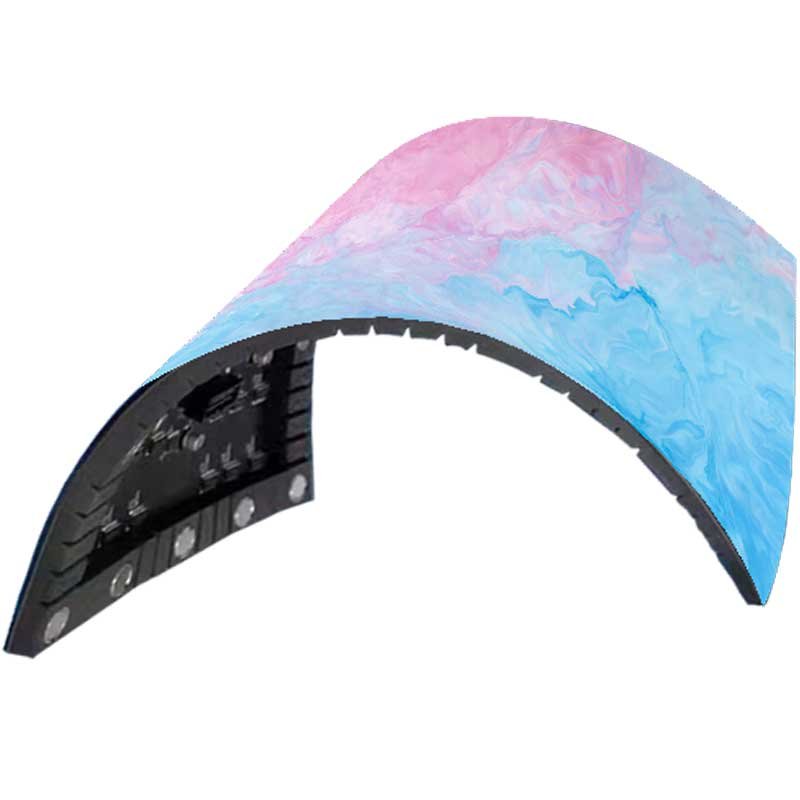
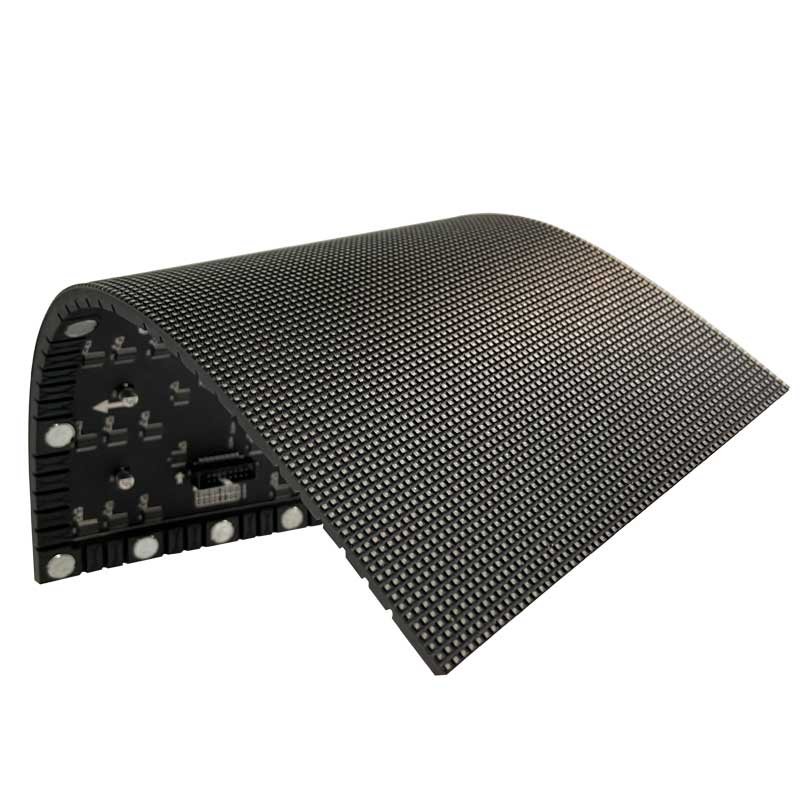
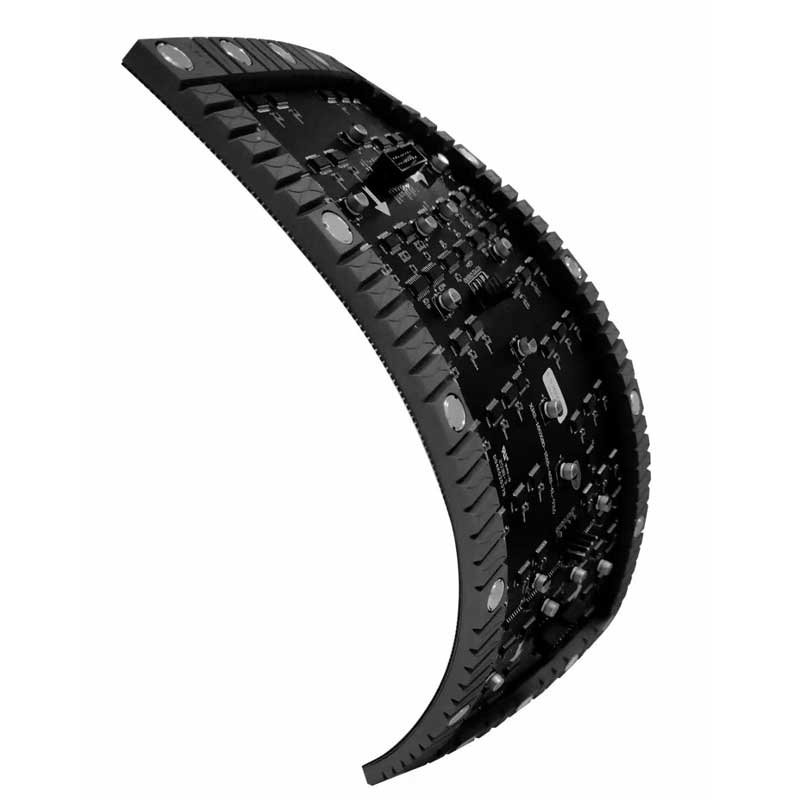
DisplayMan Flexible LED Displays use soft LED modules to create smooth solid-display surfaces on columns, cylinders, concave / convex walls, arcs and compatible wave-shaped structures.
The key advantage is not unlimited free-form shaping. It is the ability to use a standardized flexible LED module platform on a carefully engineered curved supporting frame, giving architects and integrators a practical alternative to faceted rigid LED cabinets.
Simple cylinders, columns and compatible single-curvature surfaces normally use standard flexible modules and usually do not require a new custom LED PCB/module tool. When the whole object becomes a sphere, vase, mascot or complex free-form sculpture, the project should move into Custom LED Displays.
Choose the product direction from the physical curve first. The display shape, radius and module closure determine whether a standard flexible LED platform is appropriate.
Choose when standard flexible modules can wrap the column at a safe radius
Choose when one continuous cylinder or full-wrap column is required
Choose when the wall needs a smooth continuous curve instead of faceted rigid cabinets
Choose when a standard flexible module can follow one controlled radius
Choose when the wave remains compatible with module bending limits and service access
Choose when the customer already controls the curved metal structure and system integration
| Product Direction | Surface / Shape | Best For | Selection Logic |
|---|---|---|---|
| Flexible LED Column Display | Round / curved architectural columns | Shopping malls, airports, hotels, retail, corporate interiors | Choose when standard flexible modules can wrap the column at a safe radius |
| Cylindrical LED Display | Full 360° round vertical screen | Atriums, exhibition centerpieces, retail, digital art | Choose when one continuous cylinder or full-wrap column is required |
| Curved LED Wall | Concave or convex wall | Showrooms, museums, lobbies, brand spaces | Choose when the wall needs a smooth continuous curve instead of faceted rigid cabinets |
| Arc-Shaped LED Display | Single continuous arc or semi-circle | Reception walls, presentation spaces, stages | Choose when a standard flexible module can follow one controlled radius |
| Wave-Shaped LED Display | Flowing curve with changing local radius | Exhibitions, museums, branded interiors | Choose when the wave remains compatible with module bending limits and service access |
| Flexible LED Module | Module-only / integrator supply | Structure builders, LED installers, OEM projects | Choose when the customer already controls the curved metal structure and system integration |
These are reference indoor soft-module directions. Final module revision, driver IC, refresh, power and safe radius should be confirmed for the actual project.
| Pixel Pitch | Module Size Direction | Module Resolution | Viewing Direction | Typical Use |
|---|---|---|---|---|
| P1.25 | 320 × 160 mm | 256 × 128 | Close-view premium curved displays | Retail flagships, premium showrooms, high-detail curved walls |
| P1.53 | 320 × 160 mm | 208 × 104 | Close indoor viewing | Luxury retail, museums, corporate interiors |
| P1.86 | 320 × 160 mm | 172 × 86 | Close-to-medium viewing | Columns, lobbies, exhibitions |
| P2.0 | 320 × 160 mm | 160 × 80 | Medium indoor viewing | Curved commercial walls and brand installations |
| P2.5 | 320 × 160 mm | 128 × 64 | Longer indoor viewing | Large pillars, atriums and larger curved surfaces |
Smaller pitch improves pixel density, but also increases system cost, power density and installation sensitivity. The right pitch should match viewing distance, content detail and total curved-screen size.
Both products can create non-flat displays, but the engineering problem is different. Flexible LED adapts a standard soft module to a compatible curve. Custom LED redesigns the display around a special overall shape.
| Project Shape | Typical Engineering Direction | Tooling / Development Logic |
|---|---|---|
| Simple Cylinder / Column | Standard flexible modules + cylindrical support frame | Normally no dedicated custom LED PCB/module tooling if radius is compatible |
| Concave / Convex Wall | Standard flexible modules + accurate curved frame | Normally structure customization rather than new LED-module development |
| Arc / Semi-Circle | Standard flexible modules + arc frame | Feasibility controlled mainly by safe bending radius and module layout |
| Wave Surface | Standard flexible modules where local radii remain compatible | More detailed frame and content mapping review may be required |
| Sphere / Vase / Mascot / Organic Sculpture | Usually Custom / Creative LED engineering | May require custom PCB/module geometry, masks, tooling, frames and mapping |
| Very Tight / Compound Curvature | Project review | May exceed what a standard rectangular flexible module can form cleanly |
Curve-driven project → Flexible LED. Shape-driven sculpture → Custom LED. A cylinder is usually a standard flexible-module application; a sphere or mascot normally requires deeper Custom LED engineering.
The module may be flexible, but the final display quality depends heavily on the support frame. Radius, module quantity and frame accuracy should be calculated before production.
| Engineering Factor | What to Confirm | Why It Matters |
|---|---|---|
| Curve Type | Concave / convex / cylindrical / arc / wave | Determines bending direction, frame geometry and module layout |
| Radius / Diameter | Actual radius or column diameter | Must remain within the safe bending capability of the selected module |
| Module Geometry | Common 320 × 160 mm direction | Controls how many modules close around the curve and where seams fall |
| Pixel Pitch | P1.25–P2.5 reference directions | Changes resolution, content detail, power density and project cost |
| Frame Accuracy | Curved metal / magnetic mounting surface | Poor frame accuracy can create steps, gaps and inconsistent module seating |
| Magnetic Surface | Continuous ferromagnetic mounting area where required | Supports repeatable front-service module installation |
| Power / Signal Routing | Behind the curve / within structure | Must be planned before the frame is finalized |
| Maintenance Access | Front module removal + access to cards / PSUs | A visually attractive curve is not acceptable if it cannot be serviced |
| Content Mapping | Screen resolution + seam / wrap position | Physical shape and digital content should be designed together |
Do not apply one radius such as 250 mm to every Flexible LED module. The safe minimum radius depends on the selected module design, pitch, bend direction, PCB / substrate structure and mounting method.
For a 360° cylinder, the circumference must close cleanly using the selected module width and physical seam strategy. Diameter should be calculated together with module quantity before the frame is released.
A Flexible LED project is not only a soft-module purchase. The LED modules, supporting frame, control system, power, wiring, service strategy and content mapping must work together.
| System Component | Role |
|---|---|
| Flexible LED Modules | Create the actual image surface and follow the required curvature |
| Curved Supporting Frame | Defines the final radius, flatness, alignment and mechanical safety |
| Magnetic Mounting Surface | Allows flexible modules to seat and be serviced from the front where supported |
| Receiving Cards | Drive the mapped LED pixel sections |
| Sending Card / Processor | Handles source input, scaling, resolution mapping and playback workflow |
| Power Supplies | Sized from module quantity, project load and service architecture |
| Data + Power Cables | Routed behind the curve without interfering with module seating or maintenance |
| Control Software | Maps the actual curved-screen resolution and cabinet/module layout |
| Media Player / Source | Provides scheduled, looped or live content according to the project |
| Spare Modules | Recommended for long-term maintenance and visual consistency |
| Installation Accessories | Frames, fasteners, safety parts and service tools |
| Packaging / Numbering | Protects module groups and preserves installation / mapping logic |
An inaccurate curved frame can create visible steps, uneven seams and inconsistent module seating. Structural design should therefore be reviewed as part of the display system, not as a separate afterthought.
Curved displays often use non-standard pixel canvases. The physical shape and the digital content format should be planned together.
| Content / Mapping Item | Project Guidance |
|---|---|
| 360° Column Content | Design the wrap point and seam location deliberately; avoid placing critical text across the seam |
| Curved Wall Content | Use the real screen pixel canvas instead of assuming a standard 16:9 flat screen |
| Wave Content | Preview important visual elements across changing surface angles and local curvature |
| Typography | Use sufficient font size for the real viewing distance; fine text may justify smaller pitch |
| Logos / Brand Assets | Position critical brand marks away from geometric transitions or physical seams |
| Real-Time Content | Confirm processor, source frame rate and mapping requirements early |
For cylinders and wrapped displays, define the seam position and final pixel canvas before producing key content. A standard 16:9 video can play on the screen, but it may not use the curved surface effectively.
Curved displays are often installed in architectural spaces with limited rear access. Front-service modules help, but the complete service route must include control and power hardware as well.
| Maintenance Item | Project Review |
|---|---|
| Front-Service Modules | Magnetic modules can be removable from the front depending on the selected module system |
| Power Supply Access | PSU access route must be designed into the supporting structure |
| Receiving Card Access | Cards should remain reachable without dismantling large portions of the display |
| Spare Module Plan | Include same-project spares when color consistency matters over the life of the installation |
| Cable Service | Power/data paths should not be trapped behind inaccessible structural elements |
| Safety | Hanging, overhead or public-space structures require project-specific mechanical safety review |
A curved LED installation that cannot be maintained safely is not a successful design. Module removal, power-supply access, receiving-card access and cable replacement should be checked before the frame is finalized.
A successful Flexible LED project starts with the physical geometry — not with a square-meter price or pixel pitch alone. DisplayMan reviews the curve, module bending capability, supporting structure, service access, power and signal routing, content mapping and installation conditions as one complete system.
The goal is to confirm that the selected flexible LED modules can form the required surface smoothly, safely and serviceably before the project moves into production.
Define the real application before selecting the LED module.
Confirm whether a standard flexible LED module can physically form the required curve.
Select the pitch from the real viewing condition and curved-screen geometry.
The flexible module creates the curve — the supporting frame determines the final surface quality.
Design what happens behind the LED surface before the structure is finalized.
The physical curve and digital content canvas must be designed together.
Prepare the complete display system — not only the flexible LED modules.
The project is complete only when the physical curve and digital image work together on site.
The final result depends on the complete relationship between module bending radius, supporting-frame accuracy, module closure, power and signal routing, maintenance access and content mapping. That is why DisplayMan reviews Flexible LED projects as complete curved display systems rather than quoting only the soft LED module price.
The correct engineering sequence is Diameter → Circumference → Module Width → Module Quantity → Seam Position → Final Closure. A cylinder should not be designed by bending modules around an arbitrary frame after the module quantity has already been fixed.
Turn structural pillars into 360° digital media using a compatible cylindrical radius.
Curved visual surfaces for indoor wayfinding, branding and commercial content.
Premium curved brand walls, arcs and columns integrated into store architecture.
Curved visual storytelling surfaces for exhibitions and immersive interiors.
Architectural LED curves for reception areas and branded presentation zones.
Curved or wave-shaped LED surfaces when the geometry is part of the booth design.
Round columns, curved walls and feature surfaces in indoor hospitality environments.
Large solid LED curves where the physical surface and media content are designed together.
Architecture is no longer confined to flat surfaces, and neither is digital display. DisplayMan’s Flexible LED modules grant fluid motion to any physical environment. By merging cutting-edge FPC (Flexible Printed Circuit) technology with precision structural engineering, we help architects and designers realize “impossible” visions. Whether it is a 360° panoramic pillar, a flowing building façade, or a complex geometric installation, our R-Series modules provide seamless integration and rapid deployment.
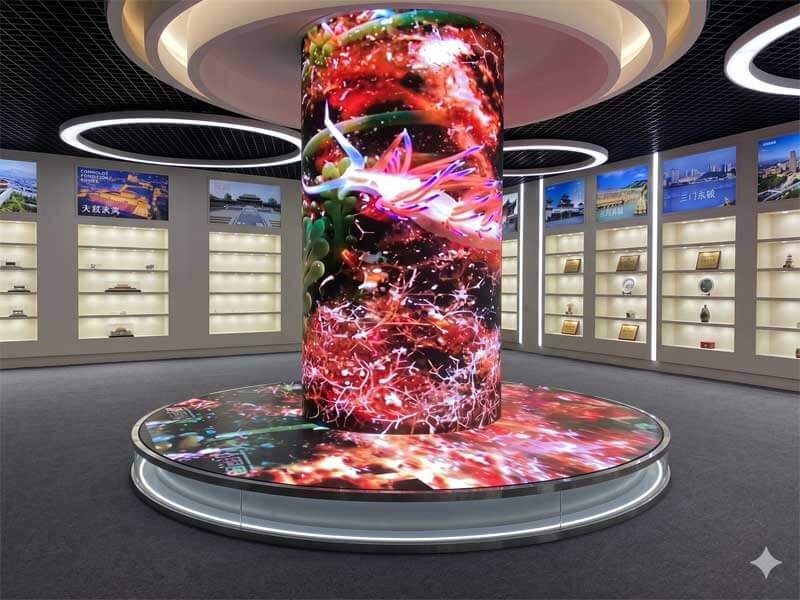
Project Highlight: Transforming structural constraints into digital assets.
The Flexible Advantage: Standardized 320x160mm modules were used to wrap this indoor column, achieving a perfect fit with a bending radius as tight as 250mm. With flatness ≥98%, the installation ensures a continuous 360° viewing experience without visible vertical seams or dark lines.
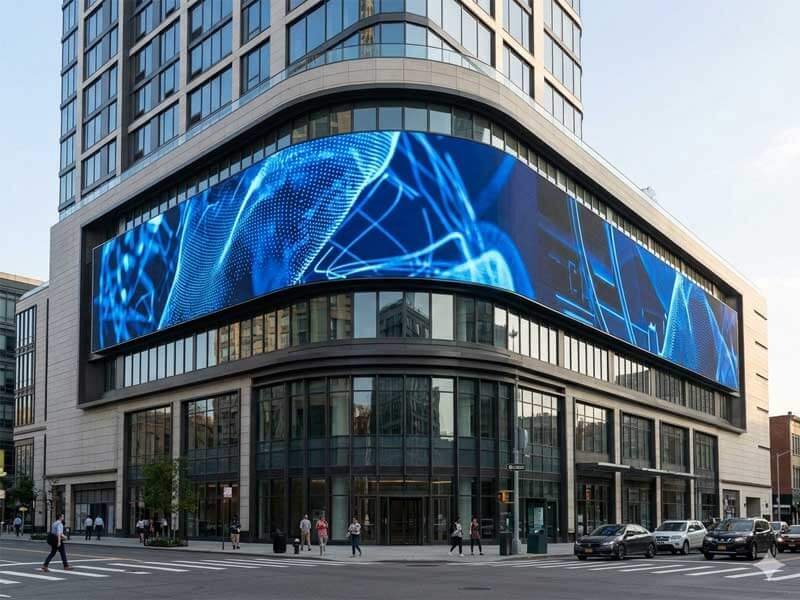
Project Highlight: Eliminating visual fragmentation at building corners.
The Flexible Advantage: Mounted on custom magnetic frames, these ultra-slim modules follow the building’s curvature like a “second skin”. Unlike heavy traditional cabinets, this solution maintains a temperature rise of ≤5°C, ensuring long-term stability without the need for bulky external cooling systems.
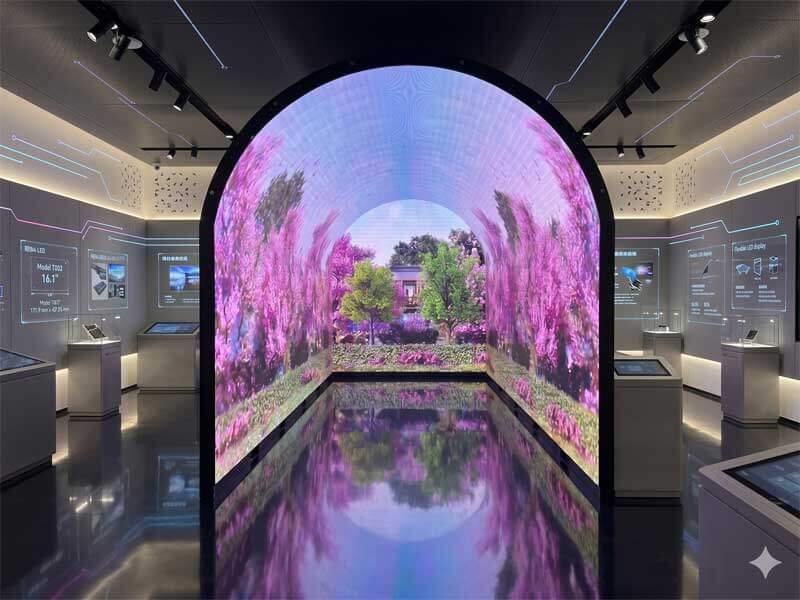
Project Highlight: Harmonizing digital content with modern architectural lines.
The Flexible Advantage: This case demonstrates the high adaptability of our FPC-based modules to multi-dimensional curves. DisplayMan’s strict ±0.003 Cx,Cy chromaticity control is vital here, ensuring flawless color uniformity across the entire curved surface even under direct ambient light.
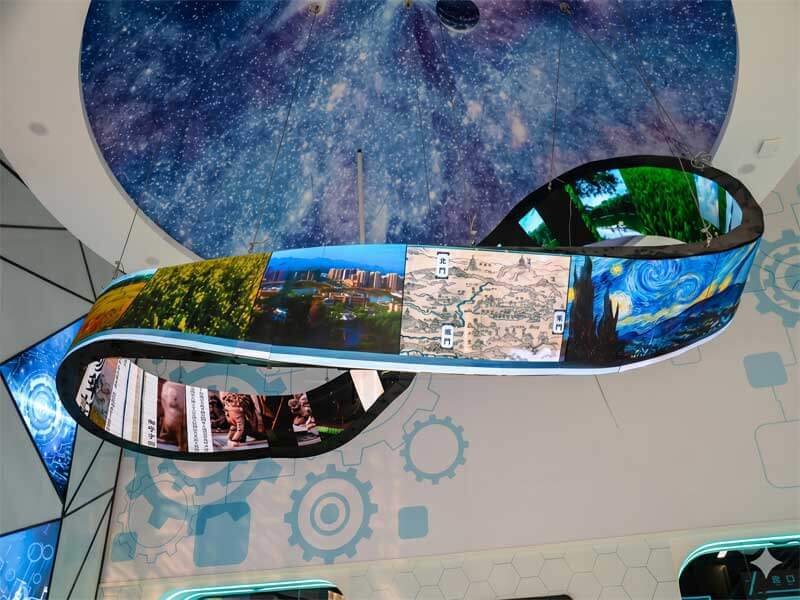
Project Highlight: Engineering a seamless, continuous mathematical loop for a landmark educational space.
The Flexible Advantage: The Möbius Strip is the ultimate test of curvature. Using ultra-thin P1.25/P1.53 modules, we achieved a “Retinal Curve” effect that remains perfectly smooth through complex multi-dimensional twists. This installation showcases the flawless synergy between mathematical art and DisplayMan’s manufacturing precision.
Case descriptions are project references. Confirm module radius, flatness, thermal performance and calibration for the selected configuration.
| Factor | Flexible LED Display | Rigid LED Display |
|---|---|---|
| Surface Type | Curved / non-flat | Flat or faceted |
| Module / Cabinet | Soft flexible LED module | Rigid module / cabinet |
| Best Use | Columns, cylinders, arcs, waves and curved architecture | Conventional flat LED video walls |
| Curve Quality | Smooth curve when radius and frame are compatible | May become visibly faceted on tight curves |
| Structure | Custom curved support frame | Standard flat cabinet frame / wall structure |
| Maintenance | Often magnetic front-service module direction | Front or rear service depending on cabinet |
| Cost Logic | Pay for curvature only when it adds real project value | Usually more economical for normal flat walls |
| Selection Rule | Choose when the surface must curve | Choose when the screen should remain flat |
| Factor | Flexible LED Display | Custom LED Display |
|---|---|---|
| Primary Engineering Goal | Adapt a standard flexible module to a compatible curved surface | Create a special overall shape or sculpture |
| Typical Shapes | Columns, cylinders, concave / convex walls, arcs, waves | Sphere, vase, can/product replica, letter, mascot, organic sculpture |
| LED Module | Usually standard flexible module | May use standard, flexible or custom-shaped PCB/module |
| Tooling / NRE | Normally limited because standard modules are reused | May require PCB development, jigs, masks, formed structure or tooling |
| Minimum-Size Logic | Controlled mainly by module bending radius and closure geometry | Complex organic shapes are often large-format and may have higher practical minimum sizes |
| Best Selection | Choose when standard flexible modules solve the curve | Choose when the whole physical form is custom |
| Factor | Flexible LED Display | Transparent LED Flexible Film |
|---|---|---|
| Transparency | Not transparent | Transparent / see-through |
| Display Surface | Solid LED image surface | Transparent LED film / glass-facing surface |
| Mounting | Curved metal frame, column or custom structure | Glass or transparent substrate |
| Best For | Columns, cylinders, curved walls and solid architectural displays | Retail windows, transparent façades and glass installations |
| Selection Rule | Choose for solid curved LED surfaces | Choose when transparency through glass is essential |
| Factor | Flexible LED Display | Flexible OLED |
|---|---|---|
| Technology | Modular LED | OLED panel |
| Typical Scale | Large architectural / commercial display structures | Small-to-medium panel products |
| Structure | Soft LED modules mounted to a support frame | Thin OLED panel with defined bend mechanics |
| Brightness / Environment | Project-dependent commercial LED direction | Panel-dependent OLED direction |
| Best For | Columns, curved walls, cylinders and architectural LED | Compact premium curved OLED products |
Send the radius, diameter or curve drawing with site photos. We need to confirm module closure, frame geometry, content canvas and maintenance access before a meaningful quotation can be finalized.
A Flexible LED Display is a solid LED display system built with soft LED modules that can follow compatible curved structures such as columns, cylinders, arcs, concave/convex walls and waves.
No. Standard Flexible LED Displays on this page are non-transparent. If the project needs a see-through display on glass, review Transparent LED Flexible Film or other Transparent LED products.
No. Flexible LED uses modular LED technology for larger curved architectural displays. Flexible OLED is a different panel technology with different size, bend and integration rules.
Simple columns, cylinders and compatible curved walls normally use standard flexible LED modules and do not need a new custom LED PCB/module tool. The supporting frame is still engineered to the required radius. Complex free-form shapes may move into Custom LED engineering.
No. Standard soft modules have bending-radius, module-size, wiring, mounting and service limits. Very tight, compound or organic shapes may require segmentation or custom LED engineering.
Reference indoor directions include P1.25, P1.53, P1.86, P2.0 and P2.5, commonly on 320 × 160 mm module platforms. Final module series should be confirmed before order.
There is no safe universal radius that should be applied to every module. The practical minimum must be confirmed from the selected module design, bend direction and project structure.
Yes. Column and cylindrical wrapping are core Flexible LED applications when the module bending capability matches the required diameter.
Yes, when the circumference can be closed cleanly using the selected module geometry and support frame. Diameter, module quantity and seam position should be calculated before production.
Many flexible modules use magnetic front-service installation. The complete maintenance route must also include receiving cards, power supplies and cabling.
Only when the display genuinely needs curvature. For a normal flat video wall, rigid cabinets are usually simpler and more economical.
Outdoor flexible LED requires a dedicated project review for brightness, sealing, weather protection, heat, structure and maintenance. The standard directions on this page are primarily indoor.
Use the actual wrapped pixel canvas, define the seam position and avoid placing critical text or logos across the wrap point.
Provide the display shape, width/height, radius or diameter, concave/convex direction, indoor/outdoor environment, viewing distance, site photos, structure drawings if available, pixel pitch preference, quantity and project schedule.
Send the required shape, radius or diameter, width × height, viewing distance, site photos and project schedule. DisplayMan can review whether a standard Flexible LED module system is suitable or whether the project should move into Custom LED engineering.
Start with your curve drawing. Share the radius or diameter, target screen dimensions, viewing distance and installation conditions so the module and support frame can be reviewed together.