High Pixel Density
Micro OLED provides fine detail from a very small image source, supporting compact magnified near-eye viewing.

A Practical Reflective Optical Path for Micro OLED AR Systems
DisplayMan combines a compact Micro OLED image source with projection lenses, a beam splitter and a curved combiner for AR prototypes, smart-glasses development and selected semi-transparent near-eye systems.
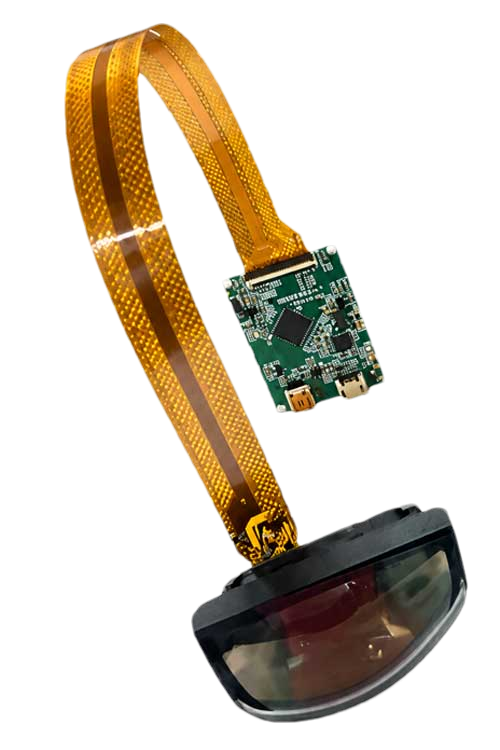
A Birdbath optical engine combines a compact Micro OLED display with projection lenses, a partially reflective beam splitter and a curved combiner that magnify and redirect the image toward the user’s eye.
The architecture is commonly reviewed for AR demonstrations and smart-eyewear prototypes because it provides a practical route from a high-resolution microdisplay to a visible virtual image without requiring a completely custom optical system from zero.
The Micro OLED creates the image, the driver board handles the host signal and timing, and the Birdbath optics form the magnified viewing path. Final performance depends on all three elements working together.
The exact lens and combiner geometry varies by platform, but the functional sequence remains consistent.
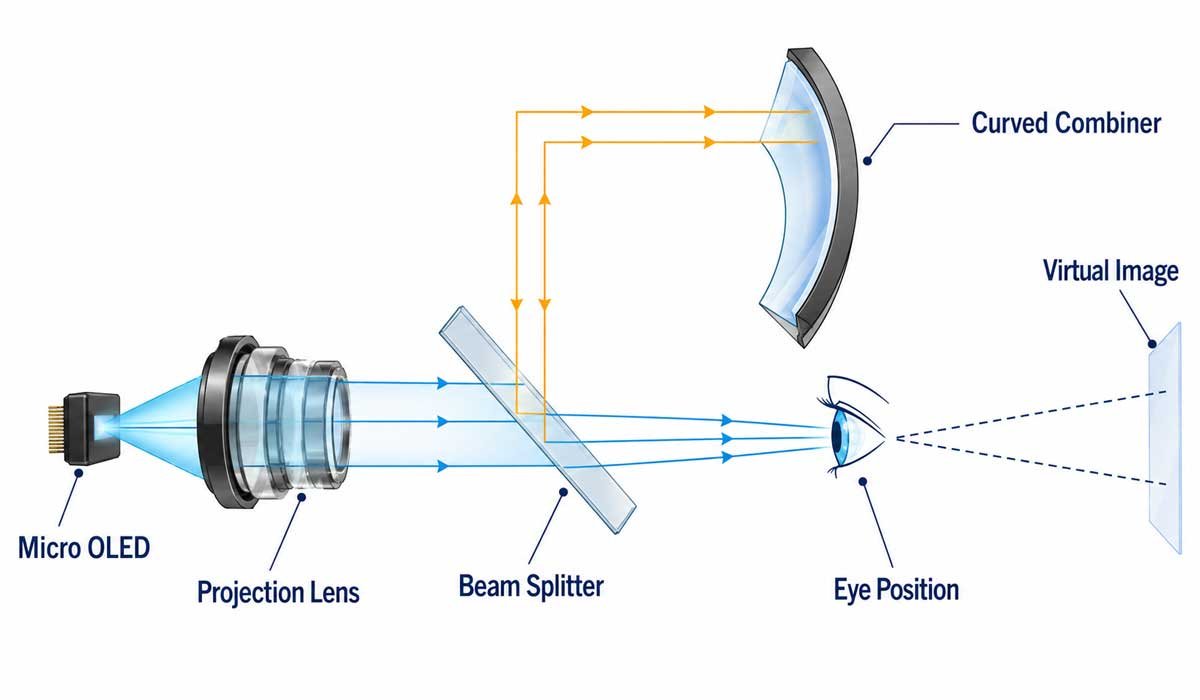
The source image passes through the projection lens, is folded by the beam splitter, reflected by the curved combiner and returned toward the eye.
The diagram explains the system logic rather than defining the dimensions or optical performance of a specific platform.
Micro OLED provides fine detail from a very small image source, supporting compact magnified near-eye viewing.
Self-emissive pixels provide true black and strong contrast, although final performance still depends on the complete optical path.
An available Birdbath platform can shorten early optical evaluation compared with designing every optical element from zero.
Birdbath optics can be bulkier than some waveguide-style approaches. Product thickness, combiner size, weight distribution and mechanical packaging should be evaluated early.
These images show real platform directions. Display, driver-board and mechanical compatibility must be confirmed for the selected configuration.
A compact single-eye Birdbath direction combining a 0.49″ FHD Micro OLED optical engine with HDMI Mini driver electronics.
Review HDMI Driver Boards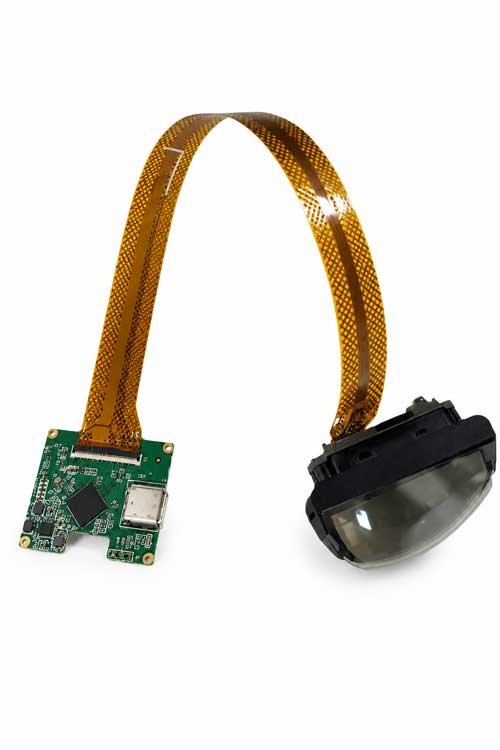
A single-eye 0.49″ FHD Birdbath platform for projects that require a compact Type-C input and display-control direction.
Review Type-C Driver Boards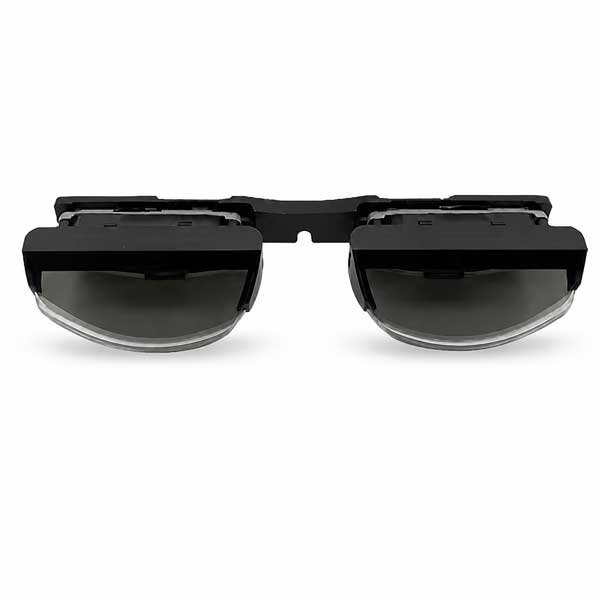
A paired left-and-right optical-engine configuration. The image shows the optical assembly; matched binocular electronics are reviewed separately.
Review Binocular Driver BoardsFOV affects perceived image size, lens geometry and the overall optical envelope.
The visible image must remain usable at the intended eye position and wearing distance.
Reflective elements introduce optical loss, so panel luminance must be reviewed against the ambient-light target.
The selected Micro OLED must fit the optical platform and provide enough detail after magnification.
Lens group, combiner, display, board, cables and housing must fit the target product volume.
Display-to-optics alignment and image correction directly affect clarity and viewing comfort.
| Optical Direction | Typical Use | Main Strength | Main Review Point |
|---|---|---|---|
| Birdbath | AR prototypes, smart eyewear and semi-transparent near-eye viewing | Practical reflective AR architecture | Thickness, combiner size, optical loss and packaging |
| Pancake | Compact VR and high-FOV binocular systems | Folded optical path reduces headset depth | Polarization, efficiency and source brightness |
| EVF Optical Module | Cameras, drones and professional viewfinders | Compact enclosed monocular viewing | Focus, eye relief, color and latency |
| Other Near-Eye Modules | Project-specific eyewear and optical instruments | Application-driven integration | Feasibility, development scope and mechanics |
For most OEM projects, the practical route is to begin with an available Birdbath optical platform and customize the surrounding display, electronics and mechanics. Full optical development from zero can require substantial design, tooling and validation.
FOV, brightness, eye box, eye relief, display compatibility and mechanical dimensions vary by optical platform. Final values must be confirmed against the selected configuration.
Compare the four optical-engine directions, or return to the complete Micro OLED Optical Engines category.
It is a reflective near-eye optical architecture that combines a microdisplay with projection lenses, a beam splitter and a curved combiner to create a magnified virtual image.
Birdbath optics are commonly evaluated for AR prototypes and selected smart-eyewear systems. Suitability depends on FOV, brightness, combiner geometry, thickness, weight and the intended ambient-light environment.
The choice depends on optical compatibility, display size, resolution, brightness, interface and the final FOV. The exact model must be matched to the optical platform.
Not always. The display, driver board and optical engine are separate system elements unless the quoted configuration explicitly includes them together.
No. Required brightness depends on optical efficiency, combiner transmission, ambient light, thermal limits and the final eye-brightness target.
Display matching, driver electronics, mechanical housing, cable routing and selected optical parameters can be reviewed. The practical scope depends on the available platform and project volume.
Provide the application, preferred display if known, FOV target, brightness environment, eye relief, mechanical space, monocular or binocular requirement, input interface, quantity and project stage.
Send your application, FOV, brightness environment, mechanical space, input signal, quantity and prototype schedule.