Full HD in 0.49″
1920 × 1080 resolution provides detailed imagery and compact optics within a 10.783 × 6.065 mm active area.

Compact 1920 × 1080 OLED-on-Silicon Image Source
DisplayMan offers this Full HD Micro OLED platform with 1800 and 3000 cd/m² options for AR glasses, near-eye HUD, EVF and professional optical systems.
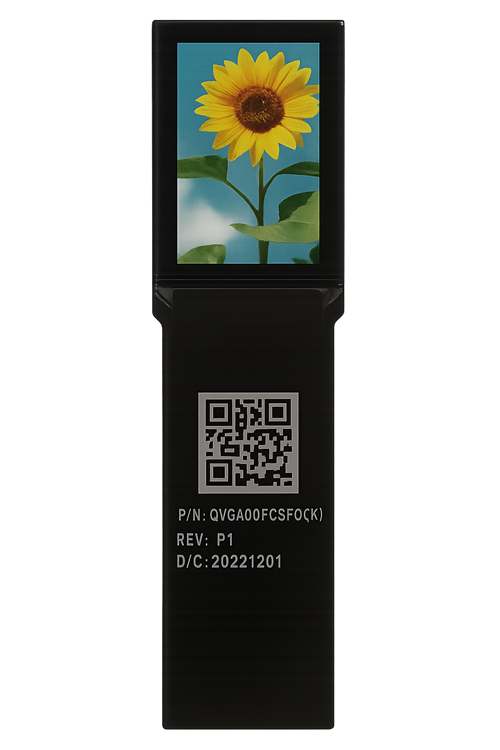
The 0.49″ Micro OLED display is a compact Full HD OLED-on-Silicon platform within DisplayMan’s broader Micro OLED displays portfolio. It combines a native 1920 × 1080 resolution with a 10.783 × 6.065 mm active area.
With 5.616 μm pixels, high contrast and up to 90 Hz operation, the platform is a strong all-round image source for AR glasses, near-eye HUD, electronic viewfinders and other compact optical systems.
Current main configurations are 1800 cd/m² and 3000 cd/m². Select brightness together with optical efficiency, thermal design and the required FPC length.
The 1800 cd/m² version supports short or long FPC models. The 3000 cd/m² version is currently available with a long FPC only.
The model is selected by brightness and FPC length. Different FPC versions are configurations of the same 0.49″ base display platform.
| Model | Brightness | FPC Direction | Resolution | Interface |
|---|---|---|---|---|
| SY049WDM01 | 1800 cd/m² | Short FPC | 1920 × 1080 | MIPI + I²C |
| SY049WDM02 | 1800 cd/m² | Long FPC | 1920 × 1080 | MIPI + I²C |
| SY049LDM01 | 3000 cd/m² | Long FPC only | 1920 × 1080 | MIPI + I²C |
| Display Technology | Active-matrix color OLED-on-Silicon / OLEDoS |
|---|---|
| Diagonal Size | 0.49 inch |
| Native Resolution | 1920 × 1080 Full HD |
| Pixel Size | 5.616 × 5.616 μm |
| Active Area | 10.783 × 6.065 mm |
| Outline Size | Approximately 15.68 × 9.09 mm reference |
| Brightness Options | 1800 cd/m² and 3000 cd/m² |
| Contrast Ratio | 50,000:1 reference |
| Uniformity | >85% reference |
| Color Depth | 8-bit or 10-bit support |
| Frame Rate | 60–90 Hz; Full HD up to 90 Hz |
| Display Interface | 4-lane MIPI D-PHY / MIPI DSI video mode |
| Control Interface | I²C |
| Compression | VESA DSC 1.1 decoder support, configuration-dependent |
| Reference Power Consumption | Approximately 468 mW at 1800 cd/m², 90 Hz under specified conditions |
| Operating Temperature | −20°C to +70°C |
| Reference Weight | Approximately 1 g |
Confirm the exact brightness, FPC length, initialization settings, driver-board compatibility and production status before design-in. The former 20000 cd/m² direction is not included in the current main offering.
1920 × 1080 resolution provides detailed imagery and compact optics within a 10.783 × 6.065 mm active area.
Two current brightness directions support enclosed optics and systems with higher optical loss.
Full HD operation up to 90 Hz supports smooth near-eye motion when the complete video pipeline is correctly configured.
True black and 50,000:1 reference contrast help details and overlays remain clear after optical magnification.
A 4-lane MIPI display interface and I²C control support compact embedded driver architectures.
FPC selection provides mechanical flexibility, but the available FPC length depends on the selected brightness model.
Compact Full HD detail and higher-brightness options for Birdbath, prism and other near-eye AR architectures.
A compact Full HD image source for head-mounted HUD and professional information-display systems.
High pixel density, contrast and smooth motion for cameras, imaging systems and optical inspection.
A practical reference platform for evaluating compact Full HD optical engines and driver electronics.
Detailed self-emissive imagery for portable observation, measurement and professional optical equipment.
Suitable for specialized viewers and optical instruments requiring compact Full HD image generation.
The display module is the image source. Final performance depends on the host, driver electronics, optics and mechanical alignment.
Use the Near-Eye Display Solution page for display selection, driver electronics, optical-engine matching, mechanics and prototype review.
The 0.40″ version is derived from the 0.49″ base platform by using a reduced active image area. It should not be counted as a separate silicon display platform.
Compare nine Micro OLED sizes and open the model page that best matches your resolution, optical and mechanical requirements.
The native resolution is 1920 × 1080 Full HD across a 10.783 × 6.065 mm active area.
The current main directions are 1800 cd/m² and 3000 cd/m². The former 20000 cd/m² direction is not included in the current main offering.
SY049WDM01 is the 1800 cd/m² short-FPC model, SY049WDM02 is the 1800 cd/m² long-FPC model, and SY049LDM01 is the 3000 cd/m² long-FPC model.
No. The current 3000 cd/m² direction is supplied with a long FPC only.
The reference platform uses a 4-lane MIPI D-PHY / MIPI DSI video interface with I²C control. Compatible driver electronics are required.
Normally no. HDMI or Type-C requires a compatible driver or conversion board that generates the correct MIPI timing, control and power sequence.
Yes. Its compact Full HD format and 1800 / 3000 cd/m² options make it a practical starting point for many AR and near-eye HUD projects, subject to optical-efficiency and brightness-at-eye evaluation.
Please provide the application, quantity, required brightness, preferred FPC length, host input, optical requirements, mechanical space and project schedule.
Send the application, required quantity, brightness target, host input, optical requirement, available mechanical space and project schedule. DisplayMan will review the suitable 0.49″ Full HD model and configuration.