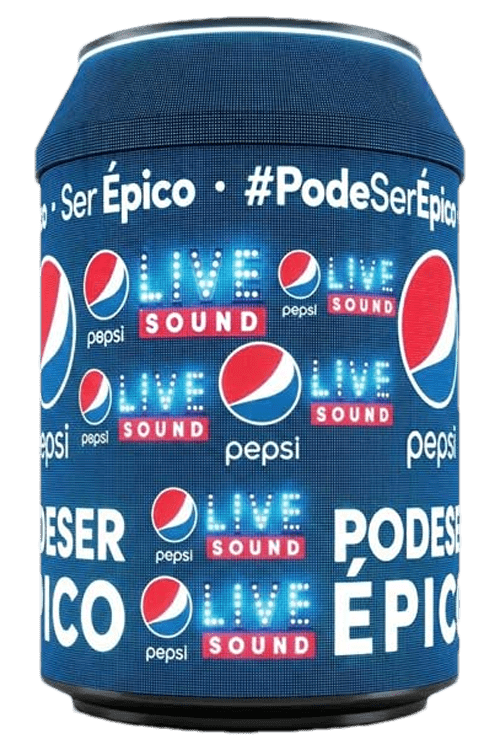
Engineering Can & Bottle LED Displays from the Product Outward
The best result starts from the real package geometry, not from an arbitrary cylinder. For a straight-sided can, the module system can remain relatively simple. For bottles and organic packaging forms, module geometry, PCB segmentation, frame design and mapped artwork must be developed together.
1. Package DimensionsHeight, diameter and recognizable silhouette
2. Curved LED SurfaceFlexible / segmented module strategy
3. Product SkeletonInternal frame, top, base and structural details
4. Power + ControlReceiving cards, power supplies and signal routing
5. Brand Pixel Map360° label artwork and hero-logo placement
6. Base + ServiceStable mounting, cable entry and maintenance access
| Engineering Factor | Why It Matters |
|---|
| Can Proportion | Height-to-diameter ratio defines whether the finished display reads immediately as a beverage can, cosmetic container or branded package. |
| Curved Sidewall | The main LED surface wraps around the body and must maintain consistent curvature, module alignment and image continuity. |
| Top / Bottom Geometry | A realistic can silhouette may include shoulder, rim, recessed top, base ring or non-display structural caps; these details should be defined before manufacturing. |
| Vertical Seam Position | A wrap-around LED surface normally has a closure line. The seam should be placed away from the primary audience and key logo area whenever possible. |
| Module Strategy | Flexible or specially segmented LED modules may be selected according to diameter, pixel pitch and required curvature. |
| Internal Skeleton | The frame controls roundness, load distribution, mounting, cable routing and service access. |
| Pixel Mapping | Packaging artwork must be adapted from a flat label into a 360° cylindrical / product-replica pixel map. |
| Power & Control | Power supplies, receiving cards, media player / processor and internal cables must fit inside the body without blocking maintenance. |
| Serviceability | Module replacement, electronics access and base access should be planned before the external shell is finalized. |
| Transport | Large product replicas may need split-body or modular sections so they can pass through doors, lifts, loading docks and shipping cases. |
Why Complex Bottle Shapes Cost More
| Geometry | Typical Engineering Level | Cost / Development Impact |
|---|
| Straight Beer / Soda Can | Constant-radius sidewall; can often use flexible LED modules or an existing can module set | Lowest custom-development level within the product-replica family |
| Can with Detailed Lid / Base | Standard curved sidewall plus dedicated non-display or shaped structural top/base details | Moderate structural customization; LED tooling may still be avoided if the sidewall remains standard |
| Bottle with Neck & Shoulder | Several diameters and transition zones; may require multiple module shapes and custom PCB layouts | Higher NRE, tooling, assembly complexity and prototype validation |
| Organic / Branded Packaging Replica | Non-constant radius, compound curves and detailed physical features | Highest engineering level; custom modules, masks/tooling, CNC/metalwork and longer development cycle may be required |
Creative LED Is a Premium Custom ProductFor fully customized Bottle and Product Replica LED Displays, tooling, PCB/module development and structure can represent a substantial portion of the project cost. Very small one-off quantities may therefore be disproportionately expensive compared with standard flexible cylindrical displays.
Core Engineering PrincipleA Can-Shaped LED Display should still look like the intended product when the screen is powered off. The physical proportion and silhouette create recognition; the LED surface adds programmable content.
Can-Shaped LED Display FAQ
Does a Can-Shaped LED Display always require custom tooling?
No. A simple straight-sided can can often use existing flexible LED modules or an existing Can LED module system when the target diameter and pixel pitch are compatible. Complex Bottle or Product Replica LED shapes may require custom PCB layouts, module geometries, masks/tooling and structure.
How small can a Can-Shaped LED Display be?
Compact straight-sided Can LED products can be much smaller than many fully custom Creative LED shapes, with market-standard examples around 1.2–1.4 m tall. Fully customized Bottle and Product Replica LED structures are normally more practical around 2 m and above; around 1.5 m is a special compact direction that must be reviewed case by case.
Why are custom bottle-shaped LED displays more expensive?
A bottle may require several LED module sizes and PCB geometries to reproduce the neck, shoulder, taper and body. Tooling, custom masks, structure, assembly engineering, pixel mapping and prototype validation add non-recurring development cost.
Can I control the display by phone or Wi-Fi?
Yes, when a compatible asynchronous or network controller is selected. USB, Ethernet, Wi-Fi and optional cellular control can be reviewed according to the installation.
Can a Can-Shaped LED Display have wheels?
Yes, a mobile wheel base can be considered for compact indoor products. The design must account for total weight, center of gravity, floor conditions, cable protection and safe locking.
Is front maintenance available?
Front-removable flexible LED modules can be considered for compatible standard Can LED structures. Fully custom bottle geometries may require project-specific access around neck, shoulder or irregular module zones.
Can DisplayMan make other bottle or packaging shapes?
Yes. Beer bottles, soft-drink bottles, cosmetic containers, jars and other product-replica forms can be reviewed. The more complex the geometry, the more likely custom PCB/module/tooling and a larger overall size will be required.
What is a Can-Shaped LED Display?
A Can-Shaped LED Display is a custom 3D LED display engineered to reproduce the proportions and visual identity of a beverage can or similar cylindrical product package.
Is it the same as a Cylindrical LED Display?
No. A Cylindrical LED Display focuses on a continuous round display surface for columns, pillars or generic cylindrical forms. A Can-Shaped LED Display is product-replica driven and emphasizes brand proportions, packaging artwork and recognizable can details.
Can it reproduce our exact beverage can artwork?
Yes, the artwork can be adapted to a 360° pixel map. Final visual accuracy depends on the physical proportions, pixel pitch, total resolution and how fine label details are handled.
Can the can diameter and height be customized?
Yes, within the limits of available LED modules, required curvature, structural design, transport, installation method and budget.
What pixel pitch should I choose?
Choose pixel pitch from viewing distance, can size, artwork detail and environment. Fine indoor pitches are useful for close viewing; larger structures or longer viewing distances usually do not need the smallest pitch.
Does the top of the can need to be an LED screen?
Not necessarily. In many projects the main curved sidewall is the most important display surface, while the top and bottom are structural or decorative elements. A project can be reviewed according to the desired viewing angles.
Where should the module seam be placed?
The vertical closure seam should normally be placed away from the hero logo and main audience direction whenever the module geometry allows.
Can it show normal video?
Yes, but standard rectangular content should be adapted to the final wrap-around pixel map so logos, text and focal elements are positioned correctly around the curved surface.
Can it be used outdoors?
Outdoor projects can be reviewed with dedicated brightness, weather protection, wind-load, structural, thermal and power-safety requirements.
Can it be moved between events?
Yes, a modular or split-body design can be considered for event use, but transport dimensions, assembly sequence, protective cases and repeatable electrical connections should be designed before manufacturing.
Can several can-shaped displays play synchronized content?
Yes. Multiple displays can be configured as a synchronized product series or campaign set, subject to the selected control architecture.
Can it be used for bottles or cosmetic containers?
The same product-replica engineering logic can be extended to other cylindrical or packaging-inspired forms, although non-constant diameters or compound curves may require a different module and structure strategy.
Is a Can-Shaped LED Display suitable for permanent retail installation?
Yes. It can be designed as a permanent flagship-store or showroom object when service access, power, content management and structural integration are planned for the site.
When is a traditional printed product prop better?
A printed prop is usually more economical when the campaign is static, short-lived and does not need video, animation or changing branded content.
When should I choose a normal LED wall instead?
Choose a normal LED wall when the physical package shape is not important and the project mainly needs efficient large-format video or advertising.
What information is needed for quotation?
Provide target height, diameter, reference product drawing or package dimensions, indoor/outdoor environment, viewing distance, installation method, artwork or content concept, quantity, site photos and project schedule.