Same Body, Different Character
A penguin, astronaut, doll, animal or branded mascot can share the same basic LED volume while looking completely different through mapped content.

DisplayMan develops mascot and character shaped LED displays that combine sculptural bodies with programmable expressions, clothing and brand graphics. Geometry, module segmentation, pixel mapping and installation are reviewed together to create a practical digital character for your venue.
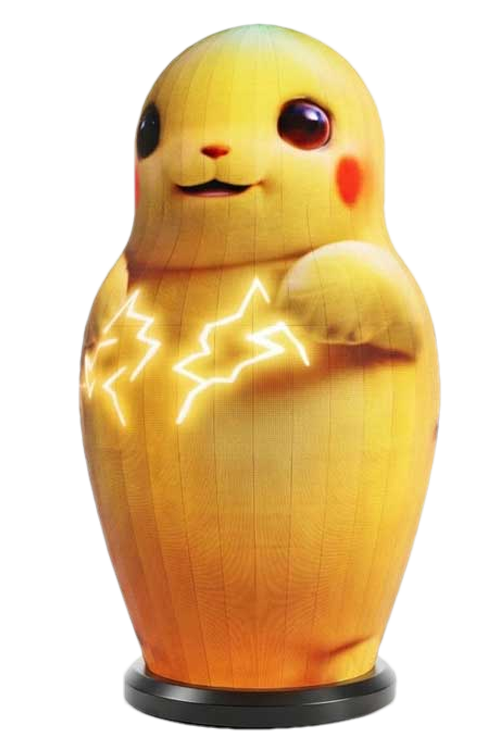
A Mascot & Character Shaped LED Display uses a standardized character-like 3D LED construction — typically a rounded semi-spherical or ellipsoidal head combined with a vase-like tapered body — and transforms that physical platform into different mascots, animals, cartoon figures, cultural characters or branded IP through specially prepared digital content.
The key idea is simple: the hardware creates the character volume; software creates the identity. Eyes, facial expressions, clothing, arms, paws, wings, fur, accessories, logos and animation are primarily created through mapped digital content rather than by physically building every visual feature as a separate LED structure.
The same underlying head-and-body platform can display completely different character identities after new mapped content is prepared. Physical size and pixel pitch can also be engineered in different configurations while preserving the same core construction logic.
Different mascots can look completely different while sharing the same fundamental LED construction. What changes most is the mapped digital content, not the basic character body.
| Platform Element | How It Works |
|---|---|
| Underlying LED Body | Semi-spherical / ellipsoidal head combined with a rounded vase-like or tapered body. |
| Character Identity | Created primarily by mapped digital content rather than by rebuilding the physical LED structure for every character. |
| Eyes & Facial Expressions | Software-defined content mapped onto the head surface. |
| Arms / Paws / Wings | Usually visually simulated through graphics and animation on the curved body rather than built as separate physical LED limbs. |
| Clothing / Fur / Accessories | Created through digital content mapping, textures and animation. |
| Brand Logo / Color | Digitally customizable without changing the basic LED hardware platform. |
| Character Changes | The same underlying 3D LED platform can display different mascots, animals, cultural figures or branded characters after new content is prepared. |
The underlying 3D character body can remain largely the same, while the face, eyes, expressions, arms, clothing, fur, colors, logo, accessories and animation are digitally customized. This allows one hardware concept to support many character identities.
Mascot & Character Shaped LED Displays are normally large-format custom systems. Approximately 2 meters is the normal starting direction, while 3–4 meter and 5 meter or larger systems can be engineered for bigger venues and landmark applications.
| Character Height Direction | Positioning | Typical Applications | Engineering Logic |
|---|---|---|---|
| Approx. 2 m | Standard commercial character direction | Retail, exhibitions, corporate lobbies, branded activations | Normal starting scale. Provides enough circumference for the semi-spherical head and tapered body modules to close properly while maintaining useful facial/body resolution. |
| Approx. 3–4 m | Large commercial character | Shopping malls, museums, large exhibitions, hotel lobbies, theme spaces | More surface area for character detail, stronger landmark presence and easier module segmentation across head/body transitions. |
| Approx. 5 m+ | Large landmark / atrium character | Atriums, themed venues, public interiors, cultural or entertainment landmarks | Project-based structure, segmented shipping, lifting, power distribution and site installation become major engineering factors. |
| Pixel Pitch | Positioning | Recommended For | Selection Logic |
|---|---|---|---|
| P1.25 | Best Overall Value / Recommended | Most Mascot & Character LED projects | Recommended balance of image quality, close-view smoothness, module engineering and project cost. At around a 2-meter viewing distance, typical character content already appears smooth and detailed. |
| P1.53 | Balanced Fine-Pitch Option | Indoor projects requiring good detail with a slightly lower system cost | A practical alternative when the project does not require the finer density of P1.25. |
| P1.86 | Cost-Effective Indoor Option | Medium-to-large characters and moderate viewing distances | Good balance of cost and image quality when the audience is not extremely close to the display. |
| P2.0 | Larger Size / Longer Viewing Distance | Large characters, malls, atriums and event installations | Suitable when overall character size increases and the minimum audience distance is longer. |
| P2.5 | Large-Format / Long Viewing Distance | Very large characters and long-distance viewing | More economical for large-scale installations where visual impact matters more than close-view fine detail. |
For most Mascot & Character LED projects, P1.25 provides the best overall balance of image quality, close-view smoothness, module engineering and project cost. At around a 2-meter viewing distance, typical character content already appears smooth and detailed. P1.53, P1.86, P2.0 and P2.5 can be selected for larger physical sizes, longer viewing distances or tighter project budgets.
The primary limitation is not simply image resolution. The semi-spherical head and tapered body contain progressively smaller circumference zones. The custom LED module segments must still be able to close into a continuous 3D surface.
| Closure Zone | Why It Sets the Minimum Size |
|---|---|
| Semi-Spherical Head | The upper LED surface narrows toward the top. Each latitude ring must retain enough circumference for the custom module segments to close without gaps or excessive overlap. |
| Head-to-Body Transition | The transition between rounded head and body must maintain continuous geometry, module alignment and pixel mapping. |
| Vase-Like Body | The body typically widens through the middle and narrows toward top/bottom zones, similar to a vase or rounded capsule. |
| Narrow Closing Zones | The smallest circumference zones determine whether the final LED shell can close properly. This is a primary minimum-size constraint. |
| Module Width / PCB Geometry | Custom modules cannot be reduced indefinitely. The required number of segments, PCB width and assembly tolerance set a practical lower size limit. |
| Surface Continuity | If the structure is too small, modules can leave gaps, overlap, create sharp polygonal transitions or fail to complete a continuous 360° surface. |
If the character becomes too small, the narrowing rings around the head or body may no longer provide enough circumference for the LED modules and PCB segments to close correctly. Gaps, overlap, excessive faceting or incomplete surface closure can result. For this reason, DisplayMan normally treats approximately 2 m and above as the practical starting direction for this product family.
The physical form can be simplified into two main LED volumes: a rounded head and a tapered body. This standardized geometry is what makes different character identities possible without physically reproducing every hand, paw, eye, wing or clothing feature.
| Engineering Factor | Why It Matters |
|---|---|
| Overall Character Height | Defines head/body proportions, module count, total pixel resolution, structure, transport and visual impact. |
| Head Diameter / Ellipsoid Profile | Controls facial pixel area and the amount of module segmentation available to close the upper curved surface. |
| Body Maximum Diameter | Controls character volume, structural stability and available pixel area for arms, clothing, patterns and logos. |
| Body Taper | The upper and lower body zones narrow progressively; their circumference must remain compatible with the selected custom module geometry. |
| Head-to-Body Ratio | Affects whether the physical object reads as a believable character platform before content is applied. |
| Module Segmentation | Head and body may use different custom LED module families or zone-specific PCB geometries to follow changing curvature. |
| Internal Skeleton | Custom metal structure defines the final character volume and supports LED modules, power, control and service access. |
| Power & Control | Power supplies, receiving cards and internal cabling must fit inside the curved shell without blocking ventilation or maintenance. |
| Serviceability | Module removal and electronics access should be engineered before the outer surface is finalized. |
| Transport | Large 3–5 m+ characters may need ring-like or vertical structural sections for shipping and on-site reassembly. |
The physical LED structure creates the volume; mapped content creates the character. The body should therefore be engineered for reliable module closure, smooth curvature and sufficient usable pixel area before visual details are added in software.
A normal flat image cannot simply be stretched over this 3D LED surface. Character artwork must be converted and mapped to the exact head and body pixel layout so the face, clothing, arms and other visual features appear in the correct physical positions.
| Mapping Stage | What Happens |
|---|---|
| Character Artwork / 3D Reference | Customer provides mascot artwork, IP references, color guidelines, expressions, clothing or animation concept. |
| Character Content Conversion | Artwork is converted into content suitable for the standardized 3D LED body rather than treated as a flat rectangular video. |
| Curved Surface Mapping | Facial and body graphics are positioned against the exact head/body pixel map. |
| Pixel Position Calibration | Eyes, mouth, clothing, arms, logos and other visual features are aligned to the final physical pixel positions. |
| Preview & Adjustment | Character proportions, feature placement and animation are reviewed before final playback content is approved. |
| Final Playback Package | Prepared media is loaded into the selected playback/controller system for scheduled, synchronized or campaign-specific operation. |
The customer can define what the character should display before delivery — mascot identity, facial expressions, clothing, brand colors, logos, animations and campaign themes can all be prepared and tested against the final pixel map in advance.
Many details that appear to be part of the character’s physical shape are actually created by mapped graphics. This is what allows the same underlying 3D LED body to become completely different characters.
| Digital Character Element | How It Is Created |
|---|---|
| Face & Expressions | Eyes, eyebrows, mouth, cheeks and facial animation are mapped onto the semi-spherical head. |
| Arms / Hands / Paws | Created primarily as visual content on the body surface so the character appears to have limbs without requiring separate physical LED structures. |
| Wings / Ears / Decorative Features | Can be represented through mapped graphics when the character design allows the main 3D body to visually simulate the feature. |
| Clothing & Uniforms | Astronaut suits, scarves, cultural clothing, sports uniforms and branded costumes are software-defined. |
| Fur / Skin / Texture | Patterns, hair, feathers, fabric and material appearance are rendered through high-resolution digital content. |
| Logos & Brand Colors | Brand identity can be changed digitally without rebuilding the main LED structure. |
| Character Animation | Blinking, smiling, changing expressions, light movement, body graphics and campaign animation can be prepared in advance. |
| Character Replacement | A new mapped content package can transform the same physical LED platform into a different mascot or visual identity. |
A penguin, astronaut, doll, animal or branded mascot can share the same basic LED volume while looking completely different through mapped content.
Eyes, mouth and facial expression can be animated so the character appears to blink, smile, react or change mood.
Clothing, logos, seasonal themes and promotional graphics can be updated without rebuilding the main physical LED structure.
The finished product is a complete 3D character platform combining custom LED hardware, structure, control electronics and software-prepared character content.
| System Layer | Typical Scope |
|---|---|
| 3D LED Head | Semi-spherical / ellipsoidal custom LED structure |
| 3D LED Body | Rounded vase-like / tapered LED structure |
| Internal Frame | Custom supporting skeleton for head/body geometry, alignment and service access |
| Power System | Power supplies, distribution, grounding and internal cabling |
| LED Control System | Receiving cards, sending/controller system and optional media player |
| Character Mapping Package | Head/body pixel map and prepared character-specific content |
| Installation Base | Floor-standing structural base, anchoring and cable entry |
| Transport & Assembly | Sectional structure, alignment references, fasteners and protective packaging for larger systems |
| Installation Method | Engineering Considerations |
|---|---|
| Floor-Standing Character | Most common direction; structural base manages stability, cable entry, electronics access and audience safety. |
| Integrated Stage / Event Platform | Character can be integrated with stage lighting, event content and show control. |
| Museum / Exhibition Installation | Requires controlled audience distance, safe floor loading, service access and content update planning. |
| Shopping Mall / Atrium | Larger 3–5 m+ systems may require lifting, sectional transport, route survey and structural anchoring. |
| Theme / Entertainment Venue | Can be integrated with synchronized lighting, sound, sensors or scheduled character content. |
| Outdoor Project | Requires project-specific outdoor modules, brightness, sealing, drainage, wind load, anchoring, temperature and maintenance engineering. |
A 3–5 m+ character will normally require sectional shipment and on-site assembly. Route access, section size, lifting, structural alignment and final commissioning should be planned before production drawings are frozen.
This platform is strongest where a recognizable character, mascot or IP identity should become a large programmable digital object rather than a conventional rectangular screen.
Turn a company mascot into a large programmable digital character for flagship stores, campaigns and corporate events.
Create familiar character identities using mapped faces, clothing, expressions and animation on the same underlying 3D LED platform.
Penguins, pandas, dolls, traditional figures and themed characters can be created through character-specific content packages.
Use a large digital character as a high-visibility promotional landmark, seasonal attraction or interactive brand centerpiece.
Create an instantly recognizable character object that can change campaign content without rebuilding the main hardware.
Use digital characters for storytelling, cultural interpretation, educational content or visitor engagement.
Character LED can become part of themed attractions, entertainment environments, family spaces and event installations.
Use a mascot or branded character as a dynamic welcome object with changing expressions and scheduled content.
| Factor | Mascot & Character Shaped LED Display | Fully Free-Form LED Sculpture |
|---|---|---|
| Physical Structure | Standardized character-like head + body geometry | Physical LED structure follows a highly specific custom object or sculpture |
| Character Detail | Primarily software-defined through mapping | More details may be built into the actual physical geometry |
| Hardware Reuse Logic | Same underlying platform can support different digital characters | New physical form may require new structural and module development |
| Engineering Cost | More repeatable once the platform size/pitch family is defined | Usually higher when every project requires a new physical geometry |
| Best Fit | Mascots, cartoon characters, branded IP, animals and cultural figures | Unique sculptures, complex objects and forms that cannot be represented by mapped content |
| Factor | Mascot & Character Shaped LED Display | Sphere / Vase LED Display |
|---|---|---|
| Top Geometry | Semi-spherical / ellipsoidal character head | Sphere: full spherical geometry |
| Lower Geometry | Vase-like / tapered character body | Vase: changing-radius artistic body |
| Primary Identity | Created through software-defined character mapping | Created primarily by the physical geometry itself |
| Size Boundary | Normally approx. 2 m+ so head/body module segments can close properly | Also benefits from larger dimensions for module closure and smooth segmentation |
| Content | Faces, clothing, arms, accessories and expressions | Sphere: globe/science/art; Vase: artistic/cultural/floral content |
| Main Engineering Advantage | One structural logic can support many digital character identities | Each product geometry is itself the final visual object |
Sphere and Vase products are defined mainly by their physical form. Mascot & Character LED uses those same geometric ideas as a standardized character platform, then creates the final identity primarily through software-defined content.
Mascot & Character Shaped LED is one featured direction within DisplayMan’s broader Custom / Creative LED engineering capability. These eight product families are common entry points, not a limit on the forms that can be developed.
Use this page when a mascot or character can be represented through a rounded head + tapered body platform with software-defined visual details. Use Custom LED Displays when the physical object itself requires a completely different free-form geometry.
Character projects can begin from the desired digital identity, from a 3D engineering / mapping problem, or simply from the venue and campaign objective. Continue from the route that best matches the current project stage.
Choose a product page when the physical display direction is already clear.
Custom LED DisplaysParent Custom / Creative LED family for characters, spheres, sculptures, product replicas, letters and other project-specific 3D forms.Sphere LED DisplayTrue spherical 360° LED form when the physical object itself must be a globe or sphere.Vase-Shaped LED DisplayChanging-diameter artistic sculpture where the physical silhouette, rather than a character identity, is the primary concept.Can-Shaped LED DisplayBranded can, bottle and product-replica LED objects where package geometry drives the physical structure.Cylindrical LED DisplayStandard flexible LED modules + cylindrical supporting frame for generic columns, pillars and 360° constant-radius media.Letter-Shaped LED DisplayFull-color LED video letters, logos, numbers and symbols for dynamic branding.Rental LED DisplaysModular event LED walls for repeated assembly, stage use and screen-size reconfiguration.Portable Foldable LED Poster DisplaysFoldable vertical LED posters for roadshows, exhibitions and launches when a compact mobile finished display is more practical than a 3D character.Choose a solution page when the custom structure, module closure, mapping or prototype problem is clearer than the final product configuration.
Bespoke & Custom Display SolutionsFor character platforms, custom geometry, unusual structures, content integration and installation constraints.OEM / ODM Display Engineering & PrototypingFeasibility, head/body module segmentation, prototype structure, mapping and system integration for new character platforms.All Display SolutionsBrowse DisplayMan engineering and integration routes across LED, LCD, touch and custom display systems.Choose an application page when the venue or campaign is known but the final display form is still being selected.
Exhibition, Events & ShowroomsMascot landmarks, trade-show characters, launch installations and reusable branded event experiences.Corporate & Office EnvironmentsBrand centers, corporate lobbies and visitor spaces where a digital mascot becomes part of the identity.Outdoor & Public Display SystemsLarge outdoor character projects where wind, sealing, drainage, anchoring, thermal design and service need deeper review.All Display ApplicationsBrowse DisplayMan applications by use case before fixing the final physical display form.DisplayMan first determines the practical head/body proportions, module closure, pixel pitch and physical structure. The mascot artwork is then converted into a software-mapped digital identity for the final 3D pixel surface.
It is a 3D Creative LED character platform typically built from a semi-spherical or ellipsoidal head combined with a rounded vase-like body. The physical LED shell provides the main character volume, while the visual identity is created primarily through software-mapped digital content.
Not necessarily. Different characters can use the same underlying head-and-body construction logic. Character identity is primarily changed through mapped faces, clothing, colors, arms, accessories, textures and animation.
Yes. Once a new content package is prepared for the same pixel map, the same physical LED platform can become a different mascot, animal, cartoon figure, cultural character or branded IP design.
Usually not. Arms, paws, wings, clothing and similar character features are primarily simulated through mapped graphics and animation on the main curved body.
Mascot & Character Shaped LED Displays are generally designed at approximately 2 meters or larger in overall height. Smaller sizes are not normally recommended because the narrowing head and body zones need sufficient circumference for the custom LED module segments to close properly.
The top of the head and tapered body contain narrow circumference zones. Custom LED modules and PCBs have practical physical dimensions, so the structure must be large enough for the segments to close into a continuous 3D surface without gaps, overlap or excessive polygonal distortion.
Yes. The same underlying construction logic can be scaled to larger project sizes such as approximately 3, 4 or 5 meters and beyond, subject to structural, transport, installation and site requirements.
Regular Mascot & Character LED directions include P1.25, P1.53, P1.86, P2.0 and P2.5. Final selection depends on overall character size, viewing distance, required facial/body detail and budget.
P1.25 is the recommended best-overall-value direction for most Mascot & Character LED projects because it balances image quality, close-view smoothness, engineering practicality and project cost.
At around a 2-meter viewing distance, P1.25 already provides a smooth and detailed visual appearance for typical mascot and character content, making it the preferred option for many indoor projects.
These options are useful when the overall character becomes larger, the viewing distance increases, or the project requires a lower system cost. P1.53 and P1.86 remain suitable for relatively close indoor viewing, while P2.0 and P2.5 are better suited to larger-format and longer-distance applications.
Not automatically. Pixel pitch affects resolution, but the minimum physical size is also controlled by module/PCB dimensions, head/body curvature and whether the narrowing rings can close properly.
The customer’s character artwork or 3D reference is converted into mapped content for the exact curved LED pixel layout. Facial features, clothing, arms, textures and animation are positioned and calibrated before final playback.
Yes. Eyes, mouth, facial expression, colors and other digital features can be animated in the prepared content.
Yes. Provide the mascot artwork, 3D reference, brand colors and desired expressions or animations. The content can then be adapted to the character LED pixel map.
Yes. Clothing, uniforms, holiday themes, campaign colors and other visual elements can be changed digitally without rebuilding the main LED structure.
Outdoor projects can be reviewed with appropriate LED modules, brightness, weather sealing, drainage, wind-load, structural, thermal and electrical protection requirements.
Large systems are normally divided into structural sections for shipping and reassembled on site. The exact split strategy depends on head/body diameter, transport route, lifting conditions and installation access.
External sensors, cameras, touch interfaces or software can be integrated when required. The LED surface itself is normally a display rather than a touch surface.
Provide target overall height, preferred pixel pitch if known, character or mascot artwork, viewing distance, indoor/outdoor environment, installation site, quantity, desired animations/content, project schedule and shipping destination.
Send the character artwork, target height, viewing distance and installation environment. DisplayMan can review the practical head/body geometry, module closure, P1.25 / P1.53 / P1.86 / P2.0 / P2.5 direction, content mapping and installation.
One standardized character-like 3D LED body can support many software-defined digital identities. The physical structure creates the volume; the mapped content creates the face, clothing, expressions, arms, accessories and brand personality.