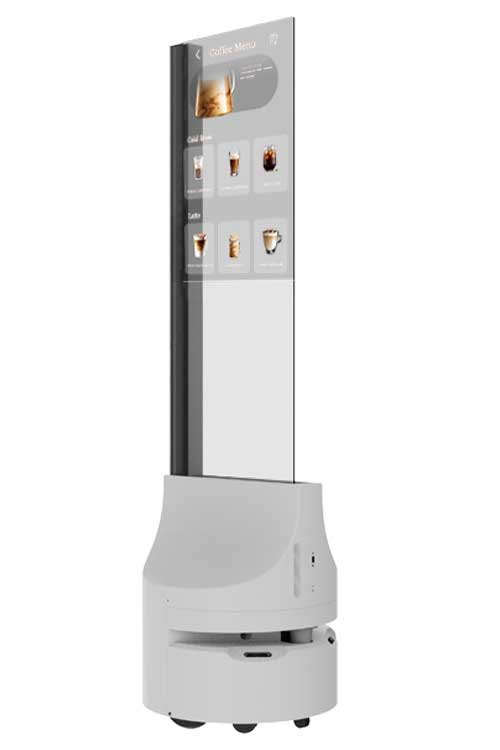
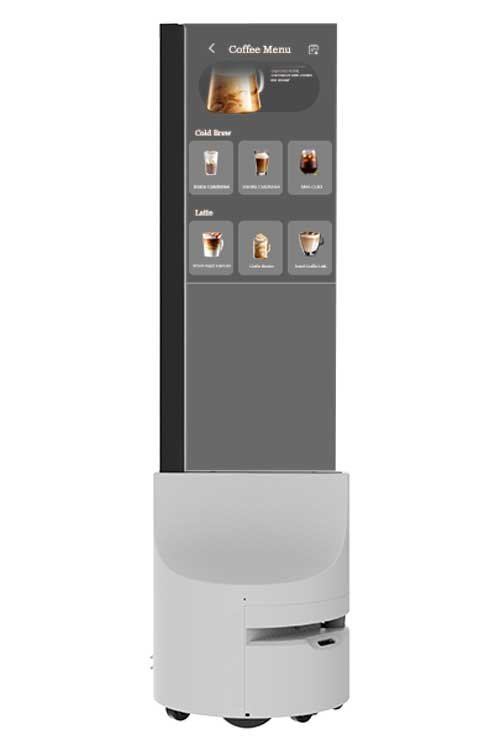
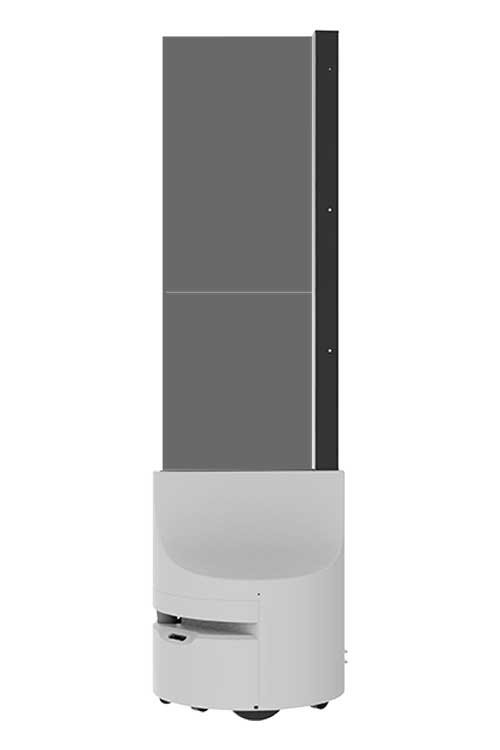
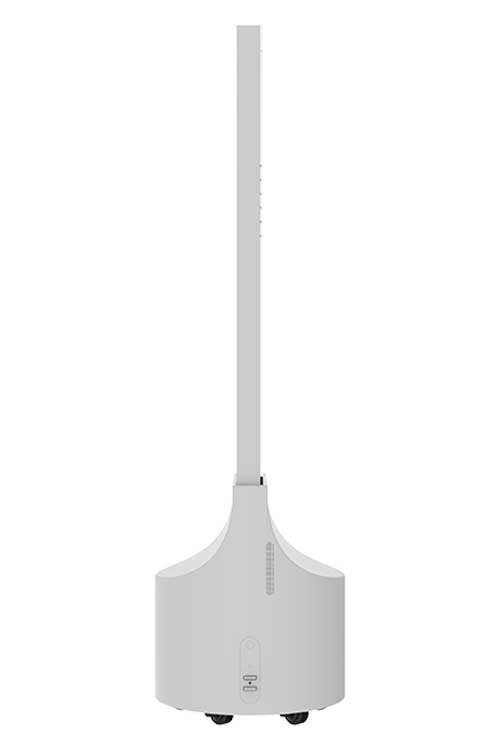
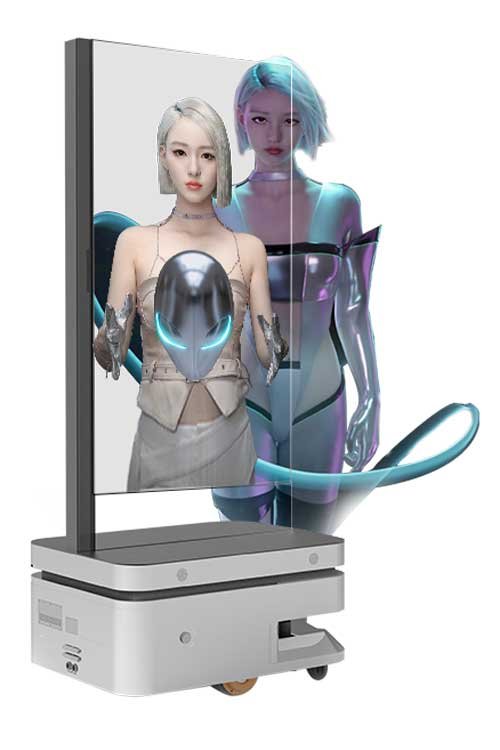
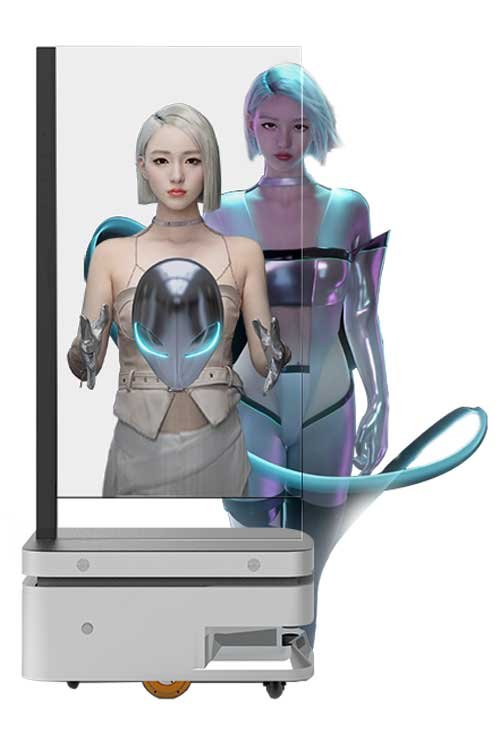
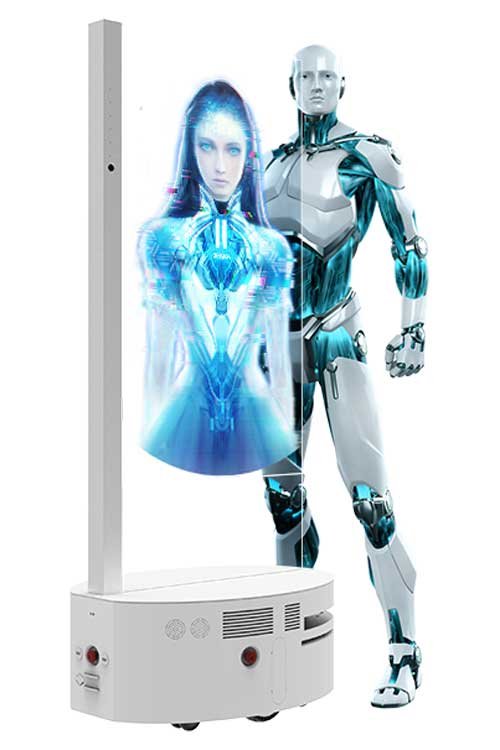
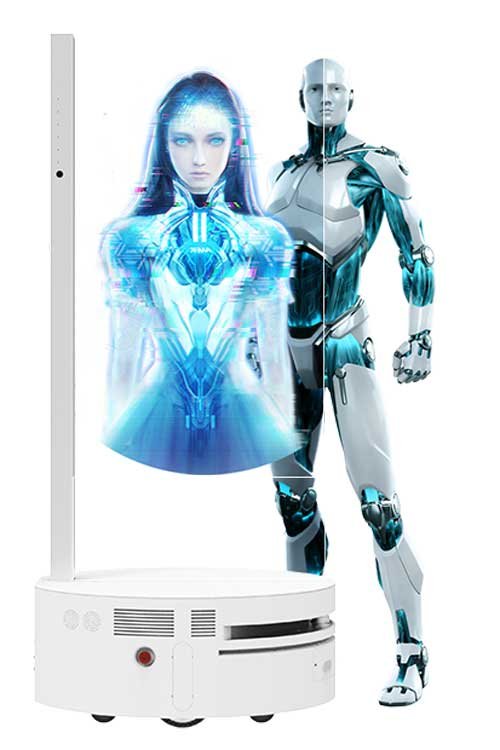
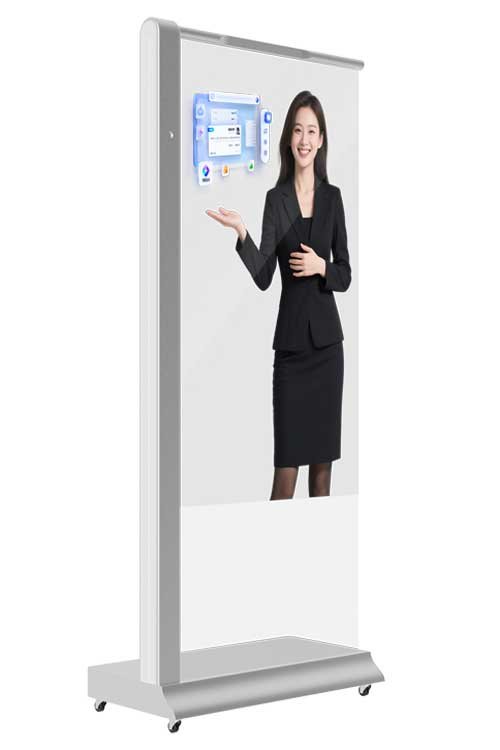
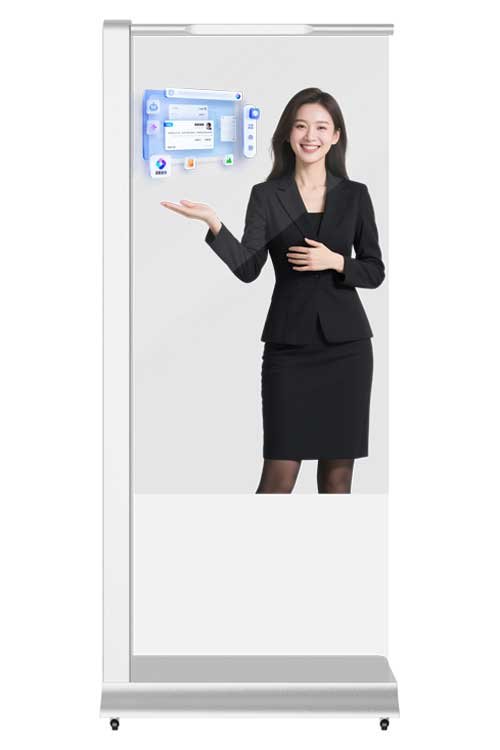
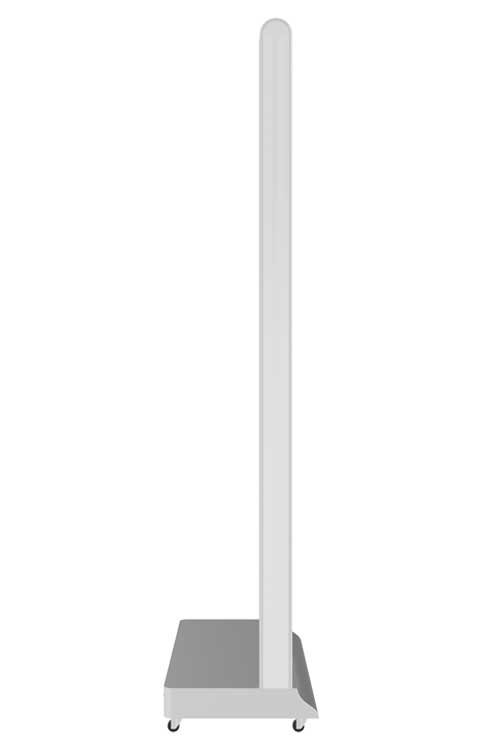
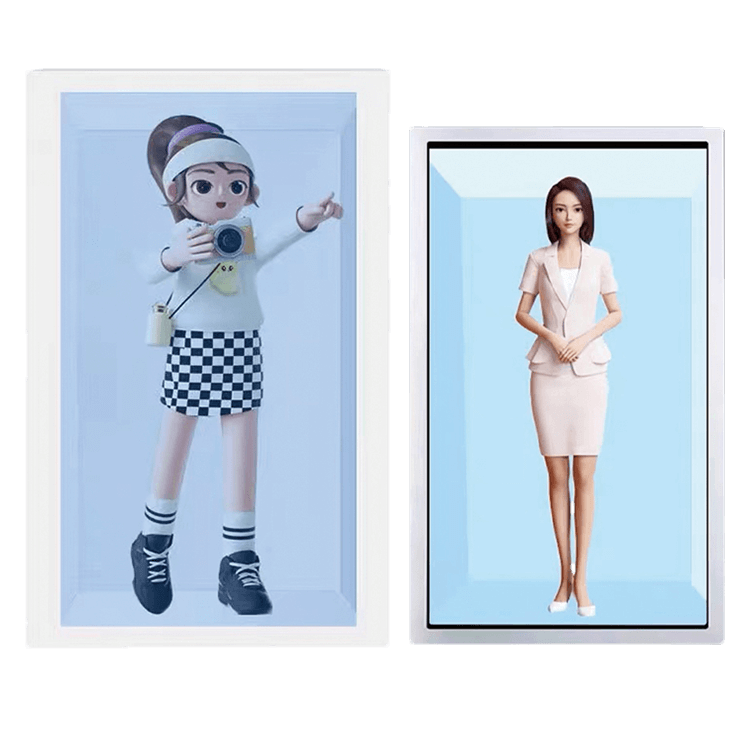
30-Inch Autonomous Mobile Base
A compact transparent OLED terminal on an autonomous mobile base for visitor-facing presentations, guided information and interactive service projects.


DisplayMan combines transparent OLED imagery with digital human content, a mobile base and project-specific interaction hardware. Select autonomous or manual mobility, then define touch, voice, computing and software requirements around the visitor experience.
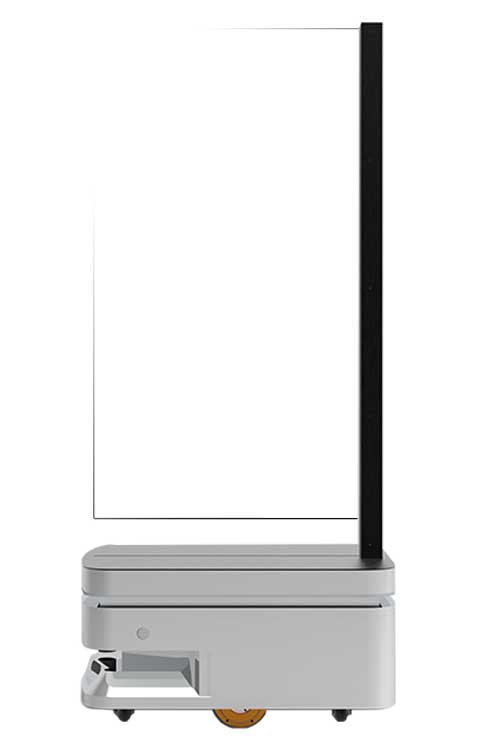
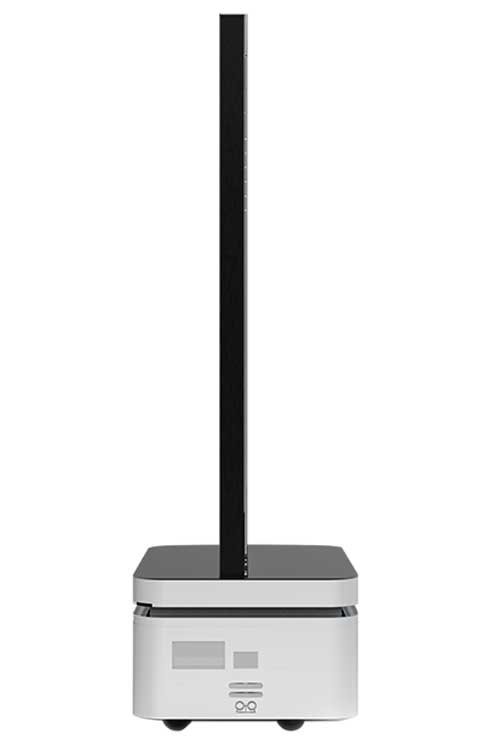
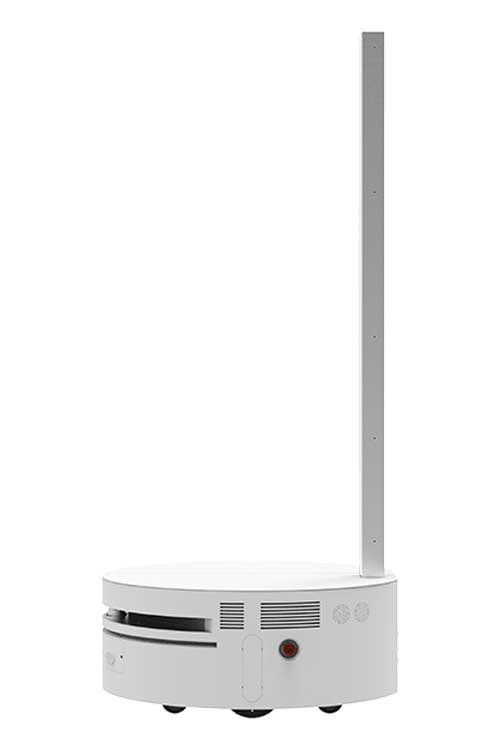
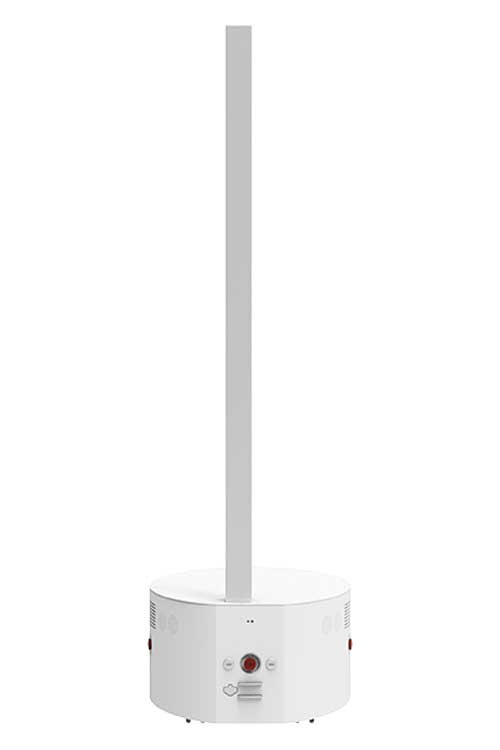
Explore each configuration from four angles. Interaction hardware and software are selected for the project.
A compact transparent OLED terminal on an autonomous mobile base for visitor-facing presentations, guided information and interactive service projects.


A 55-inch transparent OLED configuration with a Type A autonomous mobile base. Review the enclosure, navigation requirements, interaction hardware and software together for the intended venue.


An alternative 55-inch autonomous mobile configuration for projects with different structural and presentation requirements. Select Type A or Type B after reviewing dimensions, site access and integration needs.


A manually repositioned 55-inch transparent OLED terminal for exhibitions, retail and reception spaces. Staff move the unit into position; autonomous navigation and automatic docking are not implied for this format.


A Transparent OLED AI Digital Human Display is a premium interactive terminal that uses a see-through OLED display to present a digital human, virtual presenter, AI avatar or service interface.
It goes beyond normal digital signage by combining transparent OLED visual impact with touch, voice, camera, sensor, computing and software options. The terminal can welcome visitors, introduce products, explain exhibitions, provide multilingual information or support customer-facing service tasks.
The final product may be supplied as display hardware, an interactive hardware terminal, a digital-human playback system or a more complete AI-integrated solution. The exact software scope must be confirmed for each project.
Transparent OLED AI Digital Human Display is a premium customer-facing terminal that combines transparent display, digital human content and project-based interaction—not simply an OLED panel or a video player.
The product should be evaluated as a complete system. A premium screen creates the visual effect, but the real project value depends on the interaction method, computing platform, software, content and long-term operation.
Presents the avatar and interface while keeping the surrounding environment visible.
Allows visitors to select a language, browse information, choose a service or navigate product content.
Can support presence detection, content activation, gesture triggers and compatible software input.
Provide voice input and audio output for greetings, explanations and AI conversation when supported by software.
The computing platform should be selected according to digital human software compatibility and performance requirements.
May include avatar playback, scripts, voice interaction, knowledge base, CMS, multilingual content and customer backend integration.
DisplayMan can supply the hardware terminal and review system integration. The AI digital human platform, avatar, voice engine, knowledge base and backend connection may be supplied by DisplayMan, the customer or a third-party provider and must be defined before quotation.
Main sizes include 30, 55 and 77 inches. The correct size depends on interaction distance, available space, mobility, desired avatar presence, budget and software interface.
Suitable for counters, tabletop guidance, mobile demonstrations, compact exhibitions, reception desks and close-viewing interaction.
Suitable for retail, museums, lobbies, hotels, showrooms, exhibitions and smart reception. It balances avatar visibility, structure, mobility, installation and project cost.
Suitable for large museums, flagship showrooms, airports, transport hubs, corporate experience centers and high-budget installations.
Start with 55 inches for most commercial projects. Choose 30 inches for compact or mobile interaction and 77 inches only when a stronger flagship presence justifies the higher cost and structure requirements.
Not every project needs full real-time AI interaction. Select the simplest interaction method that completes the intended visitor task reliably.
Plays avatar videos, welcome messages and product introductions without open-ended AI conversation.
Supports language selection, menus, product browsing, service topics, guides and controlled visitor journeys.
Uses microphone, speaker, speech recognition and compatible AI software for spoken questions and responses.
Activates greetings or content when a visitor approaches, depending on hardware, privacy and software design.
Provides non-touch activation for exhibitions, public spaces and selected hygiene-sensitive environments.
Can provide scripts, menus or AI responses in multiple languages according to the selected software platform.
A controlled touch menu is often more reliable and easier to maintain than unrestricted voice conversation. Full AI interaction should only be selected when the knowledge base, software provider, network, privacy and long-term support are clearly defined.
Different customers use “AI digital human” to describe very different systems. These four levels help define the real scope before hardware and software are quoted.
Pre-produced avatar videos, welcome messages or looping presentations. The simplest and fastest route for exhibitions, retail promotion and brand storytelling.
Typical hardware: Transparent OLED display, media player, speaker and fixed or mobile housing.
Visitors select topics, languages, product categories or services through a controlled touch interface.
Typical hardware: Touch panel, Android or Windows system, speaker and interactive software.
Adds microphone, speech recognition, AI response, voice output and a prepared knowledge base.
Additional review: Language accuracy, background noise, network, privacy, scripts and software maintenance.
Connects the digital human to booking, visitor management, product databases, CRM, customer systems or customized AI knowledge bases.
Project model: Joint development between hardware supplier, software provider, customer IT team and system integrator.
Many commercial projects should start with Level 1 or Level 2. Advanced voice and backend integration should be added only when the service task and software responsibility are clear.
These are size-based reference configurations. The 55-inch specification has not been assigned separately to Type A, Type B or the manual mobile version. Battery, navigation and automatic charging features apply only to the confirmed powered mobile configuration. The 77-inch option is listed for project review; no product photographs are included here.
| Parameter | 30-inch reference | 55-inch reference | 77-inch reference |
|---|---|---|---|
| Display size | 30 inches | 55 inches | 77 inches |
| Display technology | Self-emissive OLED | Self-emissive OLED | Self-emissive OLED |
| Resolution | 1366 × 768 | 1920 × 1080 | 3840 × 2160 |
| Aspect ratio | 16:9 | 16:9 | 16:9 |
| Brightness | 180–600 cd/m², auto adjustment | 200–600 cd/m², auto adjustment | 200–600 cd/m², auto adjustment |
| Contrast ratio | 135,000:1 | 100,000:1 | 200,000:1 |
| Viewing angle | 178° / 178° | 178° / 178° | 178° / 178° |
| Response time (GtG) | 0.1 ms | 0.1 ms | 1 ms |
| Color depth | 10-bit, approx. 1.07 billion colors | 10-bit, approx. 1.07 billion colors | 10-bit, approx. 1.07 billion colors |
| Main control | RK3568 | Windows x86 | Windows x86 |
| CPU | Quad-core Cortex-A55, up to 2.0 GHz | Intel Core i5; generation to confirm | Intel Core i5; generation to confirm |
| Memory / storage | 4 GB / 32 GB | 16 GB / 512 GB | 16 GB / 512 GB |
| Operating system (reference) | Android 11 | Windows 10 | Windows 10 |
| Touch | 10-point capacitive | 10-point capacitive | 10-point capacitive |
| Charger input | AC 220 V | AC 220 V | AC 100–240 V |
| Listed battery voltage* | 29.47 V | 54.75 ± 0.2 V | TBD |
| Battery rating | 25.6 V, 25 Ah | 48 V, 30 Ah | TBD |
| Charging method | Automatic low-battery return or manual recharge command | Automatic low-battery return or manual recharge command | TBD |
| Full charging time | 5.5 hours | 5 hours | TBD |
| Battery cycle life | >2,000 cycles | >2,000 cycles | TBD |
| Overall power consumption | <150 W | <200 W | <600 W |
| Operating schedule | 7 days × 12 hours | 7 days × 12 hours | 7 days × 12 hours, dynamic playback |
| Operating temperature | 0–40°C | 0–40°C | 0–40°C |
| Operating humidity | 20–80% | 20–80% | 20–80% |
| Material | Tempered glass + sheet metal | Tempered glass + sheet metal | Tempered glass + sheet metal |
| Overall dimensions (mm)** | 1750 × 500 × 500 | 1860 × 832 × 570 | 1972 × 1040 × 597 |
| Packing dimensions | TBD | TBD | TBD |
| Installation | Base-mounted | Base-mounted | Base-mounted |
| Net / gross weight | 115 / 130 kg | TBD | TBD |
| Accessories | Power cord, antenna, remote control, conformity certificate, warranty card, charger | Power cord, remote control, conformity certificate, warranty card, charger, instruction manual | Power cord, antenna, remote control, conformity certificate, warranty card |
| Warranty | One year | One year | One year |
* Listed battery voltage is reproduced separately from the nominal battery rating; its measurement or charging definition must be confirmed. ** Dimension order follows the supplied data; refer to the structure drawing. TBD means to be confirmed. The operating schedule is not a battery runtime claim. Final operating system, computing hardware and software compatibility are confirmed for each order.
A complete AI Digital Human Screen may include the following hardware and software modules. The actual configuration should match the selected project level.
Shows the avatar, service interface, videos and digital content while preserving background visibility.
Capacitive touch and custom front glass can support interactive menus and branded product design.
Android or Windows hardware selected according to software compatibility, processing and peripheral requirements.
Can support visitor detection, activation, gesture input and customer software applications.
Provide voice input and output for greetings, explanation, navigation and AI interaction.
May include avatar playback, speech recognition, voice synthesis, scripts, knowledge base, UI and backend integration.
Floor-standing, mobile, counter, tabletop or custom terminal structures can be reviewed.
Power, network, signal cable, connector positions and maintenance access should be planned with the mechanical design.
Content updates, software support, privacy, network reliability, cleaning and service responsibility must be planned before deployment.
Transparent OLED AI Digital Human Displays are best used in premium customer-facing spaces where the terminal can help visitors, explain information or improve the brand experience.
Introduces products, promotions, brand stories and service information in luxury retail and smart stores.
Explains exhibits, provides multilingual narration and helps visitors navigate cultural or educational content.
Welcomes visitors, introduces the company, provides event information and guides guests in lobbies and visitor centers.
Provides hotel services, directions, restaurant information, schedules and multilingual guest assistance.
Supports guidance, wayfinding, service information and multilingual interaction in selected transport environments.
Attracts visitors, presents products and delivers repeatable explanations at trade shows and product launches.
Introduces projects, floor plans, amenities and property information in premium sales centers.
Provides structured information, training, visitor guidance and service menus in universities, libraries and service halls.
Can be developed as a branded terminal connected to customer software, databases and service workflows.
Confirm whether the terminal should attract attention, welcome visitors, answer questions, guide users, introduce products or complete a service task.
Choose video playback, touch interaction, voice AI or full backend integration before specifying the hardware.
Start with 55 inches for most applications. Use 30 inches for compact or mobile use and 77 inches for flagship projects.
Define who supplies the avatar, AI platform, scripts, knowledge base, languages, cloud service and ongoing software support.
Select Android or Windows, touch, camera, microphone, speaker, sensor, network and base structure according to the software.
Review network, privacy, content updates, maintenance staff, software subscription, support responsibility and operating hours.
The correct hardware can only be selected after the interaction and software scope are defined. A simple playback terminal and a real-time AI service terminal are fundamentally different projects.
| Project Area | Typical Hardware Scope | Typical Software / Content Scope |
|---|---|---|
| Display and Interaction | OLED screen, touch, camera, microphone, speaker, sensors and computing system | Avatar UI, touch menu, voice workflow and interaction design |
| Digital Human Content | Playback and audio hardware | Avatar appearance, clothing, voice, scripts, videos and animation |
| AI Conversation | Microphone, speaker, camera, network and suitable computing hardware | Speech recognition, language model, voice synthesis, safety rules and response logic |
| Knowledge and Service | Network and customer-system connection hardware | Knowledge base, booking system, product database, CRM or visitor-management integration |
| Operation and Maintenance | Service access, cooling, cable routing, spare parts and physical maintenance | Cloud subscription, software updates, content ownership, privacy and technical support |
Before quotation, confirm whether the requirement is hardware only, interactive hardware, digital human playback, voice AI interaction or a fully integrated service terminal.
A successful digital human terminal should help visitors complete a simple task. The interaction must be short, clear and repeatable, especially in public or noisy spaces.
Welcome messages, product introductions, exhibition guidance, FAQ answers, service menus, wayfinding, multilingual information, brand stories and short interactive responses.
Long speeches, unclear open-ended interaction, excessive menus, unrealistic AI promises and workflows that depend on unstable network or unmaintained content.
| Comparison | Transparent OLED AI Digital Human Display | Alternative Route |
|---|---|---|
| AI Screen vs OLED Signage | Best when a virtual presenter, guide or service assistant needs stronger interaction. | Transparent OLED Signage is better when premium video, images and commercial content are sufficient. |
| AI Screen vs OLED Cabinet | Best when the visitor interaction and digital human are the main focus. | Transparent OLED Display Cabinet is better when a physical product inside a protected showcase is the center. |
| Transparent OLED vs Transparent LCD Digital Human | More premium, thinner and self-emissive, with a stronger flagship visual effect. | Transparent LCD Digital Human Display is usually better for cost control and wider size flexibility. |
| Transparent OLED vs Standard LCD Terminal | Best when transparency and premium brand impression are part of the project value. | Standard Digital Signage or Touchscreen All-in-One Terminals are more practical when basic interaction and lower cost are more important. |
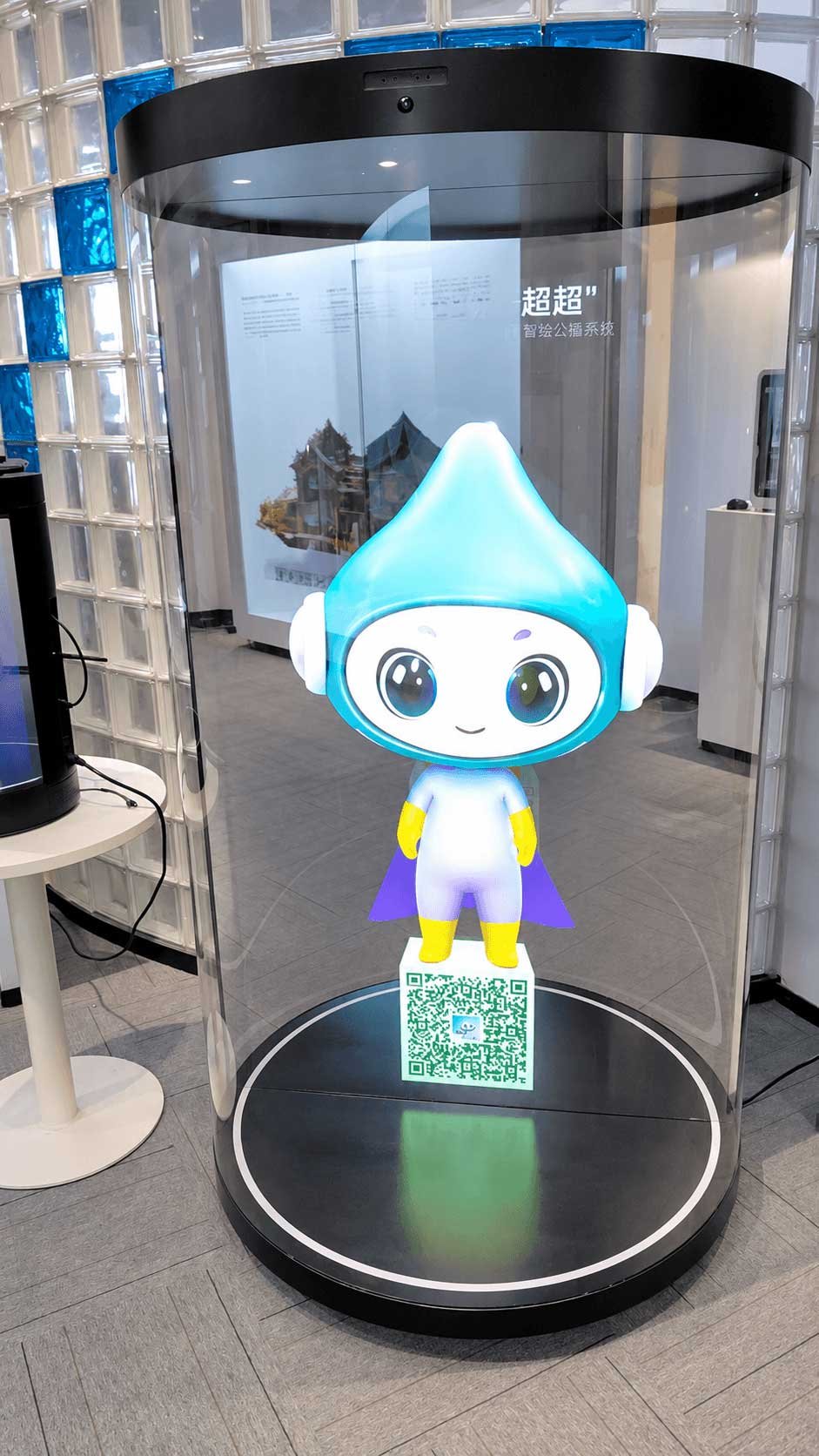
| AI Terminal vs Hologram Effect | A stable screen-based terminal suitable for repeatable customer service and interaction. | Hologram-style systems are generally better for special visual effects, events and entertainment rather than practical service workflows. |
Choose Transparent OLED AI Digital Human Display when premium transparent presentation and visitor interaction are both important. Choose simpler signage or standard terminals when the project does not need the OLED effect.
The terminal should be configured around the real interaction and software requirement. Display, computing, peripherals, base, network, power and maintenance should be reviewed as one complete system.
Hardware should follow the software requirement. Do not select cameras, microphones, computing platforms or sensors before confirming what the digital human must actually do.
The OLED screen creates the premium visual platform. Project success depends on useful content, clear software responsibility, realistic interaction and long-term operational support.
The more clearly the interaction, software and operating responsibility are defined, the faster the correct hardware terminal can be recommended.
Transparent OLED AI Digital Human Display projects connect with the Transparent OLED product family, digital human solutions, interactive terminals, customer-facing applications and alternative transparent display routes.
For product selection, start with Transparent OLED Displays and this Transparent OLED AI Digital Human Display page. Review Transparent OLED Signage when premium content playback is enough, Transparent OLED Display Cabinet when a physical product is the focus, and Transparent OLED Video Wall for larger premium installations.
| Related Product Page | When to Visit |
|---|---|
| Transparent OLED Displays | For the complete Transparent OLED family, main sizes and product categories |
| Transparent OLED Signage | When premium transparent video, images and commercial content are sufficient without advanced AI interaction |
| Transparent OLED Display Cabinet | When a physical product, artifact or luxury item inside a showcase is the center of the experience |
| Transparent OLED Video Wall | When multiple Transparent OLED panels are needed for a larger high-end visual installation |
| Custom Small-Size Transparent OLED Display | For selected icon, indicator, instrument or limited-information OLED applications |
| Related Solution Page | When It Helps |
|---|---|
| Transparent Digital Human Display Solution | For comparing Transparent OLED, Transparent LCD and other digital human display approaches at solution level |
| Transparent Display Solutions | For comparing Transparent OLED, LCD, LED and Micro LED technologies |
| Transparent Retail Display Solution | When the project is retail-focused and the correct transparent product is not confirmed |
| Transparent Exhibition & Showroom Display Solution | For museums, exhibitions, showrooms, product launches and brand experience spaces |
| OEM/ODM Display Engineering & Prototyping | When the project requires custom structure, sample development, interface integration or batch engineering |
| Application Page | When It Helps |
|---|---|
| Exhibition, Events & Showrooms | For digital presenters, product launches, trade-show interaction and showroom guidance |
| Corporate & Office Environments | For lobbies, reception areas, visitor centers and corporate experience spaces |
| Industry Applications | For reviewing display products across retail, museums, hospitality, corporate and public-service markets |
| Product / Capability | When It Helps |
|---|---|
| Touchscreen All-in-One Terminals | When the project needs a conventional interactive terminal and transparency is not essential |
| AI Recognition & Smart Access Terminals | When camera recognition, access control or identity-oriented terminal functions are required |
| Wall-Mounted Touch Terminals | When a fixed wall-mounted interactive interface is more practical than a floor-standing transparent terminal |
| Capacitive Touch Panels | When touch browsing, language selection and controlled visitor interaction are required |
| Custom Touch Panel Glass | When front glass dimensions, printing, holes, edges or surface treatments must be customized |
| LCD Controller Boards | When HDMI, signal input, media player or display-driving configuration must be reviewed |
| FPC & Cable Assembly | When cable routing, connectors and internal wiring must match the terminal housing |
| Alternative Route | When It May Be Better |
|---|---|
| Transparent LCD Digital Human Display | When cost control, wider size flexibility and a practical transparent terminal are more important than premium OLED effect |
| Transparent LCD Displays | For broader cost-controlled transparent display, cabinet, vending and OEM routes |
| Digital Signage Displays | When the project mainly needs video playback and transparency or AI interaction adds little value |
| Touch vs Non-Touch Display | When the project must decide whether interaction is necessary or passive content is sufficient |
| Transparent Display vs Standard Display | When the project must confirm whether a transparent screen is actually required |
| Decorative vs Informational Transparent Displays | When the display purpose must be clarified as visual attraction, information, interaction or a combination |
The product page should guide customers from the real visitor task and project level to the correct OLED size, interaction method, computing system, AI software scope, terminal structure and alternative display route.
A Transparent OLED AI Digital Human Display is an interactive transparent OLED terminal that presents a digital human, virtual presenter, AI avatar or service assistant on a see-through display.
Transparent OLED Signage mainly displays video, images and commercial content. The AI Digital Human Screen adds a computing system and can also include touch, camera, microphone, speaker, sensors and digital human software integration.
55" is usually the safest and most practical starting point for commercial Transparent OLED AI Digital Human Display projects.
Main product sizes include 30", 55" and 77". The 30-inch format is suitable for compact or mobile use, while 77 inches is intended for premium flagship projects.
Yes. Capacitive touch can be reviewed for menu selection, product browsing, language selection, visitor guidance and customer self-service.
Yes. Voice interaction can be reviewed with microphone, speaker and compatible AI software. The final capability depends on the software platform, language model, knowledge base, network and project scope.
Yes. Camera, motion sensor, presence sensor or gesture-trigger hardware can be reviewed for visitor detection, content activation and software interaction.
DisplayMan can supply the display terminal hardware and review software integration. The exact AI software scope may be provided by DisplayMan, the customer or a third-party software provider and must be confirmed before quotation.
Yes. Some projects use pre-produced digital human videos, scheduled content or touch-based menus without real-time voice interaction.
Yes. Multilingual scripts, menus and voice interaction can be reviewed according to the software platform and project requirements.
Yes. It can be configured as a virtual receptionist, museum guide, exhibition presenter, retail promoter, hotel concierge or customer-service terminal.
Offline video playback and local touch content may not require internet access. Cloud AI interaction, online knowledge bases and remote services normally require a stable network connection.
Depending on the AI software and performance requirement, the terminal can use Android, Windows or a customer-provided computing platform.
A battery-powered mobile configuration can be reviewed according to screen size, power consumption, required operating time, base structure and safety requirements.
Standard Transparent OLED AI Digital Human Displays are mainly designed for indoor or controlled environments. Outdoor-facing or direct-sunlight use requires separate review of brightness, protection, heat and visibility.
Please provide the application, screen size, project level, interaction method, AI software scope, hardware configuration, installation form, quantity, budget, schedule and shipping destination.

Tell us the application, screen size, project level, interaction method, AI software plan, hardware configuration, installation form, quantity, budget and project schedule.
For most commercial projects, a 55-inch Transparent OLED AI Digital Human Display is the best starting point. A 30-inch version can be reviewed for compact or mobile applications, while 77 inches is intended for premium flagship projects.
The correct terminal depends on the visitor task, interaction level, software provider, avatar and language requirements, computing platform, camera, microphone, speaker, sensors, network, housing and long-term support plan.