Cube LED Display

Transform Multiple LED Faces into One Powerful 3D Digital Experience

Transform conventional flat LED screens into a striking three-dimensional digital object. Cube LED Displays combine multiple display faces with precision 90° corner engineering, synchronized content, and multi-directional viewing for retail spaces, exhibitions, museums, corporate lobbies, and creative installations.

DisplayMan — Your Partner in Custom LED Display Engineering

cube led display

Cube LED Display: A Multi-Face Digital Sculpture Built Around 90° Corners

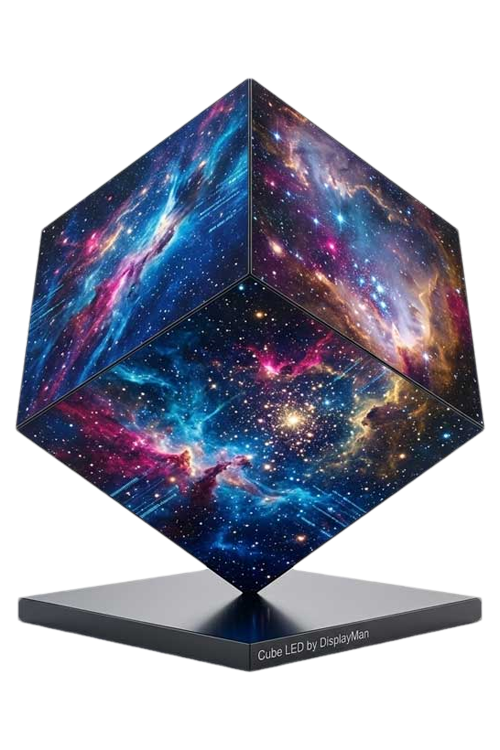
A Cube LED Display is a custom multi-face LED system built around a rigid cubic structure. Unlike a normal LED wall, the display is experienced as a three-dimensional object, with content visible from several directions and capable of continuing across precise 90° edges.

DisplayMan reviews Cube LED projects for retail, exhibitions, museums, science centers, corporate lobbies, events and architectural installations. The key engineering inputs are cube edge length, number of active faces, viewing distance, pixel pitch, corner treatment, internal structure, content mapping, mounting method and service access.

The 90° Edge Defines the Product

A professional Cube LED Display is not simply six independent panels placed together. The visual quality depends on corner precision, face alignment, edge pixel continuity, structure and multi-face content mapping.

Multi-Face VisibilityFour, five or six active display faces can be reviewed by project.
90° Corner EngineeringEdge treatment is designed to minimize dark lines and preserve the cube geometry.
Multi-Face MappingContent can be independent, synchronized or intentionally continue across corners.
Architectural 3D FormFloor-standing, suspended, rotated and integrated structures can be reviewed.

Two Cube LED Product Directions

“Cube LED Display” covers two different product directions. A compact Magic Cube is closer to self-contained digital signage, while a large Creative Cube is a project-engineered 3D LED structure. Selecting the correct direction first makes size, control, installation and budget decisions much clearer.

Compact / Standardized Direction

Magic Cube LED Digital Signage

Designed for retail stores, chain stores, showrooms, exhibitions, reception areas and smaller commercial installations. These cubes commonly use four or five active faces and can be floor-standing, wall-mounted or suspended depending on the product design.

  • Relatively compact physical size
  • 4-face or 5-face configurations are common
  • Fine-pitch indoor LED is typically reviewed for close viewing
  • Local or network content control can be configured
  • One cube or multiple cubes can form a coordinated installation
  • Suitable when fast installation and repeatable deployment matter
Best for:

Retail branding, chain stores, product promotion, exhibition booths and commercial digital signage.

Project-Engineered Direction

Custom Creative Cube LED Display

Designed when the cube itself becomes an architectural object, digital sculpture or immersive visual installation. These projects place more emphasis on 90° edge quality, custom structure, content mapping, installation engineering and long-term maintenance.

  • 4, 5 or 6 active LED faces by project
  • Custom edge length and internal structure
  • Floor-standing, suspended, rotated or integrated installation
  • Independent, synchronized or cross-corner content
  • Large architectural and landmark formats can exceed 2 m
  • Project-specific structure, power, control and service engineering
Best for:

Museums, science centers, corporate lobbies, public art, architectural media and large experiential installations.

Cube LED Sizes, Faces & Pixel Pitch Directions

Cube selection begins with the physical edge length, number of visible faces, viewing distance and installation orientation—not only with pixel pitch. Compact Magic Cube products can be much smaller than large Creative LED cubes because their display surfaces remain flat.

Product DirectionViewing / EnvironmentBest ForSelection Logic
Compact Retail CubeClose-view indoorRetail displays, showrooms, launch countersCan be smaller than many curved Creative LED shapes because the faces remain flat; practical size is governed by module dimensions, 90° corner construction, electronics and service space
Freestanding Brand CubeMedium indoorFlagship stores, malls, exhibitions, corporate lobbiesBalance physical scale, total resolution, structure and maintenance
Suspended CubeProject-based indoorAtriums, museums, exhibitions, event spacesWeight, rigging, cable routing and service access become critical
Architectural / Landmark CubeLarge project-basedPublic interiors, science centers, corporate installationsStructure, face synchronization, corner precision and installation dominate
Outdoor CubeProject-based outdoorPlazas, brand activations, outdoor event installationsOutdoor brightness, sealing, wind load, structural safety and service strategy govern selection

Compact Cube Size Reference

Common compact Cube LED products in the market are often built around module-friendly edge lengths. The examples below are useful as a reference class only; DisplayMan confirms the final edge size after pixel pitch, module layout, active faces, electronics and maintenance method are selected.

Reference Edge ClassTypical DirectionImportant Note
Approx. 320 mmVery compact indoor Magic Cube / close-view retail signageRequires a module and electronics layout specifically compatible with the small internal volume
Approx. 384 mmCompact retail, counter, showroom or exhibition Cube LEDPixel pitch and module dimensions must be matched to the final face resolution
Approx. 480–512 mmGeneral compact commercial Cube LED signageA practical class for 4/5-face products where portability and visibility are both important
Approx. 640 mmLarger retail / exhibition Magic CubeProvides more internal space for electronics and more display area while remaining relatively compact
Custom / 1 m+Freestanding commercial or project-engineered Cube LEDStructure, active faces, transport, content mapping and service access become increasingly important
Approx. 2 m+Large Creative / architectural Cube LEDCommon large-project direction, not a minimum size rule for Cube LED Displays

Pixel Pitch Direction

Pitch DirectionViewing DirectionTypical Use
P1.5–P2.0 classPremium close indoor viewingFine text, data visualization, close retail and museum use
P2.0–P2.5 classGeneral close-to-medium indoor viewingBrand cubes, showrooms, science / exhibition installations
P3–P4 classLarger indoor cubes or longer viewing distanceAtriums, large commercial interiors and event structures
P4+ classLarge / outdoor / longer-distance projectsOutdoor cube directions and large landmark structures
Cube Size Is More Flexible Than Compound-Curved Creative LED

Unlike spheres, vase-shaped displays and other compound-curved Creative LED structures, a Cube LED Display does not need many small segments to reproduce a smooth curve. Smaller cube dimensions can therefore be practical. The real minimum is determined by the selected LED module dimensions, 90° edge construction, internal electronics, cooling and maintenance space.

90° Corner Engineering: The Core of a Cube LED Display

The most visible failure point in a cube is the edge. Even when each individual face looks good, poor corner geometry can create dark lines, uneven gaps, misaligned pixels or an obvious “six screens bolted together” appearance.

FRONT FACE
RIGHT FACE
TOP FACE
1. Cube DimensionsEdge length, active faces and orientation
2. LED Face ModulesFlat face layout and edge module treatment
3. 90° Corner SystemMiter / precision edge alignment
4. Internal FrameRigid cube skeleton and electronics space
5. Multi-Face MappingIndependent / synchronized / corner-spanning content
6. Mounting + ServiceBase, suspension or rotated structural installation
Engineering FactorWhy It Matters
Cube DimensionsEdge length determines each face area, total LED area, overall resolution, weight and transport strategy.
Number of Active FacesA project may use 4, 5 or 6 display faces depending on mounting, visibility and service access; not every cube requires all six faces active.
90° Corner DesignThe edge is the defining feature. Module geometry, mitering, mask treatment and frame tolerance must minimize dark lines and visible discontinuity.
Face AlignmentAdjacent faces must remain square and coplanar so the cube does not visually twist or show uneven edge gaps.
Module GeometryStandard flat modules may work on broad faces, while edge zones may require precision-cut, mitered or project-specific module treatment.
Internal FrameThe frame must keep six planes rigid while also providing internal space for receiving cards, power supplies, cabling and service access.
Pixel MappingEach face is a separate pixel plane, but content may be independent, synchronized or mapped continuously across corners.
Corner ContentGraphics crossing an edge need special layout because a 90° physical fold changes the viewer’s perspective.
Power & SignalElectronics should be distributed so face-to-face cabling remains organized and accessible.
Thermal DesignA closed cube can trap heat. Ventilation, power density and service openings should be reviewed before final enclosure design.
MaintenanceAccess panels or removable faces should be planned before the outer LED skin is finalized.
Transport / AssemblyLarge cubes may need modular frames or split sections so the structure can pass through building access and be assembled on site.
Cube LED Size & Customization Boundary

Cube LED Displays can often be made smaller than many fully custom curved or organic Creative LED shapes. The reason is simple: each main display surface is flat, so the product does not depend on dense PCB segmentation to reproduce a smooth circle, sphere or compound curve.

For large architectural, landmark and immersive Creative LED projects, overall dimensions of approximately 2 meters or larger are common. However, 2 meters should not be treated as a minimum size for Cube LED. Compact cube projects can also be reviewed when the selected LED module size, corner design, internal electronics and service method allow a practical structure.

Very small cubes are still not unlimited. LED module dimensions, 90° corner treatment, power supplies, receiving cards, cable routing, cooling and maintenance access ultimately define the practical minimum.

Cube Size DirectionTypical Engineering LogicMain Constraints
Compact CubeCan be practical because all primary LED faces are flat. Best reviewed from the selected module dimensions and corner architecture.Module size, 90° edge design, electronics volume, cooling and service access
Medium Commercial CubeCommon for retail, exhibitions, museums, brand installations and freestanding digital sculptures.Total resolution, structure, face synchronization, transport and installation
Large Creative / Landmark CubeApproximately 2 m and above is a common direction for architectural or landmark-scale Creative LED projects, but this is a project scale rather than a minimum-size rule.Structural load, rigging or base design, modular assembly, power distribution and maintenance
Core Engineering Principle

The cube should be designed from the corners inward. Edge treatment, module geometry, frame tolerance and content strategy determine whether the finished object reads as one continuous digital sculpture or several unrelated screens.

Complete Cube LED Display System

A Cube LED Display should be quoted as a complete multi-face system, not only by total LED square meters.

LED Faces4 / 5 / 6 display planes
90° EdgesPrecision corner treatment
Internal FrameRigid geometry + service
Power + ControlReceiving + PSU + processor
Face MappingIndependent or synchronized
InstallationBase / rigging / orientation
System LayerTypical Scope
LED FacesFour, five or six active flat LED surfaces depending on project visibility and installation
90° Edge SystemPrecision edge treatment, mitered module / mask strategy and structural alignment
Internal FrameRigid cube skeleton with mounting, electronics and service-access provisions
Control ElectronicsReceiving cards, power supplies, processor / sending system and optional media player
Content MappingPer-face pixel maps plus cross-corner synchronization or 3D content layout
Installation PackageBase / rigging / mounting hardware, internal cables, transport protection and spare parts

Content Control & Multi-Cube Networking

Cube LED control should be selected according to how frequently content changes, whether each face plays the same or different media, and whether one cube or multiple cubes must be managed together. Control hardware and available interfaces are confirmed per project.

Control DirectionBest ForProject Notes
Local USB / Local PlaybackSimple standalone retail and exhibition installationsUseful when content changes are occasional and remote management is not required
Ethernet Network ControlPermanent commercial installations and reliable local networksSuitable for scheduled updates, synchronized playback and centralized management
Wi-Fi ControlRetail, showrooms and temporary installationsCan simplify local content updates where a compatible controller is selected
4G / 5G Remote ConnectivityDistributed or difficult-to-wire installationsOptional remote-network direction; final architecture depends on controller, region and network requirements
Synchronous PlaybackLive video, events and coordinated multi-face visual contentAll active faces or multiple cubes can be mapped into one synchronized system
Asynchronous PlaybackDigital signage and scheduled mediaUseful for self-contained playback without a permanently connected video source
Single Cube

Independent or Synchronized Faces

Each active face can be assigned its own content region, or multiple faces can be synchronized into one visual composition. The content workflow should be decided before the controller and pixel map are finalized.

Multi-Cube Installation

Create a Cube Cluster

Several Cube LED Displays can be arranged in different sizes or positions to create a stronger retail, event or architectural installation. Multiple cubes can be designed for synchronized playback or individual content zones depending on the selected control system.

Multi-Face Content Mapping for Cube LED Displays

Cube content can behave in several different ways. The correct media workflow depends on whether each face is independent, synchronized, part of one cross-corner composition or designed for a specific 3D viewing angle.

Content ModeMapping Strategy
Independent Face ContentEach face shows different advertising, data or visual content. Best when audiences approach from different directions.
Synchronized Six-Face ContentAll active faces display synchronized scenes, colors or animation timing for a unified 3D object.
Corner-Spanning GraphicsArtwork deliberately crosses a 90° edge. Logos and key details should be tested from the intended audience angles.
3D Illusion / Anamorphic ContentPerspective-based media can use the physical cube geometry to create depth effects, but the correct primary viewpoint must be defined.
Scientific / Data VisualizationDifferent faces can show related datasets, models, labels or visual layers while remaining synchronized.
Brand IdentityLogos, patterns and campaign elements can wrap across multiple faces or reserve one hero face for primary messaging.
Content Mode

Independent Faces

Useful when different audiences approach from different directions or when each side needs a separate message.

Synchronization

One Synchronized Object

All faces can share timing, color and motion so the cube behaves like one programmable sculpture.

90° Mapping

Cross-Corner Visuals

Media can deliberately cross a 90° edge, but important logos and text should be checked from the real audience viewpoints.

Cube LED Installation, Orientation & Maintenance

Installation MethodEngineering Considerations
Floor-StandingMost practical for retail, exhibition, museum and lobby applications; base should handle leveling, stability and cable entry.
Pedestal-MountedCreates a sculpture-like presentation while controlling audience distance and improving visual prominence.
Suspended / Ceiling-MountedRequires structural load review, rigging points, power/data routing and safe maintenance access.
Vertex / Corner-Oriented InstallationCube may be rotated so it rests visually on a vertex or edge; this creates stronger sculptural impact but increases structural engineering complexity.
Outdoor Structural MountRequires wind load, anchoring, weather protection, drainage, thermal and maintenance review.
Multi-Cube ClusterSeveral compact cubes can be arranged at different heights or positions as one coordinated installation; power, control addressing, service clearance and synchronization should be planned together.
Site

Installation Planning

  • Cube edge length and total weight
  • Number of active faces
  • Floor-standing / suspended / rotated orientation
  • Power and signal entry
  • Rigging or anchoring points
  • Audience circulation and primary sightlines
  • Door / lift / loading access
Service

Maintenance Planning

  • Removable face or service-door strategy
  • Module replacement direction
  • Power-supply access
  • Receiving-card access
  • Internal ventilation
  • Spare-module planning
  • Safe access for suspended installations
Maintenance Strategy Should Be Selected Before Production

Compact Cube LED products may use removable or front-service module concepts when the selected module design allows it. Larger Creative Cube projects may use removable faces, internal service doors or project-specific maintenance access. DisplayMan confirms the final maintenance method after the cube size, module type and mounting orientation are fixed.

Project Reference: Shenzhen Bay Laboratory “Life Cube”

DisplayMan’s Custom LED project portfolio includes a Cube LED installation for Shenzhen Bay Laboratory. The project is a useful reference because it shows how cube geometry, edge treatment and scientific content can work together as one architectural display object.

The “Life Cube” Digital Sculpture

The project is described as a multi-dimensional LED installation positioned on a single vertex to create a gravity-defying visual effect. The parent project page identifies 90° corner engineering and an indoor P2.5 LED configuration for scientific visualization.

Installation FormVertex-oriented cube sculpture
Reference PitchIndoor P2.5
Key Engineering90° edge continuity
ContentScientific text, molecular models and data visualization
Case-Study Boundary

This is a project reference, not a universal Cube LED specification. New cube projects should still be reviewed from their own size, pitch, installation, structure, content and maintenance requirements.

Typical Cube LED Display Applications

Cube LED can range from compact digital signage used by a single retail store to large architectural Creative LED installations. The physical size, active faces, controller and mounting method should follow the application rather than forcing every project into one standard specification.

Retail & Flagship Stores

Create a geometric hero object for launches, premium merchandise zones and architectural brand installations.

Trade Shows & Exhibitions

A freestanding or suspended cube gives multiple aisles a visible digital surface while creating a strong booth landmark.

Museums & Science Centers

Use different faces for synchronized scientific visualization, explanatory data and immersive media.

Corporate Lobbies

A cube can function as a digital sculpture for brand identity, innovation storytelling and visitor experience.

Events & Experiential Marketing

Use synchronized face content, animated patterns and 3D illusion media to create a recognizable event centerpiece.

Public & Architectural Installations

Larger project-specific cubes can be integrated as permanent or semi-permanent digital landmarks.

Cube LED Display vs Standard Flat LED Wall

FactorCube LED DisplayStandard Flat LED Wall
Display Geometry3D object with multiple visible facesSingle front-facing plane
Audience DirectionMultiple approach directionsPrimarily front-facing
ContentIndependent, synchronized or corner-spanning multi-face mediaStandard flat video canvas
StructureCustom rigid 3D frame with 90° corner engineeringConventional flat cabinet / wall structure
Architectural RoleDigital sculpture / spatial landmarkDisplay wall / signage surface
Best FitRetail landmarks, exhibitions, museums, atriums, branded objectsPresentations, advertising walls, general signage

Cube LED Display vs Sphere LED Display

FactorCube LED DisplaySphere LED Display
GeometrySix planar faces and 90° edgesContinuous compound-curved spherical surface
Visual CharacterGeometric, architectural, preciseOrganic, radial, globe-like
Content MappingFace-based and edge-awareSpherical coordinate mapping
Main Technical ChallengeCorner continuity and face alignmentCurvature segmentation and polar convergence
Best FitData, branding, architectural sculpture, 3D geometric installationsDigital Earth, 360° landmark, globe and organic spatial media

Cube LED Display vs Cylindrical LED Display

FactorCube LED DisplayCylindrical LED Display
Surface TypeMultiple flat facesContinuous single-axis curved surface
Edge Treatment90° corners are central to the designNo 90° vertical corners on the main display surface
Content WorkflowFace-based / corner-spanningPanoramic wrap-around
StructureRigid cubic skeletonRound frame or column wrap
Best FitGeometric digital sculpturePillars, columns and circular architectural media
Choose the Geometry from the Spatial Goal

Choose Cube LED when strong 90° geometry and multiple planar faces are part of the concept. Choose Sphere LED for a continuous 360° curved object, and Cylindrical LED for a constant-radius wrap-around surface.

Explore 8 Featured Custom LED Display Product Families

Cube LED is one featured direction within DisplayMan’s broader Custom / Creative LED engineering capability. These eight families are common product entry points, not a limit on the shapes that can be developed. Each physical form has its own module strategy, structure, content mapping and installation logic.

Choose the Product by the Physical Shape

Use this Cube page when the project is already defined around planar faces and 90° corners. Use Custom LED Displays when the final 3D form is still being selected.

Related Cube LED Products, Solutions & Applications

Cube LED projects can begin from the desired 3D form, from a corner / structural engineering problem, or simply from the venue and use case. Continue from the route that best matches the project stage.

When a Cube LED Display Is the Right Product

Recommended

Good Fit

  • Multiple audience directions matter
  • 90° geometry is part of the architectural concept
  • The display should function as a digital sculpture
  • Content needs several synchronized planes
  • A suspended or rotated geometric object is desired
  • Retail, museum, science or event use benefits from multi-face visibility
  • A normal flat wall would weaken the spatial concept
Alternative Direction

Choose Another Direction When

  • Only one front-facing screen is needed — choose Indoor / Outdoor Fine Pitch LED
  • The project requires a smooth continuous curve — choose Cylindrical LED
  • The concept requires a round 360° object — choose Sphere LED
  • The budget does not justify custom corner engineering
  • The site cannot provide safe access for internal maintenance
  • The project only needs a portable vertical event display — choose Portable Foldable LED Poster
  • The screen must be reconfigured into different sizes between events — choose Rental LED
  • A simple flat LED wall provides the same communication value

What Information Should You Provide for a Cube LED Quote?

Display

Display Requirement

  • Target cube edge length
  • Number of active LED faces: 4 / 5 / 6
  • Indoor or outdoor environment
  • Typical viewing distance
  • Preferred pixel pitch if known
  • Independent / synchronized / cross-corner content
  • Required resolution if known
  • Quantity
  • Project schedule
Project

Structure & Site Requirement

  • Floor-standing / pedestal / suspended / rotated installation
  • Site photos or CAD drawings
  • Primary viewing directions
  • Rigging or structural support
  • Power and signal locations
  • Service-access requirement
  • Door / lift / loading dimensions
  • Outdoor wind / anchoring requirement if applicable
  • Shipping destination
Cube Size + Active Faces + Installation Orientation Come First

These three inputs determine the LED area, corner strategy, internal frame, electronics layout, content map, weight and installation method. They are more useful than only asking for a square-meter price.

Cube LED Display FAQ

What are the common compact Cube LED sizes?

Compact Cube LED products are commonly built around module-friendly edge classes such as approximately 320 mm, 384 mm, 480–512 mm and 640 mm. These are reference directions rather than fixed DisplayMan models; the final size is confirmed from pixel pitch, module layout, active faces, electronics and service space.

Can I control a Cube LED Display by phone or Wi-Fi?

Phone or Wi-Fi control can be configured when a compatible controller is selected. Ethernet, local USB playback and optional cellular connectivity can also be reviewed depending on the project.

Can multiple Cube LED Displays work together?

Yes. Multiple cubes can be grouped into a coordinated installation and configured for synchronized playback or separate content zones, depending on the selected control architecture.

Is front maintenance available for Cube LED Displays?

Front-service or removable-module maintenance can be considered for compatible compact cube designs. Larger custom cubes may use removable faces, internal access doors or other project-specific service methods.

How much does a Cube LED Display cost?

Pricing depends on edge size, pixel pitch, number of active faces, indoor or outdoor configuration, 90-degree corner design, control system, structure, installation method and quantity. Compact standardized cubes and large Creative Cube projects therefore have very different cost structures.

What is a Cube LED Display?

A Cube LED Display is a custom multi-face LED system built around a rigid cubic structure, typically using four, five or six active LED faces with engineered 90° edges.

Does every cube need six LED faces?

No. The number of active faces depends on how the cube is mounted, which sides are visible, service access and project budget. Four-, five- and six-face configurations can all be practical.

What makes a Cube LED Display different from six normal LED panels?

The defining challenge is the 90° edge. A professional cube needs precise corner alignment, minimized dark lines, coordinated face geometry, internal structure and multi-face content mapping.

Can content flow across the 90° corners?

Yes, but graphics crossing an edge should be designed for the physical fold and the intended viewing direction. Important text and logos may need dedicated face zones.

Can each face show different content?

Yes. Faces can operate independently, display synchronized content or form one coordinated multi-face composition.

Can a Cube LED Display be smaller than 2 meters?

Yes. Cube LED Displays can often be made smaller than many compound-curved Creative LED shapes because the display faces are flat. Two meters is a common scale for larger architectural or landmark Creative LED projects, not a minimum size for Cube LED. The practical minimum depends on LED module dimensions, pixel pitch, 90° corner construction, internal electronics, cooling and maintenance access.

What pixel pitch should I choose?

Choose pitch from viewing distance, cube size, content detail and environment. Fine indoor pitches suit close viewing; larger cubes or longer-distance projects do not automatically need the smallest pitch.

Can Cube LED Displays show 3D or anamorphic content?

Yes. The physical geometry can support perspective-based 3D illusion content, but the primary viewing position and media layout must be defined for the effect to work correctly.

Can the cube be suspended?

Yes, subject to total weight, rigging structure, power/data routing and maintenance-access review.

Can the cube be installed on a corner or vertex?

Yes. A rotated cube can create a stronger sculptural effect, but the internal frame and mounting strategy become more demanding.

Can it be used outdoors?

Outdoor cube projects can be reviewed with dedicated brightness, waterproofing, drainage, thermal, wind-load, anchoring and electrical-safety requirements.

How is maintenance handled?

Maintenance should be designed into the frame through removable faces, service doors or planned module/electronics access. The method depends on cube size and installation.

How is heat managed inside a closed cube?

Power density, ventilation, enclosure openings and internal electronics layout should be reviewed together because a closed multi-face structure can trap heat.

How is a Cube LED Display different from a Sphere LED Display?

A cube is built from planar faces and 90° corners; a sphere uses compound curvature and spherical mapping. Their structures, module geometry and content workflows are fundamentally different.

How is it different from a Cylindrical LED Display?

A cube is a rigid geometric object with distinct faces and corners. A cylinder uses a continuous curved sidewall and panoramic wrap-around content.

What is the DisplayMan Life Cube project?

DisplayMan's Custom LED Displays page describes a Shenzhen Bay Laboratory project called the Life Cube, using a vertex-oriented cube form, 90° corner engineering and an indoor P2.5 LED configuration for scientific visualization.

What information is needed for quotation?

Provide target cube edge length, number of active faces, indoor/outdoor environment, viewing distance, installation method, preferred pitch if known, content concept, site drawings or photos, quantity and project schedule.

Start Your Cube LED Display Project

Send the cube size, number of active faces, installation orientation, viewing distance and content concept. DisplayMan can review the most practical pitch, 90° corner treatment, structure and multi-face mapping direction.

A Cube LED Display should be engineered from the 90° corners inward. Face modules, edge treatment, internal frame, mapping, mounting and service access must work together for the cube to read as one continuous digital object.

Send Your Display Requirement

Please share your application, display size, quantity and project background. We will review the most practical display direction.