
Combine visible surroundings with digital advertising using a framed transparent LED display. DisplayMan supports pitch and brightness selection, mounting, control systems and maintenance planning for indoor retail and commercial installations.
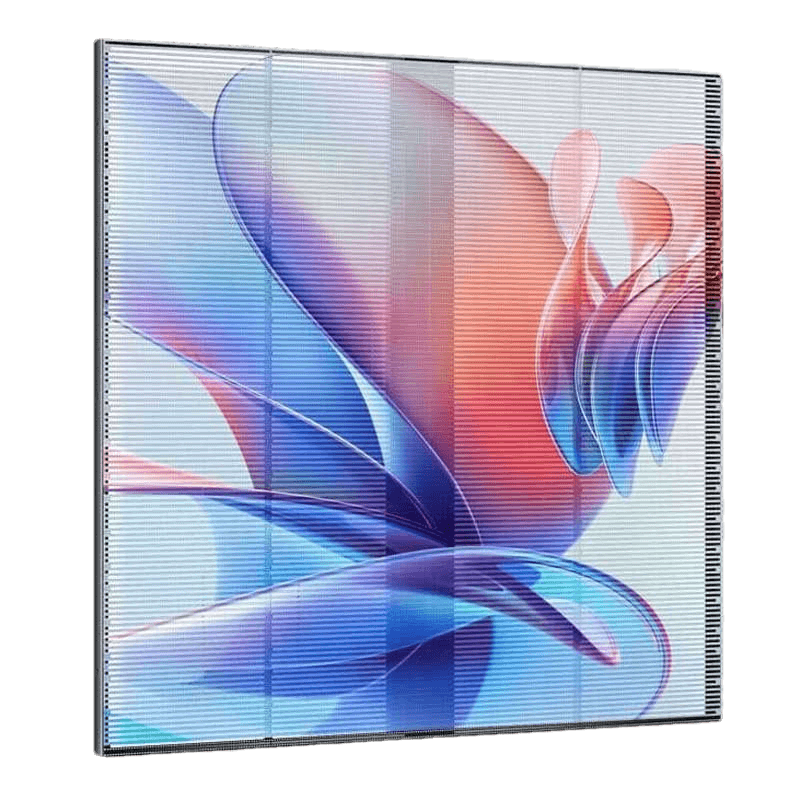
Explore indoor transparent LED displays in shopping malls and architectural atriums. These installations combine advertising, digital art and animated content with views of the space behind the display.
From suspended vertical displays to curved and large-area layouts, each example shows a different way to integrate digital media into a commercial interior. The display structure, brightness and content are selected around the installation and viewing environment.
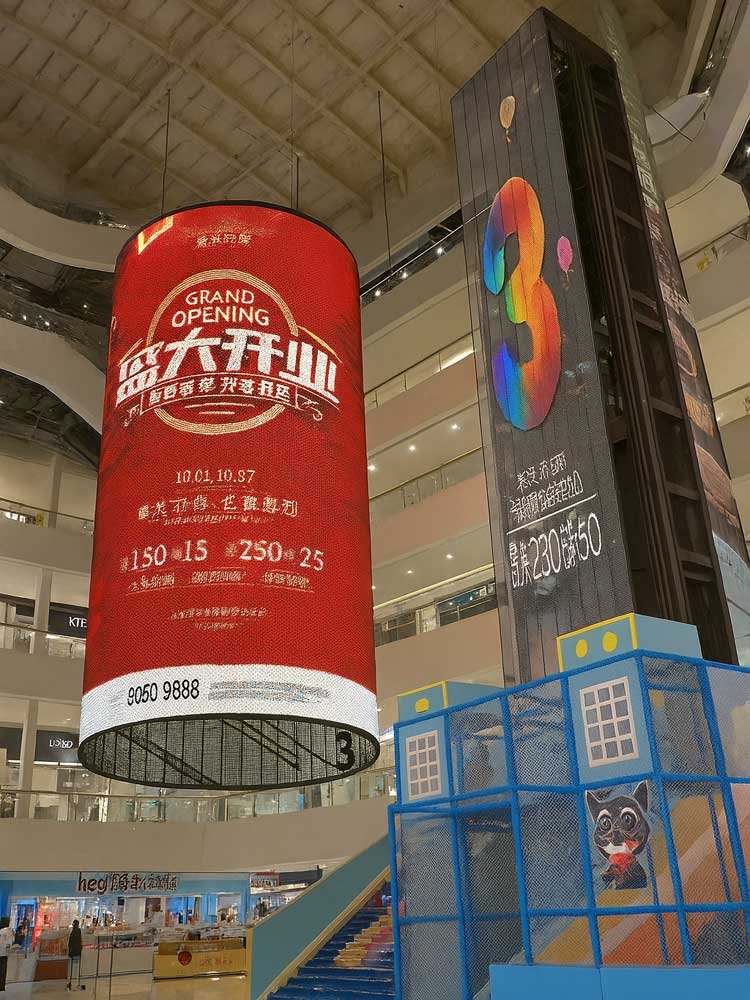
Cylindrical and vertical display sections bring advertising and event visuals into a shopping mall atrium. The transparent structure keeps the surrounding architecture visible while giving brand campaigns a prominent position.
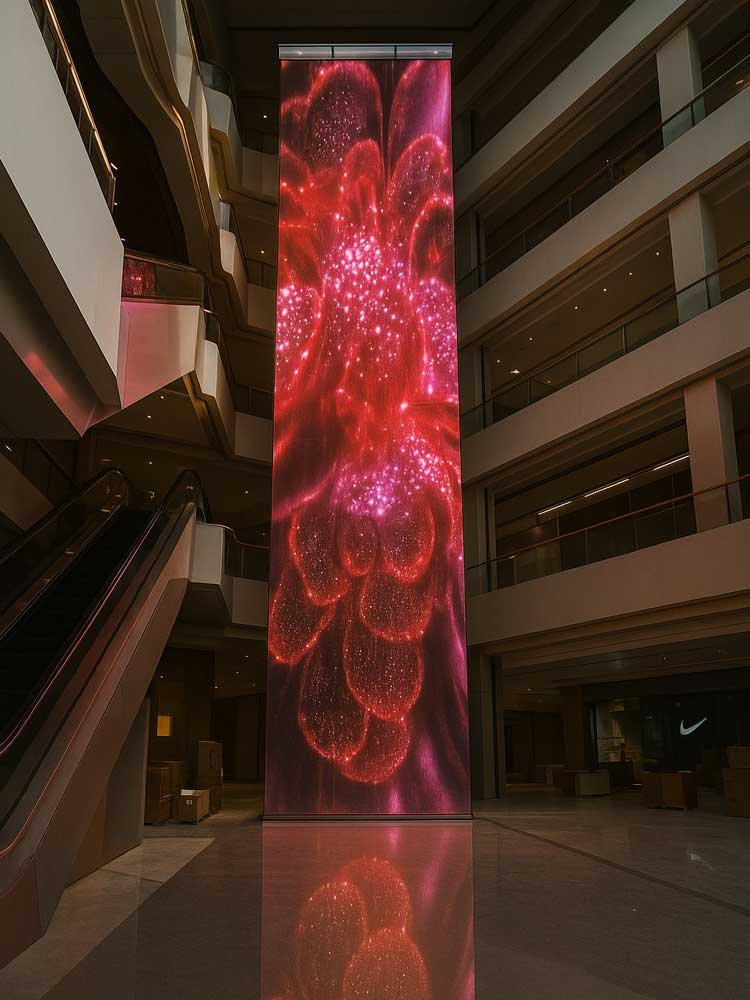
A tall atrium installation presents vivid red content, with reflections extending the visual effect onto the polished floor. The display combines a prominent media surface with an open view of the surrounding interior.
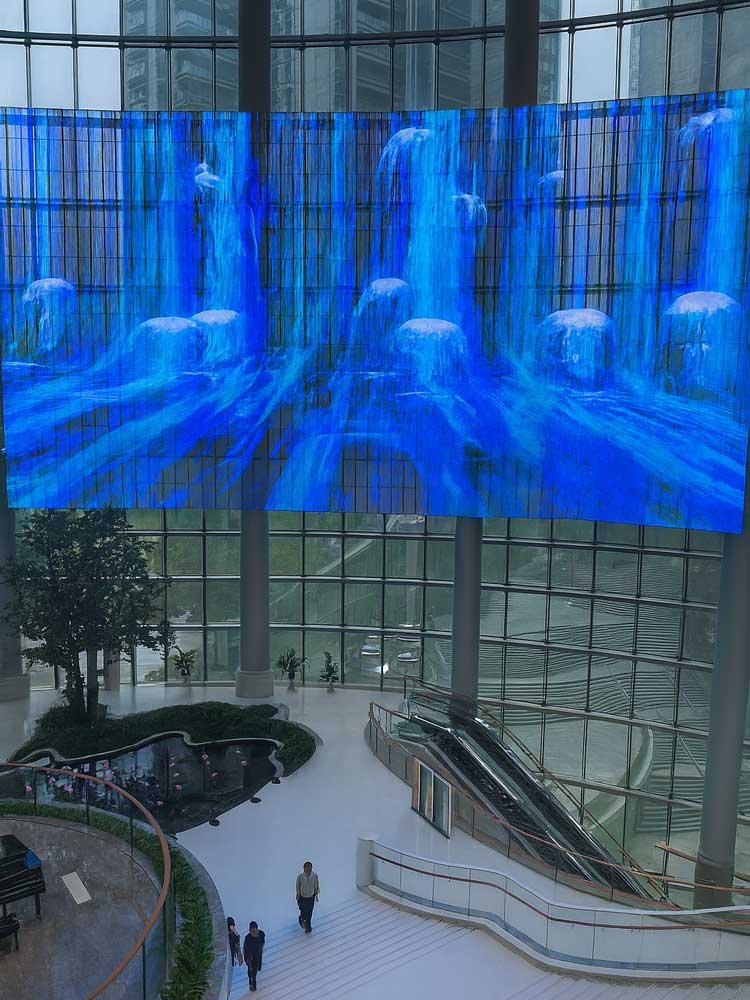
Blue waterfall animation flows across the atrium display, turning architectural surfaces into a coordinated digital-art presentation. This approach suits shopping malls, corporate spaces and cultural venues, with content and brightness planned around the site.
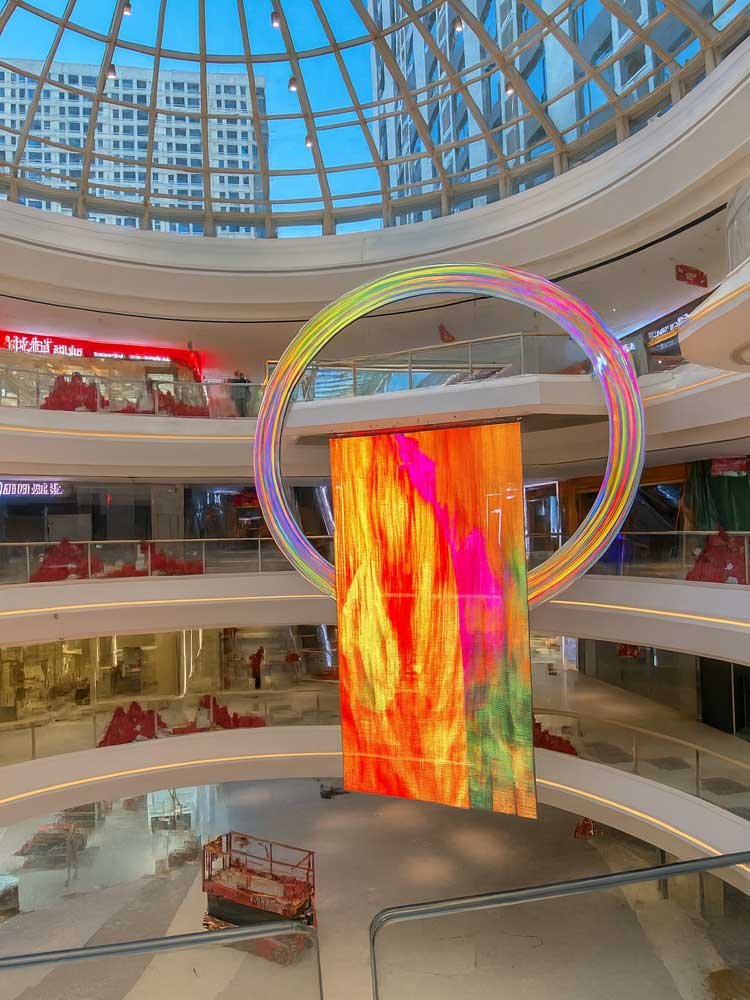
A suspended transparent LED display sits beneath a glass dome and circular architectural lighting. Colorful visual art creates a central feature while leaving the surrounding structure visible.
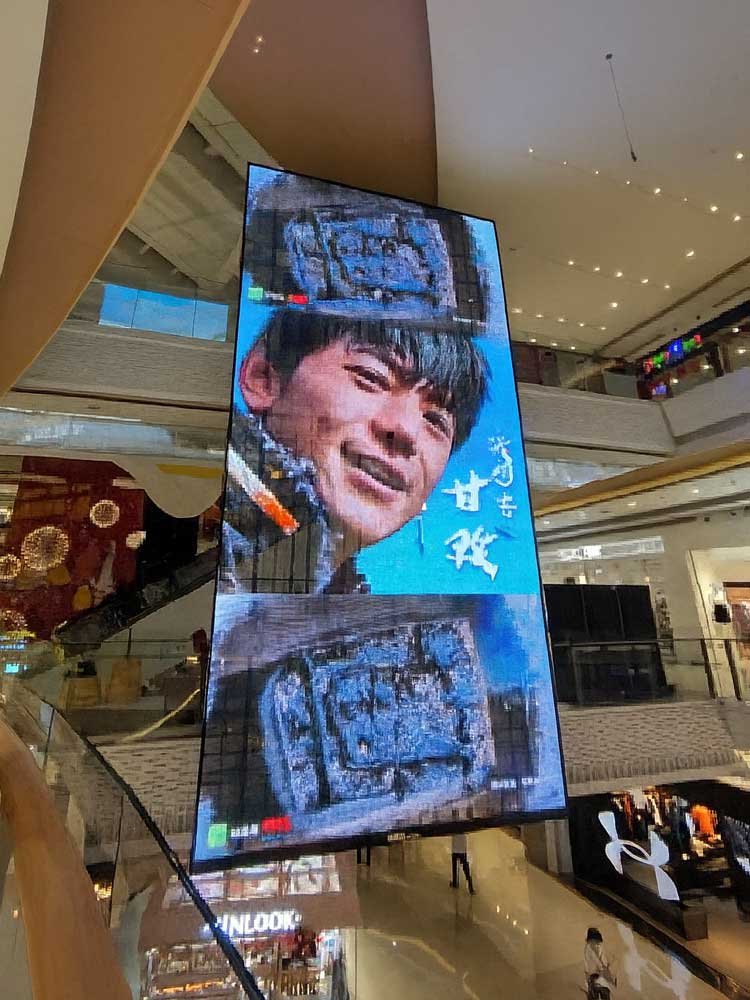
A large vertical display introduces cinematic content into the shopping mall interior. Its suspended installation provides a visible presentation area for campaigns and promotions while preserving sightlines through the display structure.
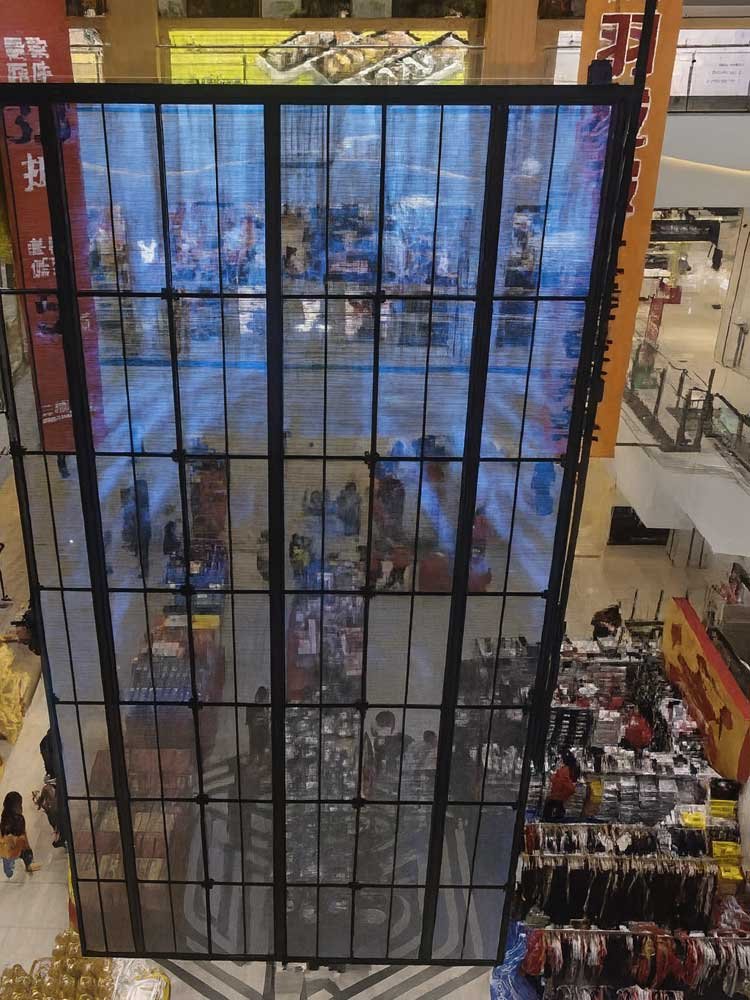
The rear view illustrates the open structure of the installation, with shoppers and retail activity visible through the display. It helps show how a large media surface can fit into a busy interior without forming a solid visual barrier.
An Indoor Transparent LED Display is a transparent LED display with its own cabinet or frame structure, designed for shopping malls, glass curtain walls, retail windows, showrooms, lobbies and other protected commercial spaces.
Its hollow LED structure displays bright digital media while preserving partial visibility, natural light and spatial openness. The screen does not need to be installed as an adhesive film layer across the glass.
This makes it a practical solution for larger indoor transparent display areas that require modular cabinet splicing, stable support and strong medium-to-long-distance visual impact.
Indoor Transparent LED Display is the structured indoor branch of the Transparent LED family: larger and more self-supporting than Film Screen, but lighter and less visually blocking than a conventional opaque LED wall.
Transparent LED products may look similar in photographs, but their structure and installation logic are different.
| Product Route | Structure | Best Use |
|---|---|---|
| Indoor Transparent LED Display | Self-supporting cabinet or framed structure | Large indoor glass walls, malls and commercial spaces |
| Transparent LED Film Display | Lightweight film-style display applied to flat glass | Storefront windows and regular indoor glass advertising |
| Flexible Transparent LED Film Display | Bendable film-style display supported by a surface | Curved glass, columns and creative shapes |
| Holographic Transparent LED Display | Fine-pitch, visually minimal transparent LED structure | Premium indoor floating-style visuals |
| Transparent LED Glass Display | Architectural glass and permanent outdoor integration | Curtain walls and building media facades |
| Outdoor Transparent LED Mesh Display | Weather-resistant outdoor mesh structure | Exposed facades and large outdoor advertising |
| Rental Transparent LED Display | Rugged reusable rental frame | Events, stages and repeated assembly |
Use Indoor Transparent LED Display when the project needs a stable framed display. Use Film Screen when a thin layer on glass is more important than cabinet structure.
The current specification range contains four pitch geometries and seven configurations. Repeated pitch columns represent different brightness, power and scanning combinations.
Available in 1,000 and 4,000 cd/m² versions. Suitable for projects requiring higher horizontal pixel density.
Available in 800, 2,500 and 4,500 cd/m² versions for different indoor lighting and window-facing conditions.
5,500 cd/m² configuration for larger displays and longer indoor or behind-glass viewing.
5,500 cd/m² configuration for large simple visuals and long viewing distances.
For an asymmetric pitch such as P3.91 × 7.8, the first number is the horizontal pixel spacing and the second is the vertical spacing.
Cabinets and frames make the screen suitable for large structured indoor installations.
The supplier table lists the same reference transparency across all seven configurations; actual appearance varies with the installation.
Select brightness according to indoor light, glass orientation and audience direction.
A standard cabinet format supports modular splicing and larger media areas.
The supplier table lists cabinet weight of no more than 8 kg/m²; confirm complete installed weight for structural design.
Supports smooth motion and camera-friendly content when matched with the confirmed driver and control system.
Service can usually be performed without outdoor facade access.
Preserves part of the view instead of replacing glass with an opaque wall.
Cabinet layout, frame, power, control and maintenance can be reviewed together.
Installed indoors behind storefront or curtain-wall glass, with content facing outside traffic or the indoor audience.
Suitable for atriums, exhibition halls, lobbies and spaces with engineered overhead support.
Structured floor-supported installation can be reviewed where the cabinet system and engineered support allow it.
For permanent retail, showroom, lobby or commercial-building display areas.
Combines 1000 × 1000 mm cabinets into a display area that matches the project dimensions.
High-brightness variants can face public traffic while remaining indoors and protected from direct weather.
The published models are Indoor and IP43. They may face outdoor viewers from behind glass, but should not be directly exposed to rain, wind or outdoor weather.
The following supplier-published values describe seven indoor configurations. Repeated pitches are separate brightness, power and scanning variants.
| Pixel Pitch / Variant | 3.91 × 7.8 mm 800 cd/m² |
3.91 × 7.8 mm 2500 cd/m² |
3.91 × 7.8 mm 4500 cd/m² |
2.6 × 6.9 mm 1000 cd/m² |
2.6 × 6.9 mm 4000 cd/m² |
10.42 × 10.42 mm 5500 cd/m² |
15.6 × 15.6 mm 5500 cd/m² |
|---|---|---|---|---|---|---|---|
| LED Configuration | 1R1G1B | 1R1G1B | 1R1G1B | 1R1G1B | 1R1G1B | 1R1G1B | 1R1G1B |
| Brightness | 800 cd/m² | 2500 cd/m² | 4500 cd/m² | 1000 cd/m² | 4000 cd/m² | 5500 cd/m² | 5500 cd/m² |
| Published Pixel Density | 32,768 pixels/m² | 32,768 pixels/m² | 32,768 pixels/m² | 55,296 pixels/m² | 55,296 pixels/m² | 9,216 pixels/m² | 4,096 pixels/m² |
| Transparency | 75% | 75% | 75% | 75% | 75% | 75% | 75% |
| Cabinet Size | 1000 × 1000 × 70 mm | 1000 × 1000 × 70 mm | 1000 × 1000 × 70 mm | 1000 × 1000 × 70 mm | 1000 × 1000 × 70 mm | 1000 × 1000 × 70 mm | 1000 × 1000 × 70 mm |
| Cabinet Resolution | 256 × 128 pixels | 256 × 128 pixels | 256 × 128 pixels | 384 × 144 pixels | 384 × 144 pixels | 96 × 96 pixels | 64 × 64 pixels |
| Module Size | 500 × 125 mm | 500 × 125 mm | 500 × 125 mm | 500 × 125 mm | 500 × 125 mm | 500 × 125 mm | 500 × 125 mm |
| Module Resolution | 128 × 16 pixels | 128 × 16 pixels | 128 × 16 pixels | 192 × 18 pixels | 192 × 18 pixels | 48 × 12 pixels | 32 × 8 pixels |
| Published Cabinet Weight | ≤8 kg/m² | ≤8 kg/m² | ≤8 kg/m² | ≤8 kg/m² | ≤8 kg/m² | ≤8 kg/m² | ≤8 kg/m² |
| IP Rating (Front/Back) | IP43 | IP43 | IP43 | IP43 | IP43 | IP43 | IP43 |
| Environment | Indoor | Indoor | Indoor | Indoor | Indoor | Indoor | Indoor |
| Viewing Angle (H/V) | 120° / 120° | 120° / 120° | 120° / 120° | 120° / 120° | 120° / 120° | 120° / 120° | 120° / 120° |
| Viewing Distance | Project dependent; evaluate pitch, screen size, content detail and actual viewing conditions | ||||||
| Gray Scale | 16 bit | 16 bit | 16 bit | 16 bit | 16 bit | 16 bit | 16 bit |
| Max. Power Consumption | 400 W/m² | 400 W/m² | 800 W/m² | 400 W/m² | 800 W/m² | 800 W/m² | 800 W/m² |
| Average Power Consumption | 200 W/m² | 200 W/m² | 400 W/m² | 200 W/m² | 400 W/m² | 400 W/m² | 400 W/m² |
| Scanning Mode | 16 scan | 16 scan | 8 scan | 14 scan | 14 scan | 2 scan | 2 scan |
| Specification | Details |
|---|---|
| Refresh Rate | 3840 Hz reference configuration; confirm with the selected receiving-card and driver system |
| Input Power | AC 100–240 V, 50/60 Hz |
| Control Mode | Synchronous or asynchronous control, selected for the screen layout and playback workflow |
| Video Input | HDMI or DVI through a compatible processor/controller; other interfaces by project confirmation |
| Operating Environment | Indoor or protected behind-glass installation; temperature and humidity limits require model confirmation |
| Rated LED Lifetime | Up to 100,000 hours under specified operating conditions; not a warranty period |
| Cabinet Material | Aluminum profiles |
| Installation | Suspended, floor-supported, behind-glass or custom fixed structure, subject to engineering review |
| Packaging | Wooden box |
Values above are supplier-published references. Final brightness variant, pitch, scanning mode, cabinet layout, power design, controller, operating conditions and installation structure must be confirmed before quotation and production.
Create the image while maintaining open space between LED structures.
Provides self-support, alignment and modular splicing.
Pitch geometry determines density, viewing distance and image detail.
Must be planned for load, ventilation, cable distance and replacement access.
Processes the source image and distributes it across the screen.
HDMI or DVI sources connect through the selected processor or controller; playback mode is configured for the project.
Routes should remain safe, hidden and accessible inside the commercial environment.
May include hanging, stacking, fixed frame or behind-glass support.
Modules, power, controller and connectors should remain serviceable.
Large promotions, event content and digital art visible across open spaces.
Indoor installation behind glass while preserving partial building transparency.
Window-facing advertising with products and store interiors still partly visible.
Welcome messages, branding, events and architectural digital art.
Vehicle campaigns, brand content and product storytelling.
Large transparent visual layers for events and product demonstrations.
Commercial or public information without a fully opaque wall.
Promotional content and large visual effects in protected indoor spaces.
Modular transparent advertising for commercial buildings and public interiors.
Use this product when a self-supporting cabinet is preferable to a film applied across glass.
Use the real critical viewing point, content detail and screen size to select pitch; do not apply one distance to every configuration.
Do not choose pitch alone. P3.91 and P2.6 variants use different brightness, power and scanning configurations.
Align 1000 × 1000 mm cabinets with the screen dimensions, glass divisions and supporting structure.
Confirm equipment position, ventilation, cable hiding, signal length and network access.
Reserve safe access to modules, cabinets, power supplies, controller and connections.
| Environment | Possible Starting Direction | What to Review |
|---|---|---|
| Controlled Interior With Moderate Light | 800 or 1000 cd/m² configuration | Comfort, power consumption and reflection |
| Bright Mall or Lobby | 2500 cd/m² configuration | Ambient light, screen size and viewing distance |
| Sunlit Indoor Glass or Window-facing Display | 4000 or 4500 cd/m² configuration | Daylight, glass reflection, heat and content contrast |
| Very Bright Large Protected Space | 5500 cd/m² configuration | Power, heat, long-distance viewing and content scale |
Select enough brightness for the real environment. Excessive brightness can increase power, heat and visual discomfort in indoor spaces.
| Viewing Condition | Product Direction | Content Approach |
|---|---|---|
| Closer Critical Viewing | P2.6 × 6.9 or P3.91 × 7.8 feasibility review | Large text, tested detail and clean structure; do not promise monitor-level quality |
| Medium-distance Retail or Showroom | P2.6 or P3.91 configurations | Products, campaigns, logos and short messages |
| Mall Atrium or Large Glass Wall | P3.91, P10.42 or project review | Large animation, event visuals and high-contrast advertising |
| Longest Indoor Viewing | P10.42 or P15.6 | Very large simple visuals and minimal text |
Indoor Transparent LED Display is strongest as large-format visual media. Small documents, menus, charts and dense interfaces belong on LCD, OLED or conventional fine-pitch displays.
| Alternative | Choose Indoor Transparent LED Display When | Choose the Alternative When |
|---|---|---|
| Transparent LED Film Display | A framed, modular and self-supporting system is needed. | A thin flat-glass media layer is more practical. |
| Flexible Transparent LED Film Display | The surface is flat and structural stability matters. | The display must follow a curve, column or irregular surface. |
| Holographic Transparent LED Display | Large commercial media and medium-distance impact matter. | Fine-pitch minimal obstruction and premium visual lightness matter more. |
| Transparent LED Glass Display | The screen is installed indoors or behind glass. | The display must become part of an outdoor architectural glass system. |
| Outdoor Transparent LED Mesh Display | The environment is protected and indoor. | The facade is exposed to rain, wind and outdoor weather. |
| Rental Transparent LED Display | The installation is fixed or long-term. | The screen must be repeatedly transported and assembled. |
| Traditional LED Display | Transparency and background visibility are important. | The project accepts a fully opaque high-impact video wall. |
The correct screen combines pitch, brightness, scanning, cabinet layout, structure, control, power, cables and content. Selecting only by price per square meter is not enough.
| Related Page | When to Visit |
|---|---|
| Transparent LED Displays | For the complete Transparent LED product family |
| Transparent LED Solutions | For comparing film, flexible, glass, mesh, rental and framed routes |
| Transparent LED Film Display | For lightweight flat-glass advertising |
| Flexible Transparent LED Film Display | For curved glass and creative shapes |
| Holographic Transparent LED Display | For visually minimal fine-pitch indoor transparent visuals |
| Transparent LED Glass Display | For permanent architectural and outdoor glass integration |
| Outdoor Transparent LED Mesh Display | For exposed weather-resistant facades |
| Transparent LED Retail Window Solution | For window-facing retail and brand-display planning |
| Transparent Exhibition & Showroom Display Solution | For showrooms, museums and exhibition projects |
| Corporate & Office Environments | For lobby, reception and corporate media requirements |
| OEM/ODM Display Engineering & Prototyping | For custom structure, samples and system integration |
It is a framed or cabinet-based transparent LED display designed for indoor and protected commercial environments such as shopping malls, glass curtain walls, retail windows, showrooms and lobbies.
No. Transparent LED Film Display is a lightweight film-type product normally installed on glass. Indoor Transparent LED Display has its own cabinet or frame structure.
No. It can be installed behind glass, suspended, stacked or fixed to a supporting structure according to the project.
The current published configurations use P3.91 × 7.8, P2.6 × 6.9, P10.42 × 10.42 and P15.6 × 15.6. Some pitches are listed in more than one brightness and scanning configuration.
They represent different brightness, power and scanning configurations for the same pixel-pitch geometry.
The supplier table lists 800, 2500 and 4500 cd/m² for P3.91 × 7.8; 1000 and 4000 cd/m² for P2.6 × 6.9; and 5500 cd/m² for P10.42 and P15.6. Final calibrated brightness may vary.
The supplier specifications list 75% transparency for all seven configurations. Actual appearance also depends on content, viewing angle, glass reflection, background and ambient light.
The supplier specification table lists a cabinet size of 1000 × 1000 × 70 mm for all configurations.
The supplier specification table lists a module size of 500 × 125 mm.
The supplier table lists cabinet weight of no more than 8 kg/m². Confirm the complete installed weight, including frames, cables and accessories, for structural design.
The product is listed as Indoor with an IP43 reference rating. It is not intended for direct exposure to rain, wind or outdoor weather.
Yes. It can be installed indoors behind a window or curtain wall while the content is viewed from outside, provided the screen remains protected from direct weather.
Viewing distance is project dependent. Select the pitch using the real critical viewing point, screen dimensions, content detail and site lighting.
Suspended, floor-supported, fixed-frame and behind-glass installations can be reviewed according to the cabinet system, site structure, loads and maintenance access.
HDMI or DVI can be connected through a compatible video processor or controller. Synchronous or asynchronous playback and any additional interfaces are selected for the project.
Large logos, bright advertising video, product campaigns, event visuals, digital art and short high-contrast messages designed for medium or long viewing work best.
Avoid small text, documents, complex charts, detailed menus, thin technical lines and low-contrast content intended for close reading.
Please provide screen dimensions, site photos or drawings, viewing distance, installation method, glass or frame details, preferred brightness, content, power and controller locations, maintenance access, quantity, budget, schedule and destination.
Send us the screen dimensions, viewing distance, installation method, glass or frame details, indoor lighting, brightness requirement, content, power and controller locations, maintenance access, quantity, budget and schedule.
We will review the appropriate pitch and brightness configuration, cabinet layout, power, control and installation system.
For direct outdoor exposure, curved glass, adhesive film or premium minimal-structure viewing, a different Transparent LED product may provide a better result.