Home | Solutions | Transparent Display Solutions | Transparent LCD Refigerator Display Solution
Commercial Refrigeration & Smart Retail Solution

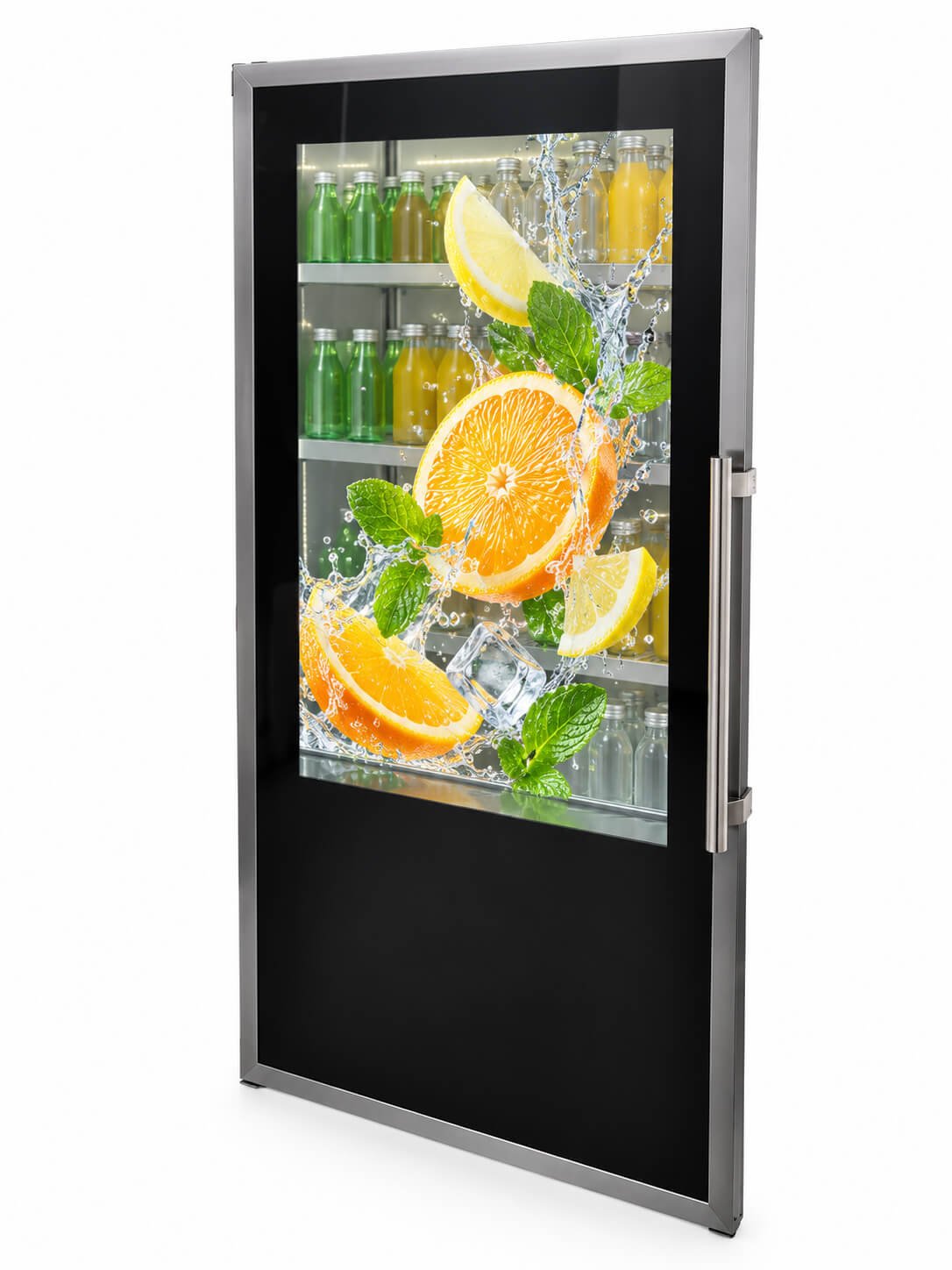
Transparent Refrigerator Display Solution

Turn a Cooler Door Into a Digital Media Surface Without Hiding the Products

A transparent LCD refrigerator display combines the transparent LCD, controlled internal lighting, insulated glass and the matching LCD driver board. It is supplied for integration into the customer’s refrigerator or vending-machine system by their manufacturer or system integrator.

Anti-Condensation HeatingExisting-Door Engineering ReviewTouch OptionalSingle or Multiple Doors
Transparent LCD refrigerator display solution
See the Product First

Transparent LCD Refrigerator Displays in Real Retail Environments

The same core technology can be integrated into a single cooler, a synchronized supermarket wall or a purpose-built refrigerated showcase.

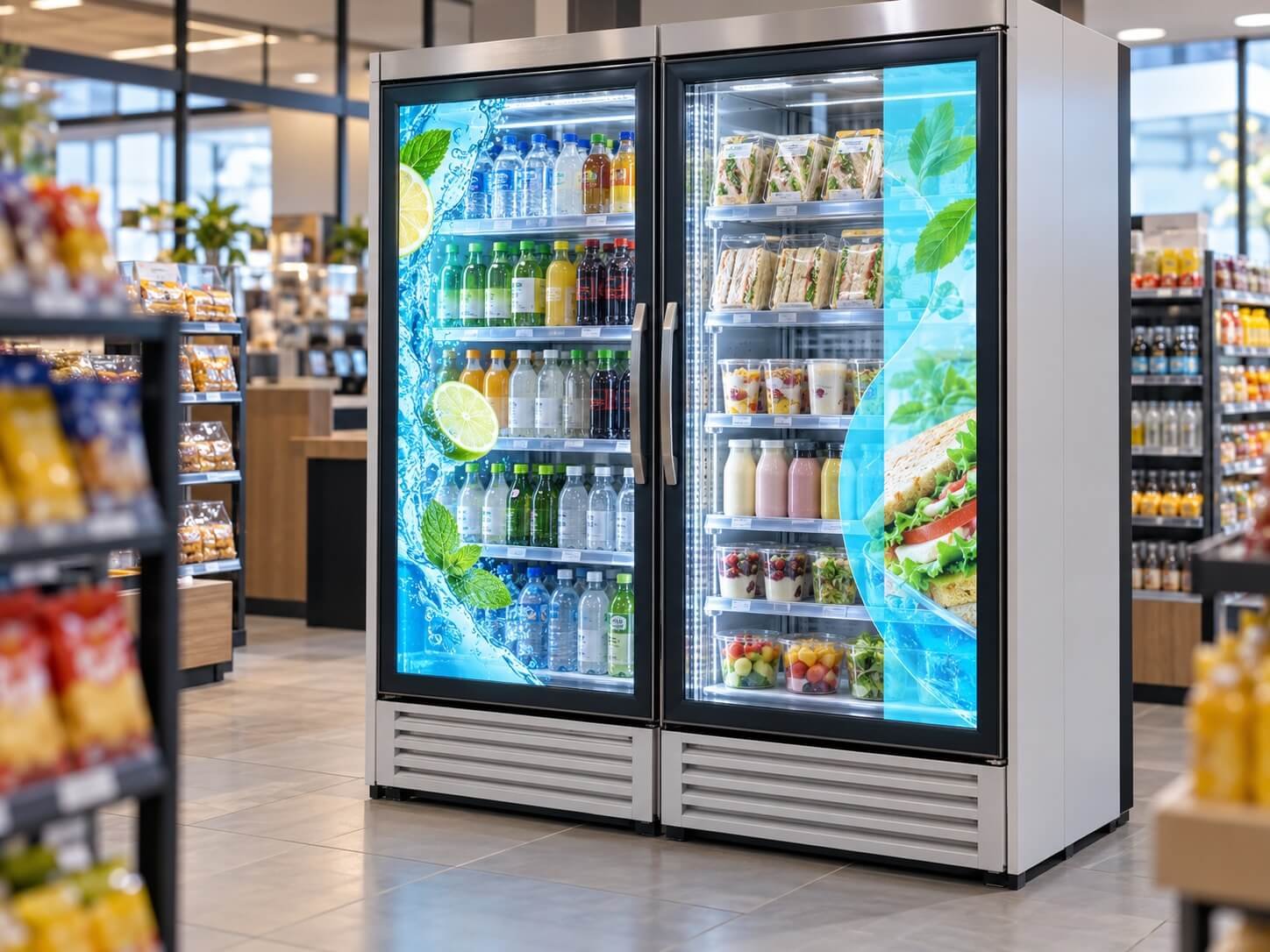
Transparent LCD beverage cooler for convenience-store point of sale

Scenario 1: Convenience Stores & Petrol Stations

The Application:
Transparent LCD cooler doors can be used in compact beverage refrigerators placed in convenience stores, petrol stations and other high-traffic retail areas.

The Value:
They keep drinks visible while adding digital promotions, brand videos, product highlights or seasonal campaign content directly to the front display surface.

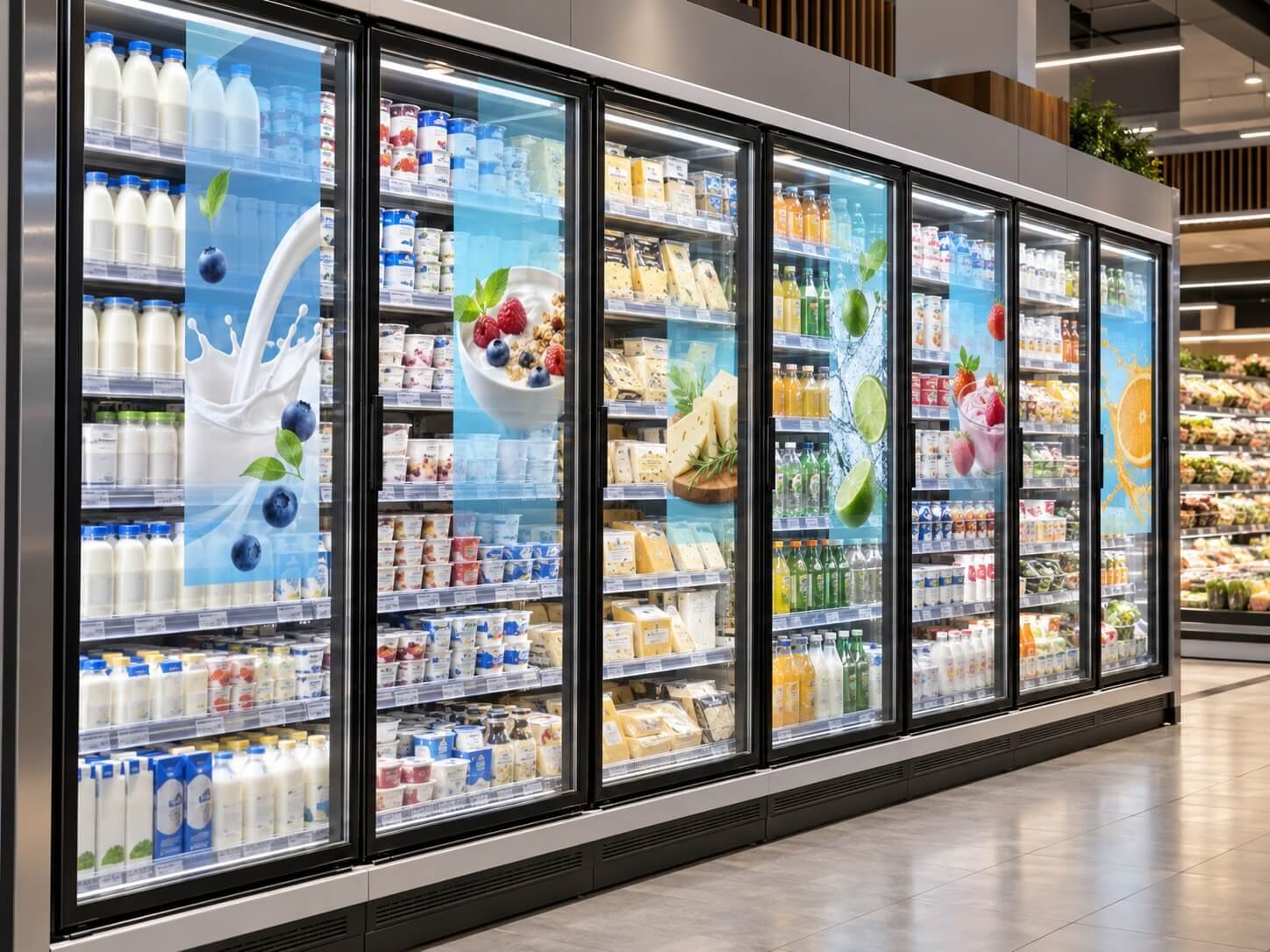
Transparent LCD refrigerator digital wall for supermarket DOOH advertising

Scenario 2: Supermarkets & Grocery Chains

The Application:
Transparent LCD refrigerator displays can be applied to beverage aisles, cold-chain display areas and branded cooler sections in supermarkets.

The Value:
They help upgrade ordinary refrigeration doors into digital promotion surfaces while still allowing customers to see the products inside.

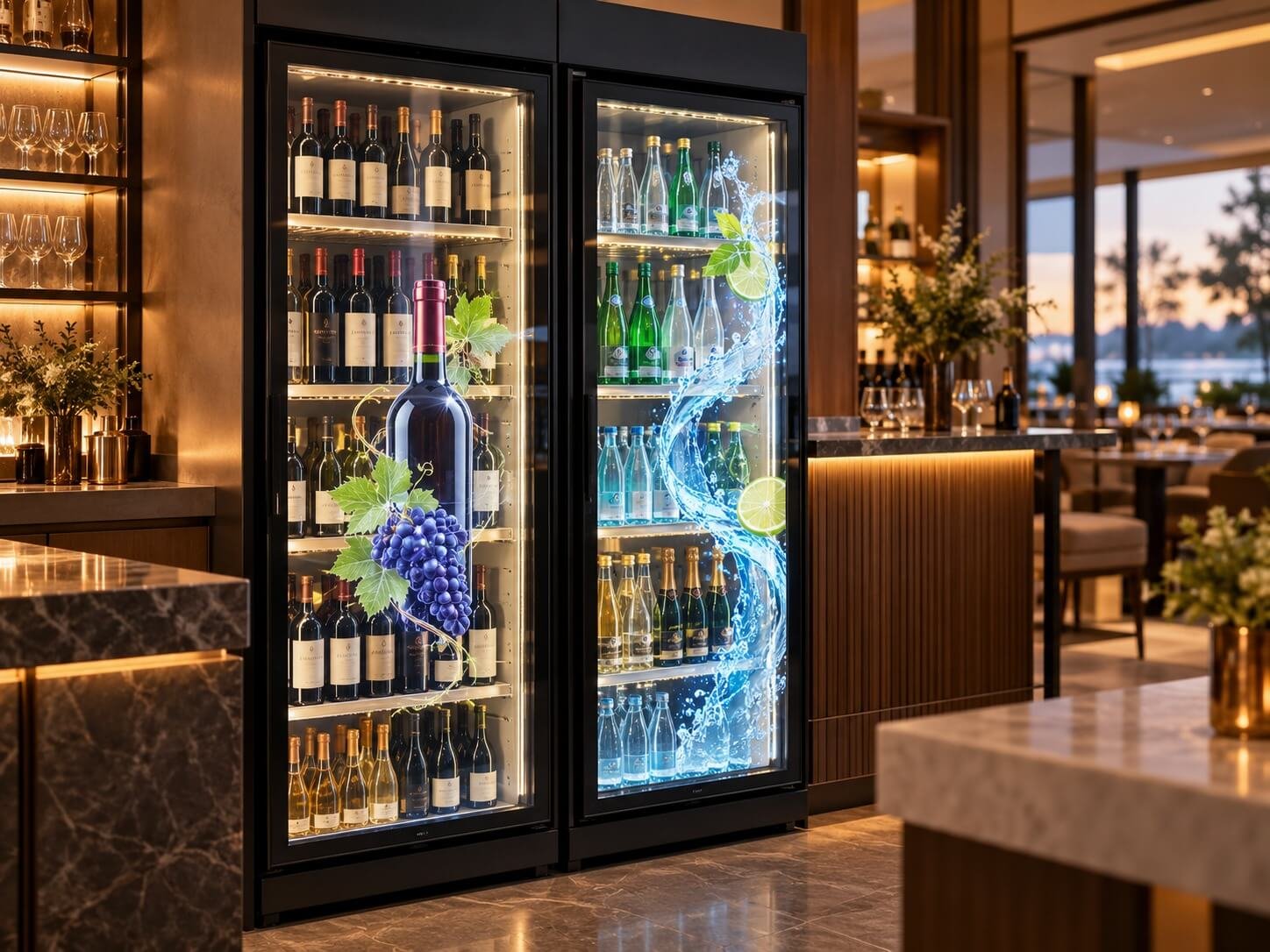
Transparent LCD refrigerator door on a champagne cooler in a VIP bar

Scenario 3: Champagne Coolers & VIP Bars

The Application:
Transparent LCD doors can be integrated into wine and champagne coolers used in hotels, clubs, VIP lounges, restaurants and premium branded hospitality spaces.

The Value:
They combine a clear view of the bottles with brand films, product stories, tasting information and event campaigns for a more premium presentation.

Transparent LCD refrigerator display on a dry-aging meat cabinet

Scenario 4: Dry-Aging & Specialty Food Cabinets

The Application:
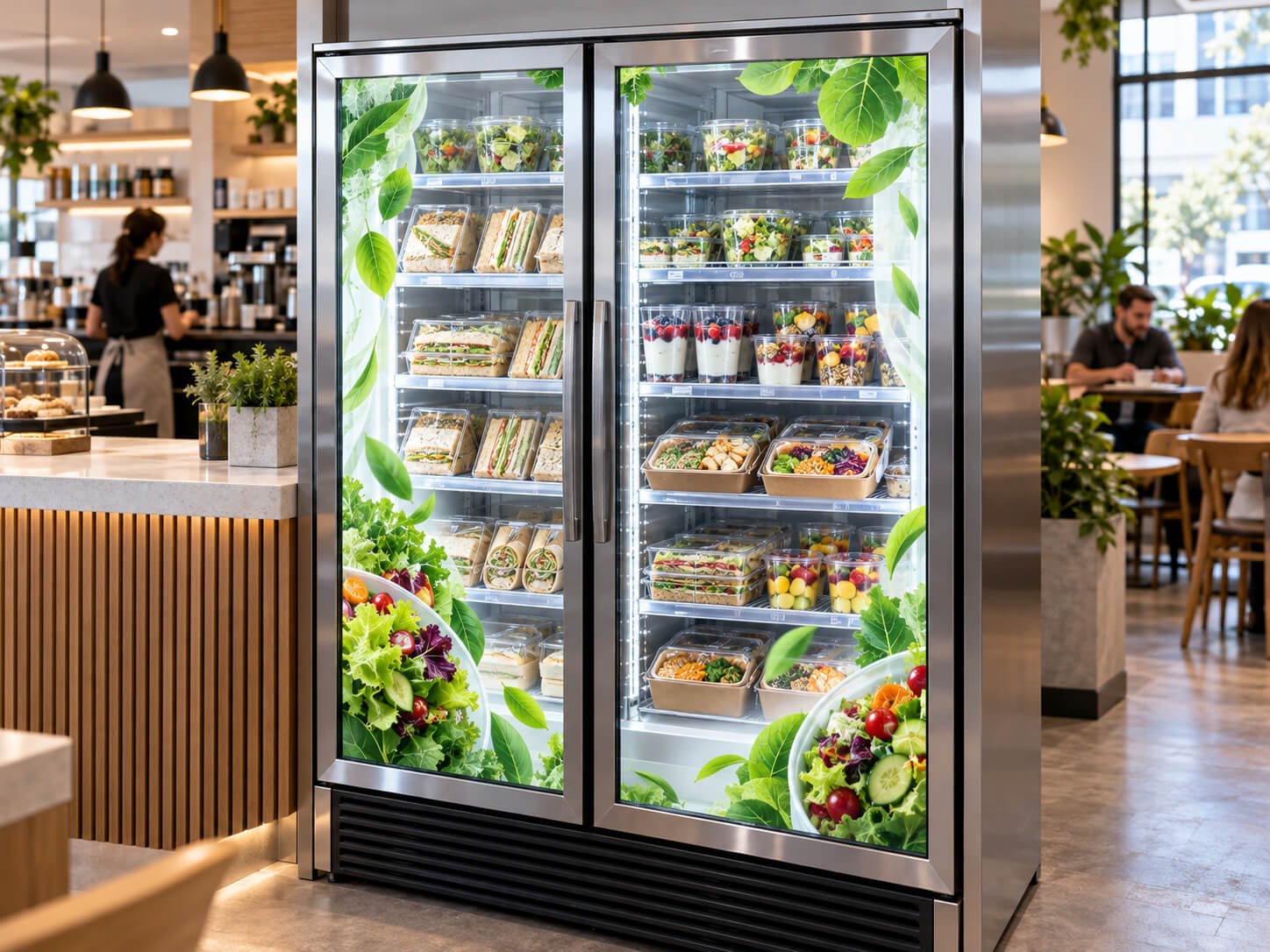
Transparent LCD refrigerator doors can be used on dry-aging meat cabinets, fresh-food showcases and specialty refrigerated displays.

The Value:
They allow customers to inspect the real food while the glass displays origin, aging time, preparation details, brand information and promotional content.

Critical Refrigerator-Door Engineering

Anti-Condensation Heating: How We Reduce Condensation on the Display Door

Condensation is one of the first questions in almost every refrigerated transparent LCD project. A temperature difference between the cold cabinet and the warmer, humid surrounding air can bring the glass surface below the dew point, allowing water vapor to condense into droplets.

Why It Happens

Cold Glass Meets Humid Air

Condensation risk increases when the door surface becomes colder than the surrounding air’s dew point. High ambient humidity, low cabinet temperature and frequent door opening can all make the problem more severe.

How It Is Controlled

Heating Film Raises Surface Temperature

An anti-condensation heating film can be integrated into the glass assembly to warm the relevant surface and reduce the chance of moisture forming. The heating voltage, power and heated area are selected around the door design and operating environment.

Complete-System Review

Heating Is Important—but Not the Only Factor

Effective condensation control also depends on insulated-glass construction, sealing, thermal bridges, cabinet temperature, ambient temperature and humidity, airflow, door-opening frequency and installation quality.

Important: an anti-condensation heater should not be treated as a universal guarantee that condensation can never occur. The complete refrigerator door and its real operating conditions must be reviewed before the heating specification is confirmed.
Information neededWhy it affects condensation control
Internal cabinet temperatureDetermines the temperature difference across the door assembly.
Ambient temperature and relative humidityDetermine the surrounding-air dew point and surface-temperature target.
Refrigerator, cooler or freezer applicationLower-temperature applications normally require a more demanding thermal review.
Door-opening frequency and airflowFrequent warm-air exchange can increase moisture exposure.
Glass layers, thickness, spacer and sealingInfluence insulation performance, edge temperatures and thermal bridging.
Available voltage and control methodDefine how the heating film is powered and whether thermostatic or system control is required.
Current 55-inch engineering example: the revised concept uses a 24 VAC, 24 W anti-condensation heating film. This is a project-specific configuration, not a fixed specification for every refrigerator door.
System, Not Just a Panel

What Is a Transparent Refrigerator Display Solution?

A transparent LCD becomes part of the refrigerator door or cabinet front. It shows videos, product information and brand content while allowing customers to see the refrigerated products behind the screen.

The visible result depends on the complete optical and mechanical system: transparent LCD, lighting, insulated glass, frame, controller, power supply, cable routing, temperature and condensation management.

Core Principle

Display + Lighting + Door + Control

A transparent LCD does not emit light by itself. Controlled light behind the panel is essential. A good-looking screen cannot compensate for an unsuitable door, poor lighting or unmanaged condensation.

Every retrofit begins with the existing door structure—not only the visible opening.
Project Fit

Who Is This Solution For?

Custom door engineering is most economical for manufacturers, integrators and repeat-volume projects. One-off buyers normally benefit from a ready-made refrigerator display.

Cooler & Refrigerator Manufacturers

Develop a new transparent-display door or add a digital option to an existing commercial refrigeration platform.

Vending & Smart-Retail Companies

Integrate a transparent media surface while keeping vending control, payment and dispensing functions in the host machine.

Beverage Brands & Retail Integrators

Build repeatable promotional cooler deployments for convenience stores, supermarkets, bars and branded retail spaces.

Only need one or two units? A ready-made complete cabinet is usually faster and more economical. Existing-door modification makes more sense when the structure will be repeated across a meaningful quantity.
Engineering Workflow

How an Existing Refrigerator Door Is Converted

The visible glass area is only the starting point. The internal glass, frame cavity, fixing method and electronics space determine whether the conversion is feasible.

Door Data Collection

Provide the full door drawing, visible opening, actual internal glass size, glass thickness, frame cross-section and fixing method.

Display & Optical Layout

Match the active area to the door, then define internal lighting, silk-screen borders, product visibility and optional touch.

Condensation & Thermal Review

Confirm internal temperature, ambient temperature and humidity, dew-point risk, insulated-glass structure, heating-film specification, sealing and airflow.

Electronics & Cabling

Reserve locations for the controller and power supply; define cable outlet, cable type, length and maintenance access.

Drawing Confirmation

The customer and door manufacturer check overall size, tolerance, orientation, installation clearance and interface details.

Prototype Validation

Build and test a prototype before volume production, including image quality, lighting, condensation control and installation.

Manufacturer Readiness Check

Can Your Refrigerator Platform Accept a Custom Transparent LCD Door?

An existing-door conversion is not a simple screen replacement. The refrigerator manufacturer must be able to change the door dimensions, glass assembly, frame load, cable path, electronics space and system interface around the final engineered design.

Door Structure

Width and Thickness Must Be Adjustable

The final door outline follows the actual LCD, insulated glass, frame and cable structure. The refrigerator manufacturer must be able to adjust the door width instead of forcing the new display assembly into an unchanged standard frame.

Based on our practical projects, a non-touch transparent LCD insulated-glass assembly commonly requires approximately 30 mm total thickness. This is a useful planning reference—not a universal fixed dimension. Touch, glass construction, heating and frame design can change the final thickness.

Tolerance & Installation

Use Controlled Negative Tolerance

For the final glass outline, we normally use a controlled negative tolerance, such as +0 / −1.0 mm where appropriate, to reduce the risk that the assembly is too large to enter the door frame.

The exact tolerance must still be agreed with the glass processor and door manufacturer. It must allow installation without creating excessive clearance, loose fixing or sealing problems.

Load Capacity

The Door Is Heavier Than Ordinary Glass

The transparent LCD door assembly includes additional glass, LCD, heating, lighting, frame parts and cables. It is normally heavier than a conventional refrigerator glass door.

The hinges, frame, rollers or sliding structure, opening mechanism and long-term door alignment must be checked for the calculated finished weight—not only the original glass weight.

Top-Side Space

Reserve Space for Cables and Electronics

Our door designs commonly route the LVDS, heating and LED-lighting cables through a top outlet. The refrigerator structure must provide sufficient clearance above the glass for cable bending, strain relief, connectors and service access.

Space must also be reserved for the external LCD controller board, power supply and related electronics. These parts may be mounted externally above or inside the host machine rather than sealed inside the glass.

Optical Environment

A White Interior Improves Reflected Light

The inside of the refrigerator should use a white or highly reflective finish wherever practical. It reflects and redistributes the internal LED light, improving brightness uniformity and helping products and digital content remain visible.

Dark interior panels absorb light and can make the transparent LCD appear dimmer or less uniform, even when the same display and light bars are used.

Customer-Side System Integration

DisplayMan Is the Display Supplier—not the System Integrator

DisplayMan supplies the Transparent LCD Refrigerator Display, including the transparent LCD assembly and its matching LCD driver board. We can provide display-side specifications, interface information and reasonable technical coordination.

The customer, refrigerator manufacturer or appointed system integrator is responsible for integrating the display into the complete machine. This includes the host controller, software, content system, communication, power distribution, mechanical installation, wiring, custom user interface and complete-system validation.

Voltage and current can usually be accommodated and are rarely the main obstacle. Mechanical integration, thermal performance, electronics placement and host-system compatibility are normally the harder customer-side engineering work.

Who should undertake this conversion? Custom existing-door development is intended for refrigerator or vending-machine manufacturers and experienced engineering integrators that can modify the door platform, integrate the supplied display and validate the complete machine. DisplayMan does not act as the customer’s complete-system integrator. A buyer without door-structure, refrigeration and system-integration capability will normally be better served by a ready-made complete cabinet.
Project-Specific Lighting

LED Light Bars Are Designed Around the Project

The LED light-bar length, quantity, placement, optical distribution and working brightness are not one fixed specification. They are selected according to the LCD size, cabinet depth, interior reflectivity, product layout and target viewing environment.

A display brightness of approximately 500 nits is sufficient for many indoor refrigerator and retail applications, but it should be treated as a practical reference rather than a mandatory value for every project.

What Determines the Lighting Design?

  • Transparent LCD size and transmission
  • Door and cabinet dimensions
  • White reflective interior surfaces
  • Product position and shelf layout
  • Ambient store lighting
  • Required image uniformity and visual effect
  • Available thermal and electrical capacity
More electrical power does not automatically produce a better display. Light distribution, reflection, heat and visual uniformity must be balanced.
Real Engineering Example

55-Inch Vending-Machine Door Retrofit — Engineering Case in Progress

This anonymized example shows why a transparent refrigerator display must be developed as a complete door system. The project is still under engineering confirmation; the customer has not signed the latest drawing.

Current revision — not yet approved

The Starting Requirement

  • Existing vending-machine door with an approximately 780 × 1220 mm visible area
  • 55-inch portrait transparent LCD
  • Refrigerated operating environment
  • Non-touch display
  • Display-side controller only; vending logic remains in the customer’s host system
Engineering lesson: the visible area alone was not enough. The full door drawing and internal glass structure were required.

What Had to Be Clarified

  • Actual glass size inside the frame
  • Total insulated-glass thickness and tolerance
  • Glass fixing and door-frame clearance
  • Controller and power-supply mounting space
  • LVDS, heating and LED cable length
  • Top cable-outlet diameter and position
  • Anti-condensation heating
  • Permanent FRONT and TOP orientation marks

Current Revised Concept

ItemCurrent project specificationStatus
Transparent LCD55-inch portrait; active area approximately 680.4 × 1209.6 mm; non-touchConfirmed in current discussion
Insulated glass outline840.5 × 1266 mmDoor manufacturer must verify fit
Total thickness30 mmDoor manufacturer must verify fit
Glass tolerance+0 / −1.0 mmShown on current drawing
Cable outletØ15 mm at the top; 19 mm from the referenced edgeShown on current drawing
External electronicsLCD controller board and power supply installed outside the insulated-glass assemblyCurrent revised architecture
Cable reservationLVDS, heating and LED cables routed through the top outlet; approximately 1.5–1.8 mInstallation space still project-dependent
Anti-condensation heating24 VAC, 24 WCurrent project configuration
Internal LED lightingTwo project-specific 670 mm light bars; actual working power 49.2 W each, 98.4 W totalSpecific to this design; not a universal lighting specification
Orientation markingTOP at upper center and FRONT at lower right; double-layer silk-screen marking hidden by the final frameAdded to current revision
Final approvalCustomer signature and door-manufacturer confirmationPending
Why this case matters: glass size, lighting, heating, electronics placement and installation orientation changed as the design developed. These details should be resolved on the drawing before production—not at the installation site.
Two Practical Starting Points

Buy a Complete Unit or Develop a Custom Door?

Fastest for 1–2 Units

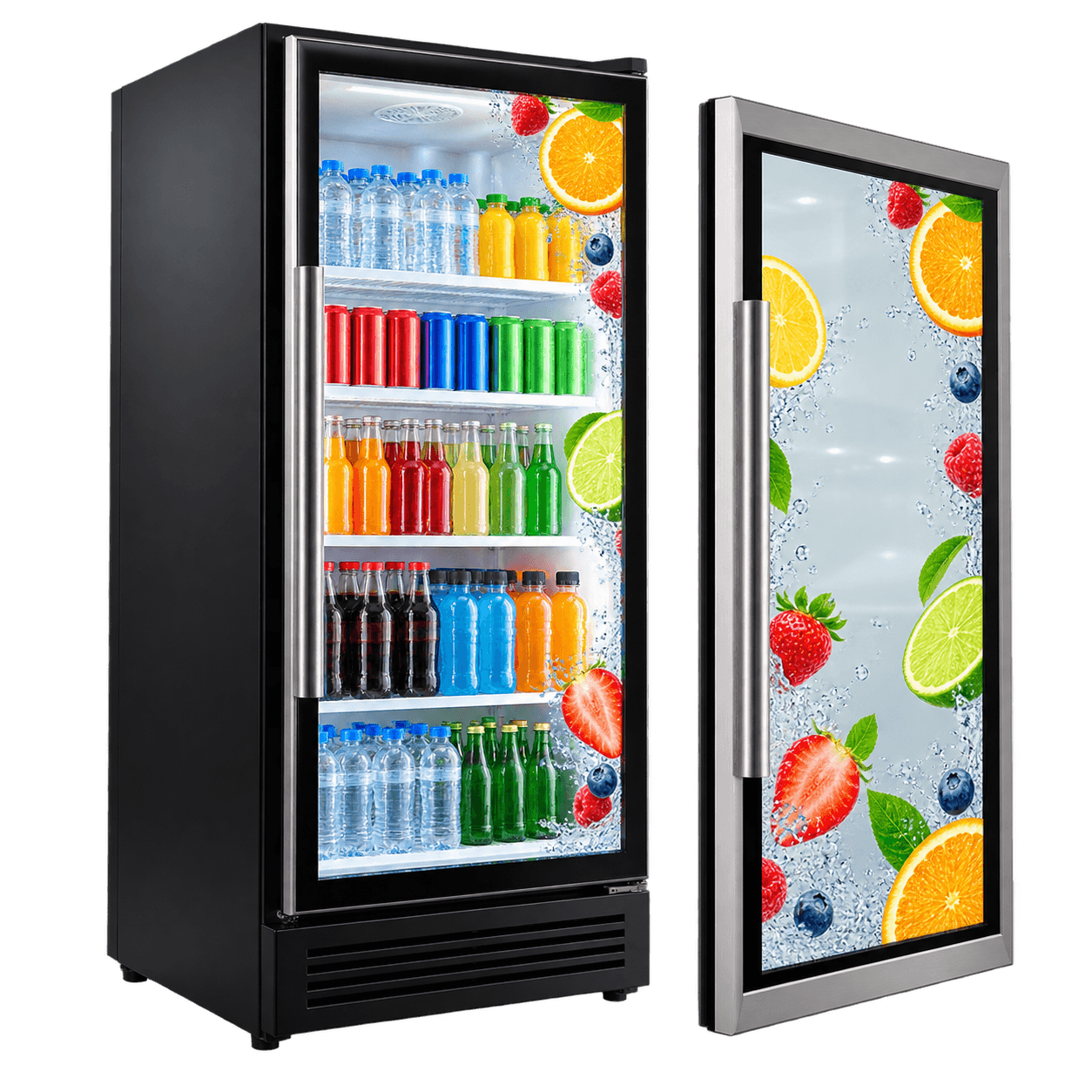
Ready-Made Transparent LCD Refrigerator Display

Choose a finished unit when you need a small quantity, a showroom sample or a quick retail installation. It avoids the engineering cost of adapting a unique existing door.

  • Faster evaluation and deployment
  • Known cabinet, lighting and display structure
  • Lower development risk for a one-off purchase

View the product page →

Best for Repeat Volume

Custom Existing-Door Integration

Choose custom integration when you manufacture refrigerators or vending machines, or when one door platform will be repeated across a larger program.

  • Designed around the customer’s door platform
  • Lower unit cost once engineering is amortized over volume
  • Door assemblies can be shipped more efficiently than complete cabinets
Complete System

Key Components and Responsibilities

ComponentFunctionProject question
Transparent LCD panelDisplays content while preserving a view of the productsWhich available panel best fits the door opening?
Internal lightingProject-specific LED light bars provide the light required for visible LCD imagesAre length, position, brightness and distribution suitable for the cabinet?
Insulated glass and frameProtect the panel and maintain the refrigerator-door structureCan the thickness, tolerance and weight fit the original frame?
Heating filmReduces condensation risk on refrigerated applicationsWhere is heating required and how is it powered?
Controller and media sourceDrive the LCD and deliver advertising contentHDMI, Android player or customer host system?
Power supply and wiringPower the LCD, lighting and heating systemWhere can electronics be mounted and serviced?
Optional touch panelAdds interaction when requiredDoes touch justify the added glass, control and software complexity?
Technology Selection

Transparent LCD vs Transparent LED Film vs Digital Signage

All three can promote refrigerated products, but they solve different problems.

ComparisonTransparent LCD Refrigerator DisplayTransparent LED Flexible Film ScreenDigital Signage
Basic principleTransparent LCD, lighting and glass are engineered into the refrigerator doorSelf-adhesive transparent LED film is applied to suitable existing glassAn opaque LCD or LED display is mounted near the refrigerated product area
Product visibilityHigh visual integration: content overlays the visible productProducts remain visible, but LED lines and pixels can be noticeableThe screen blocks whatever sits directly behind it
Close-view imageBest of the three for detailed, close-view refrigerator-door contentCommon pitches such as P3.91 are visibly coarse at short distanceStrong, conventional high-resolution image
Retrofit difficultyHighest; door, lighting, glass, heating and electronics need engineeringLowest transparent retrofit effort if the glass and environment are suitableSimple independent installation; no door conversion
CostHighest, but delivers the most integrated premium resultLower-cost transparent shortcutUsually the most economical reliable advertising option
Best choice whenThe door itself must become a premium transparent media surfaceBudget and easy installation matter more than close-view image qualityClear advertising content matters more than transparency
Selection principle: Transparent LCD provides the strongest integrated refrigerator-door experience. LED film is a simple retrofit option with a clear resolution trade-off. Conventional digital signage remains the practical choice when transparency is unnecessary.
Supply and Responsibility Boundary

Transparent LCD Display Supply Is Not Complete-System Integration

The responsibility boundary should be agreed before custom drawing and prototype development begin.

DisplayMan Supplies

The Transparent Display Side

  • Transparent LCD refrigerator display assembly
  • Matching LCD driver board
  • Project-specific LED lighting and anti-condensation components when included in the agreed display-door design
  • Display-side specifications and interface information
  • Display-side drawing and reasonable technical coordination

View Transparent LCD Vending Machine Display →

Customer / Integrator Supplies

The Complete Refrigerator or Vending System

  • Refrigerator or vending-machine host controller
  • System software and custom user interface
  • Payment, inventory, dispensing and machine-management functions
  • MDB, RS-485, UART or other machine communication
  • Power distribution, wiring and final installation
  • Mechanical, refrigeration, safety and complete-system validation
A matching LCD driver board only drives the transparent LCD. It is not a refrigerator controller, vending-machine controller or complete system-integration service.
RFQ Checklist

Information Required Before a Custom Drawing

Door, Glass & Load

  • Full door drawing
  • Visible opening and actual internal glass size
  • Glass thickness and construction
  • Frame cross-section and fixing method
  • Allowable door width and thickness changes
  • Hinge, frame or mechanism load capacity

Environment & Condensation

  • Cooler, refrigerator or freezer
  • Internal cabinet temperature
  • Ambient temperature and relative humidity
  • Door-opening frequency and airflow
  • Existing condensation conditions
  • Available heating voltage and control

Electronics & Customer System

  • Top cable outlet, bending space and path
  • Controller and power-supply mounting space
  • Required cable length and service access
  • Required LCD signal input
  • Customer-integrator plan for host compatibility, content control and custom interface
  • Prototype and volume quantity
Send the complete door drawing whenever possible. A visible-area measurement cannot establish total glass size, thickness, fixing details or electronics clearance.
FAQ

Transparent Refrigerator Display Questions

Can a transparent LCD be fitted to an existing refrigerator door?

Yes, when the door structure has suitable space for the LCD, insulated glass, lighting, cables and electronics. The full door drawing and internal glass construction must be reviewed before confirmation.

Does the refrigerator manufacturer need to change the door?

Usually yes. A custom transparent LCD assembly may require changes to door width, total thickness, frame structure, load capacity, top cable clearance and electronics mounting space. The manufacturer must be able to adapt and validate the complete door platform.

Is 30 mm the fixed thickness for every transparent LCD refrigerator door?

No. Approximately 30 mm is a common practical reference for our non-touch insulated-glass projects. The final thickness depends on the LCD, glass layers, heating, frame, touch option and refrigerator structure.

Why do you use a negative glass-size tolerance?

A controlled negative tolerance helps prevent the finished glass assembly from being too large to enter the door frame. The exact tolerance must be agreed with the glass processor and refrigerator-door manufacturer so installation, fixing and sealing remain correct.

Is the LED lighting or display brightness fixed?

No. Light-bar length, quantity, placement and output are customized around the LCD, cabinet dimensions, white reflective interior, product layout and viewing environment. A resulting display brightness of around 500 nits is sufficient for many indoor applications, but it is not a universal fixed specification.

Why should the refrigerator interior be white?

A white or highly reflective interior redistributes the LED light and improves brightness uniformity. Dark interior surfaces absorb light and can reduce the visible transparent LCD effect.

Where are the controller board and cables installed?

Many designs use a top cable outlet and mount the controller board and power supply externally above or inside the host machine. The refrigerator must reserve enough space for cable bending, strain relief, board installation, cooling and service access.

Why is the visible glass size not enough for a custom drawing?

The visible opening does not show the glass hidden inside the frame, glass thickness, fixing method, frame cavity, cable path or electronics clearance. These details determine whether the new assembly will fit safely.

Can the display include touch?

Yes. Touch can be added when the application and glass structure support it. Many advertising coolers use non-touch playback because it is simpler and more economical.

Can you make single-, double- and multi-door systems?

Yes. The door count is customizable. The display and door structure of each project are reviewed according to the cabinet platform, required content layout and quantity.

Is a complete refrigerator available for a small order?

Yes. For one or two units, purchasing a ready-made complete transparent LCD refrigerator display is usually more economical than developing a custom replacement door.

When is existing-door customization economical?

It is most suitable for refrigerator or vending-machine manufacturers and repeat-volume programs. Engineering and tooling costs can then be distributed across more units, while door assemblies are easier to ship than complete cabinets.

Does the transparent LCD controller manage the vending machine?

No. The LCD controller drives the display. Payment, inventory, dispensing, machine errors and vending software must be managed by the customer’s vending-machine controller.

Does DisplayMan provide complete refrigerator or vending-machine system integration?

No. DisplayMan supplies the Transparent LCD Refrigerator Display and matching LCD driver board, together with display-side specifications and reasonable technical coordination. The customer, refrigerator manufacturer or appointed system integrator is responsible for the host controller, software, communication, power distribution, installation, custom user interface and complete-system validation.

How does the door prevent condensation?

An anti-condensation heating film can raise the relevant glass-surface temperature and reduce moisture formation. Its voltage, power and heated area must be matched to the door structure and operating environment. Insulated glass, sealing, thermal bridges, cabinet temperature, ambient humidity, airflow and door-opening frequency must also be reviewed.

Does a heating film guarantee that the glass will never condense?

No. Heating is a critical control measure, but condensation depends on the complete thermal system and real environmental conditions. Internal temperature, ambient temperature and humidity, glass construction, sealing, airflow and installation must be confirmed before the heating design is finalized.

Can transparent LED film be attached to an ordinary glass refrigerator door?

Potentially yes, if the glass surface, wiring and environment are suitable. Installation is easier, but common pixel pitches such as P3.91 can look coarse at close viewing distances.

Has the 55-inch engineering example been completed?

No. It is an ongoing engineering example. The latest drawing still requires customer signature and confirmation from the door manufacturer before production approval.

Qualified Refrigerator Display Projects

Start With the Door Structure and the Real Application

Send your door drawing, actual glass size, internal temperature, ambient temperature and humidity, condensation conditions, lighting arrangement, cable path, controller space, required quantity and project stage.

The most useful starting document is a complete refrigerator-door drawing—not only a measurement of the visible glass opening. Please also identify the refrigerator manufacturer or system integrator responsible for integrating the supplied display into the complete machine.

Send Your Display Requirement

Please share your application, display size, quantity and project background. We will review the most practical display direction.