
Explore custom touch panel glass for LCD, OLED and equipment interfaces. DisplayMan helps match the glass size, thickness, shape, printing and surface treatment to your touch sensor, display and enclosure.
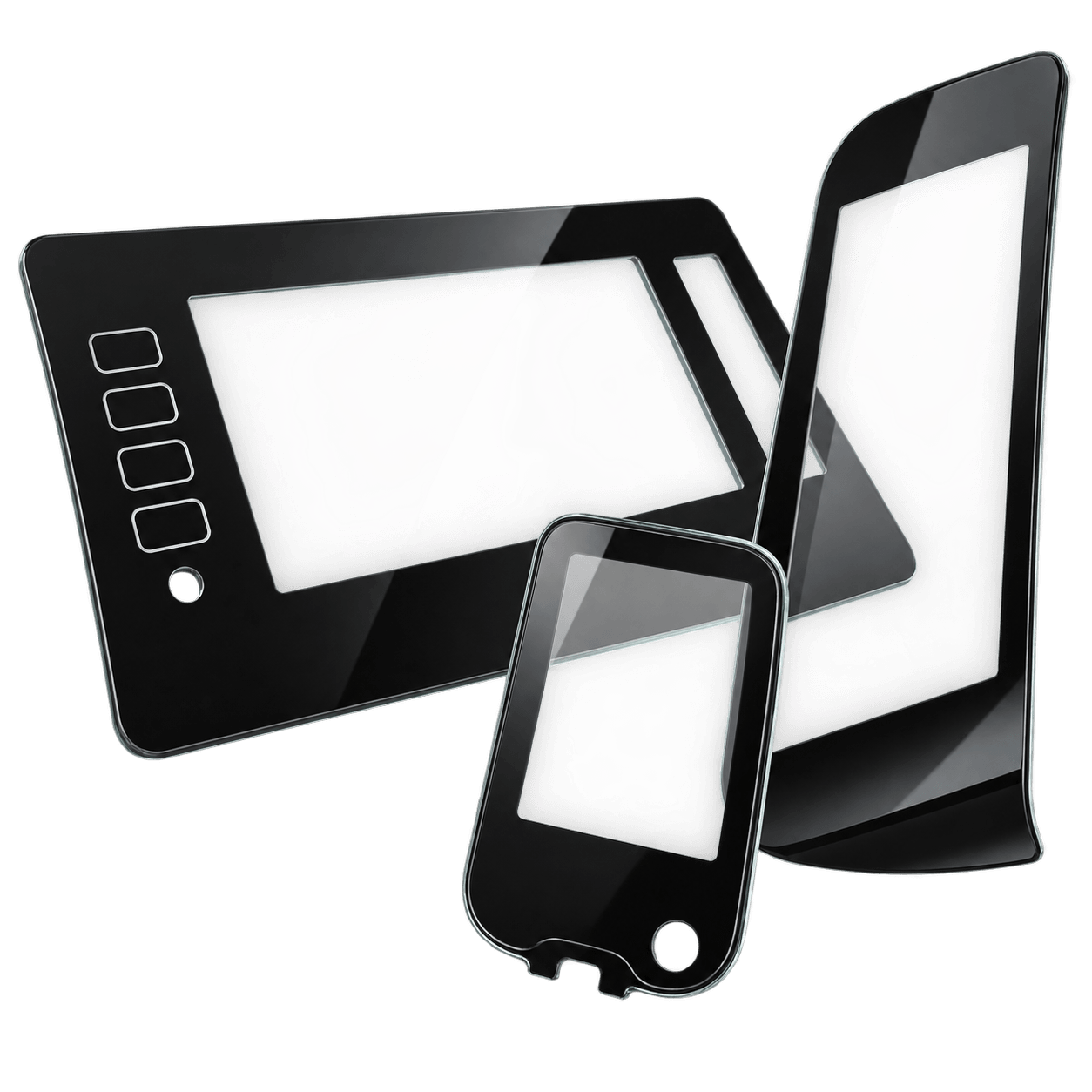
DisplayMan supplies Custom Touch Panel Glass for capacitive touch panels, resistive touch structures, TFT LCD modules, OLED displays, industrial control panels, medical devices, commercial terminals and OEM electronic products.
Custom Touch Panel Glass is the visible front cover glass or cover lens above the touch sensor or display module. It affects product appearance, mechanical protection, optical performance, touch sensitivity and final assembly.
Customization can include size, thickness, shape, edge treatment, holes, notches, printing, chemical strengthening, AG / AR / AF surface treatment and bonding with a touch panel or display module.
Choose Custom Touch Panel Glass when the project needs a customized front cover glass or cover lens. The glass itself does not provide touch sensing unless it is combined with a touch sensor, FPC and controller IC.
The correct direction depends on product appearance, glass strength, optical requirement, touch structure, display module, bonding and mechanical assembly.
| Product Direction | Best For | Selection Logic |
|---|---|---|
| Custom Cover Glass | Touch panels, TFT LCD, OLED and product front panels | Selected when the product needs a custom front-glass size, shape, thickness or mechanical outline |
| Printed Touch Panel Glass | Industrial panels, medical devices, smart controls and terminals | Selected when black border, logo, icons, button marks or multi-color printing is required |
| AG Touch Panel Glass | Bright-light, outdoor-facing and industrial environments | Selected when glare reduction is the main optical requirement |
| AR Touch Panel Glass | Premium displays and high-clarity optical applications | Selected when lower reflection and clearer display visibility are required |
| AF Touch Panel Glass | Public terminals, handheld products and frequent-touch surfaces | Selected when fingerprint resistance and easier cleaning are required |
| Chemically Strengthened Cover Glass | Industrial, medical, commercial and rugged products | Selected when higher surface strength and handling durability are required |
| Touch Glass for Capacitive Touch | PCAP touch-panel integration | Selected when cover glass must match touch sensitivity, sensor structure and controller IC |
| Touch Glass for Display Bonding | TFT LCD, OLED and custom display-module integration | Selected when the glass must match active area, viewing area, bonding and enclosure structure |
Custom Touch Panel Glass is the front glass part. It does not include a touch sensor, FPC, controller IC or touch interface unless these are separately integrated into a complete touch-panel assembly.
It defines the viewing window, black border, logo, icons and front-panel appearance.
It protects the touch sensor or display module from direct contact and handling.
Touch function requires a sensor, FPC, controller IC and host interface.
The cover glass defines the visible front surface, borders, windows, logo, icons and overall product style.
It protects the display or sensor from direct contact, scratches and product handling.
For PCAP projects, glass thickness, material, printing and bonding affect touch sensitivity and tuning.
AG, AR and AF treatments can improve glare, reflection and surface-maintenance performance.
Custom glass can match the enclosure, display area, bonding area, holes, notches and front-panel structure.
Printing can integrate logos, button marks, status windows, camera windows and decorative colors.
Glass thickness, hole position, edge distance, printing, bonding area, display opening and touch sensitivity cannot be designed independently.
| Glass Thickness | Typical Use | Engineering Note |
|---|---|---|
| 0.55 mm | Small touch panels and compact devices | Thin structure; strength and handling must be reviewed |
| 0.7 mm | Small and medium touch panels | Common compact-display direction |
| 1.0 mm | Project-based use | Balance thickness, strength and touch sensitivity |
| 1.1 mm | Common touch-panel and display-cover applications | General-purpose direction |
| 1.8 mm | Industrial and commercial front panels | Common stronger cover-glass direction |
| 2.0 mm | Products requiring increased strength | Touch sensitivity and edge processing must be reviewed |
| 3.0 mm | Rugged front-panel and protection-glass applications | Requires project-specific touch and mechanical review |
| 4.0 / 5.0 mm | Special heavy-duty front-glass projects | Requires suitable PCAP sensor, controller IC and tuning if touch is needed |
For PCAP projects, cover-glass thickness must be reviewed together with sensor pattern, controller IC, grounding, interference and required glove, water or stylus performance.
Reduces glare by diffusing strong reflections. Suitable for industrial panels, outdoor-facing displays and bright environments.
Reduces reflection and improves optical clarity, display visibility and premium appearance.
Reduces fingerprint marks and improves cleaning for frequent-touch products.
| Treatment | Main Purpose | Typical Application | Selection Note |
|---|---|---|---|
| AG | Reduce glare | Industrial, outdoor-facing and bright-light displays | Can slightly reduce perceived sharpness depending on haze |
| AR | Reduce reflection | Premium and high-clarity displays | Requires coating durability and optical review |
| AF | Reduce fingerprints | Public terminals and frequent-touch surfaces | Mainly improves surface maintenance |
| Combined Treatment | Balance multiple surface requirements | Project-based applications | AG + AF, AR + AF or other combinations require process review |
They are not separate touch technologies. They are optional surface processes applied to custom cover glass.
The printing design should align with the display active area, viewing area, touch area, sensor windows, bonding area and enclosure opening.
Cover glass is part of the PCAP touch-performance design and directly affects sensitivity and tuning.
Resistive touch uses pressure input, so the front structure must preserve pressure response and optical performance.
The cover glass should match the active area, viewing area, bezel, brightness and bonding method.
OLED integration requires careful review of visible area, module structure, bonding, heat and FPC location.
| Bonding Direction | Description | Main Review Factors |
|---|---|---|
| Air Bonding | Cover glass or touch assembly is mounted with an air gap | Cost, dust sealing, reflection, rework and mechanical support |
| Optical Bonding | Cover glass or touch assembly is bonded directly to the display | Optical clarity, bubbles, yield, sealing, material compatibility and rework |
| Frame Bonding | Adhesive is applied around the perimeter | Bonding width, flatness, dust control and enclosure pressure |
| Item | Custom Touch Panel Glass | Capacitive Touch Panel |
|---|---|---|
| Product Scope | Cover glass or front lens | Complete touch-sensor component |
| Touch Function | No touch function by itself | Detects capacitive touch |
| Main Parts | Glass, printing, coating and edge treatment | Cover glass, sensor, FPC and controller IC |
| Main Engineering Focus | Appearance, strength, optical surface and mechanical fit | Touch sensitivity, sensor, IC, FPC and interface |
| Best For | Customers needing customized front glass | Customers needing complete touch sensing |
| Selection Logic | Choose when only the front glass is needed | Choose when touch input is required |
| Item | Main Purpose | Relationship |
|---|---|---|
| Custom Touch Panel Glass | Custom size, shape, thickness, printing and structure | Main cover-glass product direction |
| AG Cover Glass | Reduce glare | Optional surface-treatment direction |
| AR Cover Glass | Reduce reflection | Optional surface-treatment direction |
| AF Cover Glass | Reduce fingerprints | Optional surface-treatment direction |
| Factor | Custom Touch Panel Glass | General Protection Glass |
|---|---|---|
| Main Purpose | Front-lens integration with touch or display | General mechanical protection |
| Printing | Usually includes border, window, logo or icons | May be plain or minimally printed |
| Touch Review | Must consider touch sensitivity when used with PCAP | May not be designed for touch operation |
| Display Alignment | Viewing area and active area must be matched precisely | May only cover the general display opening |
| Bonding | Air, frame or optical bonding may be required | Often mechanically mounted |
| Selection Logic | Choose for integrated product front-panel design | Choose for general protection only |
Custom front glass, black border, icons and rugged display integration.
Cleanable cover lens, printing, touch integration and display protection.
Frequent-touch front glass with printing and AF treatment.
Decorative black-panel appearance, icons and capacitive touch integration.
Custom windows, logos, buttons and mechanical enclosure matching.
Outdoor-facing glass, AG treatment, printing and rugged mounting.
Custom outlines, strengthened glass and environmental integration.
Custom viewing window, bonding and mechanical protection.
Matching original size, thickness, printing, holes, coating and assembly.
Cover glass only, PCAP integration, resistive structure, TFT LCD or OLED bonding.
Outer dimensions, thickness, viewing window, holes, notches, radii and tolerances.
Black border, logo, icons, AG, AR, AF and optical requirements.
Active area, sensor structure, controller IC, display model and enclosure opening.
Air, frame or optical bonding, support structure and assembly method.
Check printing, fit, flatness, strength, optics, touch sensitivity and assembly.
The correct product route depends on whether the project needs only front glass, a complete touch sensor, a touch-integrated display module or a complete terminal.
| Project Requirement | Recommended Product Direction |
|---|---|
| Main touch-component and cover-glass selection | Custom Touch Panels & Cover Glass |
| Cover glass only | Custom Touch Panel Glass |
| PCAP sensor, FPC and controller IC | Capacitive Touch Panels |
| Pressure touch or legacy replacement | Resistive Touch Panels |
| Large-format commercial touch | Infrared Touch Frames |
| TFT LCD module with touch integrated | Touch Screen TFT LCD Displays |
| Touch-to-display optical bonding | Optical Bonding Display Solution |
| Complete industrial touch computer | Industrial Panel PCs & Rugged Terminals |
It should show outer dimensions, viewing window, printing, holes, notches, corner radii, edge treatment, bonding areas and dimensional tolerances.
Custom Touch Panel Glass is the front cover glass or cover lens used above a touch panel or display module. It can be customized for size, shape, thickness, printing, coating, holes, notches and mechanical fit.
No. Cover glass does not detect touch by itself. Touch function requires a touch sensor, FPC and controller IC, especially for projected capacitive touch panels.
It may also be called cover glass, cover lens, front glass, touch cover glass, protective glass or display cover glass.
Yes. Outer dimensions, corner radius, curved edges, notches, holes, camera windows, sensor windows and special CNC outlines can be reviewed according to the drawing.
Yes. Black or white borders, logos, icons, button marks, indicator windows and multi-color back-side printing can be reviewed.
Yes. Chemical strengthening can be reviewed when higher surface strength and better handling resistance are required.
Common project directions include 0.55, 0.7, 1.0, 1.1, 1.8, 2.0, 3.0, 4.0 and 5.0 mm. Final feasibility depends on size, shape, holes, strength, touch sensitivity and quantity.
It can be reviewed, but thicker glass can reduce touch sensitivity. The cover glass, sensor design, controller IC, grounding and touch tuning must be reviewed together.
AG means anti-glare. It reduces glare by diffusing strong surface reflections and is often used in industrial, outdoor-facing and bright-light environments.
AR means anti-reflective. It reduces reflection and improves optical clarity and display visibility.
AF means anti-fingerprint. It reduces fingerprint marks and makes the glass easier to clean.
Selected combinations such as AG plus AF or AR plus AF can be reviewed. Final feasibility depends on glass material, coating process, optical target, durability and application environment.
Yes. Cover glass can be integrated with a capacitive touch sensor, but thickness, printing, sensor design, controller IC, glove, water, stylus and interference requirements must be reviewed together.
Selected front-layer or support structures can be reviewed, but resistive touch uses pressure operation and a flexible touch surface. The cover structure must not block pressure response.
Yes. The glass can be air bonded or optically bonded with a TFT LCD according to optical, mechanical, environmental and cost requirements.
Yes. Selected OLED and transparent OLED modules can be reviewed with custom cover glass, subject to module structure, optical area, bonding, heat, FPC and mechanical tolerances.
Cover glass is the front protection and appearance layer. A capacitive touch panel is a complete touch component that normally includes cover glass, touch sensor, FPC and controller IC.
Yes. Please provide the original glass sample, front and back photos, 2D drawing, dimensions, thickness, printing, holes, coating, bonding structure and product assembly photos.
A complete 2D drawing is the most important document. It should show outer dimensions, viewing window, printing, holes, notches, corner radii, edge treatment, tolerances and bonding areas.
Please provide glass size, thickness, 2D drawing, viewing window, active display area, touch active area, holes, notches, corner radius, edge treatment, strengthening, printing, AG, AR or AF requirement, bonding method, matched display or touch panel, enclosure drawing, environment, quantity and replacement sample if available.
Send us the glass size, thickness, 2D drawing, viewing window, holes, notches, printing, strengthening, AG / AR / AF requirement, bonding method, matched display or touch panel, quantity and schedule.
DisplayMan will review whether you need only custom cover glass or a complete Capacitive Touch Panel, Resistive Touch Panel, Touch Screen TFT LCD module or another display-integration structure.
Custom Touch Panel Glass is the front cover glass or cover lens. It does not include touch sensing by itself. Final feasibility depends on the complete glass, touch, display, bonding, enclosure and production structure.