Outdoor Fine Pitch LED Displays

Engineered by the Manufacturer for Real Outdoor Environments

Purpose-built outdoor small-pitch LED displays designed for high brightness, environmental durability, and long-term outdoor operation.

As a manufacturer, DisplayMan delivers outdoor LED display systems engineered to perform reliably under direct sunlight, heat, rain, and continuous operation, where visibility and stability are critical.

Key highlights

outdoor aluminum cabinet led display back view

Outdoor Fine Pitch LED is not a single fixed-format product. The final display is selected according to viewing distance, screen size, sunlight exposure, installation height, content type and supporting structure.

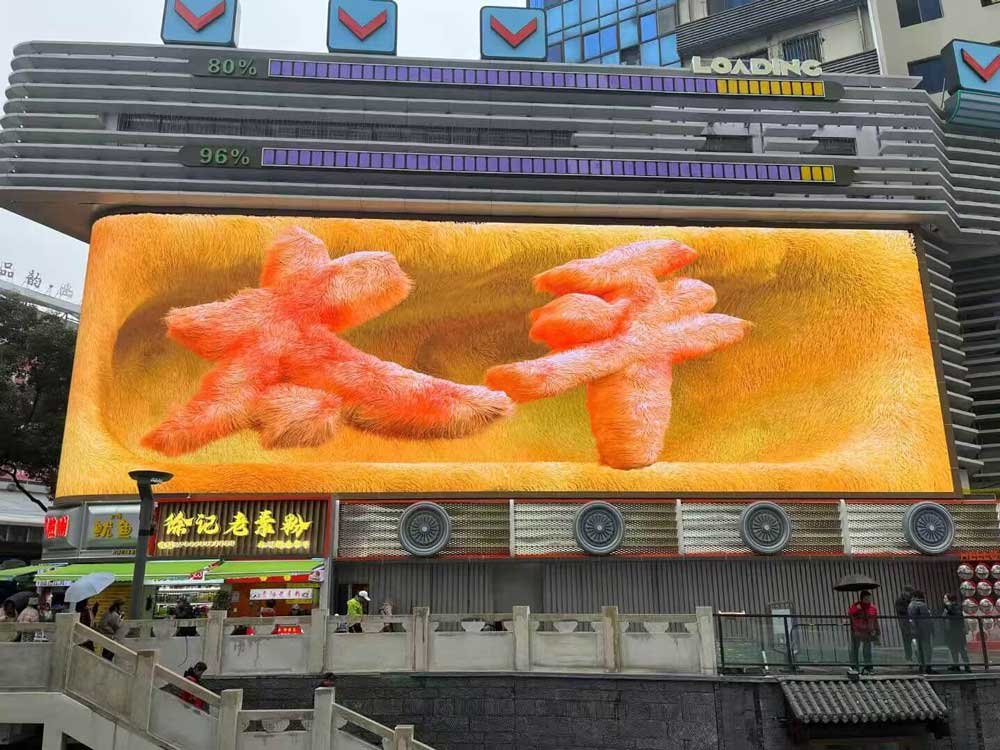
The examples below illustrate typical outdoor LED applications ranging from close-view retail façades and pedestrian areas to commercial buildings, urban media walls, public information displays and large-format DOOH billboards.

For close pedestrian viewing, P2, P2.5 and P3 are commonly reviewed when finer image detail is important. As screen size and viewing distance increase, P4, P5, P6, P8 and P10 often become more practical and cost-efficient.

These images are representative application references. Final pixel pitch, brightness, cabinet configuration and installation structure should be confirmed according to the actual project environment.

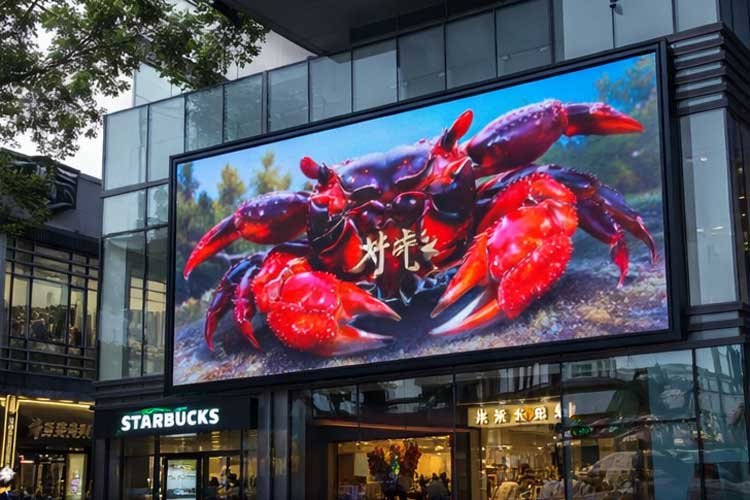
Premium Retail Façade & Storefront LED Display

High-brightness outdoor LED displays can transform retail façades and storefronts into large digital advertising surfaces while remaining clearly visible in strong ambient light.

For pedestrian-level installations where viewers are relatively close, P2.5, P3 or P4 are commonly reviewed to balance image detail, brightness and project cost.

Typical applications include flagship stores, shopping centers, commercial entrances and street-facing retail advertising.

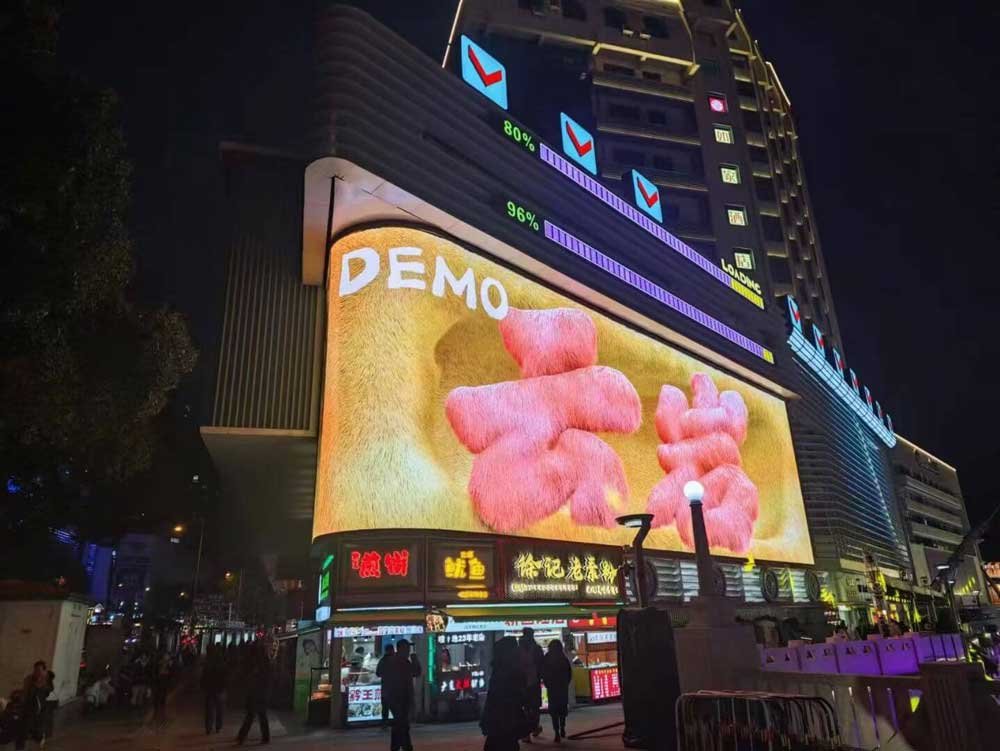
Commercial Building & Corner Façade LED Display

Outdoor LED can be integrated into building façades, architectural corners and high-traffic commercial streets to create large-format urban media surfaces.

These projects require more than pixel-pitch selection. Viewing angles, cabinet layout, steel structure, wind load, maintenance access and cable routing should all be reviewed together.

P3–P5 is often a practical direction for commercial façades where viewers approach the display from multiple distances and angles.

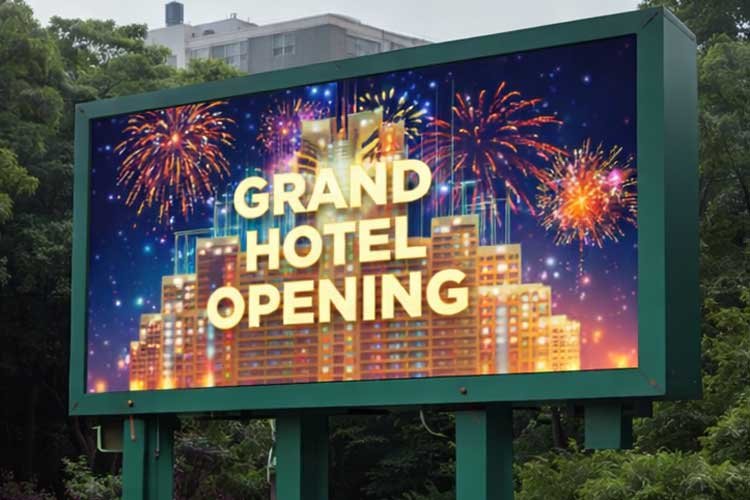
Large-Format DOOH & Roadside LED Billboard

Large outdoor LED billboards are designed for strong visual impact across medium and long viewing distances.

When the screen is mounted higher or viewed from farther away, ultra-fine pixel pitch usually provides little practical benefit. P5, P6, P8 or P10 may deliver a better balance of screen scale, brightness, power density and total project investment.

Typical applications include roadside advertising, elevated commercial displays, transportation corridors and large DOOH media networks.

Urban Commercial Media Wall & Shopping District Display

Outdoor LED media walls are widely used in shopping districts, commercial plazas and city-center locations where the screen becomes part of the surrounding architecture.

These installations often operate for long daily hours and must maintain stable brightness and color under changing daylight conditions.

Depending on viewing distance and screen size, P3, P4 or P5 are commonly reviewed for urban commercial media walls.

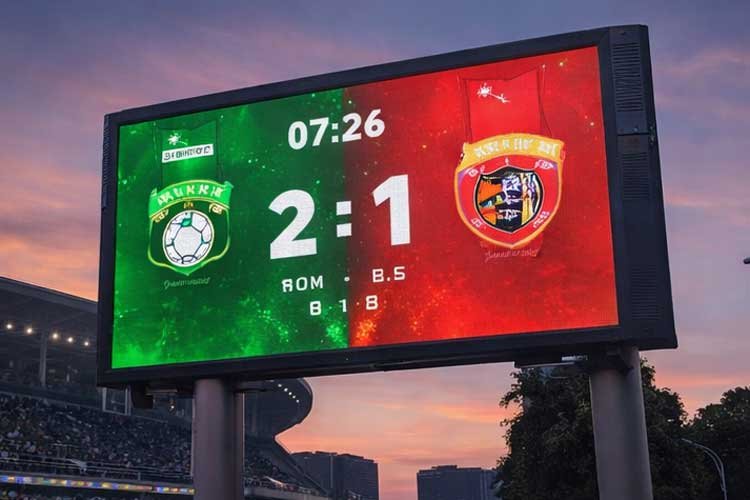
Outdoor Sports, Scoreboard & Public Information LED Display

Outdoor LED displays can also be configured for sports information, scoring, public announcements and dynamic event content.

These applications place greater emphasis on high refresh rate, reliable control systems, wide viewing angles and long operating hours, in addition to outdoor brightness and protection.

P4–P6 is often reviewed for medium-distance public or sports displays, while the final pitch should follow the actual viewing distance and required text size.

Public Plaza, Park & Large Outdoor Event LED Display

Large outdoor LED screens are suitable for public plazas, parks, entertainment areas and permanent event spaces where content must remain visible to large audiences.

For these installations, overall screen area, minimum viewing distance, daylight brightness, weather protection and structural safety are usually more important than selecting the smallest available pixel pitch.

P4, P5, P6 or larger-pitch outdoor LED systems can be reviewed according to the audience distance and total display size.

Outdoor Fine Pitch LED Displays for Façades, DOOH, Plazas and Large Outdoor Advertising

DisplayMan supplies outdoor LED display systems from P2 to P10 for commercial façades, retail plazas, pedestrian areas, DOOH networks, public information displays, transportation areas, roadside advertising and large-format outdoor media walls.

Outdoor Fine Pitch LED—also called Outdoor Small Spacing LED—is most relevant at P2, P2.5, P3 and P4, where viewers are closer and image detail matters. P5, P6, P8 and P10 extend the same product family toward larger screens and longer viewing distances.

Outdoor LED should be engineered as a complete system: module, cabinet, waterproof structure, control system, power, thermal design, steel structure, maintenance access and installation.

Outdoor P-Series Product Range

P2 / P2.5 / P3 / P4 / P5 / P6 / P8 / P10
Choose according to real viewing distance and screen scale. The smallest pitch is not automatically the best outdoor solution.

Outdoor P2, P2.5, P3, P4, P5, P6, P8 and P10 LED Displays

The Outdoor P-series covers close-view premium outdoor media through long-distance billboard applications.

P2Pitch: 2.0 mmModule: 160 × 160 × 15 mmBrightness: ≥4500 cd/m²Refresh: ≥3840 HzUltra-close premium DOOH, retail entrances and landmark displays
P2.5Pitch: 2.5 mmModule: 320 × 160 × 15 mmBrightness: 4500–5000 cd/m² adjustableRefresh: ≥3840 HzHigh-end retail façades, pedestrian areas and close-view signage
P3Pitch: 3.076 mmModule: 160 × 160 × 15 mmBrightness: ≥6500 cd/m²Refresh: ≥1920 HzCity centers, plazas, commercial façades and premium outdoor advertising
P4Pitch: 4.0 mmModule: 320 × 160 × 15 mmBrightness: 4500–6000 cd/m² adjustableRefresh: ≥1920 HzCommercial façades, public spaces and medium-distance displays
P5Pitch: 5.0 mmModule: 320 × 160 × 15 mmBrightness: 4500–6000 cd/m² adjustableRefresh: ≥1920 HzPublic squares, event venues and larger commercial screens
P6Pitch: 6.667 mmModule: 320 × 160 × 15 mmBrightness: 4500–6000 cd/m² adjustableRefresh: ≥1920 HzBuilding displays and longer-distance commercial advertising
P8Pitch: 8.0 mm nominalModule: 320 × 160 × 15 mmBrightness: 4500–6000 cd/m² adjustableRefresh: ≥1920 HzRoadside, high-mounted and wide-area outdoor screens
P10Pitch: 10.0 mm nominalModule: 320 × 160 × 15 mmBrightness: 4500–6000 cd/m² adjustableRefresh: ≥1920 HzLong-distance billboards and large-format outdoor advertising
ModelActual / Nominal PitchModule SizeModule ResolutionBrightnessRefresh RateTypical Direction
P22.0 mm160 × 160 × 15 mm80 × 80≥4500 cd/m²≥3840 HzUltra-close premium DOOH, retail entrances and landmark displays
P2.52.5 mm320 × 160 × 15 mm128 × 644500–5000 cd/m² adjustable≥3840 HzHigh-end retail façades, pedestrian areas and close-view signage
P33.076 mm160 × 160 × 15 mm52 × 52≥6500 cd/m²≥1920 HzCity centers, plazas, commercial façades and premium outdoor advertising
P44.0 mm320 × 160 × 15 mm80 × 404500–6000 cd/m² adjustable≥1920 HzCommercial façades, public spaces and medium-distance displays
P55.0 mm320 × 160 × 15 mm64 × 324500–6000 cd/m² adjustable≥1920 HzPublic squares, event venues and larger commercial screens
P66.667 mm320 × 160 × 15 mm48 × 244500–6000 cd/m² adjustable≥1920 HzBuilding displays and longer-distance commercial advertising
P88.0 mm nominal320 × 160 × 15 mm40 × 204500–6000 cd/m² adjustable≥1920 HzRoadside, high-mounted and wide-area outdoor screens
P1010.0 mm nominal320 × 160 × 15 mm32 × 164500–6000 cd/m² adjustable≥1920 HzLong-distance billboards and large-format outdoor advertising
Official Datasheet Control

The uploaded P2 source contains an internal cabinet-resolution inconsistency, so this public page does not present that conflicting source value as a fixed specification. Final production parameters should follow the confirmed project / contract datasheet.

Outdoor P-Series Technical Specifications

Module & Pixel Specifications

ModelLED PackagePitchModule ResolutionScan ModePixel Density
P2SMD12122.0 mm80 × 801/20250,000 px/m²
P2.5SMD14152.5 mm128 × 641/16160,000 px/m²
P3SMD19213.076 mm52 × 521/13105,625 px/m²
P4SMD19214.0 mm80 × 401/1062,500 px/m²
P5SMD19215.0 mm64 × 321/840,000 px/m²
P6SMD35356.667 mm48 × 241/623,040 px/m²
P8SMD35358.0 mm nominal40 × 201/515,625 px/m²
P10SMD353510.0 mm nominal32 × 161/210,000 px/m²

Cabinet Platform

ModelCabinet SizeCabinet ResolutionReference WeightMaintenanceProtection
P2960 × 960 × 105 mmConfirm before order*≈11.8 kg net / 13.5 kg grossFront + rear service on applicable configurationsFront IP65 / Rear IP45
P2.5960 × 960 × 100 mm384 × 384≈11.8 kg net / 13.5 kg grossFront + rear service on applicable configurationsFront IP65 / Rear IP45
P3960 × 960 × 105 mm312 × 312≈11.8 kg net / 13.5 kg grossFront + rear service on applicable configurationsFront IP65 / Rear IP45
P4960 × 960 × 100 mm240 × 240≈11.8 kg net / 13.5 kg grossFront + rear service on applicable configurationsFront IP65 / Rear IP45
P5960 × 960 × 100 mm192 × 192≈11.8 kg net / 13.5 kg grossFront + rear service on applicable configurationsFront IP65 / Rear IP45
P6960 × 960 × 100 mm144 × 144≈11.8 kg net / 13.5 kg grossFront + rear service on applicable configurationsFront IP65 / Rear IP45
P8960 × 960 × 100 mm120 × 120≈11.8 kg net / 13.5 kg grossFront + rear service on applicable configurationsFront IP65 / Rear IP45
P10960 × 960 × 100 mm96 × 96≈11.8 kg net / 13.5 kg grossFront + rear service on applicable configurationsFront IP65 / Rear IP45
Reference

Common Outdoor Performance

  • Viewing angle: 120° H / 120° V
  • Color processing: RGB each ≥12 bit
  • Manual / automatic / software brightness adjustment
  • Point-by-point brightness and chromaticity calibration
  • Synchronous control
  • HDMI / DVI signal input
  • AC 110–240 V, 50–60 Hz
  • Operating temperature: -10°C to +60°C
Outdoor Structure

Outdoor Reliability Direction

  • Front protection: IP65 reference
  • Rear protection: IP45 reference
  • Module flatness: ≤0.5 mm reference
  • Continuous operation: ≥7 × 24 hrs reference
  • Outdoor brightness selected by pitch and sunlight
  • Front / rear service on applicable designs
  • Iron / aluminum cabinet options on several models

How to Choose Outdoor P2, P2.5, P3, P4, P5, P6, P8 or P10

For outdoor LED, viewing distance and total screen size are more important than chasing the smallest pixel pitch.

Pitch GroupViewing DirectionTypical ApplicationsSelection Logic
P2 / P2.5Very close outdoor viewingFine text, premium DOOH, pedestrian areas, retail entrancesUse when short-distance detail justifies higher pixel density and system cost
P3Close outdoor viewingCity centers, commercial plazas, premium façadesBalanced fine-pitch direction with strong outdoor brightness
P4 / P5Medium outdoor viewingBuilding façades, public squares, event venues, information displaysPractical balance of scale, detail and budget
P6 / P8Medium-to-long viewingLarge advertising, roadside and high-mounted displaysScale and daylight visibility matter more than ultra-fine detail
P10Long-distance viewingLarge billboards and wide-area advertisingBest when maximum area and cost efficiency matter more than close detail
Outdoor Selection Rule

P2 / P2.5 make commercial sense when close-view detail is genuinely visible and valuable. For large screens viewed from farther away, P5 / P6 / P8 / P10 can reduce cost, power density and complexity without sacrificing the real viewing result.

Structural Composition of an Outdoor LED Display System

An outdoor LED wall is not simply an LED module with a waterproof label. It is a complete outdoor display system designed around visibility, sealing, heat, structure, wind and long-term maintenance.

Outdoor LED ModulePixel array, PCB, driver IC, mask and module protection
Outdoor LED CabinetMechanical alignment, sealing and module support
Receiving CardCabinet-level signal distribution
Power SupplyHigh-brightness outdoor power delivery
Sending Card / ProcessorInput, scaling, mapping and synchronization
Waterproof CablingProtected signal and power connections
Steel / Mounting StructureWind load, alignment and installation safety
Thermal DesignVentilation, heat dissipation and long-term operation
Maintenance AccessFront / rear service
Calibration + SparesWhole-wall consistency and long-term maintenance

Three Engineering Layers

Display Layer: LED package, pixel pitch, module PCB, driver IC, mask and calibration determine the image.

Cabinet Layer: flatness, waterproof protection, receiving card, power supply, cable interfaces and thermal path determine reliability.

Project Layer: processor, power distribution, steel structure, wind load, mounting, maintenance access and site installation determine whether the system works safely outdoors.

Core Project Principle

Outdoor LED projects should be quoted as complete systems—not only by LED module price or square-meter price.

Why Outdoor Fine Pitch LED Is a Serious Engineering Challenge

Smaller Pixel Pitch Outdoors Means More Than Higher Resolution

As outdoor pixel pitch becomes smaller, the challenge is not simply fitting more LEDs into the same area. The system must combine higher pixel density with several-thousand-nit brightness, weather protection, thermal control, precise mechanical alignment and long-term outdoor reliability.

This is why Outdoor Fine Pitch LED cannot be treated as an indoor fine-pitch display with waterproofing added afterward. It must be engineered as a complete outdoor display system from the beginning.

Higher Power & Heat Density

Smaller pixel pitch means more LEDs and more driver channels per square meter. Outdoors, those LEDs must also operate at much higher brightness than indoor displays to remain visible in daylight.

This increases:

  • Power density
  • Heat concentration within modules
  • Thermal stress on LEDs and driver ICs
  • Load on PCB, power supplies and cabinet electronics

Without a coordinated thermal design, excessive temperature can accelerate brightness decay, color drift and long-term component aging.

Color Stability at Outdoor Brightness

DisplayMan’s current outdoor P-series reference products operate in approximately the 4,500–6,500 cd/m² class, depending on pixel pitch and project configuration.

At these brightness levels, long-term image consistency depends on:

  • LED binning
  • Stable current control
  • Driver IC performance
  • Brightness control
  • Point-by-point brightness calibration
  • Point-by-point chromaticity calibration

The complete wall must be calibrated as one display system—not evaluated only from a single LED module.

Waterproof Protection vs. Serviceability

The reference outdoor P-series uses Front IP65 / Rear IP45 protection. That rating alone does not finish the outdoor engineering.

The project must also consider:

  • Cabinet joints and seams
  • Waterproof power connections
  • Data cable protection
  • Drainage and water paths
  • Front or rear maintenance access
  • Service clearance for power supplies and control hardware

The challenge is to protect the system from weather while keeping the display maintainable throughout its service life.

Flatness & Mechanical Tolerance Control

As pixel pitch decreases, small cabinet or module alignment errors become increasingly visible as brightness seams, color discontinuity or image distortion.

The official P-series specifications use a ≤0.5 mm module-flatness reference, while real outdoor installations must also manage:

  • Steel-structure tolerance
  • Cabinet alignment
  • Wind load
  • Thermal expansion
  • Installation movement
  • Long-term structural stability

Fine-pitch image quality depends on mechanical precision as much as on LED resolution.

Long-Term Environmental Stress

Outdoor LED displays operate under environmental conditions that do not exist in a controlled indoor wall.

  • UV radiation
  • Rain and humidity
  • Dust and pollution
  • Daily temperature cycling
  • Seasonal temperature change
  • Long daily operating hours

These stresses affect LED packages, masks, PCB materials, coatings, connectors, seals, power supplies and cabinet structures. Outdoor reliability is therefore a materials-and-system problem, not only an LED problem.

Outdoor Fine Pitch Requires Higher Engineering Discipline

P2 and P2.5 outdoor LED can produce excellent close-view image quality, but they also increase pixel density, thermal load, alignment sensitivity and system cost.

That is why a smaller pitch should be selected only when the real viewing distance and content justify it. For medium and long viewing distances, P4, P5, P6, P8 or P10 may provide a better overall project result.

System-Level Engineering Is Mandatory

Outdoor Fine Pitch LED cannot be designed piecemeal. The LED package, module, cabinet, power system, control system, waterproof interfaces, thermal design, supporting structure and calibration must be engineered together.

LED + DriverBrightness, binning and current control
ModulePixel density, PCB and thermal load
CabinetFlatness, sealing and service access
Power + ControlDistribution, mapping and reliability
StructureWind load, mounting and alignment
CalibrationWhole-wall brightness and color consistency

The key point: Outdoor Fine Pitch LED is not simply “Indoor LED used outdoors.” It is a specialized outdoor display system that must balance image detail, daylight visibility, environmental protection, thermal stability, mechanical precision and long-term serviceability.

DisplayMan Engineering View: We evaluate Outdoor Fine Pitch LED around real operating conditions—sunlight, heat, rain, dust, structure, maintenance access and long operating hours—not only how the screen performs in a controlled showroom demonstration.

Outdoor LED Project Engineering Factors

Viewing Distance

P2 / P2.5 are for close viewing; P6 / P8 / P10 are usually more economical for long-distance viewing.

Direct Sunlight

Select brightness around sunlight exposure, orientation and daytime content—not one fixed marketing number.

Screen Size

Calculate final width/height from cabinet geometry and supporting structure before quotation.

Brightness

Official reference specs range from ≥4500 to ≥6500 cd/m² depending on pitch.

Waterproof Protection

Reference front IP65 / rear IP45 protection must be combined with protected joints and installation interfaces.

Thermal Design

High brightness and dense pitch increase heat load; power, ventilation and cabinet structure must be considered together.

Wind Load & Structure

Wall, pole and steel-frame installations require structural review according to screen size and height.

Maintenance Method

Front / rear access must be defined before supporting structure is finalized.

Refresh Rate

P2/P2.5 ≥3840 Hz; P3–P10 ≥1920 Hz reference.

Control System

Processor, sending/receiving cards, HDMI/DVI and long-distance fiber should match total resolution.

Power Distribution

Outdoor walls require project-level AC distribution, grounding and cable-routing review.

Spare Parts

Plan spare modules and key electronics with the original batch for long-term consistency.

Practical Customization Boundary

For most projects, DisplayMan selects a proven module and cabinet platform first, then customizes screen size, cabinet matrix, brightness configuration, processor, steel structure, power distribution, cable routing, maintenance and installation.

Typical Outdoor LED Applications

Commercial Building Façades

Large high-brightness visual surfaces for retail buildings, headquarters and flagship exteriors.

DOOH & Media Networks

Outdoor advertising requiring repeatable brightness, content control and long operating hours.

Retail Plazas & Pedestrian Streets

P2 / P2.5 / P3 support closer pedestrian viewing where image detail matters.

Public Squares & City Centers

P3 / P4 / P5 balance detail, scale and outdoor brightness.

Transportation Areas

Public information and advertising viewed from multiple positions and distances.

Roadside & Large Billboards

P6 / P8 / P10 prioritize scale, daylight visibility and long-distance efficiency.

Outdoor LED Displays vs Indoor LED Displays

Why Indoor and Outdoor LED Systems Are Not Interchangeable

CategoryOutdoor P-Series LEDIndoor Fine Pitch LED
EnvironmentOutdoor / semi-outdoor exposureControlled indoor environment
Primary PrioritySunlight visibility + weather durabilityClose-view image refinement + visual comfort
BrightnessSeveral-thousand-nit outdoor rangeMuch lower indoor brightness
ProtectionFront IP65 / Rear IP45 referenceNo full outdoor weatherproof requirement
Thermal DesignMore demandingLower thermal load
Pixel PitchP2–P10 on this pageCommonly P1.25–P2.5
StructureOutdoor cabinet + waterproof interfaces + steel structureIndoor cabinet + wall structure
Best ForFaçades, plazas, DOOH, public outdoor displaysControl rooms, boardrooms, studios, indoor video walls

Outdoor LED Is Designed For

  • Direct sunlight and strong ambient light
  • Rain, dust and environmental exposure
  • Higher brightness and thermal load
  • Outdoor structural installation
  • Long-term façade / plaza / DOOH operation

Indoor LED Is Designed For

  • Controlled lighting
  • Close visual comfort
  • Lower brightness
  • Fine text / presentation / monitoring
  • Indoor wall structures without full weatherproofing

DisplayMan Selection View

Do not use an indoor LED wall as an outdoor product. Outdoor LED requires a different brightness, sealing, thermal, cable-protection and structural strategy.

Outdoor Fine Pitch LED vs Standard Outdoor LED Display

The important question is not “Which pitch is technically better?” It is “Which pitch is actually visible and economically sensible at the project viewing distance?”

FactorOutdoor Fine Pitch LEDStandard / Larger-Pitch Outdoor LED
Pixel Pitch DirectionMainly P2 / P2.5 / P3 / P4Mainly P5 / P6 / P8 / P10
Viewing DistanceClose to mediumMedium to long
Main ValueHigher detail for pedestrian / close-view projectsLarger area and stronger cost efficiency
Typical ApplicationsRetail entrances, city centers, premium façadesBillboards, roadside, large façades
Engineering ChallengeHigher pixel / power density, tighter thermal and sealing requirementsLarger structure, wind load and long-distance visibility
Selection LogicPay for fine pitch only when visible detail creates valueChoose larger pitch when screen scale dominates
Do Not Overspecify Outdoor Resolution

A P2 screen does not automatically create more project value than P6 or P8. If viewers are far away, larger pitch may provide the same practical visual impact with lower density, cost and thermal complexity.

Outdoor LED Displays vs Outdoor High Brightness LCD Displays

Choosing the Right Outdoor Display Technology

Outdoor LED and Outdoor High Brightness LCD are designed for different display scales and user distances.

CategoryOutdoor LED DisplayOutdoor High Brightness LCD
Display FormModular seamless LED wallSingle high-brightness LCD display / outdoor enclosure
Best Size DirectionLarge outdoor display areasSmall to medium outdoor terminals
Visual SeamSeamless LED surfaceSingle LCD panel has no module seams
Viewing DistanceMedium to long; P2/P2.5 can support closer outdoor viewingClose to medium
BrightnessHigh outdoor brightness directionHigh-brightness LCD depends on backlight and thermal system
Weather ProtectionOutdoor LED cabinet and waterproof interfacesIP-rated enclosure, front glass and thermal system
Custom SizeHighly scalable using cabinetsLimited by available LCD panel sizes
MaintenanceModule / cabinet electronics serviceComplete display / LCD / enclosure service
Best ForLarge signage, façades, plazas and DOOHOutdoor kiosks, bus stops, terminals and close-view information displays
Selection LogicChoose for large visual impact and scalable wall sizeChoose when a smaller high-resolution screen is more suitable

Choose Outdoor LED When

  • The display area is large
  • A façade, plaza or billboard is being built
  • Viewers are mainly medium / long distance
  • Custom width / height is required
  • Large public-facing visual impact is the goal
  • Module-level serviceability is valuable

Choose Outdoor High Brightness LCD When

  • The screen is small or medium size
  • Viewers are close
  • Fine UI or detailed information is displayed
  • The application is a kiosk, bus stop or terminal
  • A single high-resolution screen is more practical

DisplayMan Selection View

For large outdoor visual walls, façades and DOOH, LED is normally the stronger direction. For smaller close-view outdoor terminals, high-brightness LCD can be more appropriate.

When Outdoor P-Series LED Is — and Is Not — the Right Choice

Recommended

Good Fit

  • Outdoor façade or DOOH wall
  • Retail plaza / pedestrian display
  • Public square / city-center screen
  • Transportation outdoor display
  • Roadside or high-mounted advertising
  • Large seamless outdoor visual surface
  • Permanent installation with steel structure
Alternative

Choose Another Product When

  • The project is fully indoor
  • Temporary rental / stage product
  • Portable trade-show / roadshow poster display
  • Small close-view outdoor terminal
  • Transparency is required
  • Creative sphere / tree shape is the main goal
  • Flexible LED modules are required
  • No waterproof cabling or maintenance access is possible

What Information Should You Provide for an Outdoor LED Quote?

Visual Requirement

Display & Viewing Requirement

  • Screen width × height
  • Viewing distance
  • Preferred P2–P10 pitch if known
  • Content type
  • Required resolution if known
  • Direct sunlight direction
  • Daytime / nighttime condition
  • Installation height
  • Site photos
Project Requirement

Outdoor Engineering Requirement

  • Façade / wall / pole / steel structure
  • Front or rear maintenance
  • Waterproof requirement
  • Wind-load information if available
  • Power-supply location
  • Controller / processor location
  • Cable-routing condition
  • Quantity / number of screens
  • Project schedule
  • Installation-support requirement
Site Information Is More Valuable Than Only Asking for $/m²

Screen dimensions, viewing distance, sunlight direction, structure, waterproofing, wind load, maintenance access and cable routing can materially change the system and quotation.

Outdoor Fine Pitch LED Display FAQ

What is an Outdoor Fine Pitch LED Display?

An outdoor-rated modular LED display using a relatively small pixel pitch for clearer images at shorter outdoor viewing distances than conventional large-pitch billboards.

Is Outdoor Fine Pitch LED the same as Outdoor Small Spacing LED?

Yes. Fine Pitch LED is the more natural English industry term; Small Spacing LED is another common description.

Which pixel pitches are covered?

P2, P2.5, P3, P4, P5, P6, P8 and P10.

Which pitches are really fine pitch outdoors?

P2, P2.5, P3 and P4 are the main close-to-medium outdoor fine-pitch directions. P5–P10 extend the same outdoor family toward larger screens and longer viewing distances.

Which pitch should I choose?

Start with viewing distance, screen size and content. Smaller pitch increases detail, but also LED density, heat, cost and system complexity.

What brightness is available?

Official reference specifications range from ≥4500 cd/m² to ≥6500 cd/m² depending on pitch.

What protection level is used?

The reference P-series specifications list front IP65 and rear IP45 protection.

What refresh rates are available?

P2 and P2.5 are listed at ≥3840 Hz. P3–P10 are listed at ≥1920 Hz.

Can indoor LED be installed outdoors?

No. Outdoor use requires different brightness, waterproof protection, thermal design, cabling and structure.

Can the screen size be customized?

Yes. Final width and height are configured around cabinet geometry and the installation structure.

Can the system support front maintenance?

Several official P-series specifications support front and rear installation / maintenance; final access should be confirmed for the selected cabinet.

Can it operate continuously?

The reference specifications state support for continuous 7×24 operation, subject to correct project thermal and power design.

What is the operating temperature?

The reference specifications list -10°C to +60°C.

Is fine pitch always better than P6/P8/P10?

No. For longer viewing distances, larger pitches are often more economical while producing the same practical visual result.

Outdoor LED or Outdoor High Brightness LCD?

Use Outdoor LED for large scalable walls and façades. Use Outdoor High Brightness LCD for smaller close-view terminals.

What should I provide for a quote?

Screen width and height, viewing distance, site photos, sunlight condition, preferred pitch if known, mounting structure, maintenance access, power, quantity and schedule.

Start Your Outdoor LED Display Project

Send the screen dimensions, viewing distance, installation photos and outdoor conditions. We can help select P2, P2.5, P3, P4, P5, P6, P8 or P10 and define the complete system.

You do not need to choose the smallest pixel pitch. DisplayMan can compare the real viewing distance, screen scale, sunlight, brightness, power, cabinet layout and budget before recommending the most practical configuration.

Send Your Display Requirement

Please share your application, display size, quantity and project background. We will review the most practical display direction.