
Create transparent LED displays for selected curved glass, columns, arc-shaped storefronts and creative indoor installations. DisplayMan reviews curvature, bending direction, panel layout, control systems and installation requirements around your project.
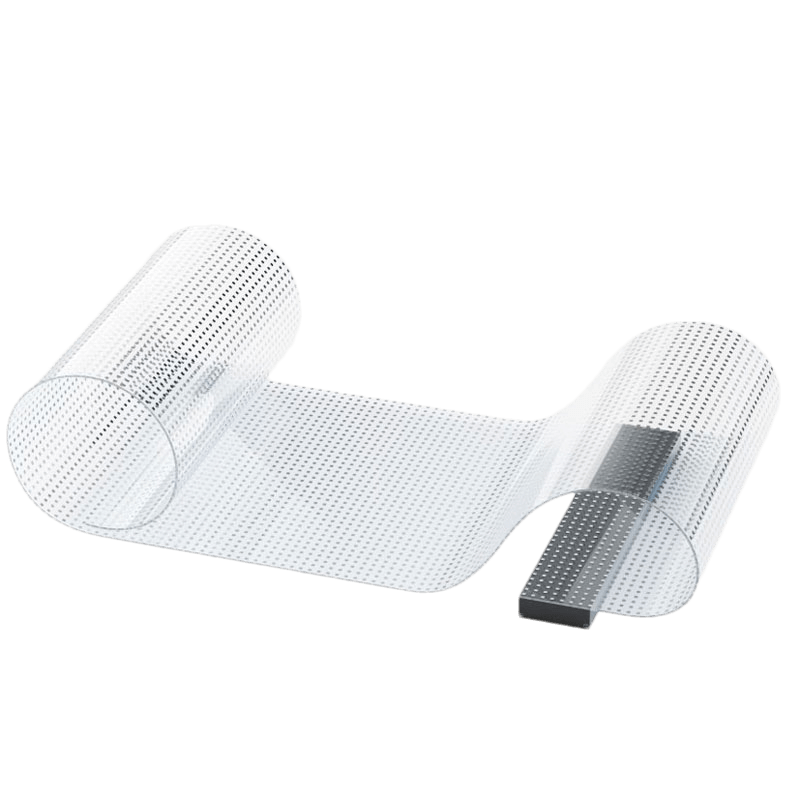
A Flexible Transparent LED Film Display is a bendable transparent LED display designed for selected curved glass, arc-shaped walls, columns, circular structures and creative indoor commercial installations.
It displays videos, animation, advertising, brand content and digital art while preserving partial visibility through the surface. Its main value is not only transparency—it is the ability to follow shapes that a standard flat Transparent LED Film Display cannot handle effectively.
The screen should be treated as a project-engineered display system. Surface curvature, bending direction, screen segmentation, cable exits, power supplies, controller, content mapping and maintenance must be reviewed together.
Flexible Transparent LED Film Display is the creative and shape-adaptable branch of the Transparent LED family. Use it when curved installation and design freedom create real project value.
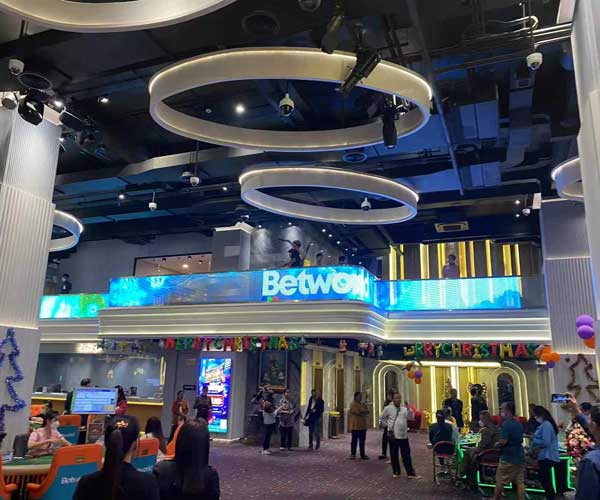
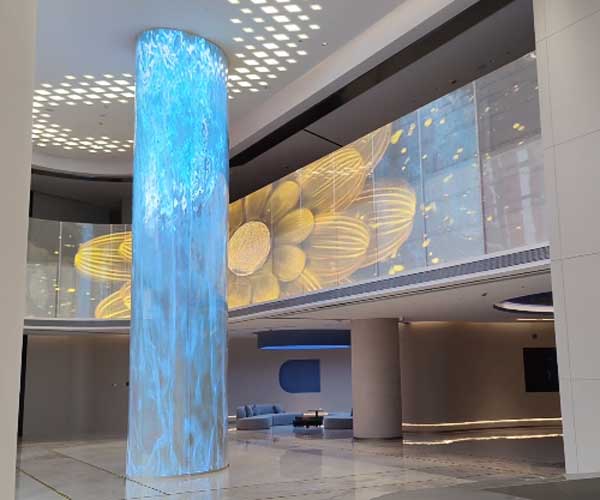
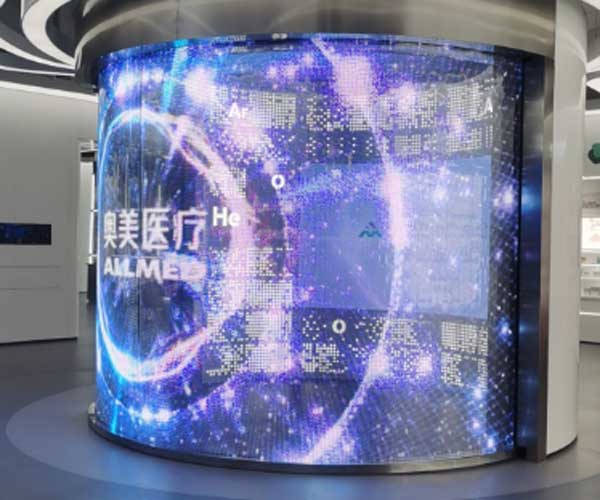
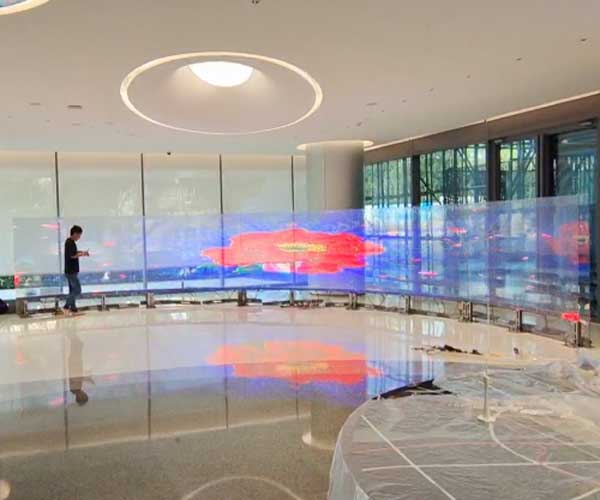
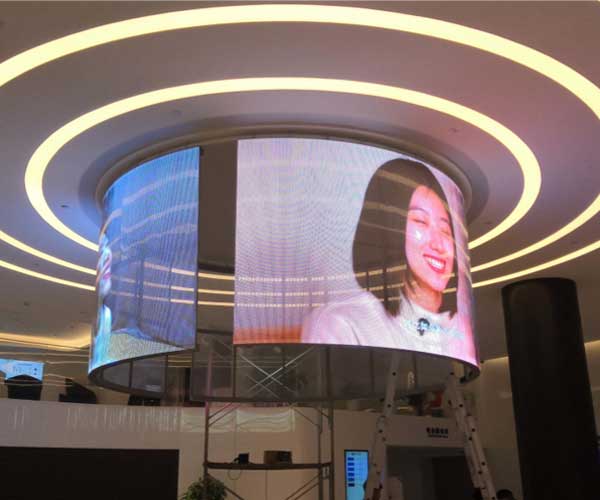
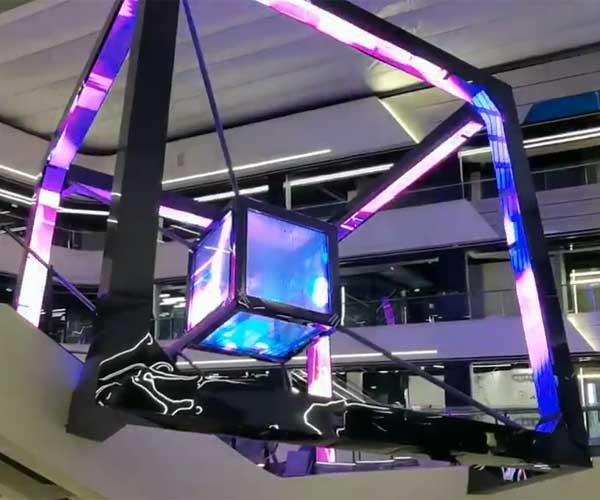
See how DisplayMan’s Flexible Transparent LED Film Display brings creativity to life. From storefronts and showrooms to curved architectural surfaces and artistic installations, these examples illustrate how a thin, bendable display can follow selected shapes and bring digital content into the surrounding space.
Transparency and digital content work together to create eye-catching, modern experiences while retaining partial views through the display. Final curvature, brightness, transparency and installation suitability depend on the selected configuration and project conditions.
Both products use transparent LED film-type structures, but they should not be sold as interchangeable products.
| Factor | Flexible Transparent LED Film Display | Transparent LED Film Display |
|---|---|---|
| Main Purpose | Curved, arc-shaped, cylindrical and creative surfaces | Flat or regular glass advertising |
| Design Priority | Flexibility and shape adaptation | Commercial practicality and regular screen layout |
| Typical Surface | Curved glass, columns, rings and creative structures | Storefront windows and flat mall glass |
| Engineering Complexity | Higher; radius, segmentation and cables require project review | Lower for standard flat installations |
| Content | Designed around the curve or surface shape | Conventional rectangular advertising content |
| Cost Logic | More project-specific | Usually more economical for flat glass |
Choose Transparent LED Film Display for flat glass advertising. Choose Flexible Transparent LED Film Display only when the display must follow a curved or creative surface.
The flexible structure provides more design freedom than rigid or flat LED products, but every surface and bending request must remain within the engineering limits of the selected configuration.
Suitable curvature can be reviewed according to bend direction, radius, glass condition and installation method.
Column diameter, full or partial wrapping, screen joints, content seam and service access must be defined.
The screen layout should follow the real arc rather than being forced into a flat rectangular design.
Support structure, power, signal, weight distribution and safety require complete project engineering.
Adaptation is possible only along permitted module and circuit directions. It is not freely cut decorative film.
The product is intended for project installation, not continuous repeated folding, rolling or reshaping during daily operation.
Provide the surface drawing, curvature or column diameter, screen dimensions, bending direction, cable-exit requirement and installation structure before confirming feasibility.
The current specification table contains six indoor configurations. The naming shows horizontal × vertical pixel spacing in millimeters.
For projects that require the strongest image-detail direction among the equal-pitch configurations.
Uses different horizontal and vertical spacing and should be selected from the real content and viewing geometry.
For curved indoor commercial displays requiring a balance between detail and transparent effect.
A practical starting direction for shopping malls, showrooms, columns and medium-distance installations.
For larger curved surfaces and longer indoor viewing where transparency matters more than fine detail.
The largest pitch in the retained indoor range, for large simple visuals and longer viewing distances.
Do not choose the smallest pitch automatically. Match the pitch to viewing distance, surface shape, content detail, transparency, power and project budget.
Supports selected curved, arc-shaped, cylindrical and creative indoor display concepts.
Reduces the visual and structural burden compared with heavy rigid LED cabinets.
The retained specification table lists 3,000–5,000 cd/m² depending on configuration.
The six retained configurations list 75% transparency, subject to the real installation and viewing conditions.
Motion can follow the architecture and create visual effects that a flat rectangle cannot produce.
Suitable for showrooms, malls, exhibitions, lobbies, museums and premium interiors.
The retained General Specs include synchronous PC control and multiple common video inputs.
The current 1000 × 240 mm module format can be arranged according to the selected structure.
Screen layout, supports, power, cabling and content mapping can be developed as one project system.
The final installation method must match the selected product model and surface. The retained General Specs list hanging and stacking; glass-mounted or special curved installation requires project-specific confirmation.
For suitable glass surfaces after confirming radius, cleaning, mounting method, cable exit and long-term stability.
For partial or full wrapping around engineered columns, frames or circular support systems.
For circular displays, exhibitions, atriums and selected creative structures using engineered suspension.
For permanent commercial installations that require a stable project-specific support system.
Equipment must be placed where it remains hidden, ventilated, safe and accessible for service.
Cable length, bending, connector position and visual exposure are especially important on columns and curved glass.
Power supplies, controller boxes, cables and connectors must be planned before the creative shape is finalized. Their location can determine whether the finished installation looks clean.
The current indoor range includes six horizontal × vertical pixel-pitch configurations. Pixel density below is calculated from the listed module resolution and the 1000 × 240 mm active module area. Final availability, curvature, dimensions and system configuration must be confirmed for each project.
| Pixel Pitch (H × V) | P6 × 6 | P5 × 10 | P8 × 8 | P10 × 10 | P16 × 16 | P20 × 20 |
|---|---|---|---|---|---|---|
| LED Configuration | 1R1G1B | 1R1G1B | 1R1G1B | 1R1G1B | 1R1G1B | 1R1G1B |
| Brightness | 5000 cd/m² | 5000 cd/m² | 5000 cd/m² | 5000 cd/m² | 4000 cd/m² | 3000 cd/m² |
| Calculated Pixel Density | ≈27,833 pixels/m² | 20,000 pixels/m² | 15,625 pixels/m² | 10,000 pixels/m² | ≈3,938 pixels/m² | 2,500 pixels/m² |
| Transparency | 75% | 75% | 75% | 75% | 75% | 75% |
| System Unit Size | 1000 × 240 × 70 mm | 1000 × 240 × 70 mm | 1000 × 240 × 70 mm | 1000 × 240 × 70 mm | 1000 × 240 × 70 mm | 1000 × 240 × 70 mm |
| System Unit Resolution | 167 × 40 pixels | 200 × 24 pixels | 125 × 30 pixels | 100 × 24 pixels | 63 × 15 pixels | 50 × 12 pixels |
| Module Size | 1000 × 240 mm | 1000 × 240 mm | 1000 × 240 mm | 1000 × 240 mm | 1000 × 240 mm | 1000 × 240 mm |
| Module Resolution | 167 × 40 pixels | 200 × 24 pixels | 125 × 30 pixels | 100 × 24 pixels | 63 × 15 pixels | 50 × 12 pixels |
| System Weight | ≤3 kg/m² | ≤3 kg/m² | ≤3 kg/m² | ≤3 kg/m² | ≤3 kg/m² | ≤3 kg/m² |
| IP Rating (Front / Back) | IP43 | IP43 | IP43 | IP43 | IP43 | IP43 |
| Environment | Indoor | Indoor | Indoor | Indoor | Indoor | Indoor |
| Viewing Angle (H / V) | 120° / 120° | 120° / 120° | 120° / 120° | 120° / 120° | 120° / 120° | 120° / 120° |
| Viewing Distance | Project dependent | Project dependent | Project dependent | Project dependent | Project dependent | Project dependent |
| Gray Scale | 16 bit | 16 bit | 16 bit | 16 bit | 16 bit | 16 bit |
| Max. Power Consumption | 800 W/m² | 800 W/m² | 800 W/m² | 800 W/m² | 800 W/m² | 800 W/m² |
| Average Power Consumption | 400 W/m² | 400 W/m² | 400 W/m² | 400 W/m² | 400 W/m² | 400 W/m² |
| Scanning Mode | 1 scan | 1 scan | 1 scan | 1 scan | 1 scan | 1 scan |
| Specification | Details |
|---|---|
| Refresh Rate | 3840 Hz reference; final value depends on the selected receiving-card and driving configuration |
| Operation Power | AC 100–240V, 50/60 Hz |
| Control Mode | Synchronous LED control system; controller, media player and CMS route are selected for the project |
| Supported Inputs | HDMI, DVI and other video inputs through the selected controller or video processor |
| Operating Environment | Indoor or protected commercial installation; final temperature and humidity limits require model confirmation |
| Rated LED Lifetime | Up to 100,000 hours under specified operating conditions; not a warranty period for the complete system |
| System Materials | Flexible transparent display module, aluminum profile and PC protective components |
| Installation | Applied to suitable glass or another approved surface; custom framed or hanging installation can be reviewed |
| Packaging | Wooden box |
The 70 mm value refers to the listed complete system-unit depth, including the profile or connection section; it is not the thickness of the flexible transparent display layer alone. Final model, active area, overall dimensions, bending direction, permitted radius, control configuration, cable exits and installation method must be confirmed before quotation and production.
A successful curved display is a complete system rather than a film layer alone.
Form the visible screen area and follow the permitted surface geometry.
Maintains the intended radius, alignment and installation safety.
Must be positioned for ventilation, safe cable length and later replacement.
Processes content and distributes signal across the selected module arrangement.
May include the retained synchronous PC route or a project-confirmed media system.
Must follow the curve without excessive stress, exposed loops or inaccessible connectors.
Maps a rectangular source canvas onto the actual curved or circular display geometry.
Allows power supplies, controller, cables and display sections to be inspected and repaired.
Supports safe transportation of modules and project-specific structure components.
The product is best used in indoor commercial projects where the screen shape contributes directly to the visual experience.
For mall interiors, retail windows, showrooms and lobbies with engineered curved glass.
For shopping centers, hotels, exhibitions and brand spaces using cylindrical digital media.
For curved retail glass that cannot be served cleanly by standard flat LED film.
For atriums, events, exhibitions and product launches where the display becomes a visual centerpiece.
For creative digital storytelling, art installations and technology demonstrations.
For curved brand walls, vehicle launches and immersive interior presentation.
For innovation displays, lobbies and visitor areas with custom architectural surfaces.
For curved walls, columns, VIP rooms, clubs and interior digital-art features.
For controlled indoor spaces where digital media follows the building shape.
Use this product only when the surface is curved, cylindrical, arc-shaped or creatively structured.
Provide the curve radius, column diameter, arc length, height, support and viewing sides.
Choose from the current P6 × 6, P5 × 10, P8 × 8, P10 × 10, P16 × 16 and P20 × 20 range according to viewing distance, content and the real installation geometry.
Align the 1000 × 240 mm module format with the real curve, joints and content seams.
Confirm equipment location, cable stress, hidden routes, ventilation and service access.
Design motion, text and visual focus for the actual curved or circular surface.
Surface geometry comes first. Pixel pitch, module quantity, content canvas and control system should be selected only after the real shape has been defined.
| Project Condition | Recommended Direction | Main Engineering Focus |
|---|---|---|
| Closer Curved Display | P6 × 6, P5 × 10 or P8 × 8 review | Image detail, visible structure, content distortion and cable hiding |
| Medium-Distance Column or Wall | P8 × 8 or P10 × 10 review | Balance detail, transparency, module segmentation and content seam |
| Larger Indoor Curved Surface | P16 × 16 or P20 × 20 review | Transparency, simple large content, viewing distance and budget |
| Full Column Wrap | Pitch selected after diameter and circumference | Module fit, image seam, cable exit and maintenance opening |
| Circular Hanging Display | Project-specific pitch and structural review | Suspension, weight, power path, signal distribution and safety |
The retained technical table lists a viewing distance greater than 3 meters for all six configurations. Projects requiring closer critical viewing should be reviewed carefully rather than relying only on the pitch name.
A curved screen should not simply reuse a flat rectangular video without content testing and mapping.
Include the screen circumference, radius, visible viewing sector, module seams and content starting point in the creative template.
Avoid small text, dense documents, fine diagrams, complex charts, low-contrast graphics and important content placed across hidden or sharply curved areas.
| Alternative | Choose Flexible Transparent LED Film Display When | Choose the Alternative When |
|---|---|---|
| Transparent LED Film Display | The surface is curved, cylindrical or creatively shaped. | The project is a standard flat-glass advertising installation. |
| Holographic Transparent LED Display | Shape adaptation and bending are the main project requirements. | A minimal-structure, premium floating visual effect is the main goal. |
| Transparent LED Glass Display | The display must adapt to an existing creative or curved surface. | The LED display should be integrated more deeply into architectural glass construction. |
| Outdoor Transparent LED Mesh Display | The project is an indoor curved or creative display. | The project is a fully exposed weather-resistant outdoor facade. |
| Rental Transparent LED Display | The installation is project-specific and shape adaptation matters. | The screen must be repeatedly assembled, transported and reused for events. |
| Transparent OLED Displays | A larger transparent LED surface must follow a curve. | A premium flat transparent panel with close-viewing image quality is preferred. |
| Traditional LED Displays | Transparency and creative integration are important. | Transparency is unnecessary and a solid opaque LED wall is acceptable. |
Curved transparent LED projects require more early engineering than normal flat-screen projects.
The flexible display, support shape, controller, power, cables and content should be designed as one system. Solving only the screen surface is not enough.
The surface geometry is the most important part of the quotation package.
Use these pages to compare alternative Transparent LED technologies and project routes.
| Related Page | When to Visit |
|---|---|
| Transparent LED Displays | For the full Transparent LED product family and initial technology selection |
| Transparent LED Film Display | For regular flat-glass storefront and mall advertising |
| Holographic Transparent LED Display | For premium minimal-structure floating visual effects |
| Transparent LED Glass Display | For permanent glass-integrated architectural projects |
| Indoor Transparent LED Display | For more conventional indoor transparent LED structures |
| Outdoor Transparent LED Mesh Display | For exposed outdoor waterproof facade projects |
| Rental Transparent LED Display | For repeated event assembly, transportation and reuse |
| Custom Transparent LED Displays | For unusual structures that require broader custom LED engineering |
| Related Page | When It Helps |
|---|---|
| Transparent LED Solutions | For comparing film, flexible film, glass, mesh, indoor and rental routes |
| Transparent LED Retail Window Solution | For storefront and brand-window projects |
| Transparent LED Event Backdrop Solution | For exhibitions, product launches and creative temporary displays |
| Architectural Transparent LED Wall Solution | For interior architecture and large transparent media features |
| Transparent Exhibition & Showroom Display Solution | For showrooms, museums, exhibitions and experience centers |
| Exhibition, Events & Showrooms | For commercial application planning and project positioning |
| Corporate & Office Environments | For lobbies, visitor centers and corporate experience spaces |
| OEM/ODM Display Engineering & Prototyping | For engineering drawings, samples, structures and system integration |
Confirm the surface shape first. A flat surface usually belongs to standard Film Screen; a curved or cylindrical surface may justify Flexible Transparent LED Film Display; exposed outdoor or repeated-rental projects require different products.
It is a bendable transparent LED display film designed for selected curved glass, arc-shaped walls, columns, circular structures and other creative indoor commercial installations.
No. Standard Transparent LED Film Display is the more practical choice for flat glass advertising. Flexible Transparent LED Film Display is selected when the screen must follow a curved or creative surface.
The current indoor range includes P6 × 6, P5 × 10, P8 × 8, P10 × 10, P16 × 16 and P20 × 20 configurations. Final availability and model selection must be confirmed for the project.
The numbers describe the horizontal and vertical pixel spacing in millimeters. For example, P5 × 10 uses 5 mm horizontal spacing and 10 mm vertical spacing.
Selected curved-glass applications can be reviewed according to the curvature, bending radius, screen layout, cable exit, installation direction and maintenance requirement.
A column or cylindrical display can be reviewed, but the required diameter, bend direction, screen segmentation, cable path, controller and service access must be confirmed.
No. Flexible does not mean unlimited bending. Every project must stay within the permitted bending direction and radius of the selected product.
No. Project-based size adaptation may be possible, but cutting must follow the product circuit, LED layout and engineering instructions. It is not freely cut decorative film.
The retained technical table lists 75% transparency for the current six configurations. The real visual result also depends on content, viewing angle, glass, ambient light and installation.
The retained specification range lists 3,000 to 5,000 cd/m² depending on the selected configuration.
Yes. The six models listed in the current Module & Cabinet Specs table are indoor products with an IP43 reference rating.
The products on this page are intended for indoor or protected commercial environments. Fully exposed outdoor projects should use a dedicated Outdoor Transparent LED Mesh Display.
The display uses a synchronous LED control system. HDMI, DVI and other video inputs can be supported through the selected controller or video processor, while standalone media-player and content-management options are confirmed according to the project.
Large logos, flowing animation, high-contrast product visuals, digital art, column-wrapped patterns and motion graphics designed around the real surface shape work best.
Avoid small text, dense documents, complex charts, thin technical lines, low-contrast graphics and flat-screen content that becomes difficult to understand when wrapped around a curve.
Please provide the surface type and dimensions, drawings or site photos, bending radius or column diameter, screen area, viewing distance, pitch preference, installation method, content, cable and power locations, quantity, budget, schedule and shipping destination.
Send us the surface dimensions, radius or column diameter, drawings or photos, required display area, viewing distance, installation method, content, power and controller locations, quantity, budget and schedule.
We will review whether the surface is suitable for Flexible Transparent LED Film Display and recommend a configuration from the current P6 × 6, P5 × 10, P8 × 8, P10 × 10, P16 × 16 and P20 × 20 indoor range.
The correct solution may be Flexible Transparent LED Film Display, standard Film Screen, Holographic Invisible Screen, LED Glass Screen, Outdoor Mesh Screen or Rental Transparent LED. Surface shape and installation environment determine the product route.