Sphere LED Display Manufacturer | 360° Seamless Ball Screens

Transform static environments into digital landmarks. DisplayMan Sphere LED displays deliver a gapless, immersive visual experience that captures attention from every angle—engineered for those who refuse to settle for flat.

Proven Impact: DisplayMan Spheres in Action

While many screens just show content, a DisplayMan Sphere creates a landmark. From the precision required for scientific data to the prestige of corporate branding and creative art, our spheres are engineered for stability and high-visual impact. Below are three distinct ways our partners use spherical technology to dominate their spaces:

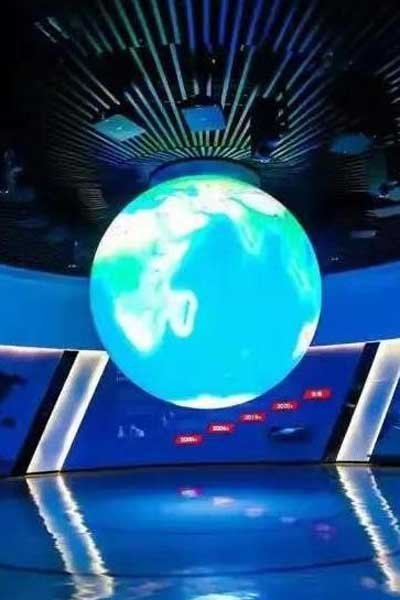
suspended digital globe led sphere science museum

A stunning 360-degree "Digital Earth" installation designed for science centers and educational galleries. This high-resolution sphere features seamless mapping technology to visualize planetary data and global simulations in real-time, creating an immersive focal point for large-scale exhibits.

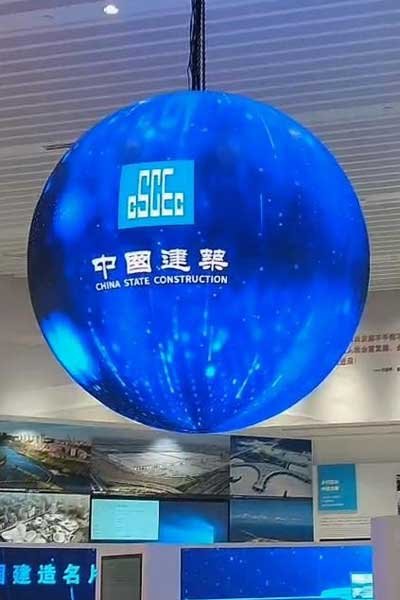
corporate lobby branding sphere led display china state construction

Tailored for corporate headquarters, this hanging Sphere LED display prominently features the China State Construction (CSCEC) logo. It serves as a dynamic brand beacon, using vibrant 3840Hz refresh rates to ensure flicker-free logos and brand content that capture attention from every angle of the lobby.

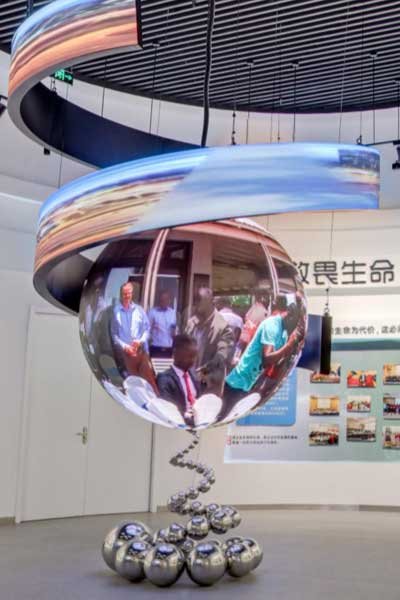
creative led sphere with spiral ribbon display art installation

Pushing the boundaries of digital art, this installation pairs a high-definition LED sphere with a synchronized spiral LED ribbon. Ideal for flagship stores and luxury showrooms, this multi-screen ecosystem combines unique geometry with cinematic content to turn any space into a responsive digital landmark.

Sphere LED Display: A 360° Custom LED Digital Sculpture

A Sphere LED Display is a custom LED system built around a true 3D spherical surface. Unlike a flat LED wall or a simple cylindrical wrap, a sphere curves in every direction and converges toward the top and bottom, so the module geometry, internal frame, pixel mapping and service strategy must all be designed around the final diameter.

DisplayMan reviews sphere projects for retail, exhibitions, science visualization, corporate lobbies, museums, public installations and architectural landmarks. The main design inputs are diameter, viewing distance, indoor/outdoor environment, pixel pitch, mounting method, content type and maintenance access.

One of Eight Featured Custom LED Product Families

Sphere LED Display is one of eight featured Custom LED product families: Sphere, Christmas Tree, Can-Shaped, Cube, Cylindrical, Vase-Shaped, Letter-Shaped, and Mascot & Character Shaped LED Displays.

360° Viewing GeometryDesigned for audiences positioned around the display rather than only in front of it.
Custom Spherical StructureSphere diameter, module segmentation and internal frame are engineered together.
Sphere-Specific MappingContent must be adapted to the final pixel map and polar convergence zones.
Indoor & Outdoor ReviewDifferent brightness, protection, thermal and structural strategies apply by environment.

Sphere LED Diameter & Pixel Pitch Selection

For fully customized Creative LED spheres, physical size is part of the engineering. A sphere that is too small may not provide enough module segments to create a visually smooth round surface. DisplayMan therefore treats approximately 2 m and above as the normal custom project direction, while around 1.5 m is a special compact configuration that requires engineering review.

Sphere DirectionReference DiameterTypical ApplicationsEngineering Logic
Special Compact Custom SphereApprox. 1.5 mPremium retail, exhibitions, brand spaces, compact museum installationsSpecial review only. Practicality depends on pixel pitch, available module geometry, tooling and the smoothness required by the final surface.
Standard Custom SphereApprox. 2–3 mMuseums, science centers, exhibitions, corporate lobbies, shopping mallsNormal Creative LED project direction with more space for module segmentation, internal structure and service access.
Large Architectural SphereApprox. 3–5 m+Atriums, entertainment venues, public interiors, large commercial landmarksSelect pitch from real viewing distance; large structures may require segmented shipment and on-site assembly.
Giant / Landmark SphereProject-basedUrban landmarks, stadiums, major public installations, large digital artStructure, installation, wind load, power distribution, modular transport and maintenance dominate the engineering.
Outdoor SphereProject-basedPlazas, exterior landmarks, outdoor events and public media objectsOutdoor LED modules, sealing, drainage, thermal management, wind load, cable protection and maintenance must be reviewed together.

Pixel Pitch Direction

Pitch DirectionViewing DirectionTypical Sphere Use
P1.5–P2.0 classPremium close indoor viewingDetailed digital Earth, scientific data, fine graphics and close-view installations where the selected sphere module system supports the pitch
P2.0–P2.5 classClose-to-medium indoor viewingCommon direction for museums, exhibitions, corporate lobbies and commercial Sphere LED projects
P3–P4 classMedium-to-long indoor viewingLarger architectural spheres and installations where total scale matters more than extreme pixel density
P5+ classOutdoor / long-distance viewingOutdoor and large landmark projects, subject to brightness, weatherproofing and structural design
Why We Do Not Promote Very Small Fully Custom Spheres

Very small sphere products are possible only when a mature existing module and tooling set already matches the required diameter and pitch. For a new fully custom development, reducing the diameter increases segmentation difficulty and tooling complexity. DisplayMan therefore normally recommends approximately 2 m+ for custom Sphere LED projects, with around 1.5 m treated as a special compact direction.

Existing Sphere Tooling vs Fully Custom Development

The largest cost difference in a Sphere LED project is often whether a mature sphere module/tooling system already exists for the required diameter and pitch, or whether the project needs a completely new module set.

Project DirectionModule / Tooling StrategyCost & Lead-Time ImpactBest Fit
Existing Sphere Module / Tooling SetUses a previously developed combination of sphere diameter, pitch and module segmentationLower development cost and shorter engineering cycle because the PCB/module/mask system already existsProjects that can accept an existing mature diameter and pitch combination
Partially Customized SphereExisting module concept with project-specific structure, control, brightness, installation or content requirementsModerate customization while avoiding a complete new sphere module family where possibleCommercial and museum projects needing mechanical or system adaptation
Fully Custom Creative SphereNew diameter and/or pitch requiring new PCB/module geometry, masks/tooling, frame segmentation and validationHighest NRE, tooling and prototype cost; longer development cyclePremium architectural, landmark, scientific or branded projects where the exact sphere geometry is essential
Custom Diameter Is Not Just a Frame Change

On a true LED sphere, changing the diameter can change the circumference of every latitude zone, the number and shape of modules, pole convergence, frame segmentation, pixel map and service layout. A new custom sphere may therefore require new PCB designs and multiple dedicated module types rather than simply resizing the metal frame.

Why Sphere LED Requires Dedicated Creative LED Engineering

The engineering problem is not simply “bending an LED screen into a ball.” A sphere introduces compound curvature, polar convergence, non-rectangular segmentation and a 360° content surface.

1. LED Surface ModulesTriangular, trapezoidal or project-specific segmented LED modules
2. Spherical FramePrecision structural shell that defines diameter and roundness
3. Receiving + PowerInternal receiving cards, power supplies and cable distribution
4. Video ProcessorInput processing, scaling and sphere pixel-map output
5. Media MappingProject-specific coordinate map for the complete 360° surface
6. Mounting + ServiceSuspended, floor-standing or integrated structural installation
Engineering FactorWhy It Matters
Surface GeometryA sphere curves in every direction; top and bottom convergence make rectangular-module approaches impractical without geometric segmentation.
Module / PCB ShapeTriangular, trapezoidal or project-specific module geometry may be used to follow the spherical surface.
Internal FrameThe frame defines diameter, roundness, module alignment, service access and the final structural load.
Pixel MappingFlat video content must be mapped onto a spherical coordinate system so graphics remain readable around the 360° surface.
Heat & PowerPower supplies, receiving cards and internal heat paths must be arranged without creating inaccessible service zones.
Tooling & NREA fully custom diameter or pitch can require multiple new PCB/module shapes, masks, carriers and assembly fixtures. Development cost must be evaluated before prototype production.
MaintenanceModule access should be planned before the sphere structure is finalized; service strategy depends on diameter and installation method.
Core Engineering Principle

Sphere diameter, module geometry, internal structure and pixel map must be designed as one system. Changing the diameter can change the mechanical segmentation, total pixels, content map and installation load.

Common Sphere LED Module Segmentation Strategies

There is no single universal way to build every Sphere LED Display. The best segmentation method depends on diameter, pixel pitch, required roundness, number of unique module types, tooling budget and service strategy.

Segmentation DirectionHow It WorksEngineering Trade-Off
Latitude / Abdomen-Shaped SegmentsDifferent curved or tapered module widths are distributed from the equator toward the poles to follow changing circumference.Can create a smooth spherical profile but may require several unique PCB/module geometries.
Triangular / Football-Style SegmentationTriangular or polygonal modules form a geodesic-style sphere with repeated facet geometry.Can reduce the number of module types, but facet visibility and pixel continuity must be controlled carefully.
Multi-Zone Curved SegmentationThe sphere is divided into several curvature zones, each using a module shape optimized for that latitude range.Balances roundness and module count but requires detailed mechanical and mapping coordination.
Project-Specific Hybrid DesignTwo or more segmentation methods are combined to match a demanding diameter, pitch, outdoor requirement or installation constraint.Highest flexibility, but also the highest engineering, tooling and prototype complexity.
Fewer Module Types vs Better Roundness

Reducing the number of unique LED modules lowers tooling, spare-parts and assembly complexity, but an aggressive reduction can make the sphere look more faceted. The engineering objective is to achieve the required visual roundness with the smallest practical number of module types.

Content Mapping for a 360° Sphere LED Display

A spherical screen has no single permanent “front.” Content therefore needs a different design logic from a conventional LED wall.

Pixel Map First

Before final content production, the creative team should work from the confirmed sphere pixel map so the media matches the actual module geometry and resolution.

Protect Important Content Zones

Text, logos and product details should be positioned around the main viewing directions and kept away from extreme top/bottom convergence when readability matters.

Design for 360° Continuity

Looping textures, planetary surfaces, abstract motion and continuous panoramic content can take advantage of the fact that there is no visual back side.

Content TypeSphere Mapping Strategy
Global / Planetary ContentLatitude-longitude style mapping works naturally for Earth, planets, weather, data visualization and scientific simulations.
Brand Logo / TypographyLogos should be positioned around the main audience directions; a single flat logo cannot be assumed to read correctly from all 360° viewpoints.
Abstract Motion GraphicsContinuous textures, particles, fluid motion and generative art are highly suitable because they do not depend on a single front-facing composition.
Product Visualization3D models and brand assets can be adapted to the sphere, but important information should avoid the top/bottom convergence zones.
Live Data / Interactive ContentExternal touchscreens, sensors or control systems can change sphere content while keeping the LED surface itself non-touch.

How to Add Interaction Without Touching the LED Sphere

The LED sphere itself is normally treated as the visual output surface. Interaction is better handled by an external control interface or sensor system.

Human Interface

Touchscreen Control Console

Use a separate touch display or kiosk to select scenes, rotate data sets, switch products or trigger sphere animations.

Sensor Trigger

Sensors & Proximity

Presence, motion or proximity sensors can trigger content when visitors approach the installation.

Control System

Synchronous / Scheduled Playback

The sphere can be integrated with a live source or independent media playback architecture depending on the project workflow.

Interaction Boundary

Direct physical touch on the LED sphere is normally not recommended. External touchscreens, sensors or gesture interfaces protect the LED surface and create a more maintainable interaction system.

Sphere LED Installation & Service Planning

Installation MethodEngineering Considerations
Suspended / Ceiling-MountedUseful for atriums, museums and exhibition halls; requires structural load review, rigging points, hidden or protected power/data routing and safe service access.
Floor-Standing BasePractical for retail, showrooms and exhibitions. A fixed or mobile base can be reviewed according to diameter, weight, center of gravity and relocation requirements.
Integrated Architectural MountFor permanent installations where the sphere becomes part of the interior or building structure.
Large Segmented InstallationLarger spheres are often divided into structural sections for shipping and reassembled on site; split lines, alignment, lifting and commissioning should be planned before production.
Outdoor Structural MountRequires project-specific review of wind load, waterproof interfaces, drainage, cable protection, thermal conditions and long-term maintenance access.
Maintenance

Plan Service Access Before Manufacturing

  • Module removal direction
  • Receiving-card access
  • Power-supply access
  • Internal cable routing
  • Suspension / base structure
  • Safe maintenance position
  • Spare module strategy
Installation

Plan Site Integration Before Shipment

  • Ceiling or floor load capacity
  • Entrance / lift / door clearance
  • Final assembly location
  • Power and signal entry point
  • Controller position
  • Rigging or lifting method
  • Local installation responsibilities
Front-Service Modules Can Be Considered — But Not Assumed

Some sphere module systems allow modules to be removed from the outside surface. For a fully custom sphere, however, the service method depends on module shape, magnetic/mechanical fixing, diameter, mounting and internal electronics. Maintenance access must be confirmed as part of the sphere engineering rather than treated as a universal fixed feature.

Typical Sphere LED Display Applications

Digital Earth & Science Visualization

A spherical screen is naturally suited to planetary data, geography, climate, astronomy and global simulation content.

Corporate Lobby Landmark

A hanging or floor-mounted sphere can operate as a programmable brand object rather than a conventional rectangular signage screen.

Retail & Flagship Stores

Special compact or standard custom spheres can act as product-launch centerpieces, luxury-brand visual objects and high-traffic focal points when the physical scale justifies a true 360° display.

Museums & Visitor Centers

The 360° surface supports educational storytelling where audiences gather around the object from multiple directions.

Exhibitions & Events

Sphere LED works well as a central digital sculpture when the objective is to create an instantly recognizable booth landmark.

Public & Architectural Installations

Larger project-specific spheres can be engineered as permanent indoor or outdoor media landmarks.

Sphere LED Display vs Flat LED Wall

FactorSphere LED DisplayFlat LED Wall
Viewing Geometry360° curved surface; audience can gather around the objectPrimarily front-facing
Architectural RoleDigital sculpture / spatial landmarkDisplay wall / signage surface
Content WorkflowRequires spherical mapping and content-zone planningStandard 16:9 or custom flat-canvas content
StructureCustom spherical frame and segmented modulesRectangular module / cabinet structure
ServiceMust be designed around sphere diameter and mounting methodGenerally simpler front or rear access
Best UseLandmarks, immersive exhibits, brand objects, science visualizationPresentations, advertising walls, dashboards, conventional video content

Sphere LED Display vs Cylindrical LED Display

FactorSphere LED DisplayCylindrical LED Display
SurfaceCompound 3D curvature in all directionsSingle-axis continuous cylindrical curve
Top / Bottom GeometrySurface converges toward polesConstant diameter along most of the body
Content MappingSpherical mapping requiredPanoramic wrap mapping is simpler
Module EngineeringOften needs triangular / trapezoidal / project-specific segmentationFlexible rectangular modules can often wrap around a cylinder
Best ForDigital Earth, floating landmarks, 360° sculptureColumns, pillars, product towers, architectural wraps
Engineering ComplexityHigherUsually lower
Choose the Shape from the Spatial Goal

Choose a Sphere when the display should function as a 360° object or digital sculpture. Choose a Cylinder when the project is mainly wrapping a column, pillar or constant-radius body. The geometry determines the engineering and content workflow.

Explore 8 Featured Custom LED Display Product Families

Sphere LED is one featured direction within DisplayMan’s broader Custom / Creative LED engineering capability. These eight product families are common entry points, not a limit on the shapes that can be developed.

Featured Product Families, Not the Limit of Creative LED

DisplayMan has dedicated pages for Sphere, Christmas Tree, Can-Shaped, Cube, Cylindrical, Vase-Shaped, Letter-Shaped, and Mascot & Character Shaped LED Displays. Creative LED can also extend to rings, flowers, torches, branded objects, sculptures and other project-specific forms. Use the Custom LED Displays parent page when the final shape is still being selected.

Related Sphere LED Products, Solutions & Applications

Sphere LED projects can begin from three different directions: the buyer may already know the display form, may need help solving the custom engineering problem, or may only know the final venue and use case. Use the route that best matches the current stage of the project.

When a Sphere LED Display Is the Right Product

Recommended

Good Fit

  • 360° viewing is part of the concept
  • The display should become a physical landmark
  • Digital Earth / planet / globe visualization
  • Audiences gather around the object
  • Retail or exhibition centerpiece
  • Custom architectural media sculpture
  • Project accepts sphere-specific content mapping
Alternative Direction

Choose Another Shape When

  • The audience views content only from the front
  • A standard rectangular wall would solve the project more efficiently
  • The goal is to wrap a column or pillar — choose Cylindrical LED
  • The concept is a logo or letter — choose Letter-Shaped LED
  • The concept is a branded product replica — choose Can-Shaped LED
  • The concept is a mascot or character identity mapped onto a character-like 3D LED body — choose Mascot & Character LED

What Information Should You Provide for a Sphere LED Quote?

Display

Display Requirement

  • Target sphere diameter
  • Can an existing mature diameter/pitch combination be accepted, or is the exact size mandatory?
  • Indoor or outdoor environment
  • Typical / minimum viewing distance
  • Preferred pixel pitch if known
  • Need for exact spherical appearance vs acceptable faceted segmentation
  • Content type
  • Required overall resolution if any
  • Quantity
  • Project schedule
Engineering

Mechanical & Site Requirement

  • Suspended / floor-standing / integrated installation
  • Site photos or drawings
  • Available structural support
  • Height above floor
  • Power and signal location
  • Service-access requirement
  • Shipping destination
  • Local installation responsibility
Diameter + Pitch + Existing Tooling Flexibility Come First

For a sphere project, the most useful starting information is the physical diameter, viewing distance, pixel pitch and whether the project can accept an existing mature sphere module/tooling combination. These inputs affect module count, tooling cost, structure, mapping, prototype development and logistics.

Sphere LED Display FAQ

Why is a fully custom Sphere LED Display expensive?

A true sphere may require several uniquely shaped PCB and LED module types, dedicated masks or carriers, precision structural sections, a project-specific pixel map and prototype validation. If the diameter or pitch is new, tooling and NRE can represent a significant part of the first project cost.

Does every new sphere diameter require new LED modules?

Not always, but often the diameter and pixel pitch are directly linked to the sphere module geometry. If an existing mature module/tooling combination cannot be reused, a new diameter can require new PCB/module designs and revised frame segmentation.

Can you make a Sphere LED Display smaller than 1.5 meters?

Very small spheres are only practical when a suitable existing module and tooling system already exists. For new fully custom Creative LED development, DisplayMan treats around 1.5 m as a special compact review size and normally recommends approximately 2 m or larger.

What module shapes are used for Sphere LED Displays?

Depending on the project, the sphere may use triangular, trapezoidal, abdomen-shaped, multi-zone curved or other project-specific LED module geometries. The objective is to achieve the required roundness with a practical number of unique module types.

Is front maintenance available?

Front-service maintenance can be considered when the selected sphere module and fixing system support external module removal. For fully custom spheres, the maintenance method must be confirmed during engineering rather than assumed as a universal feature.

How is a large Sphere LED Display shipped?

Large spheres are commonly divided into structural sections for transport and then assembled and aligned on site. The exact split strategy depends on diameter, shipping access, lifting conditions and the final installation structure.

Can you make a hemisphere instead of a full sphere?

A hemisphere or dome-like form can be reviewed as a related Creative LED geometry when full 360-degree viewing is not required. Its structure, module segmentation and content mapping should be engineered specifically for that geometry.

What is a Sphere LED Display?

A Sphere LED Display is a custom 360° LED display built around a spherical frame using segmented LED modules and sphere-specific content mapping.

Is a Sphere LED Display the same as a curved LED screen?

No. A curved LED screen normally bends along one main axis. A sphere has compound curvature and converges toward the top and bottom, which requires different module geometry and mapping.

What is the difference between a Sphere LED Display and a Cylindrical LED Display?

A cylinder has a constant-radius wrap and simpler panoramic mapping. A sphere curves in every direction and normally requires more complex surface segmentation and spherical media mapping.

What pixel pitch should I choose?

Choose pitch from viewing distance, sphere diameter, content detail and environment. Smaller pitch is useful for close indoor viewing; larger architectural spheres do not automatically need the smallest pitch.

What sphere diameters are available?

For fully customized DisplayMan Sphere LED projects, approximately 2 m and above is the normal project direction. Around 1.5 m can be reviewed as a special compact configuration. Smaller sizes should only be considered when an existing mature sphere module/tooling set already matches the required diameter and pitch.

Can a Sphere LED Display show a digital Earth?

Yes. Planetary and geographic content are among the most natural applications because the physical display geometry already matches the subject.

How is normal video displayed on a sphere?

Content is adapted using a sphere-specific pixel map. Important logos, text and focal points should be positioned with the main audience directions and polar convergence in mind.

Can the Sphere LED Display be interactive?

Yes. Interaction is normally provided through an external touchscreen, sensor, gesture system or control interface that changes the content shown on the sphere.

Can the sphere be suspended from a ceiling?

Yes, subject to diameter, weight, building structure, cable routing and service-access review.

Can it be floor-standing?

Yes. A floor-standing base is practical for retail, exhibition and showroom projects and can simplify installation and maintenance.

Can Sphere LED Displays be used outdoors?

Outdoor sphere projects can be reviewed, but they require a dedicated outdoor module, brightness, waterproofing, cable protection, structural and wind-load design.

Do you provide a pixel map for content creation?

Sphere projects should include a project-specific pixel-map or media-mapping reference so the content team can prepare graphics for the final geometry.

Is the LED surface touch-sensitive?

Normally no. Direct touch on the LED sphere is not the preferred interaction method; an external touch display or sensor system is more practical.

What information is needed for quotation?

Provide target diameter, indoor/outdoor environment, viewing distance, installation method, preferred pitch if known, quantity, site photos or drawings, content type and project schedule.

Is Sphere LED one of DisplayMan's Custom LED Display products?

Yes. Sphere LED is one featured Custom / Creative LED direction. DisplayMan also develops other geometric, product-replica, branded and free-form LED shapes according to project requirements.

Start Your Sphere LED Display Project

Send the target diameter, viewing distance, installation method and environment. We can review the most practical sphere structure, pixel pitch and content-mapping direction.

A Sphere LED Display should be engineered as a complete 3D system. Diameter, module geometry, frame, pixel mapping, mounting and service access need to work together before the final specification is confirmed.

Send Your Display Requirement

Please share your application, display size, quantity and project background. We will review the most practical display direction.