1600 × 1200 Real RGB
UXGA resolution provides detailed imagery, menus and overlays in a compact 0.5″ display format.

High-Resolution 1600 × 1200 OLED-on-Silicon Image Source
DisplayMan offers this compact real-RGB Micro OLED platform for electronic viewfinders, medical imaging, near-eye displays and professional optical systems.
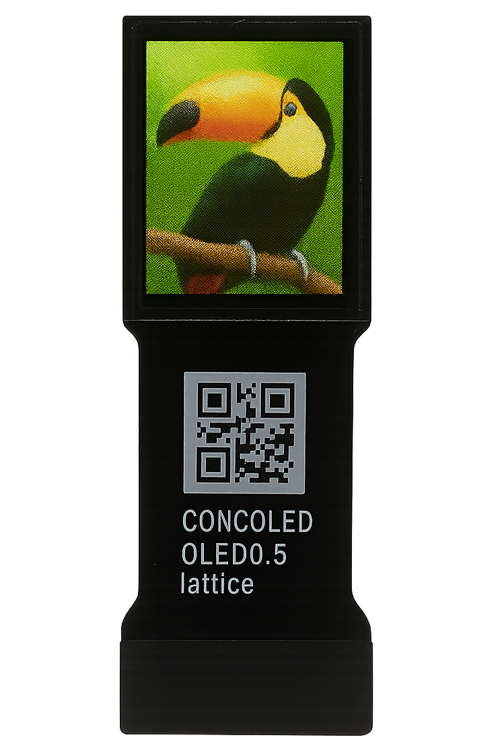
The 0.5″ Micro OLED display is a high-resolution OLED-on-Silicon module within DisplayMan’s broader Micro OLED displays portfolio. It provides a native 1600 × 1200 real RGB resolution across a 10.08 × 7.56 mm usable display area.
Its 4:3 UXGA format offers more vertical image detail than a 16:9 Full HD format, making it practical for electronic viewfinders, medical viewers, optical instruments and near-eye systems that benefit from a taller image area.
The reference platform combines 1000 cd/m² luminance, 100,000:1 typical contrast and 60–120 Hz operation in a compact 0.5″ module.
The panel uses a MIPI display interface with I²C control. HDMI, Type-C and other host inputs require compatible driver electronics.
The following engineering references are based on the SY050WGM01 data sheet. Final production specifications and compatibility should be confirmed against the selected module and approved drawing.
| Model | SY050WGM01 |
|---|---|
| Display Technology | Active-matrix color OLED-on-Silicon / OLEDoS |
| Diagonal Size | 0.5 inch |
| Native Resolution | 1600 × 1200 UXGA, real RGB |
| Number of Dots | 5.76 million subpixels: 1600 × 1200 × 3 |
| Pixel Size | 6.3 × 6.3 μm |
| Usable Display Area | 10.08 × 7.56 mm |
| Brightness | 1000 cd/m² reference |
| Contrast Ratio | 100,000:1 typical |
| Uniformity | >85% reference |
| Color Depth | 8-bit or 10-bit; 16.7 million or 1.07 billion colors |
| Frame Rate | 60–120 Hz |
| Display Interface | One-port, 4-lane MIPI D-PHY / MIPI DSI video mode |
| Control Interface | I²C |
| Compression | VESA DSC 1.1 decoder support, 3:1 and 3.75:1 reference ratios |
| Scaling Support | 1200 × 900 to 1600 × 1200; 800 × 600 to 1600 × 1200 reference modes |
| Reference Power Consumption | Approximately 500 mW under specified conditions |
| Operating Temperature | −20°C to +70°C |
| Storage Temperature | −40°C to +80°C |
Brightness, power, frame rate and supported functions depend on drive settings and operating conditions. Confirm current availability and driver-board compatibility before design-in.
UXGA resolution provides detailed imagery, menus and overlays in a compact 0.5″ display format.
The taller image area is useful for viewfinders, medical imaging and optical instruments that need more vertical detail.
A wide frame-rate range supports smooth motion when the host, driver and complete image pipeline are correctly configured.
True black and 100,000:1 typical contrast help fine details remain visible after optical magnification.
A 4-lane MIPI DSI interface and I²C control support compact embedded display architectures.
Support for 16.7 million or 1.07 billion colors enables detailed grayscale and color reproduction.
UXGA detail, 4:3 format and up to 120 Hz for professional cameras and imaging equipment.
A compact high-resolution image source for diagnostic viewers and specialized medical optical equipment.
Fine pixel density and strong contrast for digital microscopes, laboratory viewers and inspection instruments.
A practical 4:3 UXGA direction for compact head-mounted displays and binocular optical evaluation.
Detailed self-emissive imagery for portable thermal viewers and professional observation systems.
A reference platform for evaluating high-resolution eyepieces, driver electronics and near-eye optical engines.
The panel is one component in the complete image chain. Final quality depends on the host, driver electronics, optics and mechanical alignment.
Use the Near-Eye Display Solution page for display selection, driver electronics, optical matching, mechanics and prototype review.
Compare aspect ratio, resolution, brightness, active area, field of view, interface and mechanical space together—not by diagonal size alone.
Compare nine Micro OLED sizes and open the model page that best matches your resolution, optical and mechanical requirements.
SY050WGM01 provides a native 1600 × 1200 UXGA real RGB resolution across a 10.08 × 7.56 mm usable display area.
The reference luminance is 1000 cd/m². Final luminance depends on drive settings, operating conditions and the exact production version.
The 1600 × 1200 format provides more vertical pixels than a 16:9 Full HD format, which can be useful for EVF, medical imaging, microscopes and instrument displays.
The platform uses a one-port, 4-lane MIPI D-PHY / MIPI DSI video interface with I²C control.
Normally no. HDMI or Type-C requires compatible conversion and driver electronics that output the correct MIPI timing, control and power sequence.
The data-sheet reference frame-rate range is 60–120 Hz. The final rate depends on host bandwidth, MIPI configuration, compression and complete system design.
It is a relevant direction for medical viewers and optical instruments that benefit from compact UXGA resolution, but final selection requires optical, regulatory and system-level evaluation.
Please provide the application, quantity, host input, required frame rate, brightness, optical specifications, mechanical limits and project schedule.
Send the application, required quantity, brightness target, host input, optical requirement, available mechanical space and project schedule. DisplayMan will review whether the SY050WGM01 platform is suitable.