Industrial TFT LCD Displays – Engineered for Extreme Environments | DisplayMan

High-reliability TFT LCD modules designed for 24/7 operation, wide temperature ranges, high-brightness visibility, and rugged industrial performance.

Built for demanding applications in automation, transportation, energy, medical, and outdoor systems.

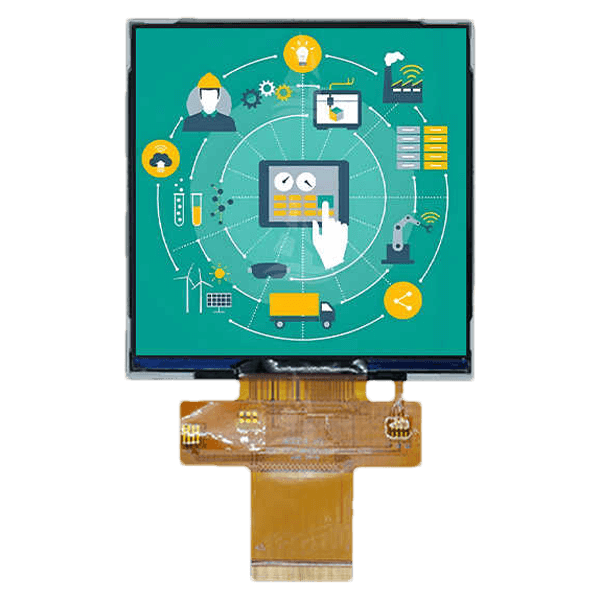
4.0 inch ips 480x480 square tft lcd rgb interface st7701s high brightness wide temperature display module

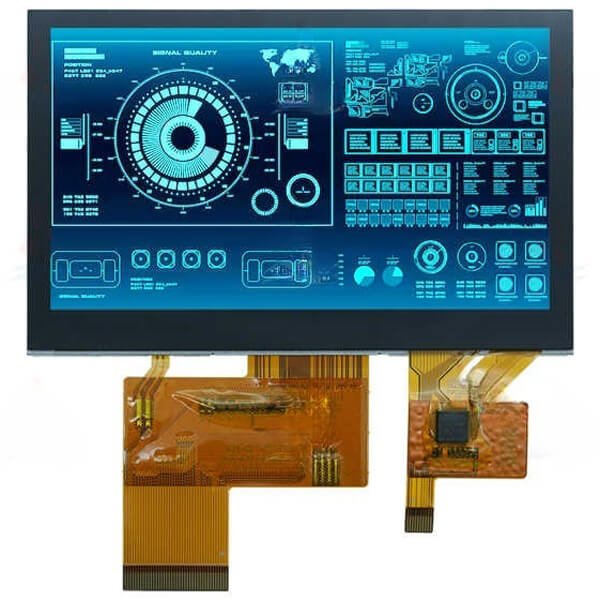
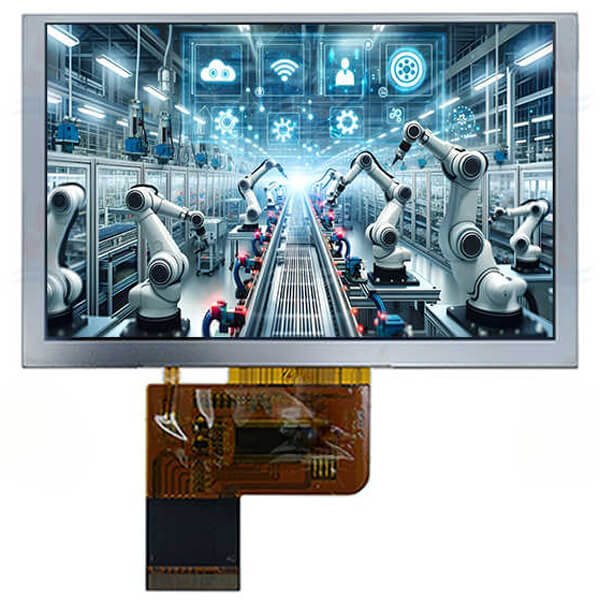
🖼️ Showcase of DisplayMan Industrial TFT LCD Displays

Discover DisplayMan’s robust lineup of Industrial-Grade TFT LCD modules, purpose-built for harsh environments, mission-critical equipment, and long-life operation where durability and reliability are non-negotiable.

From factory automation systems, medical instruments, and test equipment to transportation displays, agricultural machinery, and energy control panels, these industrial TFTs deliver stable performance under extreme temperatures, vibration, humidity, and continuous 24/7 operation.

This showcase highlights our full spectrum of industrial-spec TFT displays — including wide-temperature operation, high brightness, IPS wide-viewing angles, rugged mechanical structures, long-lifecycle ICs, and customizable electrical interfaces such as RGB, LVDS, and MIPI.

Whether you require a standard industrial module or a fully customized display designed for your enclosure, environmental conditions, and UI architecture, this collection demonstrates the engineering strength and reliability DisplayMan brings to industrial TFT display design.

Explore the displays built to power real-world industrial applications — stable, durable, and ready for the toughest conditions.
SpecificationDetails
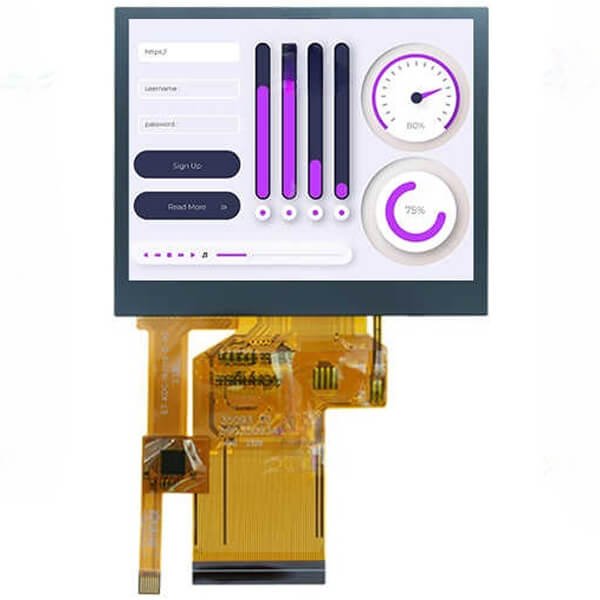
Product Name3.5″ IPS Industrial LCD with Capacitive Touch
Part NumberKD035LQFPA093-04-C036A
Resolution320 × 240
Display TypeIPS, Normally Black
Controller ICST7272A
Brightness800 cd/m²
Touch PanelCapacitive Touch
Touch ICFT6336G
InterfaceRGB (16/18/24-bit)
Operating Temp.–30°C to +85°C
pecificationDetails
Product Name4.3″ Industrial TFT LCD with Capacitive Touch
Part NumberKD043WQFPA142-01-C037D
Resolution480 × 272
Display TypeIPS, Normally Black
Controller ICST7282A
Brightness650 cd/m²
Touch PanelCapacitive Touch (5-point)
Touch ICFT5446U
InterfaceRGB (24-bit)
Operating Temp.–30°C to +80°C
SpecificationDetails
Product Name5.0″ Industrial TFT LCD
Part NumberKD050WVFLA033
Resolution800 × 480
Display TypeIPS TFT, Normally Black
Controller ICST7262
Brightness800 cd/m²
Touch PanelNone
InterfaceLVDS
Input Voltage3.3V
Operating Temp.–30°C to +85°C
SpecificationDetails
Product Name5.9″ Industrial TFT LCD
Part NumberKD059WVFLD002-C001A
Resolution840 × 512
Display TypeIPS TFT, Normally Black
Controller ICJD9168S
Brightness850 cd/m²
Touch PanelCapacitive Touch (5-point)
Touch ICGT911
InterfaceLVDS
Operating Temp.–30°C to +80°C
SpecificationDetails
Product Name6.2″ Industrial TFT LCD
Part NumberKD062VGFPA003-01
Resolution640 × 240
Display TypeIPS TFT, Normally Black
Controller ICST5043AA / ST5894AA
Brightness900 cd/m²
Touch PanelNone
InterfaceRGB (16/18/24-bit)
Input Voltage3.3V
Operating Temp.–30°C to +85°C
SpecificationDetails
Product Name7.0″ Industrial TFT LCD
Part NumberKD070WVFLA035A-C049C
Resolution800 × 480
Display TypeIPS TFT, Normally Black
Controller ICRM533C0 / RM577C1
Brightness1030 cd/m²
Touch PanelCapacitive Touch (10-point)
Touch ICGT9271
InterfaceLVDS (6/8-bit)
Operating Temp.–30°C to +85°C
SpecificationDetails
Product Name8.0″ Industrial TFT LCD
Part NumberKD080WVFIA033
Resolution800 × 600
Display TypeIPS TFT, Normally Black
Controller ICJD9165BA
Brightness800 cd/m²
Touch PanelNone
InterfaceMIPI (4-lane)
Input Voltage3.3V
Operating Temp.–20°C to +70°C
SpecificationDetails
Product Name12.8″ Industrial TFT LCD
Part NumberKD128FHFLD001-01
Resolution1920 × 1080
Display TypeIPS TFT, Normally Black
Brightness1000 cd/m²
Contrast Ratio1500 : 1
Touch PanelNone
InterfaceLVDS
Input Voltage3.3V
Operating Temp.–30°C to +70°C
SpecificationDetails
Product Name21.5″ Industrial TFT LCD
Part NumberKD215FHFLA022
Resolution1920 × 1080
Display TypeIPS TFT, Normally Black
Brightness1000 cd/m²
Contrast Ratio1000 : 1
Touch PanelNone
InterfaceDual-Channel LVDS
Input Voltage5V
Operating Temp.–20°C to +85°C

⚔️ Industrial TFT vs. Consumer TFT — What Really Separates Them?

At first glance, consumer TFT LCDs and industrial TFT LCDs may look similar on a datasheet.
But once deployed in real-world environments — heat, cold, vibration, sunlight, and 24/7 operation — the differences become impossible to ignore.

This comparison highlights why OEM engineers consistently choose Industrial TFT LCDs when reliability, lifecycle stability, and total cost of ownership matter.

If your product is expected to work outside the lab, this table tells you everything you need to know.


CategoryConsumer TFT LCDIndustrial TFT LCD (DisplayMan)
Temperature Range0°C ~ 50°C–40°C ~ +85°C
Brightness200–400 nits1,000–3,000 nits
Backlight Life10,000–20,000 hrs50,000–100,000 hrs
Viewing AngleTN narrowIPS 178°
Shock / Vibration ResistanceWeakReinforced structure
EMI ProtectionLimitedIndustrial EMI / ESD shielding
24/7 StabilityNot suitableEngineered for constant operation
Interface OptionsMostly MCU / RGBLVDS, RGB, MCU, MIPI, HDMI
Lifecycle SupportShort (6–18 months)Long-term stable supply
CustomizationVery limitedFull OEM / ODM
Sunlight ReadabilityPoorBonding + AR + High Brightness

✅ Key Takeaways for OEM & System Designers

  • Consumer TFTs optimize for cost, not longevity — ideal for gadgets, unsuitable for field deployment

  • Industrial TFTs optimize for uptime, stability, and environmental resilience

  • Higher brightness and IPS viewing angles ensure consistent visibility in sunlight and harsh lighting

  • Long backlight life and wide temperature support dramatically reduce maintenance and downtime

  • Long-term supply and customization protect your product roadmap from sudden redesigns

In industrial, outdoor, automotive, and professional equipment,
the display is not a component — it’s a system-critical interface.

Choosing an Industrial TFT LCD is not an upgrade — it’s risk control.

⚠️ The Pain: Why Standard Consumer TFT LCDs Fail in Industrial Applications

Industrial environments push displays far beyond consumer tolerances.

When a standard TFT module is installed in heavy-duty equipment, it quickly reveals its limitations — often causing expensive failures, downtime, and safety risks.

Below are the six critical failure modes that make consumer displays unsuitable for industrial use.

Lorem ipsum dolor sit amet, consectetur adipiscing elit. Ut elit tellus, luctus nec ullamcorper mattis, pulvinar dapibus leo.

Lorem ipsum dolor sit amet, consectetur adipiscing elit. Ut elit tellus, luctus nec ullamcorper mattis, pulvinar dapibus leo.

Consumer TFT displays are designed for climate-controlled environments.

In industrial settings, they encounter:

  • sub-zero temperatures that slow liquid-crystal response, causing ghosting
  • high temperatures that blacken polarizers or warp layers
  • rapid thermal transitions that create condensation, internal stress, or delamination
  • reduced contrast and color shift at low temperatures
  • IC malfunction due to thermal expansion mismatch

Result:

Unstable display performance, unreadable UIs, and early material degradation.

Industrial TFTs require wide-temperature LC materials, heat-resistant adhesives, and industrial-grade driver ICs to survive.

Factories, vehicles, transportation systems, and handheld devices expose displays to constant mechanical stress.

Consumer modules fail because they use:

  • thin BLU (backlight unit) frames
  • low-rigidity metal housings
  • minimal bracket reinforcement
  • fragile FPC solder joints

Consequences include:

  • flickering backlights
  • cracked glass
  • connector loosening
  • IC detachment
  • color mura due to pressure points

Industrial modules must use thicker metal frames, reinforced corners, shock-absorbing structures, and industrial adhesive systems.

Consumer TFTs typically operate at 200–400 nits with glossy polarizers.

In factories or outdoor installations, they suffer from:

  • severe glare that hides important data
  • washed-out text and UI elements
  • reflective surfaces that produce mirror-like reflections
  • backlight overdrive causing thermal buildup
  • UV exposure that accelerates polarizer aging

This leads to unreadable screens and safety hazards for operators.

Industrial systems require 1,000–3,000 nits, optical bonding, and AG/AR coatings for visibility under sunlight or harsh lighting.

Industrial environments contain motors, inverters, radios, welders, power converters — all producing high EMI/ESD levels.

Consumer displays lack:

  • EMI-shielded circuits
  • grounded metal frames
  • ESD-resistant touch controllers
  • noise-immune LVDS signaling

Exposure causes:

  • flickering
  • unstable backlights
  • communication dropouts
  • corrupted display data
  • touchscreen misbehavior

Industrial TFTs need shielding layers, ESD protection, filtered connectors, and robust grounding paths.

Consumer displays are not designed for continuous duty cycles.

Problems include:

  • LED backlight wear → brightness decay
  • driver IC overheating → ghosting, artifacts
  • thin PCBs → thermal warping
  • LCD degradation → contrast loss
  • solder aging → intermittent faults

Under constant use (automation, kiosks, EV chargers, control panels), consumer displays often fail within months.

Industrial TFTs use derated LEDs, thicker copper layers, heat-dissipating frames, and long-life materials to support 24/7 operation for years.

Consumer displays follow a 6–18 month lifecycle — unacceptable for machines requiring 5–10 years of guaranteed availability.

Risks:

  • discontinued ICs
  • panel obsolescence
  • inconsistent suppliers
  • forced redesign of PCB or enclosure

For industrial OEMs, this equals:

  • re-qualification costs
  • certification repetition
  • huge engineering burden
  • risk of product downtime

Industrial displays must offer long-term BOM control, stable supply, and lifecycle guarantees.

🛠️ The Solution: DisplayMan Industrial TFT LCD Displays

DisplayMan designs and manufactures TFT LCD modules specifically for demanding industrial applications — where failure is not an option.

Every module is built with rugged construction, wide-temperature materials, long-life components, and EMI-resistant electronics to ensure stable operation in harsh, 24/7 environments.

Below is a deeper look at how DisplayMan builds truly industrial-grade displays.

🔧 Engineered for Harsh Environments

Industrial environments expose displays to extreme heat, freezing temperatures, sudden thermal swings, and constant vibration.

DisplayMan uses:

  • wide-temperature liquid crystals that maintain responsiveness in –40°C cold starts
  • high-temperature polarizers resistant to sunlight and heat soak
  • industrial-grade driver ICs with extended temperature ranges
  • reinforced adhesives and optical layers to prevent warping or delamination

Result:

Panels remain clear, stable, and responsive whether installed in a refrigerated warehouse, an outdoor kiosk, or a factory floor.

🌞 High Brightness & Sunlight Readability

Industrial systems often operate in environments with strong ambient light or direct sun exposure.

To ensure visibility, DisplayMan equips modules with:

  • 1,000–3,000 nits high-efficiency LED backlights
  • high-transmission LCD stack for sunlight readability
  • optical bonding to eliminate internal reflections and condensation
  • anti-glare (AG) / anti-reflective (AR) coatings
  • high contrast ratio polarizers optimized for harsh light

These enhancements deliver sharp visibility, even in:

  • outdoor EV chargers
  • parking meters
  • marine displays
  • sunlight-exposed control panels

📡 EMI-Resistant Electrical Design

Industrial machines generate significant electromagnetic noise.

DisplayMan protects display performance through:

  • shielded FPC and PCB layouts
  • robust grounding and filtering
  • EMI-rated connector design
  • industrial-grade timing controllers
  • ESD-protected touch panels (2–10 kV)

This prevents:

  • flicker
  • signal dropout
  • touchscreen malfunction
  • visual artifacts

Industrial operators can rely on DisplayMan displays even near motors, inverters, RF transmitters, and high-power switching equipment.

🏗️ Mechanical Reinforcement

Industrial use cases often involve heavy vibration, impact, and mechanical stress.

DisplayMan ensures durability with:

  • thicker metal backplates
  • rigid BLU frames to prevent backlight flex
  • shock-absorbing mechanical structures
  • reinforced bezel thickness
  • industrial glue systems for lamination
  • anti-twist construction to prevent mura

This makes the displays ideal for:

  • machinery HMIs
  • handheld tools
  • vehicle dashboards
  • transportation systems
  • construction and agricultural equipment

Where constant movement or impact is unavoidable, DisplayMan modules continue operating with consistent image integrity.

*

♾️ Long-Life Components & Stable Supply

Industrial products require displays that last years, not months.

DisplayMan ensures long-term stability through:

  • high-lifetime LED backlights (50,000–100,000 hrs)
  • BOM-controlled components to prevent unexpected changes
  • long-lifecycle IC selection
  • strict QC and traceability
  • lifecycle guarantee for industrial customers

This eliminates the risk of:

  • sudden part discontinuation
  • revalidation of equipment
  • retooling or redesign
  • operator downtime and service costs

Industrial buyers can rely on DisplayMan for stable production and multi-year availability.

DisplayMan Industrial TFT LCDs are engineered to survive extreme environments, deliver long-term reliability, and integrate seamlessly into mission-critical systems — ensuring your equipment performs flawlessly for years.

🧭 Applications That Depend on Industrial TFT LCDs

Industrial TFT LCD Displays aren’t cosmetic components — they are mission-critical interfaces that determine safety, uptime, and user performance.

DisplayMan displays are trusted across industries because they deliver visibility, reliability, and precision under the toughest conditions.

🏭 Factory Automation & Industrial Equipment

Industrial production environments expose displays to dust, vibration, heat, and long operating hours.

DisplayMan TFT LCDs are ideal for:

  • HMIs and touch control panels
  • PLC operator stations
  • CNC machines and robots
  • Environmental and process monitors
  • Packaging and assembly-line equipment

Why our displays excel:

High-brightness, wide-temperature tolerance and reinforced mechanical structures ensure the UI stays readable, responsive, and stable during 24/7 manufacturing operations.

🚗 Automotive, Transportation & Heavy Vehicles

Transportation systems require displays that can withstand shock, sunlight, and rapid temperature changes.

Applications include:

  • Vehicle dashboards and instrument clusters
  • EV charging stations
  • Telematics and fleet-monitoring devices
  • Marine navigation interfaces
  • Railway control terminals

How DisplayMan adds value:

Our sunlight-readable, EMI-shielded, vibration-resistant displays maintain clarity on highways, sea routes, and industrial yards—where reliability directly impacts safety.

🔋 Energy & Power Management Systems

Energy systems often operate outdoors or in high-temperature enclosures.

DisplayMan industrial TFTs are used in:

  • Solar inverters & battery storage systems
  • Smart meters and energy controllers
  • Wind turbine interfaces
  • Power distribution units (PDU)

Why they’re essential:

High-brightness and anti-reflective coatings ensure visibility under direct sunlight, while wide-temp and EMI-resistant components ensure accurate data in high-noise electrical environments.

🏥 Medical, Laboratory & Diagnostic Instruments

Mission-critical medical interfaces require stable color accuracy and long-term reliability.

Common applications:

  • Diagnostic analyzers
  • Portable medical devices
  • Monitoring and imaging equipment
  • Benchtop laboratory instruments

DisplayMan advantage:

IPS technology, calibrated gamma, and precise color reproduction ensure that medical professionals receive accurate, consistent visual information — every time.

🌦️ Outdoor Kiosks & Rugged Public Terminals

Public terminals face vandal resistance, weather exposure, and constant usage.

Solutions include:

  • Ticketing and ATM kiosks
  • Self-service POS terminals
  • Parking meters
  • Smart city infrastructure
  • Information boards

Why DisplayMan:

High-brightness modules with optical bonding withstand sunlight, fog, condensation, dust, and temperature swings — ensuring continuous uptime in public environments.

🧰 Field Equipment & Handheld Tools

Portable devices used in the field require displays that survive drops, vibration, and environmental stress.

Industries include:

  • Inspection devices
  • Industrial analyzers
  • Multimeters & oscilloscopes
  • Engineering handheld HMIs

DisplayMan’s solution:

Rugged mechanical frames, transflective or high-brightness options, and wide-temperature LCD material ensure visibility and durability in outdoor and remote locations.

🧪 Industrial OEM Development Process

DisplayMan follows a rigorous, engineering-first development workflow designed specifically for industrial clients who require long lifecycle stability, environmental reliability, and precise system integration.

Each step is driven by our optical, electrical, and mechanical engineering teams to guarantee predictable results and long-term support.

1️⃣Requirement Definition

The process begins with a comprehensive analysis of your product’s technical and environmental requirements:

  • Operating temperature range (e.g., –40°C to +85°C)
  • Brightness & sunlight readability targets
  • Viewing angle and color performance needs
  • Interface type: LVDS, RGB, MCU, MIPI DSI, HDMI
  • Mechanical constraints (housing, bezel, mounting, FPC orientation)
  • Touch requirements (PCAP / resistive / custom cover glass)
  • Environmental challenges: vibration, shock, humidity, EMI
  • Long-term supply and product lifecycle expectations

This step ensures the display is engineered for your exact use case, not a generic module.

2️⃣ Engineering Feasibility & Proposal

Once requirements are gathered, DisplayMan’s engineering departments collaborate to build a technical proposal:

  • Optical engineering evaluates backlight design, brightness feasibility, optical bonding options, polarizer type, and contrast optimization.
  • Electrical engineering determines timing compatibility, signal integrity, interface selection, pin mapping, and EMI shielding requirements.
  • Mechanical engineering reviews enclosure fit, mounting structure, heat dissipation, and shock-proof design.

Deliverables may include:

  • Feasibility report
  • Preliminary mechanical drawing
  • Proposed module configuration
  • Estimated optical performance
  • BOM-controlled components
  • Project timeline

This ensures technical alignment before physical development begins.

3️⃣ Prototype & Validation

After approval, DisplayMan builds engineering prototypes that reflect real production characteristics.

Our prototypes typically include:

  • Fully assembled TFT LCD module
  • Driver board or interface adaptor
  • Custom FPC and cables
  • Optional touch panel integration
  • Preliminary mechanical frame or cover glass

Every prototype undergoes industrial validation tests, such as:

  • Thermal cycling
  • Heat soak
  • Cold start
  • Vibration/shock testing
  • Sunlight / high-ambient-light testing
  • Optical uniformity and brightness analysis
  • EMI/ESD checks

Customers validate the display inside their system for:

  • UI clarity
  • Timing compatibility
  • Power behavior
  • Mechanical fit
  • Environmental performance

4️⃣ Optimization & Final Approval

Based on prototype feedback, our engineers fine-tune the display for optimal performance.

Typical optimizations include:

  • Brightness and LED current tuning
  • Uniformity enhancement
  • Color and gamma calibration
  • Timing adjustments (frame rate, polarity, sync parameters)
  • FPC modifications for easier assembly
  • Mechanical strengthening for vibration
  • Optical bonding adjustments
  • Touch sensitivity and firmware tuning

After refinement, we provide:

  • Updated drawings
  • Updated specification sheets
  • Pre-production samples
  • Final validation data

Once the customer approves the design, the display is locked for mass production.

5️⃣ Mass Production & Long-Term Support

DisplayMan ensures reliable mass production with industrial-grade quality control:

  • 100% electrical testing
  • Aging/burn-in tests
  • Optical inspection (brightness, uniformity, mura detection)
  • Mechanical integrity checks
  • ESD and EMI validation

To protect your long-term product lifecycle, we maintain:

  • BOM control (no unannounced component changes)
  • Lifecycle management for long-running industrial products
  • Stable supply chain for extended production years
  • Engineering and technical support throughout the product’s life

Our commitment does not end at shipment — DisplayMan becomes your long-term display technology partner.

🔍 Industrial Engineering FAQ — Expert Answers for OEMs

Industrial TFT LCDs are engineered for long-term stability, wider temperature ranges, and harsh environmental exposure.

They use:

  • Wide-temperature liquid crystal materials
  • Heat-resistant polarizers and adhesives
  • Industrial-rated timing controllers (TCON/ICs)
  • Reinforced mechanical structures and BLU frames
  • EMI/ESD-hardened circuitry
  • Long-life LED backlights (50,000–100,000 hrs)

Consumer displays are optimized for short life cycles, indoor temperature, and minimal vibration, making them unsuitable for industrial devices.

DisplayMan implements a BOM-controlled lifecycle strategy, including:

  • Long-lifecycle IC selection
  • Component obsolescence monitoring
  • Locked manufacturing processes
  • Guaranteed supply continuity based on forecast
  • Early EOL notifications with last-time-buy support

This ensures your display does not disappear unexpectedly—critical for equipment expected to run 5–10+ years.

Every industrial module is validated through:

  • Thermal cycling (–40°C ⇄ +85°C)
  • Cold start & heat soak
  • Vibration & shock testing
  • High-brightness burn-in
  • Sunlight/strong-light readability test
  • EMI/ESD immunity checks
  • Optical uniformity & mura detection
  • Connector and FPC mechanical fatigue tests

These tests simulate real-world industrial environments to guarantee stability before mass production.

DisplayMan uses a combination of optical and backlight engineering:

  • High-brightness backlights (1,000–3,000 nits)
  • High-transmission LCD stack design
  • Optical bonding to remove internal reflections
  • Anti-glare (AG) / anti-reflective (AR) coatings
  • High-contrast polarizers
  • Optional transflective configurations

These enhancements ensure readability even in direct sunlight, under exposed sky, or near reflective machinery.

Mechanical reliability is achieved through:

  • Reinforced metal backplates
  • Rigid light-guide & BLU support frame
  • High-strength lamination adhesives
  • Anti-bending mechanical structures
  • Optimized bezel design to absorb and distribute stress
  • Strengthened FPC contact areas

This is essential for vehicles, factory robots, construction equipment, and portable tools.

Depending on distance, noise level, and system architecture:

  • LVDS: best for EMI-heavy environments and long cable lengths
  • RGB / MCU: for compact HMIs or low-pin microcontroller systems
  • MIPI DSI: for high-speed, low-power embedded platforms
  • Custom driver boards: for HDMI, VGA, or specialized controller requirements

Each project receives a signal integrity review to ensure perfect compatibility.

Yes. Industrial customers often require deep customization:

  • Custom glass cover, thickness, and printed bezel
  • FPC length, bend angle, and connector orientation
  • Mechanical frame modifications
  • Interface/pinout custom mapping
  • Brightness and color tuning
  • Extended temperature materials
  • Optical bonding & coatings
  • Custom touch firmware

DisplayMan engineers work directly with your R&D team to ensure perfect fit and system reliability.