
Present advertising, brand content and animation on storefront windows, mall glass walls and showroom glazing. DisplayMan supports indoor transparent LED film displays with project-based pixel-pitch selection, mounting, power and control-system integration.
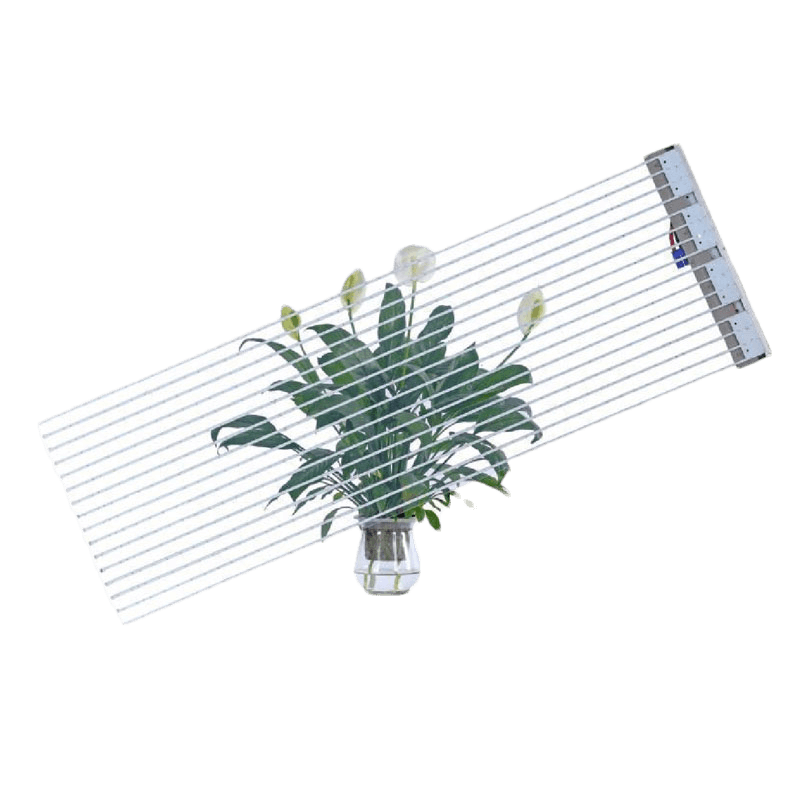
A Transparent LED Film Display is a lightweight transparent LED display system designed for installation on suitable indoor glass surfaces or behind protected storefront glass.
RGB LED pixels display advertising videos, promotional campaigns, logos, animations and digital art while preserving partial visibility through the glass. When the screen is powered off, the remaining transparency depends on pixel pitch, module layout, glass, viewing angle and ambient lighting.
This product is positioned for indoor commercial glass display projects that need higher brightness and more scalable display dimensions than panel-based Transparent OLED or Transparent LCD products normally provide.
Transparent LED Film Display is an indoor transparent commercial display for storefront windows, mall glass walls, showrooms, lobbies and exhibitions where brightness, visibility and lightweight installation are important.
DisplayMan’s Transparent LED Film Display transforms glass surfaces into dynamic storytelling platforms. All three examples below use indoor-installed displays viewed from outside through the glass. They combine advertising, animation and digital art with partial visibility through the glazing.
These are indoor display applications: the LED film is installed on the interior side of the glass, while the audience watches from outdoors. Water effects, floral content and whale animations create engaging street-facing presentations without placing the display hardware outdoors.
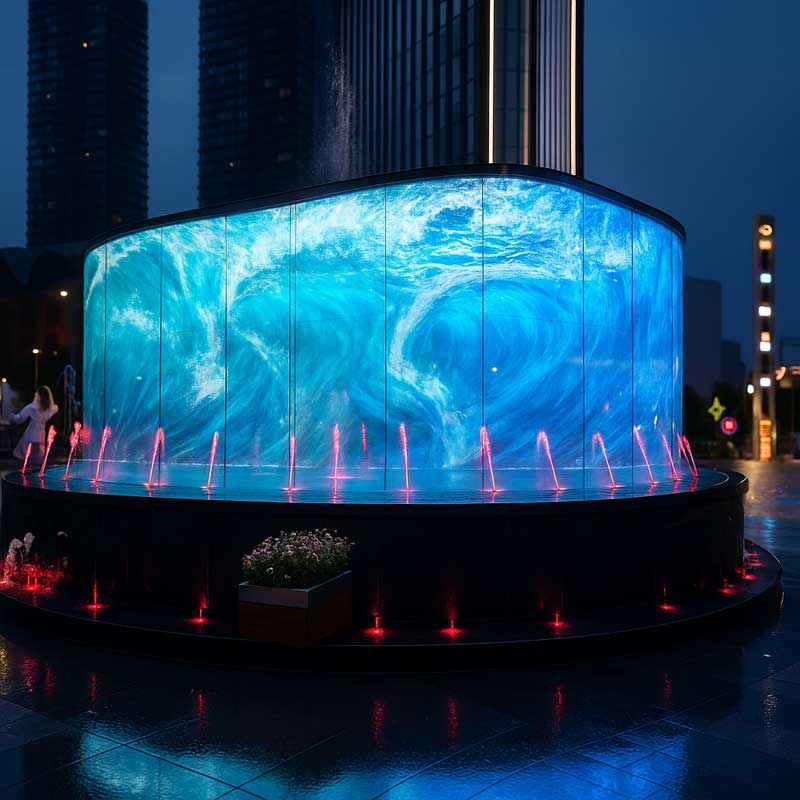
This indoor-installed Transparent LED Film Display presents an aquarium-like wave animation through curved glazing. Viewers watch the digital water effect from outside, while the display hardware remains inside the glazed structure.
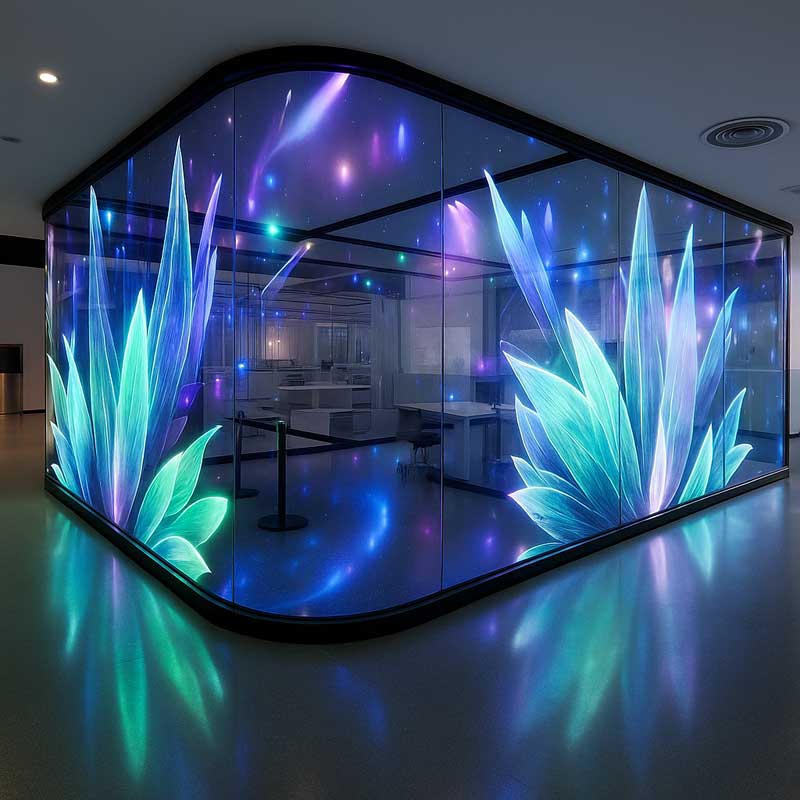
Installed on the interior side of a glass enclosure, this Transparent LED Film Display presents vivid digital artwork to viewers outside. It turns the glazed surface into a street-facing showcase for retail, showrooms and exhibition spaces.
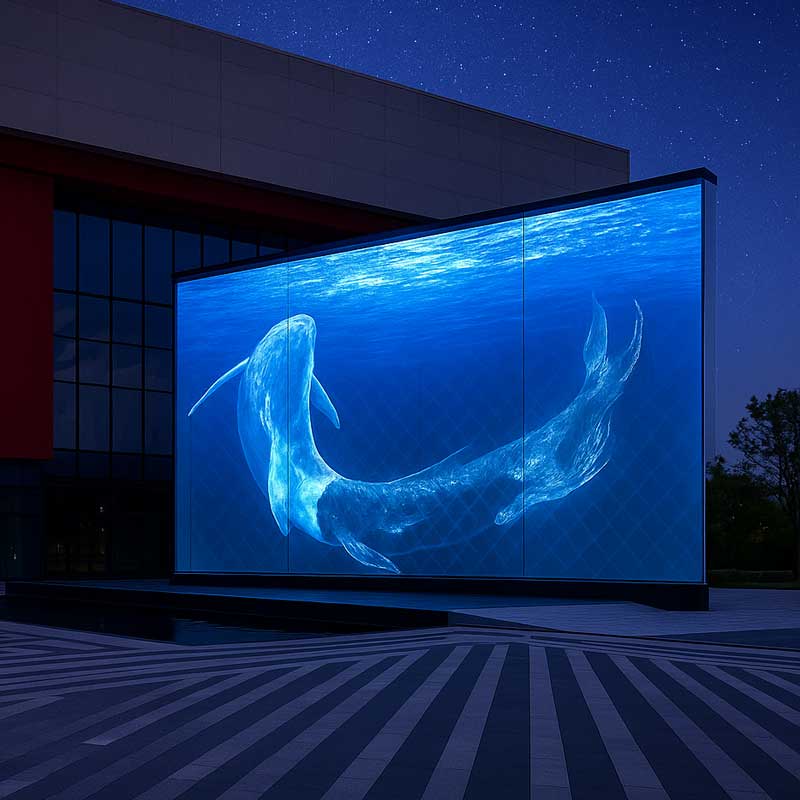
This large flat Transparent LED Film Display is installed indoors behind the glass and viewed from outside. A 3D-style whale animation creates a striking nighttime presentation for passersby while the installation remains an indoor application.
The product is designed to add dynamic digital media to existing or planned glass surfaces without installing a heavy opaque LED cabinet wall.
Suitable for storefront windows, shopping mall glass walls, showrooms, lobbies and selected indoor commercial glass walls.
Selected models are only a few millimeters thick, allowing a cleaner integration with glass than traditional cabinets.
Lower weight helps reduce structural load, transportation complexity and the need for heavy steel framing.
Different pitch options allow the project to prioritize visibility, daylight and architectural openness.
Higher-brightness configurations can remain visible in retail windows, malls and strong ambient-light environments.
Multiple film sections can be arranged to match larger glass dimensions and different content ratios.
Useful for converting existing store and building glass into a media surface without replacing the entire wall.
Supports live input, scheduled playback, media players, remote updates and CMS-based operation.
Dimensions can be reviewed around the glass, but cutting and layout must follow the product circuit and engineering rules.
Transparent LED Film Display contains LED pixels, circuits and connection zones. Size adaptation must follow the selected product structure and cannot be handled as unrestricted on-site cutting.
The available DisplayMan range is based on five indoor pixel-pitch formats. The final choice should match viewing distance, glass size, image detail, transparency, power and project budget.
For projects that need the highest image detail within the current product range and can accept the associated pixel density and power requirements.
For retail, showroom and indoor commercial glass projects that need a balance between display detail and transparency.
A practical general-purpose option for shopping malls, showrooms, storefront glass and medium-distance indoor viewing.
For larger indoor glass areas where longer viewing distance and lower pixel density are more important than fine close-up detail.
The largest pixel pitch on this product page, intended for large indoor display areas, simple high-impact content and longer viewing distance.
Screen area, cabinet arrangement, controller, power, cable routing and installation can be reviewed around the glass and site conditions.
Pixel pitch is the center-to-center distance between adjacent LED pixels. For unequal spacing such as P4 × 8, the first number is the horizontal pitch and the second number is the vertical pitch.
| Pixel Pitch | Recommended Direction | Selection Logic |
|---|---|---|
| P4 × 8 mm | Higher-detail indoor advertising and closer viewing within the available range | Higher pixel density and stronger image detail; requires careful power and cost review |
| P6.5 × 6.5 mm | Retail windows, showrooms and indoor commercial glass | Balanced detail and transparency for medium-size installations |
| P10 × 10 mm | General storefront, shopping mall and showroom projects | Mainstream balance between image quality, viewing distance and project cost |
| P16 × 16 mm | Larger glass areas and longer indoor viewing distances | Higher transparency and lower pixel density than the finer-pitch models |
| P20 × 20 mm | Largest indoor glass areas in the current range | Lowest pixel density in the listed range; best suited to simple content and longer viewing |
Do not select the smallest pitch automatically. Choose between P4 × 8, P6.5 × 6.5, P10 × 10, P16 × 16 and P20 × 20 according to viewing distance, content detail, glass size, transparency, power and budget.
P4 × 8 and P6.5 × 6.5 provide the strongest detail direction within the available range.
P10 × 10 is a practical starting point for many indoor storefront, shopping mall and showroom applications.
P16 × 16 and P20 × 20 reduce pixel density and are better suited to large glass areas, simple content and longer viewing distances. Final transparency remains configuration-dependent.
| Project Priority | Recommended Direction | Trade-Off to Review |
|---|---|---|
| More Image Detail | P4 × 8 or P6.5 × 6.5 | Higher pixel density, power and project cost |
| Balanced Indoor Commercial Display | P10 × 10 | A compromise between detail, transparency and scale |
| Larger Glass and Longer Viewing | P16 × 16 or P20 × 20 | Less fine detail at closer distance |
| Bright Storefront Behind Glass | Select brightness from the exact model and site | Higher power and heat must be included in the system design |
The correct model is the one that produces readable content at the real indoor viewing distance while preserving the required glass visibility and matching the project budget.
Installation is simpler than a heavy LED cabinet wall, but the glass, layout, cable exit, power supply, controller and maintenance method still require site-specific review.
The selected installation method must match the exact model, glass condition and supporting structure.
Can be reviewed for large glass walls, exhibition spaces, atriums and temporary projects where direct adhesion is not preferred.
Uses a project-specific support method when stable positioning, service access or permanent installation is required.
The screen may be transparent, but power supplies, controller boxes and cables are not. Their locations must be planned around glass frames, walls, ceilings, floors or hidden service areas before the screen layout is finalized.
The current DisplayMan range includes five indoor horizontal × vertical pixel-pitch configurations. Pixel density below is calculated from the listed cabinet resolution and cabinet area rather than copied from the inconsistent supplier row.
| Specification | P4 × 8 | P6.5 × 6.5 | P10 × 10 | P16 × 16 | P20 × 20 |
|---|---|---|---|---|---|
| LED Configuration | 1R1G1B | 1R1G1B | 1R1G1B | 1R1G1B | 1R1G1B |
| Brightness | 5000 cd/m² | 5000 cd/m² | 5000 cd/m² | 4500 cd/m² | 4500 cd/m² |
| Calculated Pixel Density | 31,250 pixels/m² | ≈23,692 pixels/m² | 10,000 pixels/m² | ≈3,938 pixels/m² | 2,500 pixels/m² |
| Transparency | 75% | 75% | 75% | 75% | 75% |
| System Unit Size | 1000 × 512 × 70 mm | 1000 × 416 × 70 mm | 1000 × 320 × 70 mm | 1000 × 512 × 70 mm | 1000 × 640 × 70 mm |
| System Unit Resolution | 250 × 64 pixels | 154 × 64 pixels | 100 × 32 pixels | 63 × 32 pixels | 50 × 32 pixels |
| Module Size | 1000 × 64 mm | 1000 × 52 mm | 1000 × 80 mm | 1000 × 128 mm | 1000 × 160 mm |
| Module Resolution | 250 × 8 pixels | 154 × 8 pixels | 100 × 8 pixels | 63 × 8 pixels | 50 × 8 pixels |
| System Weight | ≤4 kg/m² | ≤4 kg/m² | ≤4 kg/m² | ≤4 kg/m² | ≤4 kg/m² |
| IP Rating (Front / Back) | IP43 | IP43 | IP43 | IP43 | IP43 |
| Environment | Indoor | Indoor | Indoor | Indoor | Indoor |
| Viewing Angle (H / V) | 120° / 120° | 120° / 120° | 120° / 120° | 120° / 120° | 120° / 120° |
| Viewing Distance | Project dependent | Project dependent | Project dependent | Project dependent | Project dependent |
| Gray Scale | 16 bit | 16 bit | 16 bit | 16 bit | 16 bit |
| Max. Power Consumption | 800 W/m² | 400 W/m² | 800 W/m² | 800 W/m² | 800 W/m² |
| Avg. Power Consumption | 400 W/m² | 200 W/m² | 400 W/m² | 400 W/m² | 400 W/m² |
| Scanning Mode | 1/1 | 1/1 | 1/1 | 1/1 | 1/1 |
The 70 mm value refers to the listed complete system-unit depth, including its profile or connection section; it is not the thickness of the transparent display film layer alone. Final active area, overall dimensions, glass attachment, cable exits, power and control configuration must be confirmed before quotation and production.
| Specification | Details |
|---|---|
| Refresh Rate | 3840 Hz reference; final value depends on the selected receiving-card and driving configuration |
| Operation Power | AC 100–240V, 50/60 Hz |
| Control Mode | Synchronous LED control system; controller, media player and CMS route are selected for the project |
| Supported Inputs | HDMI, DVI and other video inputs through the selected controller or video processor |
| Operating Environment | Indoor or protected behind-glass installation; final temperature and humidity limits require model confirmation |
| Rated LED Lifetime | Up to 100,000 hours under specified operating conditions; not a warranty period for the complete system |
| System Materials | Transparent LED film sections, aluminum profiles and PC protective components |
| Installation | Applied to suitable glass or installed with a project-specific fixed or hanging support structure |
| Packaging | Wooden box |
A Transparent LED Film Display project is a complete LED display system, not only a transparent film layer.
Form the visible digital display area and are arranged according to glass dimensions and content ratio.
Determine image detail, transparency, viewing distance, brightness and system cost.
Must be located where heat, service access and cable length can be managed safely.
Colorlight, Novastar or another system processes and distributes content to the screen.
Supports scheduled advertising, live PC input, video processing, synchronized playback or CMS operation.
Must follow the glass frame and hidden service routes without damaging the transparent visual effect.
May include adhesive preparation, hanging parts, fixed supports, cable covers and protective measures.
Controls videos, schedules, screen brightness, day/night operation and remote updates.
Power, controller, connectors and replaceable display sections must remain serviceable after installation.
This indoor Transparent LED Film Display is most effective where glass is part of the commercial environment and digital media should remain visible without completely closing the space.
For indoor or protected behind-glass brand campaigns, promotions and product-launch content.
For entrances, atriums, escalator areas and commercial media surfaces inside shopping centers.
For vehicle videos, campaigns and brand storytelling while keeping the cars visible.
For welcome messages, company branding and digital art on reception glass or partitions.
For lightweight indoor event installations, product storytelling and booth-media surfaces.
For offices, hotels, clubs, restaurants, showrooms and real-estate sales centers.
For protected airport, station and waiting-area glass used for advertising and public information.
For large, simple visual content on suitable indoor glass surfaces where transparency remains valuable.
For large protected glass walls that need digital impact while preserving daylight and spatial openness.
Provide glass size, flatness, frames, joints, viewing side, sunlight direction, installation height and whether the product is protected behind glass.
Closer viewing generally needs smaller pitch; large glass walls and long-distance viewing can use larger pitch and lower pixel density. Final transparency must be confirmed from the selected structure rather than assumed from pitch alone.
Define whether image detail, transparency, cost or display scale has the highest priority.
Review ambient light, window direction, reflections, daytime visibility, operating hours, power and heat.
Match the display area and content ratio to glass frames, joints, cable paths and the position of power and controller equipment.
Select live synchronous input, scheduled asynchronous playback, CMS or customer integration and ensure all equipment remains serviceable.
The correct screen is selected from the site and commercial purpose first. Pitch, brightness and transparency should follow the viewing distance, glass structure and content—not the other way around.
Transparent LED film content should be designed for the real viewing distance and pixel pitch. It works best with simple, bright and high-impact commercial visuals.
Use larger text, stronger contrast, wider lines and cleaner compositions as viewing distance and pixel pitch increase.
Avoid small text, detailed product specifications, thin lines, complex charts, document-style content, low-contrast images and interfaces designed for a phone or monitor.
| Comparison | Transparent LED Film Display | Alternative Route |
|---|---|---|
| LED Film Display vs Flexible LED Film Display | Best for flat or regular indoor commercial glass. | Flexible Transparent LED Film Display is better for strongly curved or irregular creative surfaces. |
| LED Film Display vs Holographic Transparent LED Display | A practical indoor glass-media product with defined P4 × 8 to P20 × 20 options. | Holographic Transparent LED Display emphasizes a more visually invisible or futuristic presentation. |
| Film Screen vs LED Glass Screen | More practical for adding a display to suitable existing indoor glass. | Transparent LED Glass Display is better when the display is integrated into the glass construction. |
| Film Screen vs Transparent OLED | Better for larger glass areas, higher brightness and scalable indoor advertising. | Transparent OLED Displays are better for premium close-viewing panel-based signage and cabinets. |
| Film Screen vs Transparent LCD | Better for glass advertising and larger simple visual content. | Transparent LCD Displays are better for cabinets, vending, refrigerators and close-viewing product information. |
| Indoor Film Screen vs Outdoor Transparent LED | The models on this page are indoor products and the largest listed pitch is P20 × 20. | Outdoor Transparent LED Mesh Display should be reviewed for exposed outdoor and extreme long-distance applications. |
Use this page for the current indoor P4 × 8, P6.5 × 6.5, P10 × 10, P16 × 16 and P20 × 20 range. Outdoor mesh products belong on a separate product page.
The display film, pitch, module layout, power, controller, cable routing, glass condition, installation and content system should be reviewed as one project.
A visually clean glass display depends as much on the hidden power, controller and cable plan as it does on the LED film itself.
This product is an indoor transparent LED display system. Outdoor mesh-screen specifications and applications should be evaluated separately.
Site information is essential because the correct pitch, brightness, layout and installation cannot be selected from screen size alone.
Transparent LED Film Display projects connect with the broader Transparent LED family, glass-window and facade solutions, commercial applications, control integration and alternative transparent technologies.
Start with Transparent LED Displays for the complete product family and this page for mainstream flat-glass film installations. Review Flexible Transparent LED Film Display for curved surfaces, Transparent LED Glass Display for glass-integrated construction and Outdoor Transparent LED Mesh Display for exposed building-scale applications.
| Related Product Page | When to Visit |
|---|---|
| Transparent LED Displays | For an overview of the full Transparent LED product family and technology routes |
| Flexible Transparent LED Film Display | When the surface is curved, irregular or requires stronger creative-form flexibility |
| Holographic Transparent LED Display | When ultra-high transparency and futuristic invisible-screen positioning are central to the project |
| Transparent LED Glass Display | When the display should be integrated into a permanent architectural glass structure |
| Indoor Transparent LED Display | When a more conventional indoor transparent LED cabinet or module structure is acceptable |
| Outdoor Transparent LED Mesh Display | When the display is a large exposed facade or architectural outdoor installation |
| Rental Transparent LED Display | When the project is temporary, event-based or requires repeated assembly and dismantling |
| Custom Transparent LED Displays | When the project requires a special size, structure, pitch or non-standard LED configuration |
| Related Solution Page | When It Helps |
|---|---|
| Transparent LED Solutions | For comparing film, flexible film, glass, mesh, indoor and rental Transparent LED directions |
| Transparent LED Retail Window Solution | For storefront windows, brand campaigns and behind-glass retail advertising |
| Transparent LED Facade Solution | For larger commercial building glass and architectural media projects |
| Transparent LED Event Backdrop Solution | For exhibitions, product launches and temporary high-impact transparent displays |
| Architectural Transparent LED Wall Solution | For permanent architectural integration, atriums and large transparent media walls |
| Transparent Retail Display Solution | When the project is retail-focused but the correct transparent technology is not yet confirmed |
| Transparent Exhibition & Showroom Display Solution | For showrooms, exhibitions, museums and brand experience projects |
| Application Page | When It Helps |
|---|---|
| Exhibition, Events & Showrooms | For event installations, product launches and showroom media displays |
| Corporate & Office Environments | For lobbies, visitor centers, office glass and corporate branding |
| Outdoor & Public Display Systems | When environmental protection and public-facing display requirements must be reviewed |
| Industry Applications | For reviewing display routes across retail, automotive, corporate, transportation and commercial markets |
| Component / Capability | When It Helps |
|---|---|
| LCD Controller Boards | For broader signal-input and controller comparison when the project includes mixed display technologies |
| FPC & Cable Assembly | When custom cable routing, connectors and internal wiring must match the site or structure |
| Digital Signage Displays | When CMS, media playback and commercial content-management routes need to be compared |
| OEM/ODM Display Engineering & Prototyping | When the project requires custom drawings, sample engineering and system integration |
| Alternative Route | When It May Be Better |
|---|---|
| Transparent OLED Displays | When premium close-viewing panel quality and controlled indoor presentation are more important than glass-area flexibility |
| Transparent LCD Displays | When the project is a cabinet, vending machine, refrigerator or product-visible display structure |
| Transparent LED vs Transparent LCD | When the project needs to compare glass-wall advertising with product-cabinet display routes |
| LED Displays | When transparency is unnecessary and a conventional high-impact opaque LED wall is acceptable |
| Commercial Video Walls | When close-viewing detail and conventional indoor display quality are more important than transparency |
| Transparent Display vs Standard Display | When the project must confirm whether preserving background visibility creates enough value |
The product page should guide customers from the glass surface and viewing distance to the correct pitch, brightness, transparency, Transparent LED product form, control system and installation route.
A Transparent LED Film Display is a thin, lightweight LED display film designed for installation on glass surfaces. It displays advertising, branding and visual content while maintaining partial visibility through the glass.
Yes. Transparent LED Film Display is also commonly described as LED adhesive film screen, LED transparent film screen or LED film display.
It is mainly used on retail windows, shopping mall glass walls, commercial building glass, automotive showrooms, corporate lobbies, exhibitions and interior glass partitions.
No. The film-style structure is much thinner and lighter than a traditional LED cabinet display, although power supplies, controllers, cables and installation accessories still require proper planning.
The current table lists a complete system-unit depth of 70 mm and system weight of ≤4 kg/m². The 70 mm value includes the profile or connection section and is not the thickness of the transparent display film layer alone. Final mechanical dimensions depend on the selected configuration.
The current product range includes P4 × 8, P6.5 × 6.5, P10 × 10, P16 × 16 and P20 × 20.
Pixel pitch should match viewing distance, required image detail, glass size, transparency, brightness, content and budget. Smaller pitch is not automatically the best choice.
No. Smaller pitch improves image detail but normally reduces transparency, increases pixel density, power consumption and cost. Larger pitch improves transparency and suits longer viewing distances.
The current technical table lists 75% transparency for all five configurations. Actual visible transparency also depends on the film structure, content, viewing angle, glass, ambient light and installation.
The current listed configurations provide 4,500 to 5,000 cd/m² depending on pixel pitch. Brightness should be adjusted for the real indoor or behind-glass environment.
Yes. Behind-glass retail advertising is one of the main applications. The project should review sunlight direction, glass reflection, daytime visibility, heat and cable routing.
The models on this page are indoor products. Directly exposed outdoor installations should use a dedicated outdoor Transparent LED product.
No. Project-based size adaptation may be possible, but cutting must follow the circuit, module structure and engineering instructions. It should not be treated like freely cut decorative film.
This indoor product is mainly intended for flat or regular glass installations. Strongly curved or irregular surfaces should use a Flexible Transparent LED Film Display feasibility review.
Colorlight, Novastar or other project-specific LED control systems may be reviewed with synchronous, asynchronous, media-player, PC, CMS or network-based content management.
Please provide glass dimensions, display area, site photos or drawings, viewing distance, installation environment, required brightness and transparency, preferred pitch, content type, control method, cable and power locations, quantity, budget, schedule and shipping destination.
Send us the glass dimensions, display area, site photos, viewing distance, installation environment, brightness and transparency priorities, content type, control system, quantity, budget and project schedule.
We will review the most practical pitch, display layout, power and controller configuration, cable route and installation direction for the actual site.
The correct solution may be Transparent LED Film Display, Flexible Transparent LED Film Display, Transparent LED Glass Display, Indoor Transparent LED Display or Outdoor Transparent LED Mesh Display. The decision depends on the glass, shape, exposure, viewing distance, brightness, transparency and commercial purpose.