
Create transparent stage and event displays with modular rental cabinets. DisplayMan supports cabinet selection, display layout, control systems, packing and installation planning for repeated assembly and transport.
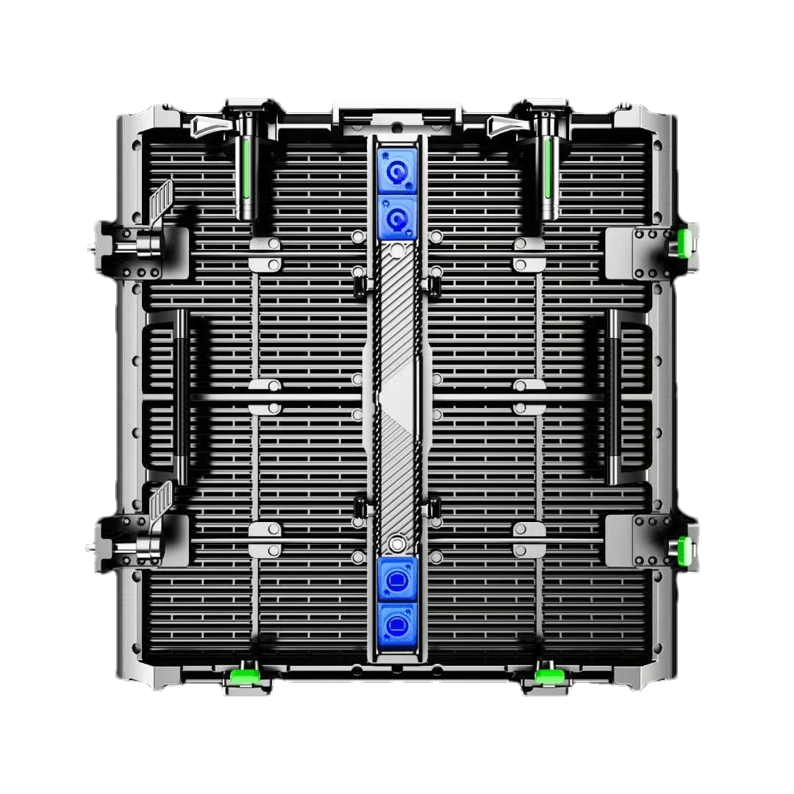
Explore rental transparent LED cabinet formats and assembly details for concerts, exhibitions and touring events. Aluminum frames, quick-lock systems and modular connections support efficient setup and flexible display layouts.
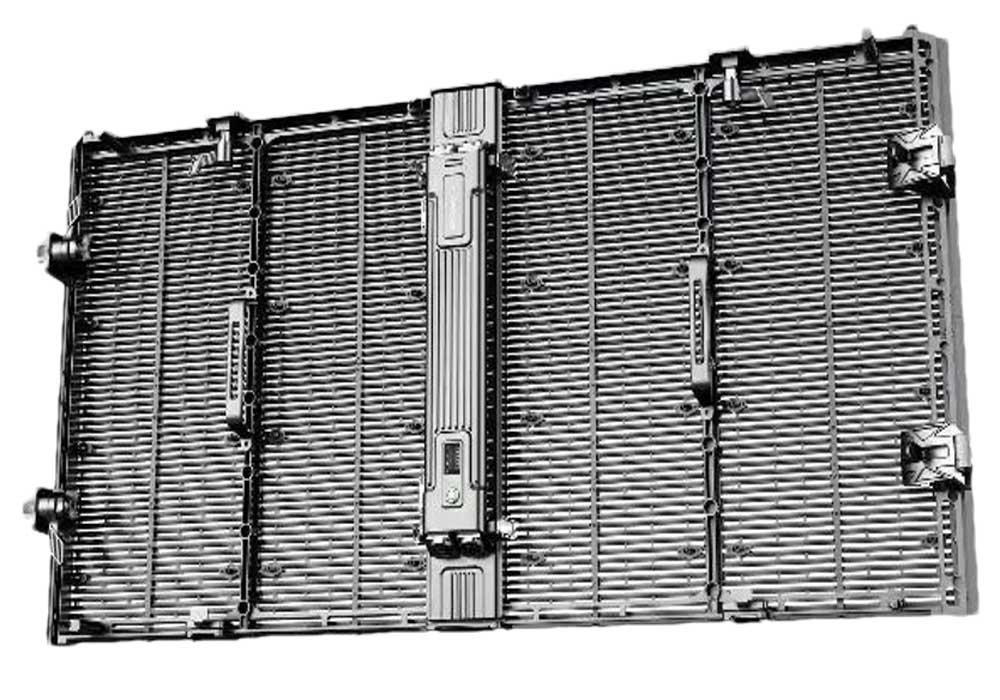
A 500 × 1000 mm panel combines an open display structure with quick-lock assembly for event and exhibition backdrops. Modular cabinets support layouts selected around the stage design and installation requirements.
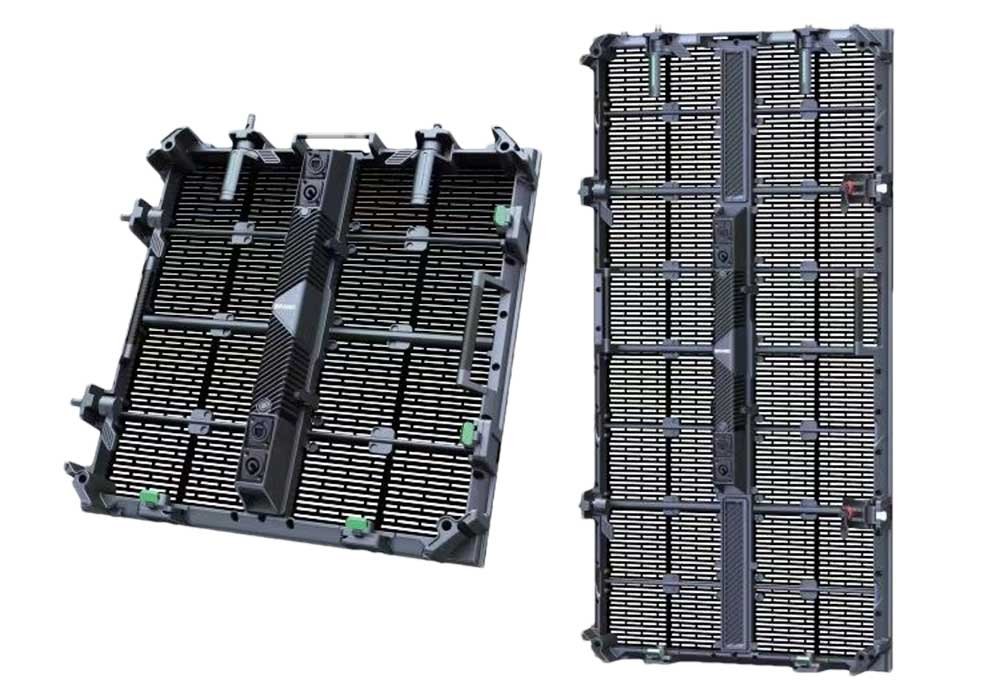
500 × 500 mm and 500 × 1000 mm cabinet options support flat and curved display layouts. Wave, corner or cylindrical configurations are reviewed against cabinet compatibility, available locking angles and the support structure.
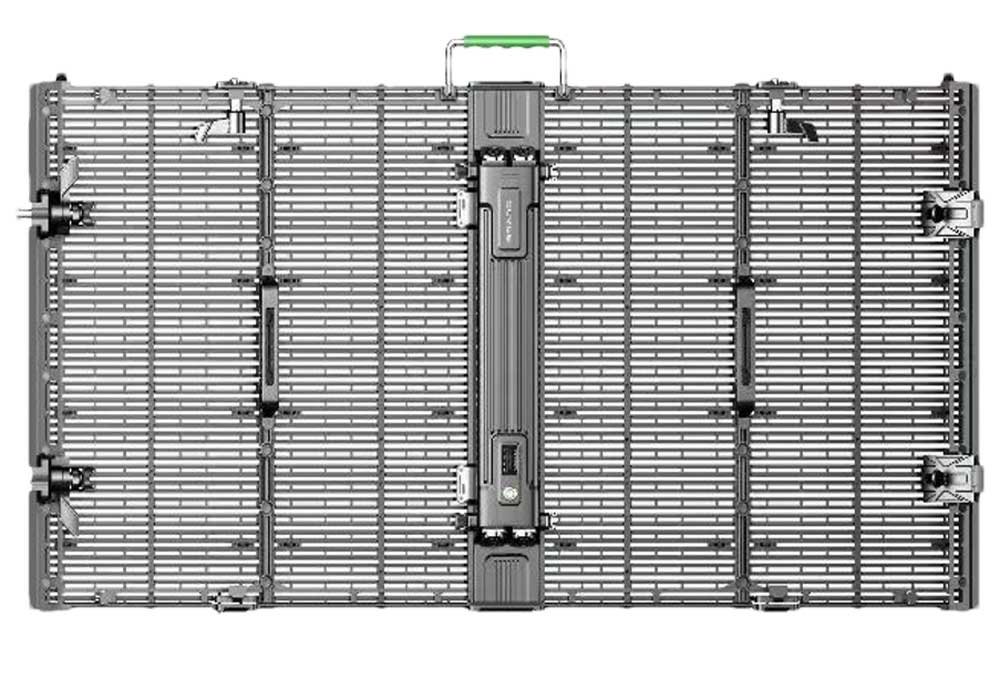
An aluminum frame and reinforced locking hardware support repeated assembly for touring and event use. Flat or arc configurations are selected according to the cabinet design, locking range and installation plan.
A Rental Transparent LED Display is a transparent LED display with a rental-oriented aluminum cabinet, fast-lock structure and modular connection system.
It is designed for concerts, exhibitions, trade shows, product launches, corporate events, fashion shows, studios and other temporary installations that must be assembled, dismantled, transported and reused.
The transparent structure allows stage lighting, performers, products, scenery and background effects to remain partially visible, creating more depth and visual layering than a conventional opaque LED rental wall.
Rental Transparent LED Display is the temporary event and touring branch of the Transparent LED family. Its value is not only transparency, but also reusable cabinet engineering and efficient event operation.
Transparent LED products should be selected from the installation cycle and operating environment, not only from appearance.
| Product Route | Structure | Best Use |
|---|---|---|
| Rental Transparent LED Display | Quick-lock rental cabinet for repeated handling | Stages, concerts, exhibitions and temporary events |
| Indoor Transparent LED Display | Framed cabinet for long-term protected installation | Malls, curtain walls and fixed commercial spaces |
| Outdoor Transparent LED Mesh Display | Weather-resistant fixed outdoor structure | Building facades and permanent exterior media |
| Transparent LED Film Display | Thin film-style display applied to flat glass | Storefront and glass advertising |
| Flexible Transparent LED Film Display | Flexible film supported by curved surfaces | Curved glass, columns and creative fixed shapes |
| Holographic Transparent LED Display | Visually minimal fine-pitch transparent structure | Premium indoor floating-style effects |
| Transparent LED Glass Display | Architectural glass-oriented system | Permanent building and glass integration |
Choose Rental Transparent LED Display when repeated transport and fast event installation are essential. Choose a fixed product when the display will remain installed for long-term operation.
Built around transport, loading, assembly, dismantling and reuse rather than one-time fixed installation.
Rental-oriented locks and standardized cabinets support more efficient setup and removal.
Model-dependent options preserve lighting, performers, products and stage depth behind the display.
Brightness must be confirmed for the selected indoor or outdoor rental cabinet and venue conditions.
Standard cabinet formats simplify modular layouts, inventory and flight-case planning.
Selected compatible cabinets can support arc or wave layouts; lock angles and achievable radius require model confirmation.
Provides a useful starting point for cameras and live events, subject to the selected driver, scan mode and camera test.
Project configurations can be reviewed for fast access to modules, receiving cards and power supplies.
Cabinets, cases, cables, spare parts and accessories can be configured as one reusable system.
For conferences, exhibitions, corporate events and conventional stage backdrops.
Allows stage lighting, performers and physical scenery to remain visible.
Uses compatible curve-lock cabinets for creative stage and exhibition layouts.
For concerts, fashion shows, product launches and large event spaces.
For booths, conferences and venues where overhead rigging is unavailable.
Cubes, separated zones and project-specific structures require layout and safety review.
The following ranges are retained for preliminary product selection. They describe a product family rather than one verified universal cabinet, so every value requires confirmation against the selected model datasheet.
| Feature | Specification |
|---|---|
| Transparency | 60–80% reference range; model dependent |
| Brightness | 3,000–5,000 cd/m² reference range; model dependent |
| Cabinet Weight | ≤12 kg/m² reference; confirm cabinet and complete rigged weight |
| Cabinet Sizes | 500 × 500 mm and 500 × 1000 mm reference formats |
| Cabinet Thickness | <60 mm reference; confirm selected cabinet |
| Pixel Pitch | 2.6–10 mm preliminary range; confirm availability |
| Curvature | Up to ±20° curve-lock reference on compatible cabinets only |
| Refresh Rate | ≥3840 Hz reference configuration; confirm driver and scan mode |
| IP Rating | IP43–IP65 range; select the actual protection level for the event environment |
| Rated LED Lifetime | Model-specific; confirm rated conditions and warranty separately |
This table is an initial selection guide, not a production datasheet. Final pitch, transparency, calibrated brightness, cabinet dimensions, IP rating, curve-lock angle, refresh configuration, maintenance method, weight and warranty must be confirmed for the selected model before quotation and production.
Create the display image while maintaining visual openness.
Supports handling, alignment, repeated transport and modular assembly.
Connects cabinets efficiently while maintaining alignment and structural security.
Supports compatible arc or wave layouts within the selected cabinet range.
Should support fast testing, replacement and event troubleshooting.
Receives live, recorded or generated event content and maps it to the screen.
Selected according to venue, screen dimensions and certified load requirements.
Organized for quick deployment, safe routing, redundancy and dismantling.
Protect the rental fleet and support rapid repair between and during events.
Large transparent backdrops that combine video, lighting and performers.
Temporary brand displays that preserve booth depth and product visibility.
Places digital animation around presenters and physical products.
Branding, keynote backdrops, sponsor content and opening visuals.
Combines runway movement, lighting and transparent visual layers.
Temporary studio sets where refresh rate, brightness and moiré require testing.
Short-term campaigns, seasonal displays and promotional roadshows.
Performance spaces, clubs and live-show backgrounds requiring visual depth.
Flat, curved, cube and multi-layer layouts designed around the event concept.
Select this product when the display will be repeatedly assembled, transported and reused.
Choose pitch from the real audience, presenter and camera positions rather than screen size alone.
Plan 500 × 500 and 500 × 1000 mm inventory around common stage sizes and transport efficiency.
Review rigging points, floor load, total weight, maximum height and certified support.
Match brightness, refresh, scan mode and content to stage lighting and filming conditions.
A rental fleet is incomplete without transport packaging, accessories and a repair strategy.
| Event Condition | Pitch Direction | Main Review Points |
|---|---|---|
| Exhibition Booth or Closer Audience | Finer end of the 2.6–10 mm range | Image detail, cabinet visibility, moiré and camera distance |
| Corporate Event or Medium Stage | Middle of the available range | Balance detail, transparency, brightness and fleet cost |
| Concert or Large Venue | Larger pitch may be practical | Stage size, long viewing, transparency and inventory efficiency |
| Broadcast or Presenter Background | Separate camera test required | Refresh, scan mode, shutter, moiré, focus and brightness |
A larger pitch may provide better transparency, lower fleet cost and a more practical result for large stages viewed from farther away.
The simplest and most reusable format for concerts, exhibitions and conferences.
Uses compatible curve locks to create a controlled visual curve.
Requires radius, cabinet count, seams, access and structural review.
Combines multiple cabinet angles to form a stage or hanging visual feature.
Requires edge treatment, content mapping, structure and safe access.
Creates openings for performers, products, lighting and stage scenery.
The achievable radius and shape depend on cabinet width, quantity, lock increments, rigging and the selected model.
Content, lighting, scenery, performers and the visible background should be planned together rather than as separate systems.
Small text, long paragraphs, documents, dense menus, fine charts, thin lines and low-contrast content that depends on close reading.
| Factor | Rental Transparent LED Display | Traditional Rental LED Display |
|---|---|---|
| Transparency | 60–80% reference range | Opaque |
| Background Visibility | Lighting, performers and scenery remain partly visible | Background is blocked |
| Stage Style | Open, layered and creative | Solid, dense and direct |
| Content | Large motion graphics designed around transparency | Full-screen video and more detailed imagery |
| Best Use | Transparent backdrops, exhibitions, launches and creative stages | Conferences, concerts and video walls where transparency is unnecessary |
| Selection Logic | Choose for stage depth and openness | Choose for maximum solid image density |
Visit Rental LED Displays when the event needs a conventional opaque rental video wall rather than transparency.
| Alternative | Choose Rental Transparent LED When | Choose the Alternative When |
|---|---|---|
| Indoor Transparent LED Display | The screen must be transported and repeatedly reinstalled. | The installation is fixed inside a mall, lobby or curtain wall. |
| Outdoor Transparent LED Mesh Display | The application is temporary event use. | The display is a permanent exposed outdoor facade. |
| Transparent LED Film Display | A self-structured rental cabinet is required. | The display should remain as a thin layer on flat glass. |
| Flexible Transparent LED Film Display | The screen must be repeatedly assembled at events. | A fixed display must follow curved glass or a column. |
| Holographic Transparent LED Display | Rental operation and stage scale matter. | Minimal structure and premium close viewing matter more. |
| Transparent LED Glass Display | No glass is required and the screen must travel. | The display is integrated into permanent architectural glass. |
DisplayMan can support product configuration, but venue load limits, truss, motors, suspension, safety cables, floor loading and local event regulations must be approved by qualified rigging and structural professionals.
| Operation Stage | Recommended Checks |
|---|---|
| Before Each Event | Cabinets, modules, locks, receiving cards, power supplies, cables, accessories, cases, spares and test signal |
| During Installation | Alignment, lock engagement, rigging, safety cables, base support, power loading and signal routing |
| During the Event | Signal stability, brightness, temperature, camera performance, cable safety and emergency shutdown |
| After Dismantling | Cabinet, module, connector and cable damage; missing accessories; repair and cleaning list |
| Transport and Storage | Dry storage, flight-case condition, foam protection, connector covers and inventory records |
Inspection, repair, cleaning, inventory control and spare-parts replacement after each event directly determine performance at the next event.
| Related Page | When to Visit |
|---|---|
| Transparent LED Displays | For the complete Transparent LED product family |
| Transparent LED Solutions | For comparing rental, film, flexible, indoor, outdoor and glass routes |
| Rental LED Displays | For conventional opaque event and stage LED walls |
| Indoor Transparent LED Display | For fixed indoor cabinet-based transparent displays |
| Outdoor Transparent LED Mesh Display | For permanent exposed outdoor facades |
| Transparent LED Film Display | For lightweight flat-glass advertising |
| Transparent LED Event Backdrop Solution | For stage and event system planning |
| Transparent Exhibition & Showroom Display Solution | For exhibitions, product launches and showroom projects |
| Exhibition, Events & Showrooms | For application requirements and project positioning |
| OEM/ODM Display Engineering & Prototyping | For custom cabinets, structures, samples and system integration |
It is a transparent LED display with a rental-oriented cabinet and locking structure, designed for stages, exhibitions, concerts, product launches and other temporary installations.
A rental screen is engineered for repeated transport, assembly, dismantling and reuse. A fixed screen is optimized mainly for long-term installation.
No. It uses its own rental cabinet, hanging, stacking, truss or temporary support structure.
The current preliminary range is 2.6–10 mm. Actual availability and final pitch depend on viewing distance, transparency, screen size, content, camera requirements and budget.
The current reference range is 60–80%, depending on the selected pitch, LED layout and cabinet configuration. Confirm the selected model datasheet.
The current reference range is 3,000–5,000 cd/m². Final calibrated brightness should match the venue, stage lighting, daylight exposure and camera requirements.
The current cabinet-weight reference is no more than 12 kg/m². Rigging design must use the confirmed complete weight, including accessories, cables and support hardware.
500 × 500 mm and 500 × 1000 mm are the current reference formats. Availability and compatibility must be confirmed for the selected model.
Compatible cabinets may offer curve locks with a reference range up to ±20°. Final angle, radius and layout must be confirmed from the selected cabinet, lock increments, quantity and structural safety.
Yes, subject to cabinet configuration, total weight, rigging points, venue limits, safety factors and approval by qualified event-rigging professionals.
Yes, subject to screen height, floor load, base stability, stacking frame and local event-safety requirements.
The preliminary family range includes IP43–IP65 configurations. The exact model and protection level must be selected for the real event environment; wind, rain, power protection and rigging require separate review.
The current refresh-rate reference is at least 3840 Hz, but the driver, scan mode, camera distance, shutter settings, brightness and moiré risk must still be tested for broadcast projects.
Large high-contrast stage visuals, brand animation, sponsor content, product-launch graphics, digital art and motion designed around lighting and background visibility work best.
Avoid small text, documents, detailed charts, dense menus, thin lines and monitor-style content that requires close reading.
A practical rental package may include spare modules, power supplies, receiving cards, power and signal cables, locking accessories and basic repair tools.
Usually not. Outdoor Transparent LED Mesh Display or another fixed transparent LED system is normally more appropriate for permanent facade use.
Please provide event type, screen size, viewing distance, indoor or outdoor use, hanging or stacking method, venue drawings, pitch, brightness, camera requirements, control system, transport and flight-case needs, spare-parts plan, quantity, budget, schedule and destination.
Send us the event type, screen dimensions, viewing and camera distances, indoor or outdoor environment, hanging or stacking method, venue drawings, pitch and brightness requirements, control system, transport plan, spare-parts needs, quantity, budget and first-event date.
We will review the suitable cabinet format, pitch, transparency, brightness, IP level, flat or curved layout, control system and rental-fleet configuration.
A complete rental package should include cabinets, hanging or stacking accessories, control equipment, power and signal cables, flight cases, spare parts and an event-operation plan.