
Integrate transparent LED visuals into architectural glass and permanent facade projects. DisplayMan supports pixel-pitch selection, glass-grid planning, mounting, control systems and maintenance access for your installation.
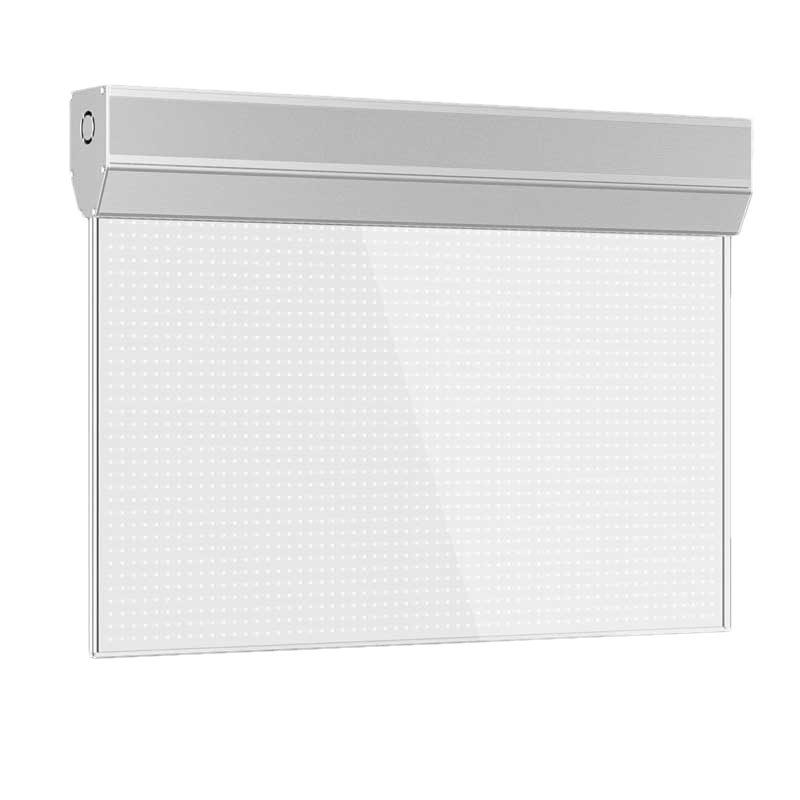
Explore transparent LED glass display directions for service halls, check-in areas, building facades and shopping mall atriums. Indoor information displays and outdoor architectural systems use different product configurations, protection levels and installation structures, so each project is specified for its actual environment.
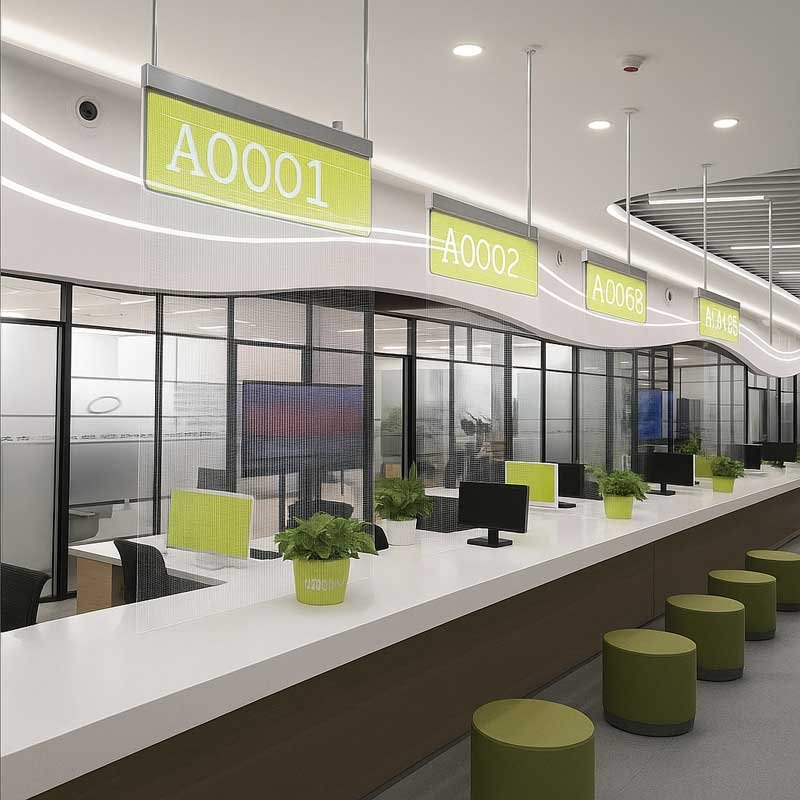
Queue numbers such as A0001 and A0002 provide visible guidance above service counters while retaining views through the glass. This layout suits banks, government halls and customer service centers.
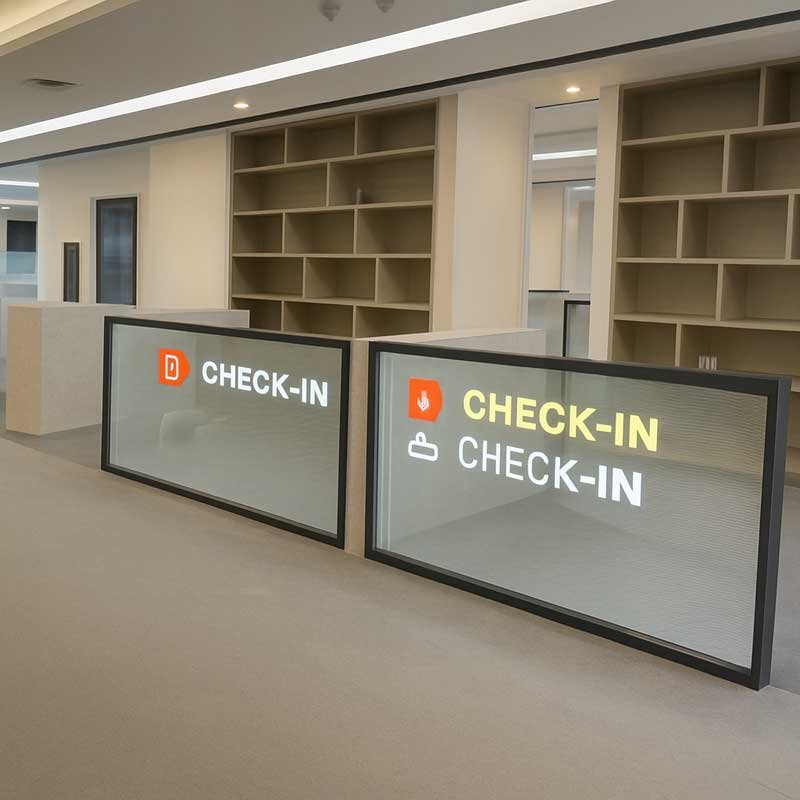
Digital check-in prompts are incorporated into the counter area, providing visitor information while preserving an open view of the space behind the displays.
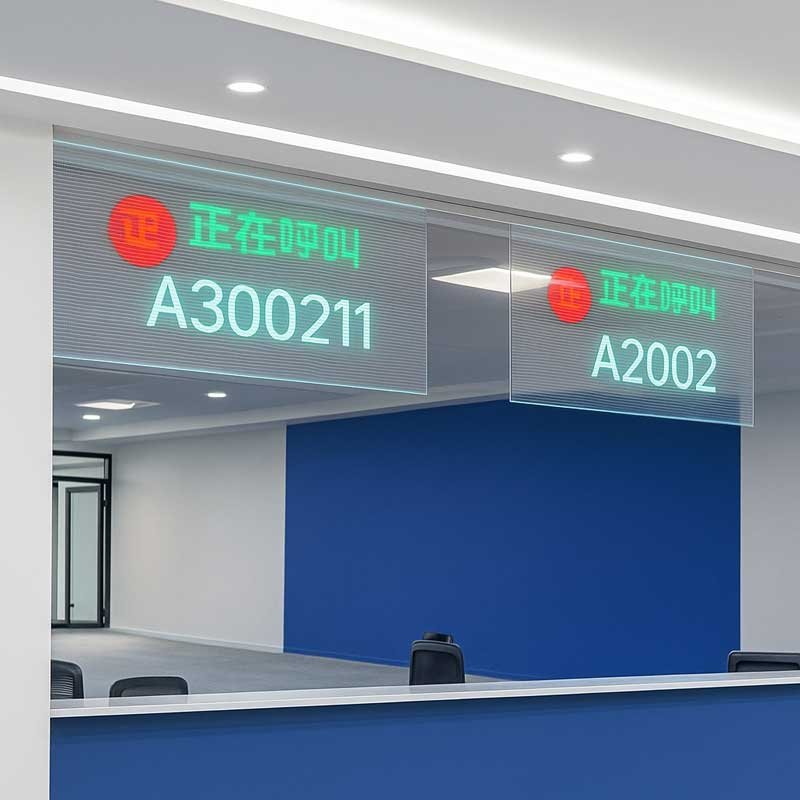
A transparent display presents queue information within the service-counter layout. Live updates can be supported through integration with the project’s queue-management system.
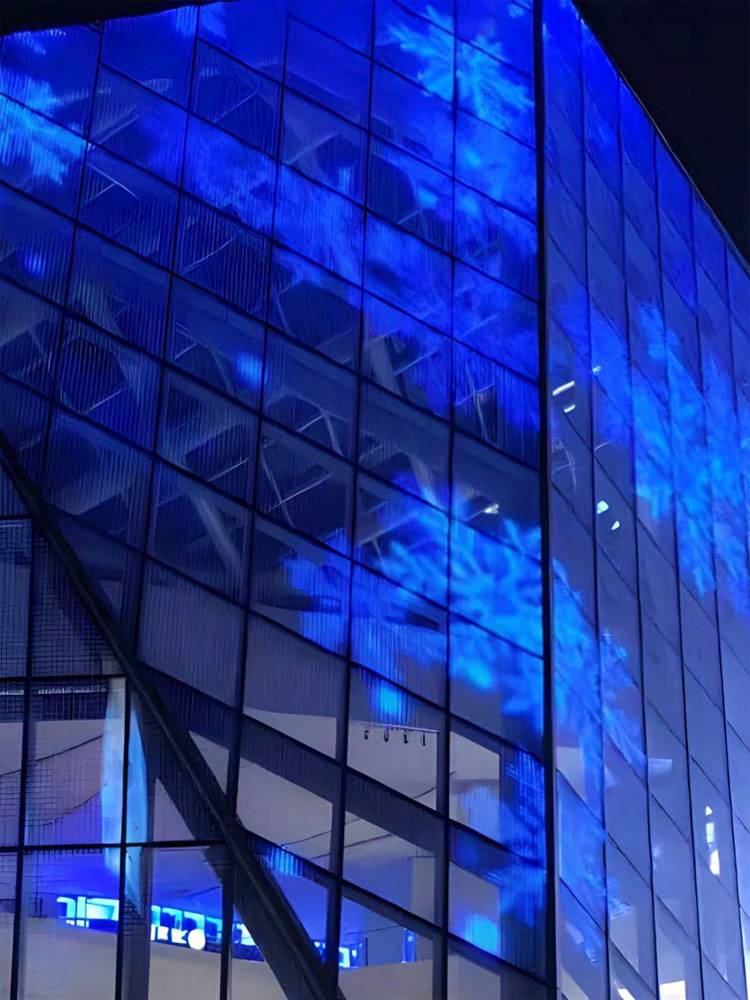
Blue digital visuals animate a building facade, combining architectural glass with a media surface for branding and visual storytelling.
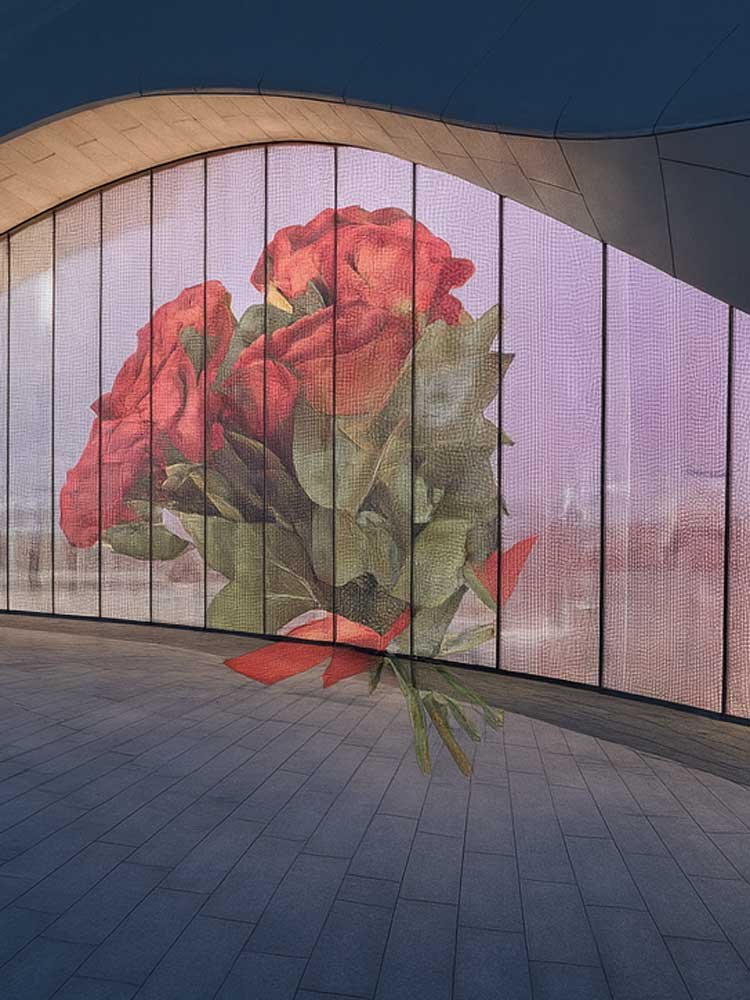
Red rose visuals follow a curved architectural facade, illustrating how digital artwork can complement a building’s form. Glass configuration, visibility and structural integration are reviewed for each project.
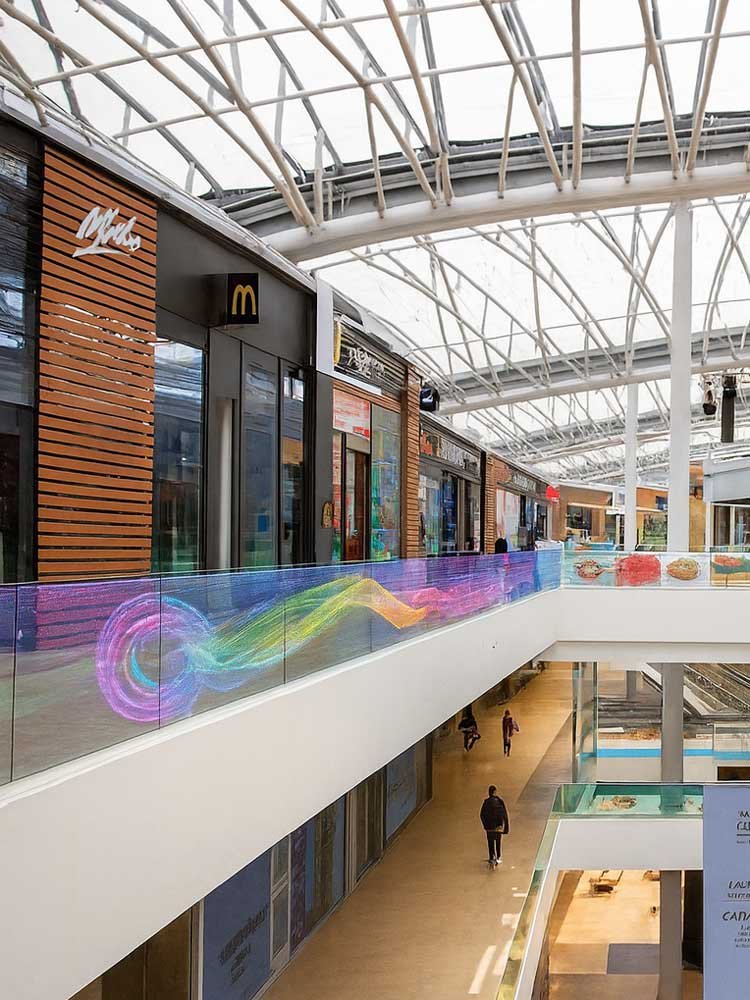
Wave-like visuals extend along upper-level glass railings, creating a display area for retail branding and promotional content. Railing safety and structural requirements remain part of the installation design.
A Transparent LED Glass Display is an architectural transparent LED display system for permanent glass walls, curtain walls, building entrances and landmark media installations.
It combines transparent building surfaces with high-brightness LED media, allowing a facade or glass wall to display branding, digital art, public information and commercial content while preserving daylight and visibility.
Unlike lightweight Film Screen products added to existing glass, this product is positioned for long-term structural projects. Glass, cabinets, frames, waterproofing, building loads, power, control, access and maintenance must be reviewed as one system.
75% reference transparency helps retain visibility and natural light.
The published range supports daylight-facing architectural media.
All seven published configurations are listed as Outdoor and IP65.
Designed around long-term glass, facade and structural installation.
Supports closer architectural viewing through very large long-distance facades.
Turns a building surface into a branded communication and digital-art platform.
This product belongs to architectural display engineering and should not be confused with lightweight products intended mainly for quick installation on existing glass.
| Product Route | Best Use | Main Difference |
|---|---|---|
| Transparent LED Glass Display | Permanent outdoor or architectural glass media | Structural integration, IP65 and long-term building use |
| Transparent LED Film Display | Flat indoor storefront glass | Lightweight media added to existing glass |
| Flexible Transparent LED Film Display | Curved glass and columns | Flexible shape adaptation |
| Holographic Transparent LED Display | Premium indoor floating visuals | Fine pitch and minimal obstruction |
| Outdoor Transparent LED Mesh Display | Large exposed media facades | Open mesh rather than glass-oriented integration |
| Rental Transparent LED Display | Stages and repeated events | Rugged reusable rental frame |
Select pitch according to the nearest critical viewing point, total facade size, transparency, content detail and budget.
Highest detail in the current range for closer architectural viewing.
Balanced for entrances, malls and medium-distance viewing.
Mainstream commercial-building and curtain-wall option.
For larger surfaces and longer viewing distances.
For large simple visuals and stronger distance performance.
For very large landmark facades and long-distance content.
The following supplier-published table applies to the outdoor IP65 P5-P40 series. It should not be used as the specification for every indoor application shown above.
| Pixel Pitch (H × V) | 5 × 5 mm | 8 × 8 mm | 10 × 10 mm | 16 × 16 mm | 20 × 20 mm | 30 × 30 mm | 40 × 40 mm |
|---|---|---|---|---|---|---|---|
| LED Configuration | 1R1G1B | 1R1G1B | 1R1G1B | 1R1G1B | 1R1G1B | 1R1G1B | 1R1G1B |
| Brightness | 5000 cd/m² | 5000 cd/m² | 5000 cd/m² | 5000 cd/m² | 5000 cd/m² | 5000 cd/m² | 5000 cd/m² |
| Published Pixel Density | 40,000 pixels/m² | 15,625 pixels/m² | 10,000 pixels/m² | 3,906 pixels/m² | 2,500 pixels/m² | 1,024 pixels/m² | 625 pixels/m² |
| Transparency | 75% | 75% | 75% | 75% | 75% | 75% | 75% |
| Cabinet Size | 1200×1000×70 mm | 1200×1000×70 mm | 1200×1000×70 mm | 1200×1000×70 mm | 1200×1000×70 mm | 1200×1000×70 mm | 1200×1000×70 mm |
| Cabinet Resolution | 240 × 200 pixels | 150 × 125 pixels | 120 × 100 pixels | 75 × 63 pixels | 60 × 50 pixels | 40 × 33 pixels | 30 × 25 pixels |
| Module Size | 1000×240 mm | 1000×240 mm | 1000×240 mm | 1000×240 mm | 1000×240 mm | 1000×240 mm | 1000×240 mm |
| Module Resolution | 200 × 48 pixels | 125 × 30 pixels | 100 × 24 pixels | 63 × 15 pixels | 50 × 12 pixels | 33 × 8 pixels | 25 × 6 pixels |
| Published Cabinet Weight | ≤15 kg/m² | ≤15 kg/m² | ≤15 kg/m² | ≤15 kg/m² | ≤15 kg/m² | ≤15 kg/m² | ≤15 kg/m² |
| IP Rating (Front/Back) | IP65 | IP65 | IP65 | IP65 | IP65 | IP65 | IP65 |
| Environment | Outdoor | Outdoor | Outdoor | Outdoor | Outdoor | Outdoor | Outdoor |
| Viewing Angle (H/V) | 120°/120° | 120°/120° | 120°/120° | 120°/120° | 120°/120° | 120°/120° | 120°/120° |
| Viewing Distance | Project dependent; select according to pixel pitch, screen size, content and the critical viewing point | ||||||
| Gray Scale | 16 bit | 16 bit | 16 bit | 16 bit | 16 bit | 16 bit | 16 bit |
| Max. Power Consumption | 800 W/m² | 800 W/m² | 800 W/m² | 800 W/m² | 800 W/m² | 800 W/m² | 800 W/m² |
| Average Power Consumption | 400 W/m² | 400 W/m² | 400 W/m² | 400 W/m² | 400 W/m² | 400 W/m² | 400 W/m² |
| Scanning Mode | 1/1 Scan | 1/1 Scan | 1/1 Scan | 1/1 Scan | 1/1 Scan | 1/1 Scan | 1/1 Scan |
| Specification | Details |
|---|---|
| Refresh Rate | 3840 Hz reference configuration; confirm with the selected receiving-card and driver system |
| Input Power | AC 100–240 V, 50/60 Hz |
| Control Mode | Synchronous or asynchronous control, selected for the screen layout and playback workflow |
| Video Input | HDMI or DVI through a compatible processor/controller; other interfaces by project confirmation |
| Outdoor Operating Conditions | Temperature, humidity, solar load, wind, corrosion and altitude limits require project and model confirmation |
| Rated LED Lifetime | Up to 100,000 hours under specified operating conditions; not a warranty period |
| System Materials | Aluminum profiles and transparent PC structural components, depending on model |
| Installation | Facade-integrated or custom fixed support designed for the building and maintenance strategy |
| Packaging | Wooden box |
Form the active display area and align with the facade grid.
Provides the building envelope or supporting architectural surface.
Transfers load and maintains alignment and access.
Protect outdoor power and signal interfaces.
Calculated from screen area, maximum load and local electrical standards.
Distributes source content across the facade.
Supports reliable outdoor operation.
Allows cabinets, power and control components to be serviced.
Routes power and signal through architectural service zones.
Permanent brand communication and digital media facade.
Entrances, atriums and transparent commercial media walls.
Digital art and architectural storytelling.
Building-scale campaigns while preserving daylight.
High-traffic branding and public information.
Premium entrance and nighttime media effects.
Queue information and guidance in open public spaces.
Large media architecture visible from public areas.
Coordinated with facade and building design.
Provide facade dimensions, glass grid, frames, elevation and section drawings.
Select P5–P40 from the nearest important viewing point and screen scale.
Confirm wind, rain, sunlight, corrosion, altitude and temperature.
Match cabinets and modules to mullions, supports and content ratio.
Calculate load, cable paths, control room, network, grounding and protection.
Define access, lifting, cleaning, service responsibility and spare parts.
| Project Direction | Suggested Pitch | Content Strategy |
|---|---|---|
| Closer entrance or retail building | P5 / P8 | Brand visuals, larger text and higher-detail animation |
| Mall or headquarters facade | P8 / P10 | Advertising, corporate media and architectural animation |
| Large curtain wall | P16 / P20 | Large logos, simple messages and high-contrast sequences |
| Very large landmark facade | P30 / P40 | Extremely large simple visuals for long-distance viewing |
| Small text or detailed information | Separate feasibility review | Do not treat architectural Transparent LED as an LCD monitor |
Coordinate display area, cabinets, glass panels, mullions and joints.
Support wind, frame, waterproofing and corrosion discussions.
Calculate electrical load, control room and network requirements.
Match the media canvas to facade proportions and cabinet grid.
Plan access, replacement, cleaning, lifting and spare parts.
Protect cabinets and structural parts for international delivery.
Elevation, sections, glass grid, total dimensions, installation height and site photos.
Wind, rain, sunlight, temperature, viewing direction, power, control room and maintenance access.
Pitch preference, content, daily hours, total area, budget, schedule, destination and certifications.
| Related Page | When to Visit |
|---|---|
| Transparent LED Displays | Complete Transparent LED product family |
| Transparent LED Solutions | Compare architectural, film, flexible, mesh and rental routes |
| Transparent LED Facade Solution | Storefront, mall and building facade planning |
| Architectural Transparent LED Wall Solution | Permanent building and curtain-wall integration |
| Transparent LED Film Display | Lightweight flat-glass indoor advertising |
| Outdoor Transparent LED Mesh Display | Open-mesh outdoor media facades |
| Outdoor & Public Display Systems | Public-facing environmental and operational requirements |
| OEM/ODM Engineering & Prototyping | Custom drawings, structure and project integration |
An architectural transparent LED display system for permanent glass walls, curtain walls, building entrances and landmark media installations.
Yes. The supplier-published P5-P40 outdoor series lists IP65 for the front and back. Final weatherproofing, connections, structure and site suitability still require project engineering.
The current published range includes P5, P8, P10, P16, P20, P30 and P40.
The supplier-published outdoor series lists 5,000 cd/m² for every pitch. Final calibrated brightness and daylight performance depend on configuration and site conditions.
The supplier-published outdoor series lists 75% transparency. Real appearance also depends on content, glass, module layout, viewing angle and ambient light.
Viewing distance is project dependent. Select the pitch using the real critical viewing point, screen dimensions, content detail and site conditions.
The supplier table lists cabinet weight of no more than 15 kg/m². Structural design must use the confirmed complete installed weight, including frames, cables and accessories.
The supplier-published outdoor range lists IP65 for the front and back. IP performance depends on the complete assembly, sealed connections and correct installation.
Some projects may integrate the display with architectural glass, but structural, glass, waterproofing and local building approval must be reviewed separately.
Yes, subject to facade condition, structure, wind load, access, waterproofing, power, cabling and maintenance review.
HDMI or DVI can be connected through a compatible video processor or controller. Synchronous or asynchronous playback and any additional interfaces are selected for the project.
Large logos, architectural animation, digital art and high-contrast video designed for the real viewing distance.
Small text, dense documents, complex charts, detailed menus and low-contrast content.
Film Screen is a lightweight display added to existing flat glass. LED Glass Display is positioned for permanent architectural and outdoor integration.
Yes. Local licensed professionals should confirm structure, curtain wall, wind load, fire, electrical, waterproofing and construction compliance.
Facade drawings, glass grid, dimensions, viewing distance, outdoor conditions, pitch, content, control, power and cable routes, maintenance access, quantity, budget, schedule and destination.
Send us the facade drawings, glass grid, dimensions, viewing distance, installation height, outdoor environment, pitch, content, power and control locations, maintenance route, quantity, budget and schedule.
We will review the appropriate P5–P40 model, cabinet layout, display area and control requirements.
The right transparent LED glass display solution depends on the glass configuration, facade structure, viewing distance, brightness, weather exposure and maintenance access. Display layout, mounting, waterproofing, power and control must be planned together for the installation.
Share facade drawings, dimensions, pitch, environment, structure, power, control, maintenance, quantity, budget and schedule.
