
DisplayMan Engineering Guide · Quick Answer
Transparent LCD or OLED: Which Fits Your Display Cabinet?
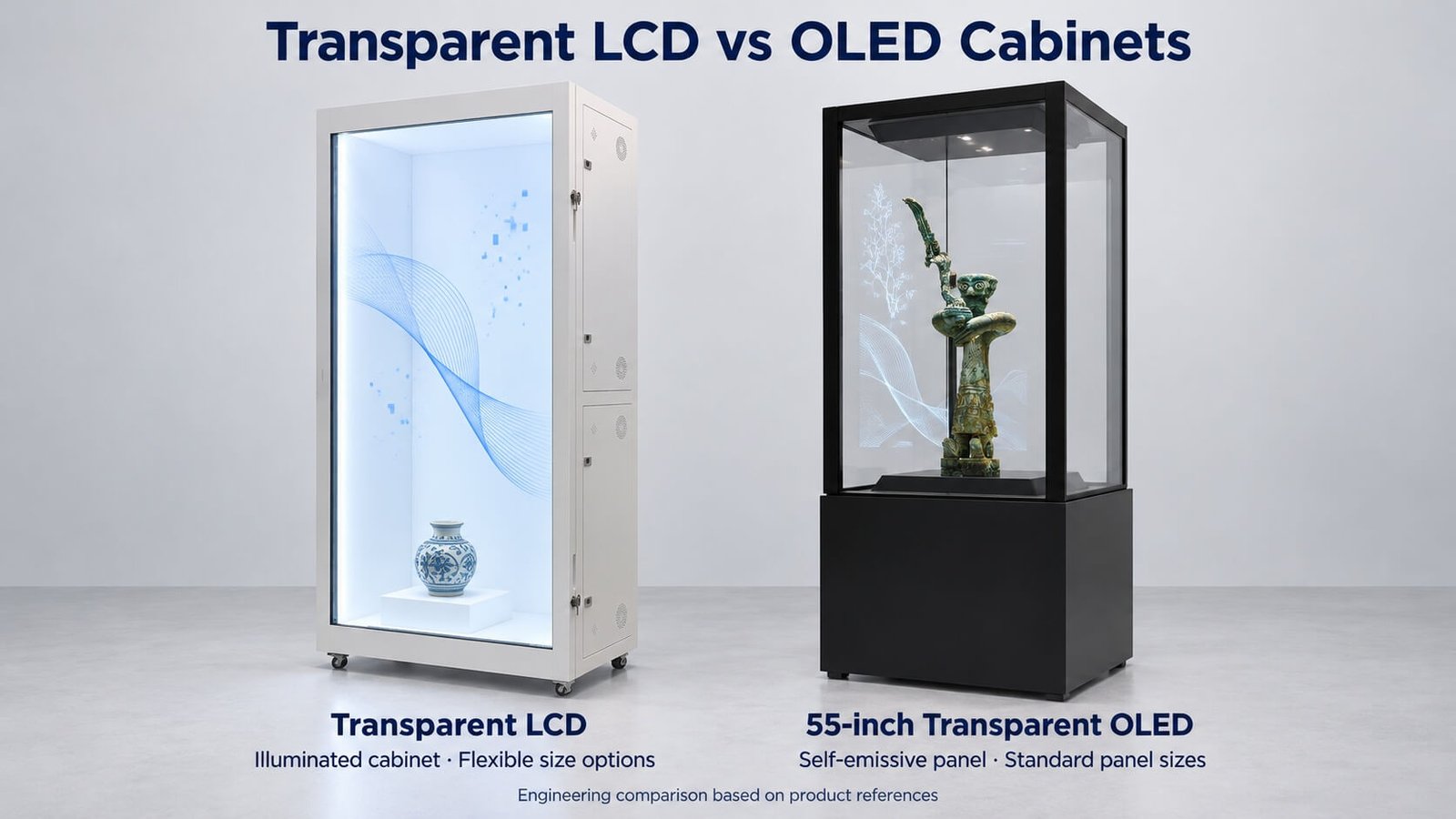
Choose transparent LCD when the cabinet can accommodate suitable internal illumination and the project prioritizes cost control or an available LCD customization route. Consider transparent OLED when a self-emissive image and a display structure without a separate backlight better fit the design. Neither technology is the best choice for every showcase: background, ambient light, product lighting, dimensions and daily operating hours all affect the result.
- Lighting and sensitive goods: Transparent LCD needs illumination behind the panel. Transparent OLED does not need a display backlight, but the goods may still need separate lighting. For wine, collectibles or other sensitive products, evaluate total light exposure and heat in the complete cabinet; OLED alone does not guarantee preservation safety.
- Dimensions and budget: Confirm available panel sizes, active area, mechanical integration and any feasible resizing process before fixing the cabinet design. Compare the complete system cost, including lighting, controller, cover glass and installation.
- Reliability: Match the panel to the required operating schedule. For OLED, assess repeated static graphics and follow the selected model’s protection guidance. For both technologies, plan thermal management, service access and spare parts.
DisplayMan’s recommendation: Share your cabinet drawing, displayed goods, viewing conditions, operating hours and target quantity first. Select the display and lighting together before finalizing the enclosure.
View the decision matrix → Prepare your quotation requirements →
Introduction: The Engineering Blueprint for Transparent Cabinet Design
In the evolving landscape of luxury retail, high-end exhibition, and professional storage (such as premium wine cellars), the integration of transparent display technology has transitioned from a mere “visual gimmick” to a sophisticated engineering challenge.
Designing a transparent cabinet is not simply about picking a screen size from a catalog. It is a multi-dimensional process that requires balancing photonic physics, thermal management, material safety, and structural customization. A mismatch between the display technology and the environment can lead to more than just a poor visual experience—it can result in technical failure, pixel degradation, or even damage to the high-value products stored inside.
As a design house or solution provider, your reputation rests on the long-term stability and “wow-factor” of the final installation. However, in an industry filled with fragmented data and unrealistic marketing promises, understanding the hard physical limits of the hardware is essential.
This guide is designed to provide you with a transparent, engineering-focused deep dive into the two dominant technologies in this space: Transparent LCD and Transparent OLED. We will go beyond the surface-level aesthetics to explore:
- The fundamental light physics that dictate viewing angles and product safety.
- The critical impact of light and heat on sensitive goods like fine wine and spirits.
- The technical realities of panel resizing, operational lifespans, and the “10-year warranty” myth.
- Our collaborative protocol for transforming a creative concept into a precise, executable quotation.
At DisplayMan, we believe that the most successful projects are built on a foundation of honest engineering and early-stage collaboration. By understanding the constraints and possibilities detailed in the following sections, you will be empowered to provide your clients with solutions that are not only visually stunning but also technically flawless and built to last.
I. The Core Physics: Backlight Dependency vs. Self-Emitting Intelligence
1. Mechanism Difference: Light Environment Management
The fundamental engineering divide between these two technologies lies in their relationship with the internal environment of the cabinet.
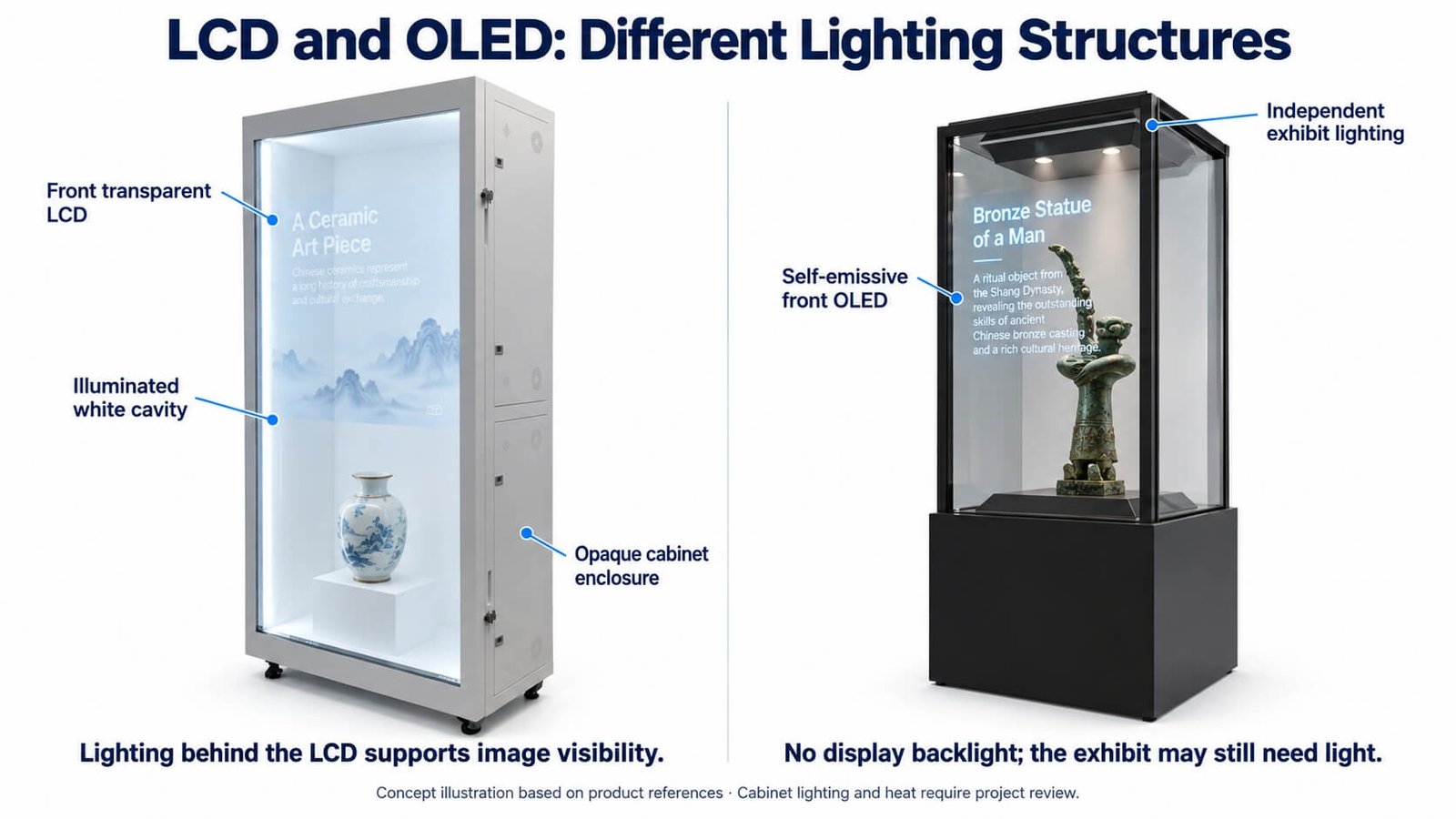
- Transparent LCD (The “Light Valve”): An LCD panel is non-emissive. To render an image, it requires a high-intensity illumination behind the panel (typically LED strips lining the cabinet interior).
- The Environment: The illumination behind the panel must be designed to make the image and the displayed goods visible. This creates a high-luminance environment inside the showcase.
- Optimization: Ideal for General Merchandise (shoes, electronics, jewelry) where high visibility and bright presentation are the goals.
- Transparent OLED (The “Active Glass”): OLED is Self-Emitting. Every pixel is its own light source, meaning no external or internal backlight is needed.
- The Self-Emitting Advantage: An unlit OLED pixel emits no image light, so the background remains visible through the panel. It does not create an opaque black surface; perceived contrast depends on the background and ambient lighting.
- Optimization: A useful option for premium showcases where avoiding a separate display backlight helps the design, including wine and spirits projects that pass the required lighting and thermal review.
2. The “Wine Safety” Factor: Thermal and Photochemical Protection
This is where technology choice becomes a functional necessity rather than a design preference.
- The LCD Challenge in Wine Storage: Fine wines are highly sensitive to heat and constant illumination. To use a Transparent LCD, the cabinet needs suitable illumination while the display is in use. Depending on its intensity, spectrum, exposure time and installation, this can introduce:
- Thermal Accumulation: Lighting adds heat that must be included in the cabinet thermal design and, where applicable, the refrigeration load.
- Light Degradation: Continuous exposure to high-intensity light can trigger chemical reactions in premium wine (often called “light-strike”), altering its flavor and value.
- The OLED Solution: T-OLED can display graphics without a separate LCD-style backlight. Light is emitted by the active pixels, while separate product lighting can be specified as needed. This gives more freedom to manage exposure, but the displayed goods still require appropriate lighting and temperature control; OLED does not guarantee product preservation.
3. Structural Architecture: Single-Sided vs. 360-Degree Viewing
- The LCD Limitation: Due to the necessity of containing and reflecting the backlight, Transparent LCD cabinets are commonly optimized for front viewing with controlled illumination. This is a common design arrangement rather than an absolute physical restriction; other configurations need an optical and mechanical review.
- The OLED “Island” Potential: Since T-OLED does not rely on internal light reflection, we can engineer a Four-Sided “Digital Glass Box.” By arranging suitable T-OLED panels on multiple faces, a cabinet can support viewing from several sides. Panel dimensions, corner joints, frames and electronics must still be designed; multiple faces do not automatically create a seamless 360-degree image.
4. Engineering Verdict: Matching Technology to Product Value
- Transparent LCD is a practical option for Standard Retail & Mass-Market Vending, providing cost-effective, high-brightness solutions for products that are not sensitive to light.
- Transparent OLED can suit High-End Wine Cabinets and Luxury Spirits when a self-emissive display and open visual structure are priorities. Product preservation, operating temperature and illumination still need independent validation.
II. Application-Driven Selection: Standard Goods vs. Fine Wine & Luxury
1. Scenario A: General Merchandise & High-Volume Retail
For products that are inert and not sensitive to environmental factors, Transparent LCD can be an effective choice.
- Target Products: Consumer electronics, footwear, jewelry, and branded FMCG (Fast-Moving Consumer Goods).
- The “Brightness Advantage”: These products benefit from a high-luminance environment. The intense internal lighting required by LCD makes the physical product “pop” and appear more vibrant to the consumer.
- Cost-Efficiency: For large-scale rollouts in shopping malls or vending clusters, the lower cost-per-square-inch of Transparent LCD can improve the project budget; actual ROI depends on the complete system cost and the commercial use.
2. Scenario B: Professional Wine Cabinets & High-End Spirits
When the cabinet is designed for premium liquor, the engineering priority shifts from “maximum brightness” to “product preservation.”
- The “Dark Cabinet” Requirement: Professional sommeliers and collectors know that darkness is the best friend of fine wine.
- OLED Design Advantage: Transparent OLED can show digital information without a separate display backlight. Vintage, tasting notes and branding can appear in front of the goods. If the product must remain visible, suitable product lighting is still required; exposure is not zero.
- Thermal Stability: LCD backlights generate localized heat. In a precision-controlled wine cellar or cooling cabinet, this heat can create “micro-climates” that stress the wine. OLED avoids the separate display-backlight load, but its panel and electronics still produce heat. Compare complete assemblies under the intended operating conditions.
3. Scenario C: Luxury Branding & High-Tech Showrooms
For projects where the objective is to create a “futuristic” or “magical” brand experience, the physical limitations of the display become the bottleneck.
- The “True Transparency” Factor: T-OLED can provide an open see-through appearance. Compare model-specific transmittance, haze, reflections and protective-glass layers under the same viewing conditions rather than applying one transparency figure to all panels.
- Seamless Integration: For high-end boutiques (watches, perfumes), the ultra-thin profile of OLED (no bulky light-box required) can simplify integration into minimalist glass structures. Actual frames, support points and electronics remain part of the design.
4. Technical Summary: Selection Matrix
| Feature | Transparent LCD | Transparent OLED |
|---|---|---|
| Ideal Product | Electronics, Jewelry, Shoes | Premium showcases, including reviewed wine/spirits projects |
| Internal Environment | Needs suitable rear illumination | No separate display backlight; product lighting may still be needed |
| Thermal Impact | Moderate (Heat from Backlight) | Panel and electronics still generate heat |
| Preservation Risk | Depends on illumination and thermal design | Must be assessed for the stored goods |
| ROI Focus | Mass Retail / Vending | High-End Custom / Branding |
III. The Art of Customization: Precision Resizing and Physical Boundaries
In high-end cabinet design, a “standard” screen rarely fits a “creative” vision. Understanding the physical limits of resizing is crucial for any design house to ensure a project moves from concept to stable reality.
To understand where customization begins, we must first look at the standard industrial foundation.
1. Standard Transparent LCD Reference Chart
Planning reference, not an approved model schedule: The nominal sizes and dimensions below are retained from the supplied reference list. Confirm availability, whether dimensions represent active area or panel outline, native resolution and the complete assembly drawing before releasing a cabinet design. The final column is a checklist item, not a specification shared by all rows.
Before opting for complex resizing, engineering firms should check if a standard factory dimension meets the project requirements. Starting with a standard size can reduce integration complexity; optical performance and ROI still depend on the complete project.
| Size (Inch) | Screen Dimensions (mm) | Aspect Ratio | Resolution | Key Specifications |
|---|---|---|---|---|
| 7″ | 154 × 86 | 16:09 | 1024 × 600 | Panel: IPS Technology |
| 10.1″ | 217 × 136 | 16:10 | 1280 × 800 | Transmittance: verify by model |
| 12.1″ | 261 × 163 | 16:10 | 1280 × 800 | Viewing angle: verify test conditions |
| 14″ | 310 × 174 | 16:09 | 1366 × 768 | Contrast: verify optical configuration |
| 15.6″ | 344 × 194 | 16:09 | 1366 × 768 | Response Time: 10ms |
| 19″ | 411 × 256 | 16:10 | 1440 × 900 | Power: DC12V 3.0A |
| 21.5″ | 475 × 267 | 16:09 | 1920 × 1080 | Refresh Rate: 60Hz |
| 32″ | 698 × 393 | 16:09 | 1920 × 1080 | Signal: Industry LVDS |
| 36.3″ | 452 × 804 | 09:16 | 1216 × 2160 | Interface: HDMI/VGA/USB |
| 43″ | 943 × 530 | 16:09 | 1920 × 1080 | Operating temperature: verify selected model |
| 49″ | 1074 × 604 | 16:09 | 1920 × 1080 | Storage temperature: verify selected model |
| 55″ | 1210 × 680 | 16:09 | 1920 × 1080 | Flagship Model |
| 65″ | 1428 × 804 | 16:09 | 3840 × 2160 | 4K UHD Standard |
| 75″ | 1650 × 928 | 16:09 | 3840 × 2160 | Ultra-Large Display |
| 86″ | 1895 × 1066 | 16:09 | 3840 × 2160 | High-Brightness Spec |
| 98″ | 2159 × 1215 | 16:09 | 3840 × 2160 | Large-format reference; confirm availability |
2. The Engineering of Precision Resizing (When Standard Doesn’t Fit)
If your project requires a dimension not listed above—such as an ultra-wide shelf display or a specific oval integration—DisplayMan first reviews whether a suitable standard panel, custom cover glass or a specialist resizing process is feasible. Resizing is not a standard capability of every LCD cell.
- The “Short-Side” Constraint: Any permitted cut depends on the specific panel, driver locations, routing and sealing design. Reducing one dimension does not mean all panels can be cut along the same edge.
- Technical Reason: Driver and conductor positions must be checked on the proposed panel. Cutting an active electrical path can make the display unusable.
- Example: A target such as 1210 x 400 mm, compared with a nominal 1210 x 680 mm display area, is an engineering request rather than a guaranteed cutting capability. Confirm active area, outline and electrical layout before approval.
- Size and Yield Limits: Feasibility, glass handling, resealing and yield depend on the selected panel and process. Do not assume a universal 55-inch threshold or a guaranteed 98-inch cutting capability.
- Environmental Limitation: A resized panel requires its own validated environmental and sealing limits. Do not carry over the original panel rating or claim outdoor suitability without verification.
Pro Tip: Scaling from Prototype to Production
For repeat projects, compare standard panels with custom cover glass, approved resizing and panel-level development as separate routes. A volume such as 5,000 units/year for a 32-inch project is an input for feasibility review, not a guarantee that new display-panel tooling is available or economical. A printed mask can change the visible window but cannot create new pixels or physically reshape a standard panel.
3. Transparent OLED: The “Fixed-Size” Masterpiece
Unlike the mechanical flexibility of LCD, Transparent OLED (T-OLED) is a precision display with moisture-sensitive organic layers protected by encapsulation. This creates a different set of design parameters.
- Zero Cutting Capability: A finished T-OLED panel must not be cut to fit a cabinet. Damaging its electrical structure or encapsulation can cause failure and moisture-related degradation.
- Available Formats: Review the proposed 30″, 48″, 55″ and 77″ configurations against the current model list. These labels do not establish universal availability, aspect ratio or active area. In particular, a bar-format configuration must not be treated as a standard 16:9 panel.
- Design Strategy: If your project requires a non-standard dimension for OLED, we do not modify the panel. Instead, we utilize the “CTP Masking Method” (detailed in Part VII) to adapt the surrounding glass to your cabinet’s architecture.
Standard Transparent OLED Reference Chart
Model verification required: The following supplied format references are not a universal OLED size standard. Confirm the exact panel or assembled configuration, active area, resolution and current availability. Brightness must specify APL and protective-glass conditions. A bar-format reference is not equivalent to a standard 16:9 panel.
| Size (Inch) | Display Area (mm) | Resolution | Brightness | Key Features |
|---|---|---|---|---|
| 30″ | 664.29 × 373.48 | 1366 × 768 | 135–350 cd/m² | High-end compact units |
| 48″ | 1206.53 × 339.34 | 1920 × 540 | 150–400 cd/m² | Ultra-wide / Shelf-top |
| 55″ | 1209.6 × 680.4 | 1920 × 1080 | 150–400 cd/m² | Global Flagship Standard |
| 77″ | 1697.28 × 954.72 | 3840 × 2160 | 150–500 cd/m² | 4K Cinematic Masterpiece |
4. Why We Reject the “Price List” Approach
In professional display engineering, providing a generic price list is a high-risk practice that leads to project failure. Because every high-end cabinet is a unique environment, our quotation is the final result of a technical validation process, not a simple retail lookup.
The Quotation Protocol: Verification Before Valuation
We only provide firm quotations after the following engineering milestones are met:
- Requirement intake: The client provides exact dimensions, target opening sizes, and the environmental conditions (e.g., thermal sensitivity of the product inside).
- Engineering Feasibility Study: Our engineers evaluate the interplay between the chosen technology (LCD vs. OLED) and your 3D CAD files. We check for cable routing, sensor placement, and cooling airflow.
- Solution Confirmation: Once the technical layout is confirmed as “stable” and “executable,” we finalize the bill of materials (BOM).
Variables That Dictate Your Quote:
- Resizing Complexity: For LCD, a custom-cut 55″ panel is more expensive than a standard one due to laser-labor, specialized edge-sealing, and “yield insurance.”
- Integration Specifications: The cost changes based on whether the project requires High-Brightness LED strips, Anti-Glare (AG) glass, or a bespoke Capacitive Touch Panel (CTP).
- Engineering Setup: Every custom-cut dimension or unique masking layout requires a specific hardware configuration and engineering setup fee.
The Engineering Verdict: A “Price List” sells a component; DisplayMan sells a verified solution. This protocol makes the quotation specific to an agreed scope and validity period, protecting your project from the “under-quote” traps common in the commodity market.
5. Summary Table: Customization Comparison
| Feature | Transparent LCD | Transparent OLED |
|---|---|---|
| Resizing Possible? | Panel-dependent; engineering approval required | Strictly No |
| Max Cutting Size | Confirm for the proposed panel and process | N/A |
| Aspect Ratio | Standard or approved custom configuration | Depends on the selected panel/configuration |
| Process Type | If approved: specialist cutting and resealing | Standard Factory Assembly |
| Risk Level | Process-dependent; validate the complete assembly | Depends on integration and operating conditions |
Pro Tip: Scaling from Prototype to Production
While resizing (cutting) is the most flexible solution for small batches and unique dimensions, the decision between Cutting and Custom Masking (New Tooling) depends heavily on the screen size and annual volume:
- Medium/Large Panels (e.g., 32″): For dimensions around 32 inches, a volume of 5,000+ units per year can justify a detailed cost comparison, but it does not establish a universal break-even point. A masked cover lens may create an oval visible opening while retaining the original rectangular panel; a new-shaped active panel is a different manufacturing project.
- Small Panels (e.g., under 10.1″): For smaller displays, the MOQ and development cost depend on whether the request concerns cover-glass printing, touch customization, a custom LCD cell or a new TFT panel. These processes must be quoted separately; there is no single masking MOQ.
Engineering Verdict: A standard panel with a reviewed mechanical integration is a useful first route for proving the concept. Consider resizing only where the proposed panel and process have been approved. However, if you are planning a high-volume rollout of a unique shape, our team will calculate the “Tipping Point” where custom tooling becomes the more economical and stable engineering path.
IV. Reliability & Long-term Operation (24/7 Duty Cycle)
In high-end commercial installations, “Showtime” is often 24/7. Understanding how different display technologies handle continuous operation is the foundation of a successful, low-maintenance project.
1. Operational Lifespan: The 24/7 Benchmark
Every display technology has a “pivot point” where performance begins to degrade. This is determined by the chemistry of the materials involved.
- Transparent LCD (The Industrial Workhorse): Transparent LCDs are highly robust. Under 24/7 continuous load, these panels typically maintain stable luminance and pixel integrity for a model-specific operating life that must be assessed from its data sheet, duty cycle and complete assembly. LCD does not rely on organic light-emitting pixels, but its backlight, polarizers, liquid-crystal system and electronics still age. Confirm the complete system rating rather than assuming unlimited always-on operation.
- Transparent OLED (The Premium Performer): Because T-OLED relies on organic light-emitting diodes, these materials have a shorter functional half-life. For 24/7 high-intensity usage, brightness aging depends on the panel, content, temperature and operating schedule. Do not apply a universal two- or three-year limit to every transparent OLED.
2. The “Burn-In” (Ghosting) Risk: Static vs. Dynamic Content
This is the most critical technical distinction for software and content designers.
- Transparent OLED Vulnerability: OLED pixels are subject to “Burn-In” if they are forced to display the same static image (like a logo, a fixed price tag, or a navigation bar) for extended periods. This results in permanent “ghost images” on the screen. Read the OLED burn-in and prevention guide for related background.
- Engineering Requirement: OLED content should follow the selected model’s operating recommendations, with dynamic content and appropriate management of fixed elements. We recommend using moving graphics, screen savers, or content that shifts every few minutes to ensure pixel longevity.
- Transparent LCD Stability: LCD is less susceptible to the same organic differential-aging mechanism, but image retention, heat and component aging can still occur. A static wine menu or fixed logo requires a suitable panel rating and operating strategy rather than an unconditional 24/7 promise.
3. Thermal Management: Cabinet Temperature Control
Heat is the enemy of all electronics, but it affects these two technologies differently.
- LCD Heat (External Source): In a Transparent LCD cabinet, the heat primarily comes from the Backlight LED strips. While these are efficient, they generate localized heat inside the cabinet that must be managed to protect the displayed product (especially wine).
- OLED Heat (Internal Source): T-OLED does not need an LCD-style backlight, but the complete system still needs a thermal review. However, the electronics in the “T-con” board and power supply still require ventilation.
4. Comparison Summary: Operational Integrity
| Reliability Factor | Transparent LCD | Transparent OLED |
|---|---|---|
| Typical 24/7 Lifespan | Verify model, duty cycle and aging criterion | Verify model, content and aging criterion |
| Burn-In Risk | Image retention and component aging remain possible | Content- and use-dependent differential aging |
| Content Strategy | Review static content and rated operating conditions | Follow the model’s content and duty-cycle guidance |
| Component Stability | High Industrial Grade | High-Tech / Sensitive |
| Maintenance Level | Low | Moderate (Content-dependent) |
V. Warranty Policy & The MTBF Reality
In the professional display industry, a warranty is a written scope of support. MTBF (Mean Time Between Failures), brightness-aging life, parts availability and warranty duration are different measures and should not be treated as interchangeable.
1. The Engineering Truth Behind “10-Year” Requests
We often receive requests for decade-long warranties, especially for high-end European projects. However, providing such a claim would contradict the physical and commercial realities of the display industry:
- Hardware Lifespan: As detailed in Part IV, the functional peak of transparent panels (especially organic ones like OLED) is naturally shorter than 10 years of 24/7 use.
- Component Obsolescence: the future availability of a particular driver board, panel revision or replacement part cannot be assumed. A long-term service commitment requires a defined spare-parts, substitution and repair plan, rather than a universal two- to four-year supply limit.
2. Standardized Warranty Framework
DisplayMan operates under international industrial standards to ensure a sustainable and honest partnership:
- Standard Warranty: 1 Year is the standard framework described for this project discussion. Confirm the exact coverage, exclusions, operating limits and shipping responsibilities in the written quotation and order terms.
- Extended Warranty Ceiling: For Transparent LCD: Extensions are available up to 3 years (subject to additional premium). Availability, exclusions and service arrangements must be confirmed for the specific assembly; an extension is not an unconditional parts guarantee.
- For Transparent OLED: Due to the organic nature of the material, warranty extensions are evaluated on a project-by-project basis and must reflect the selected model’s operating limits.
3. The “Maintenance Spare Parts Kit” (The Pro-Active Solution)
Instead of relying on a “paper warranty” that may fail due to discontinued parts, we recommend the Strategic Buffer Strategy for long-term projects:
- The 5-10% Buffer: We suggest clients purchase a small percentage of critical spare parts (AD boards, power units, and sometimes an extra panel) during the initial order.
- The Advantage: Having compatible spares available can help keep a cabinet serviceable after a model is discontinued, provided parts remain usable and repair access is planned. It can reduce downtime and dependence on future parts supply, but does not guarantee ten years of uptime. Choose the spare quantity against the installed base and service requirements.
4. Warranty Terms vs. Project Nature
| Feature | Standard Project | High-End Custom (Long-term) |
|---|---|---|
| Warranty Duration | 1 Year | Up to 3 Years (Extended) |
| Parts Availability | Current Cycle | Recommended “Buffer Kit” Purchase |
| Response Logic | Replacement | System-level maintenance |
| Reliability Basis | Factory QC | Engineering MTBF Analysis |
VI. From Concept to Quote: Why Custom Solutions Do Not Use Price Lists
In the world of high-end display engineering, a transparent screen is not a standalone “gadget”—it is a complex, integrated system. For a professional design house, relying on a generic price list is one of the most common risks to project stability and budget accuracy.
1. The Variable Complexity of Integration
A “55-inch Transparent LCD” can have ten different price points based on its engineering specifications. A fixed price list cannot account for the following critical variables:
- Luminance Requirements: A sunlit installation and a controlled showroom can require different optical and thermal designs. For transparent displays, assess illumination, reflections, background and model-specific brightness conditions rather than applying a universal 500- or 1500–2500-nit rule. The cooling and power requirements for these two versions are vastly different.
- Optical Bonding & CTP: Does the project require a high-impact Cover Lens or Anti-Glare (AG) coating? The integration of a Capacitive Touch Panel (CTP) changes both the structure and the cost.
- Resizing vs. Standard: As detailed in Part III, the labor and yield insurance for a laser-cut panel are fundamentally different from a factory-standard unit.
2. The “Budget Trap” for Design Agencies
We understand that solution providers need early-stage estimates for their clients. However, providing a “generic” price often leads to two dangerous outcomes:
- The Under-Quote: You present a low price to your client, only to find out later that the project requires custom thermal management or specialized glass, destroying your profit margin.
- The Over-Quote: You use a high safety margin and lose the bid to a competitor who understood the technical requirements more accurately.
3. The DisplayMan Professional Protocol
To protect the integrity of your project and the reputation of your firm, we follow a rigorous three-step quotation process:
- Step 1: Technical Requirement Intake Our engineers review your cabinet’s 3D files (CAD/SolidWorks) and internal dimensions. We ask about the stored product type (e.g., is it wine that needs thermal protection? Or jewelry that needs high brightness?).
- Step 2: Feasibility & Layout Verification We provide a technical layout to ensure the display fits the cabinet’s physical constraints, checking for sensor placement, cable routing, and heat dissipation.
- Step 3: Firm, Accurate Quotation Once the solution is verified as technically sound, we provide a final quote. This gives the end-client a defined scope, assumptions, exclusions and quotation validity period before approval.
4. Summary: The Engineering Approach vs. The Commodity Approach
| Feature | The Commodity Approach (Price List) | The Engineering Approach (DisplayMan) |
|---|---|---|
| Price Accuracy | Estimated / High Risk | Firm within agreed scope and validity |
| Technical Fit | “Hope it works” | Verified by CAD/3D |
| Risk Management | Post-purchase troubleshooting | Pre-purchase risk mitigation |
| Client Perception | Buying a component | Investing in a verified solution |
VII. The “Economic Extension” Strategy: Matching Custom Dimensions
In bespoke cabinet design, the “Golden Ratio” of the furniture often conflicts with the fixed “Outline Dimensions” of industrial display panels. When the target opening is larger than the display area, we utilize the CTP Masking Method to bridge the gap.
1. The Engineering Challenge
Suppose your cabinet design requires a glass front of 1400 x 800 mm, but the active display you’ve selected (e.g., a 55″ Transparent OLED or LCD) is smaller than the opening. 1232 x 708.9 mm may be used as an illustrative assembly envelope only; it must not be assumed to be the active area of every 55-inch panel.
- The Problem: Simply mounting the screen leaves unsightly structural gaps, exposed cables, and visible frame edges.
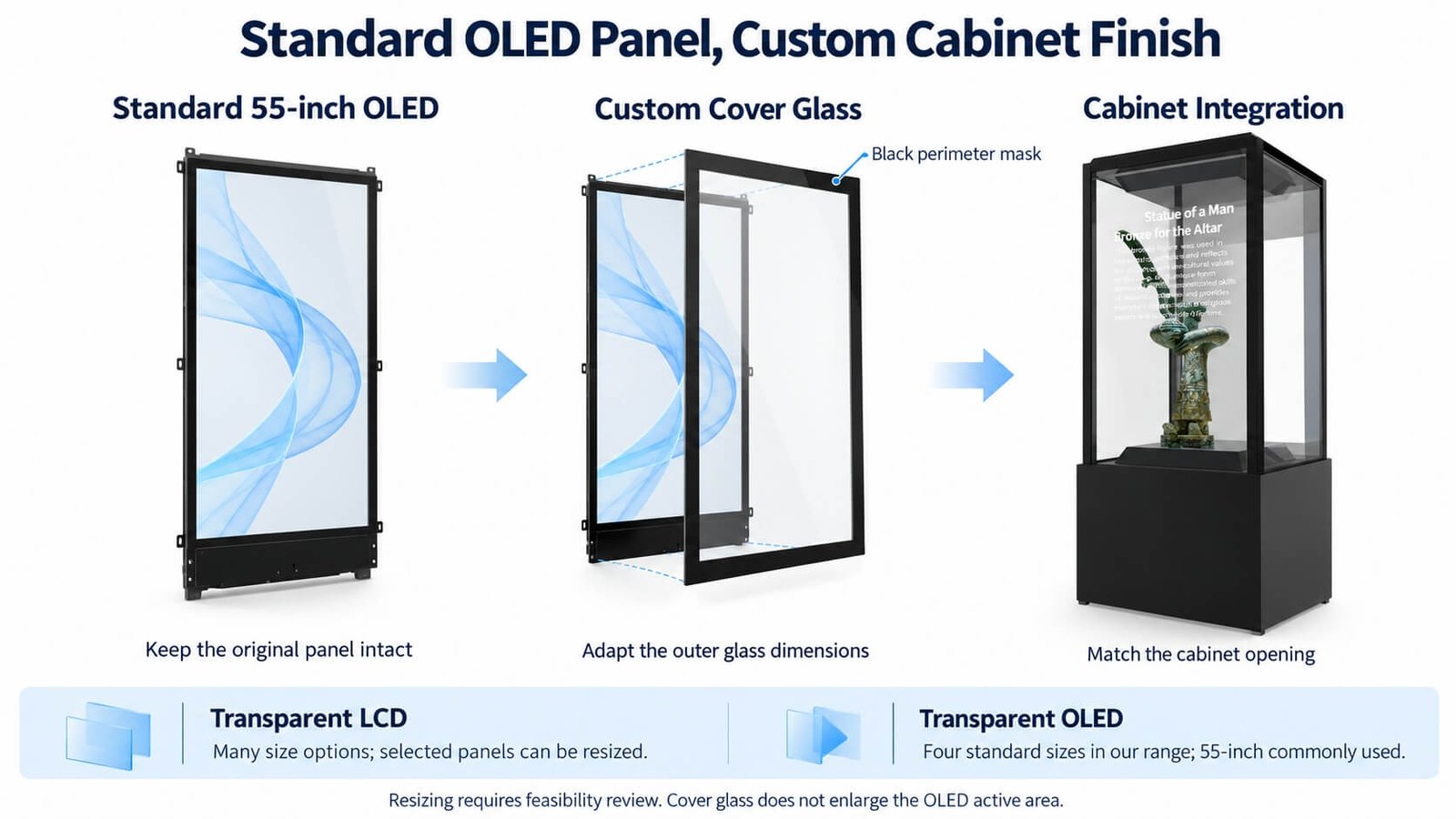
- The Solution: We do not resize the expensive display panel. Instead, we customize the Cover Lens (CTP/Glass).
2. The CTP Masking Method: Logic & Execution
This strategy involves three layers of integration:
- Layer 1: The Core Display: We use a standard 55″ factory-sealed panel (subject to approved handling, integration and warranty conditions).
- Layer 2: The Extended Cover Glass: We fabricate a custom piece of tempered glass (or a Capacitive Touch Panel) that matches your exact 1400 x 800 mm cabinet opening.
- Layer 3: Black Silk-Screen Masking: We apply a high-precision black silk-screen print to the border areas of the cover glass. This “mask” hides the inactive areas and the internal cabinet frame, leaving only the active display area visible.
3. Key Advantages for Solution Providers
- Cost Efficiency: It is significantly more affordable to customize a piece of cover glass than to pay for laser-cutting an LCD panel or attempting to customize an OLED substrate.
- Structural Integrity: Because the display panel remains in its original factory state, the internal seals are never breached. This avoids a panel-cutting step, but the completed assembly still needs optical, mechanical and warranty validation.
- Seamless Aesthetics: The result is a “Flush-Mount” look. From the outside, the viewer sees a single, continuous sheet of glass that perfectly fits the cabinet, with the digital content appearing to float exactly where you want it.
- Functional Integration: This method allows us to integrate touch functionality (PCAP Touch) over a specified sensor area, including a masked area where the sensor design, print materials, controller and application support it. Touch coverage does not enlarge the displayed image.
4. Implementation Comparison
| Feature | Direct Panel Resizing (Cutting) | CTP Masking Strategy |
|---|---|---|
| Primary Cost | High (Labor + Yield Risk) | Lower (Glass Customization) |
| Seal Integrity | If resized: validate the replacement seal | Original panel seal retained; integration still reviewed |
| Max Size | Panel- and process-dependent | Limited by glass, sensor and structural capability |
| Aesthetics | Visible Frame/Bezel | Seamless / Flush-Mount |
| Best For | Ultra-narrow/Unique Aspect Ratios | Standard Cabinet Integration |
Conclusion: Strategic Selection — Matching Technology to Vision
Choosing between Transparent LCD and Transparent OLED is not a matter of “better or worse,” but a matter of Engineering Fit. Your decision should be guided by three pillars: the nature of the product being displayed, the physical environment of the cabinet, and the long-term operational goals of the project.
The Decision Matrix: Quick Reference
| Choose Transparent LCD if… | Choose Transparent OLED if… |
|---|---|
| You are displaying general merchandise (shoes, jewelry, electronics) that benefits from high-intensity internal lighting. | You are displaying light-sensitive luxury goods and have verified that the complete OLED cabinet meets their illumination and temperature requirements. |
| Budget and ROI are key drivers, especially for mass-market retail or high-volume vending machine rollouts. | Branding and “Wow-Factor” are paramount, and the project requires the highest possible transparency and “floating” aesthetics. |
| The project requires non-standard shapes, such as ultra-wide or ultra-tall aspect ratios that require an approved panel route or a custom visible window. | The project requires multi-sided viewing, such as an island cabinet with a reviewed panel arrangement and corner structure. |
| The content is primarily static, such as fixed menus, pricing, or informational text that will remain visible for long periods within the approved duty cycle. | The content is highly dynamic and cinematic, utilizing motion graphics to prevent pixel burn-in and maximize organic life. |
| Long-term serviceability is a priority and the chosen assembly is approved for the planned duty cycle and maintenance schedule. | You are designing a high-tech flagship exhibit where cutting-edge technology defines the brand’s identity. |
Final Expert Verdict
- For the “Workhorse” Project: If your goal is a reliable, bright, and cost-effective commercial display for standard retail, Transparent LCD remains the industry gold standard. Its ability to be resized and its suitability for many informational display projects, subject to image-retention and duty-cycle review make it the most versatile tool for most cabinet designs.
- For the “Masterpiece” Project: If you are designing for a luxury boutique, a high-end wine cellar, or a futuristic showroom where an open visual design and self-emissive graphics are important, Transparent OLED is a candidate worth reviewing against the project’s optical, thermal, structural and commercial requirements.
Moving Forward
At DisplayMan, we don’t just supply panels; we verify visions. Because every custom cabinet carries unique thermal, structural, and optical requirements, we invite you to share your 3D CAD files and project specifications with our engineering team.
By moving away from generic price lists and moving toward verified engineering solutions, we ensure that your creative concept is delivered with the precision, reliability, and technical excellence that your clients demand.
Let’s build a display that lasts. Contact our engineering team to start your feasibility study today.
From guide to product
Explore Related Display Products
Compare a standard illuminated showcase, a self-emissive cabinet and a custom LCD integration route.
Transparent LCD Display Cabinets
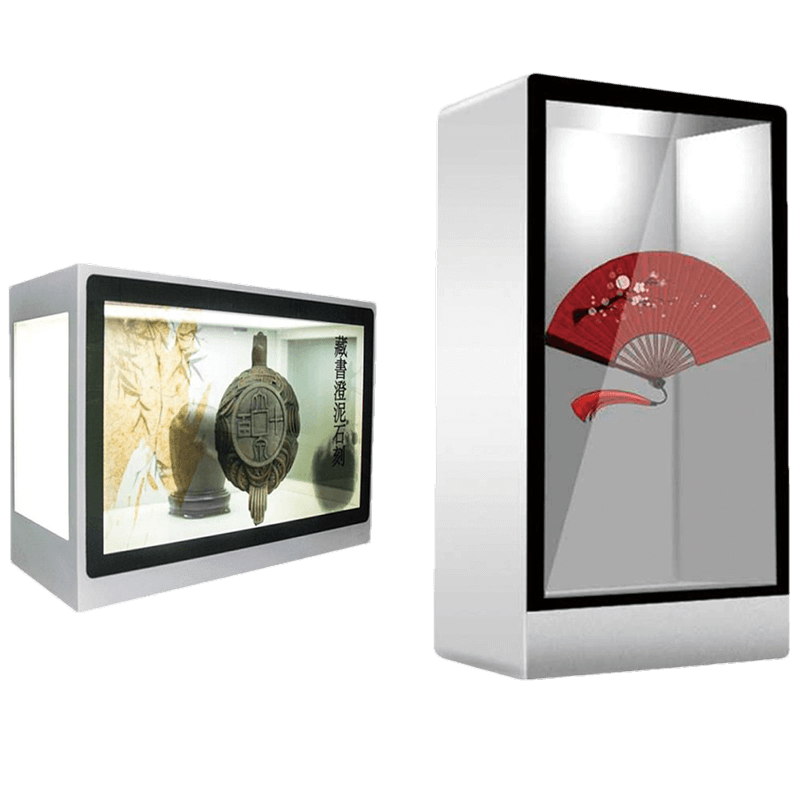
Explore display cabinets that combine digital images with illuminated physical merchandise.
Explore LCD cabinets →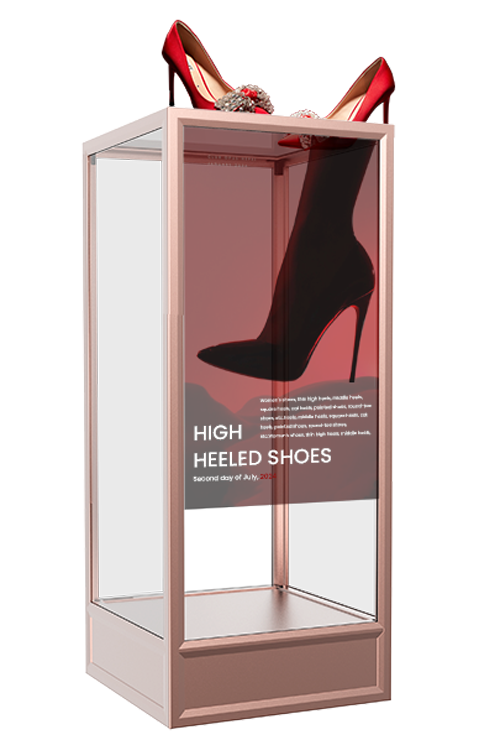
Transparent OLED Display Cabinets
Review self-emissive cabinet formats for open product presentations and multi-sided designs.
Explore OLED cabinets →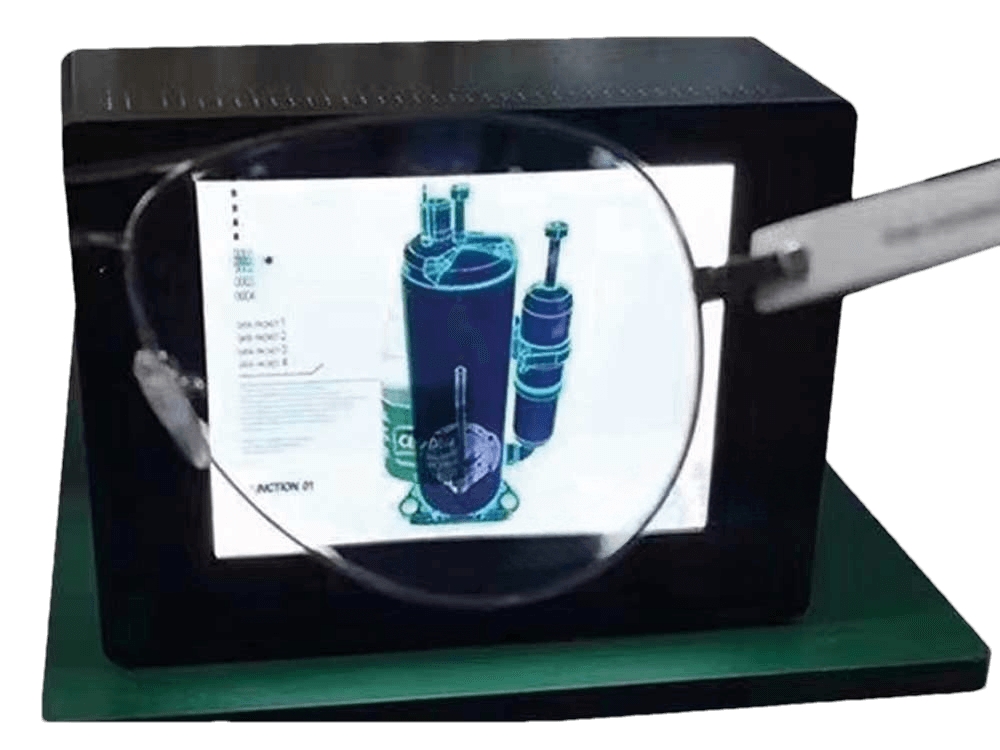
Custom Transparent LCD Displays
Discuss panel selection, cover glass, touch and mechanical integration for your project.
Review custom options →Project review
Plan Your Transparent Display Cabinet
Share your cabinet dimensions, product type, quantity and installation environment. DisplayMan can help identify the information needed to compare a practical LCD or OLED solution.
Prefer to open the enquiry form here?
Technical reference: LG 55EW5G-V manufacturer specifications illustrate model-specific brightness and operating-hour conditions. For purchasing, use the approved data sheet and written terms of the selected DisplayMan assembly.