


- The Ultimate Solutions
DisplayMan is the trusted leader in custom small-size transparent OLED displays, delivering high transparency, ultra-thin, and fully customizable solutions for automotive, AR, medical, and luxury retail industries. Get a custom quote today!
Welcome to DisplayMan’s latest exhibition, where innovation meets elegance with our custom small-size transparent OLED display showcases. Building on our commitment to professionalism and cutting-edge technology, we invite you to experience the future of display solutions. Our transparent OLED showcases are designed to captivate audiences by seamlessly integrating digital content with physical products, creating an immersive and engaging experience.
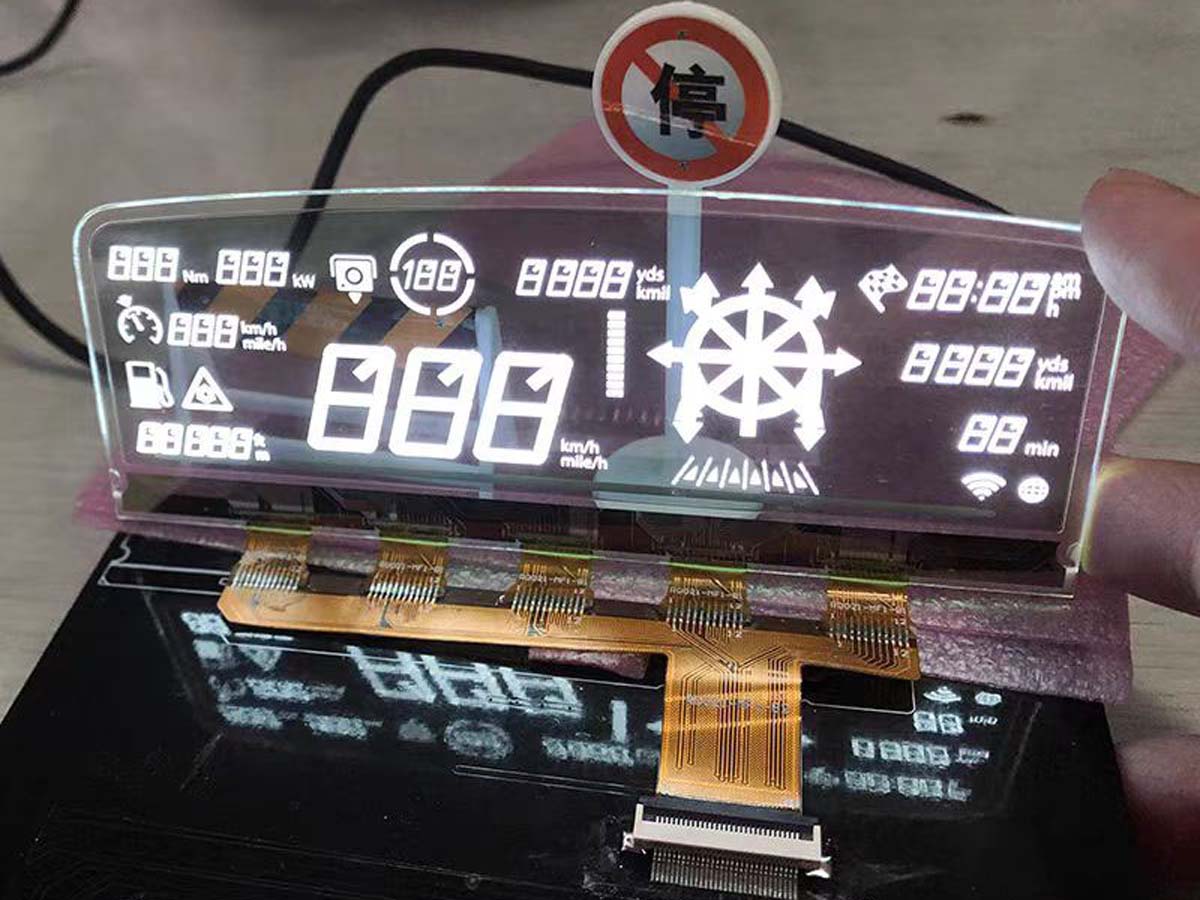
This is a small – sized transparent OLED display. It shows various vehicle – related information such as speed (in both km/h and mph), power (kW), distance (yds, km), and time. There are also icons for different functions like a camera, warning signs, and a steering wheel symbol. A red – bordered “no entry” – like sticker is placed on the top of the display. The flexible circuit board at the bottom connects the display, indicating it’s designed for integration into a system, likely for automotive applications such as a head – up display (HUD).
This small – sized transparent OLED display features a sleek, translucent design. It emits a bright green glow, showing diverse vehicle – related data. There’s speed information in both kph and mph, power indicators, and drive mode options like PARK, ECO, SPORT, and RACE. It also displays battery percentage and distance in kmile. Connected to a circuit board below, it’s likely part of an automotive or similar monitoring system.
This is a small – sized transparent OLED display. Held by a finger, it shows characters in green against the transparent background. The visible content includes what seems like Chinese characters on the top and the number “5.00” along with bar – like graphics below. It’s surrounded by a workspace filled with various colorful wires and electronic components, suggesting it’s being used in an electronics testing or prototyping environment.
A Custom Small-size Transparent OLED Display is a project-based transparent self-emissive display reviewed for compact OEM products, instruments, indicators, smart devices and transparent product windows.
It is mainly intended for fixed or limited display content such as icons, segments, numbers, symbols, warning marks, status indicators, mode indicators, battery or level bars and selected text zones.
This product is not positioned as a standard dot-matrix OLED module, smartphone-style display or small full-color video screen. Every project requires technical and commercial feasibility review before sample development.
Custom Small-size Transparent OLED Display is a specialized under-10-inch OEM direction for defined, limited information—not a general-purpose custom screen for any content.
Custom small-size Transparent OLED should only be reviewed when transparency is essential to the final product and the project can support the development cost, tooling, MOQ and production planning.
Every icon, number, symbol, segment, warning mark and display state should be defined before feasibility review.
Outer size, visible area, transparent window, thickness, FPC direction and connector space must be confirmed.
Interface, voltage, driving method, MCU, main board and assembly space affect whether the design is practical.
Custom development cannot be evaluated at the cost level of an off-the-shelf OLED or TFT LCD module.
The project should have a realistic annual quantity, product lifecycle and commercial plan—not only a concept sample.
If TFT LCD, standard OLED or segment LCD can solve the requirement, those technologies will usually be more practical.
Undefined “custom transparent screen” requests, full graphic UI, small full-color video, smartphone-style transparent OLED, one low-cost sample, no product drawing, no quantity plan or unrealistic price targets are generally not suitable for this product direction.
The most realistic projects use fixed or limited-content layouts. The display should be designed around the exact information the final product needs to communicate.
For numbers, units, level values and fixed display zones using a segment-style information structure.
For product icons, warning marks, function symbols and selected status indicators.
For mode, alarm, operating condition, charging, connection and product status information.
For speed, distance, temperature, power, pressure, capacity and other changing numeric values.
For battery, progress, volume, power, filling level and other bar-style indicators.
For a transparent information area integrated into an instrument, smart product, luxury device or OEM housing.
| Display Direction | Best For | Main Design Input |
|---|---|---|
| Segment Display | Numbers, values, units and fixed zones | Segment drawing, digit count, units, display states and update logic |
| Icon / Symbol Display | Warnings, modes, functions and product symbols | Icon artwork, position, on/off logic and color feasibility |
| Indicator Display | Status, alarms, operating modes and connection states | State table, visibility, viewing angle and operating environment |
| Numeric Display | Measurements, automotive values and instruments | Number range, decimal points, units, refresh and driver logic |
| Status Bar Display | Battery, level, power, progress and warning zones | Bar count, fill logic, color, orientation and transparent background |
| Product Window | Smart devices, premium electronics and instruments | Window size, housing, cover glass, FPC exit, connector and assembly method |
Custom small-size Transparent OLED projects are generally reviewed below 10 inches. The correct size should be defined by the required content and the real product window—not by diagonal size alone.
For compact status symbols, tiny warning marks and special information zones where very limited content is required.
For smart accessories, product indicators, compact instruments and small OEM display areas.
For automotive concepts, laboratory equipment, medical devices and premium product windows.
For larger instrument panels, technical equipment and concept-level OEM products. Cost, structure and quantity requirements normally increase significantly.
A larger transparent OLED is not automatically easier. Larger custom formats generally require stronger quantity support, higher tooling cost and more careful mechanical and electronic design.
Customization must start from the actual product and display-state drawings. Every item below is subject to technical and commercial feasibility.
Do not start with “we need a custom transparent screen.” Start with the content drawing, transparent window, product structure, FPC location, electronics, annual quantity and the reason transparency is essential.
This category does not have one universal standard specification. The table below describes the practical feasibility-review scope.
| Item | Reference Direction |
|---|---|
| Product Name | Custom Small-size Transparent OLED Display |
| Product Type | Project-based feasibility-review custom display |
| Display Principle | Transparent self-emissive OLED |
| Practical Size Direction | Generally under 10 inches |
| Recommended Content | Icons / segments / numbers / symbols / warnings / status bars / limited text |
| Full Graphic Dot-Matrix | Not the normal direction; requires special feasibility review |
| Video Playback | Not recommended for this product category |
| Transparency | Project based; depends on design, content and structure |
| Color | Project based; subject to display architecture and manufacturing feasibility |
| Interface | SPI / I2C / custom interface / project-specific driving review |
| FPC | Direction, length and connector position can be reviewed |
| Cover Structure | Glass, protective cover or customer housing integration |
| Touch | Project-based review only; not the primary direction |
| Applications | Automotive concepts, instruments, medical, laboratory, smart devices and premium OEM products |
| MOQ | Project based |
| Tooling | Normally required for custom development |
| Unit Price | Project based and generally higher than standard modules |
| Sample Development | Only after technical and commercial feasibility review |
No sample, MOQ, tooling cost, unit price or lead time should be promised before the content, structure, electronics, environment and production plan have been reviewed.
A custom small-size Transparent OLED must be developed together with the display content, electrical connection and final product structure.
Shows the defined icons, segments, values and status information while maintaining a see-through visual area.
Defines every visible element, its position and the operating states in which it turns on, changes or remains off.
Must fit the customer housing, assembly method, main board position and available connector space.
Selected according to the display architecture, update logic, voltage and customer control system.
The display may sit behind glass, inside an instrument window or under a transparent product cover.
The MCU, available voltage, connector, interface and software logic must be confirmed early.
Outer dimensions, thickness, active area, fixing method, protection and FPC exit must match the final product.
Temperature, humidity, sunlight, vibration, lifetime and certification requirements affect feasibility.
Tooling, process design, production yield, MOQ, testing and long-term supply must be included in the project plan.
The technology is best suited to premium OEM products where a transparent display effect adds real commercial or functional value.
For selected warning icons, battery status, drive modes, charging indicators and concept interior display windows.
For operating status, modes, power, warnings and premium transparent interfaces in smart products.
For values, units, alarms, modes and status information where the background or product structure should remain visible.
For selected measurement values, process status, warnings and operating modes subject to reliability and certification review.
For premium control windows, brand-specific visual effects, status indicators and product differentiation.
For operating steps, alarm symbols, power levels and limited technical information in selected environments.
If the product only needs to display information, compare TFT LCD, standard OLED and segment LCD first.
Provide all icons, numbers, segments, symbols, units, status bars and display states.
Define outer size, visible area, active area, transparent area, thickness, viewing direction and cover structure.
Confirm FPC exit, connector, voltage, interface, driver, MCU, main board and available assembly space.
Confirm temperatures, sunlight, humidity, vibration, lifetime, testing and certification requirements.
Provide tooling budget, sample quantity, target price, annual forecast, product lifecycle and production schedule.
The right project has a defined display-state drawing, a real product structure, confirmed electronics, a realistic tooling budget and batch-production potential.
Providing complete files at the beginning reduces misunderstanding and prevents engineering work on an impractical concept.
Show every icon, segment, number, symbol, warning, unit, bar and operating state.
Show outer dimensions, visible area, active area, thickness limit, transparent window and FPC direction.
Provide a 2D or 3D model showing the installation position, cover, fixing method, main board and cable space.
Provide voltage, interface, MCU, main board, connector, software logic and any current circuit information.
Provide operating and storage temperature, sunlight, moisture, dust, vibration, lifetime and certification requirements.
Provide sample quantity, annual forecast, tooling budget, target unit price, project schedule and final product value.
Many custom transparent OLED ideas are visually interesting but cannot match the final product’s cost structure. Budget and production quantity should be reviewed before detailed development.
The transparent OLED effect must create enough product value to justify engineering, tooling, sample cost, production risk and long-term supply planning.
| Technology | Choose Custom Small-size Transparent OLED When | Choose the Alternative When |
|---|---|---|
| Segment LCD | Transparent self-emissive appearance is essential and justifies premium development. | Fixed numbers, icons and symbols are needed at much lower cost and low power. |
| Standard OLED | The see-through effect is a core product feature. | A compact self-emissive display is needed without transparency, with easier samples and lower cost. |
| TFT LCD | Only limited information is required and the transparent visual effect is essential. | The product needs full graphic UI, images, color, video or mature mass production. |
| Transparent LCD | The project is a special under-10-inch fixed-content OEM product. | The project needs a larger transparent product window, cabinet or full graphic content with external lighting. |
| Transparent Micro LED | The project needs selected fixed icons or segments in a compact custom product. | The project needs premium full-color dot-matrix transparent graphics and can support very high cost. |
| Standard LEDs or Backlit Icons | A true transparent OLED effect is important to product differentiation. | Only simple warning lights, symbols or status indicators are required at the lowest practical cost. |
If transparency is not essential, standard OLED, TFT LCD or segment LCD is usually the better direction. Custom Transparent OLED should only be selected when the visual effect is central to the product value.
This product should be treated as a complete OEM development project, not as an off-the-shelf display purchase.
Content, transparent area, FPC, interface, electronics and product structure must be designed together. A feasible display glass alone does not guarantee a feasible final product.
A complete feasibility package allows engineering and commercial review to begin from real project conditions instead of assumptions.
Custom small-size Transparent OLED projects connect with the wider OLED family, custom-display engineering, FPC and touch integration, and several alternative technologies that may be more practical.
Start with this page when the project needs an under-10-inch transparent display with fixed icons, segments, numbers or limited information. Review Transparent OLED Displays for the complete family, Transparent OLED Signage for commercial video display and Custom OLED Displays when transparency is not essential.
| Related Product Page | When to Visit |
|---|---|
| Transparent OLED Displays | For the full Transparent OLED product family, main sizes and product categories |
| Transparent OLED Signage | When the project needs full-color commercial video, images or digital signage content |
| Transparent OLED Display Cabinet | When a larger OLED screen must display digital content in front of a physical product |
| Transparent OLED AI Digital Human Screen | When the project needs an avatar, virtual guide or interactive customer-facing terminal |
| Transparent OLED Video Wall | When several available OLED panels are used for a premium selected-layout display wall |
| OLED Displays | When a standard non-transparent OLED module may meet the application more practically |
| Custom OLED Displays | When OLED customization is required but the transparent effect is not essential |
| Product / Capability | When It Helps |
|---|---|
| OEM/ODM Display Engineering & Prototyping | When the project requires technical feasibility, drawings, samples, electronics integration and batch engineering |
| Custom LCD Module Solution | When a complete custom LCD module may provide better commercial feasibility |
| FPC & Cable Assembly | When FPC direction, length, connector and internal cable routing must match the product structure |
| Custom Touch Panel Glass | When cover glass, printing, holes, edge treatment or product-window construction must be reviewed |
| Capacitive Touch Panels | When the project may be better served by a standard display with a modern touch interface |
| Alternative Route | When It May Be Better |
|---|---|
| Segment LCD Displays | When fixed icons, numbers and symbols are needed with much better cost control and low power |
| TFT LCD Displays | When the product needs full graphic UI, text, images, video, mature samples and cost-effective mass production |
| Standard OLED Displays | When a compact self-emissive display is needed but transparency is unnecessary |
| Transparent LCD Displays | When the project needs a larger transparent display structure or full graphic content with external lighting |
| Custom Transparent LCD Display | When a custom transparent product window is needed with more practical structural options |
| Transparent Micro LED Displays | When the project needs premium full-color transparent dot-matrix graphics and can support a very high budget |
The product page should first confirm whether a custom Transparent OLED is necessary, then guide the customer toward the correct content format, size, electronics, tooling and alternative display technology.
It is a project-based transparent self-emissive display direction, generally reviewed for under-10-inch OEM products that need fixed icons, segments, numbers, symbols, warning marks, status bars or other limited information.
No. It is not normally available as a standard low-cost module. Display content, size, FPC, interface, structure, tooling, quantity and commercial feasibility must be reviewed before sample development.
Under-10-inch projects can be reviewed. Final feasibility depends on the content layout, transparent area, FPC position, electronics, product structure, tooling budget and production quantity.
Full graphic dot-matrix customization is not the normal direction for this product category. If the project needs freely changing UI, images or complex graphics, TFT LCD or a standard OLED module is usually more practical.
Video playback is not the recommended direction for custom small-size Transparent OLED. Transparent OLED Signage, Transparent LCD, TFT LCD or Transparent Micro LED should be reviewed instead.
Fixed icons, segments, numeric values, units, warning marks, mode indicators, battery or level bars, status symbols and limited text areas are the most realistic directions.
Yes. Icon, segment, number, symbol and status-zone layouts can be reviewed according to technical feasibility, tooling, quantity and product structure.
FPC direction, length, exit position and connector location can be reviewed according to the display design, customer main board and available assembly space.
SPI, I2C or another project-specific interface may be reviewed, but the final driving method depends on the display architecture, content and customer electronics.
Selected automotive indicator concepts can be reviewed, but temperature, lifetime, visibility, vibration, reliability, qualification requirements and production quantity must be evaluated carefully.
Selected limited-information applications can be reviewed. Readability, reliability, certification, cleaning, operating environment and long-term supply requirements must be confirmed.
Usually not. Custom Transparent OLED requires specialized feasibility review, tooling and project-based production, so it is generally more expensive than standard OLED, TFT LCD or segment LCD solutions.
Custom display content, electrodes or segment layout, FPC, interface, tooling and production process may all require project-specific development.
A one-piece low-cost sample is usually not practical. Sample development normally requires the customer to support the necessary engineering and tooling cost.
MOQ depends on size, content, tooling, supplier feasibility and production process. It must be reviewed case by case together with the annual quantity plan.
Please provide the content drawing, outer size, visible and active areas, transparent window, product structure, FPC direction, interface, voltage, operating environment, sample and annual quantity, tooling budget and target unit price.
Send us the display-content drawing, required dimensions, transparent window, product structure, FPC direction, interface, voltage, environment, quantity, tooling budget and target unit price.
We will first review whether a custom Transparent OLED is technically and commercially realistic. If another technology is more practical, we can also review TFT LCD, standard OLED, segment LCD, Transparent LCD or Transparent Micro LED.
This product is intended for selected OEM projects with defined limited content, clear mechanical and electronic requirements, realistic development budget and batch-production potential.
Please share the content drawing, display dimensions, product structure, FPC, interface, voltage, environment, quantity, budget and project background.
Please share your application, display size, quantity and project background. We will review the most practical display direction.