5.06 × 3.29 mm Image Area
A very small image source for optical systems where board space, weight and optical volume are tightly constrained.

A miniature 640 × 400 Micro OLED platform with full-color and high-brightness monochrome configurations for compact near-eye viewers, lightweight optical instruments and space-constrained display systems.
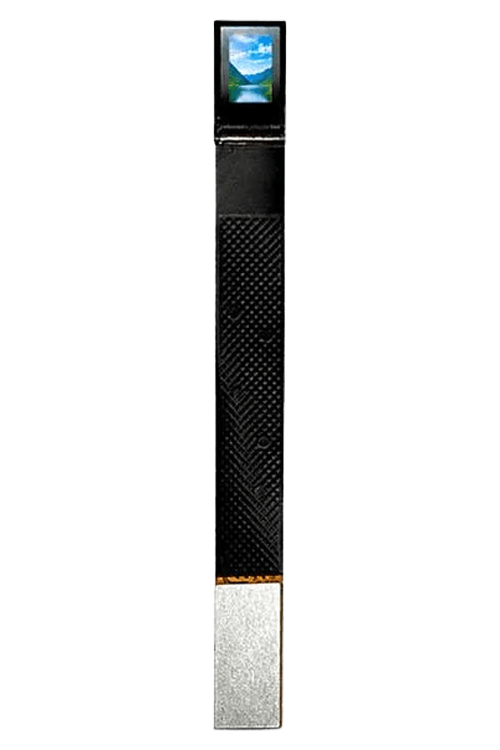
The TAS023VGH01 is the smallest platform in DisplayMan’s broader Micro OLED displays portfolio. It combines a native 640 × 400 resolution with a 5.06 × 3.29 mm active area and a module weight of only 0.2 g.
Full-color, monochrome white, green and red directions allow the same compact platform to be reviewed for different image, brightness and power priorities. It is an image source for an optical system—not a direct-view finished display.
The 7.8 μm pixel structure, 640 × 400 format and 5.06 × 3.29 mm display area identify this as a dedicated compact platform rather than a cropped 1.03″ device.
Reference brightness is 3000 cd/m² for full color, 6000 cd/m² for monochrome white, and 10000 cd/m² for monochrome green or red.
The following engineering references are based on the TAS023VGH01 specification. Confirm the selected color configuration, final supply status and driver compatibility before design-in.
| Model | TAS023VGH01 |
|---|---|
| Display Technology | Active-matrix OLED-on-Silicon / OLEDoS |
| Diagonal Size | 0.23 inch |
| Native Resolution | 640 (H) × 400 (V), RGB subpixels for full-color configuration |
| Pixel Size | 7.8 × 7.8 μm |
| Pixel Arrangement | RGB irregular hexagon |
| Display Area | 5.06 × 3.29 mm |
| FPC Dimensions | 54.33 × 6.02 × 1.09 mm |
| Gray Scale | 256 levels |
| Interface | 1-lane MIPI + I²C |
| Refresh Rate | 25–90 Hz |
| Contrast Ratio | >10,000:1 |
| Brightness Uniformity | >90% |
| Weight | 0.2 g |
| Power Supply | VDD 1.8 V; VCC 5.0 V |
| Operating Temperature | −40°C to +65°C |
| Storage Temperature | −55°C to +90°C |
| Full Color | 3000 cd/m² typical; <145 mW typical |
|---|---|
| Monochrome White | 6000 cd/m² typical; <130 mW typical |
| Monochrome Green | 10000 cd/m² typical; <120 mW typical |
| Monochrome Red | 10000 cd/m² typical; <100 mW typical |
Brightness and typical power differ by full-color or monochrome configuration. State the required color, target brightness and quantity so the correct build direction can be reviewed.
A very small image source for optical systems where board space, weight and optical volume are tightly constrained.
SVGA-class horizontal resolution supports compact symbols, menus, targeting information and live imagery.
High-brightness monochrome directions support applications with greater optical loss or demanding ambient conditions.
A selectable refresh-rate range supports different power, latency and motion requirements.
A compact MIPI image interface with I²C control suits purpose-designed miniature electronics.
The reference operating range of −40°C to +65°C supports specialized portable and industrial systems.
A miniature image source for monocular assisted-reality and information-display architectures.
Full-color or high-brightness monochrome output for compact optical combiners and embedded viewers.
A low-mass display direction for miniature cameras, scopes and specialized electronic viewfinders.
Monochrome configurations for portable thermal imagers, night-vision viewers and observation equipment.
A compact image source for eyepieces, inspection tools and specialized optical equipment.
A small platform for evaluating drivers, magnifying optics, brightness and mechanical integration.
The panel must be combined with a compatible MIPI driver, power sequence, optics and mechanical assembly. Final image quality depends on the complete signal-to-eye path.
Use the Near-Eye Display Solution page to review display selection, electronics, optics, mechanics and prototype evaluation as one system.
Full-color and monochrome versions have different brightness, power and optical behavior. Confirm the color mode before completing electronics and optics.
TAS023VGH01 provides a native 640 × 400 resolution with 7.8 μm pixels across a 5.06 × 3.29 mm display area.
The full-color configuration is specified at 3000 cd/m² typical brightness.
The reference values are 6000 cd/m² for monochrome white and 10000 cd/m² for monochrome green or red.
It uses a one-lane MIPI image interface plus I²C control.
Normally no. A compatible driver must convert the host signal and provide the required MIPI timing, control and power sequence.
Typical directions include compact AR or HUD viewers, miniature EVFs, thermal and night-vision viewers, and medical or optical instruments.
No. Its 7.8 μm pixel size, 640 × 400 resolution and 5.06 × 3.29 mm display area define a dedicated compact platform.
Please provide the color configuration, target brightness, quantity, host interface, optical architecture, mechanical envelope and project schedule.
Send the application, required quantity, brightness target, host input, optical requirement, available mechanical space and project schedule. DisplayMan will review whether the TAS023VGH01 platform is suitable.