1920 × 1200 Real RGB
WUXGA resolution provides detailed imagery and extra vertical workspace for menus, status data and composition overlays.

A 1920 × 1200 real-RGB Micro OLED with a 16:10 image format, 2000 cd/m² reference brightness and 4-lane MIPI interface for high-detail EVF, head-mounted display and professional optical systems.
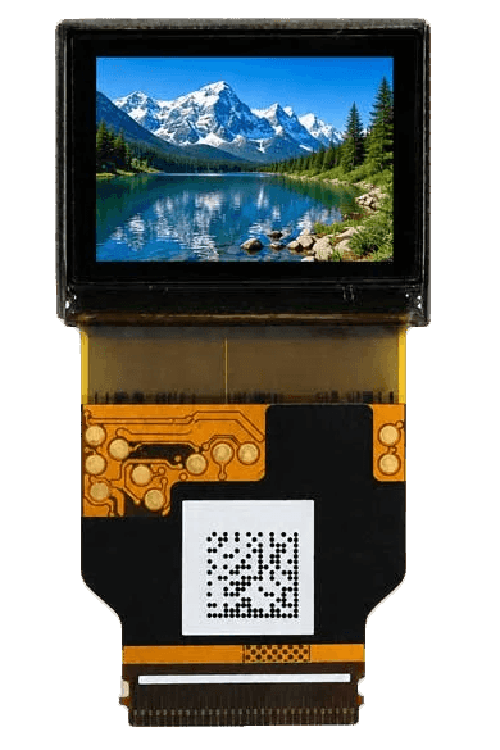
The 0.72″ WUXGA platform expands DisplayMan’s Micro OLED displays portfolio with a native 1920 × 1200 real-RGB resolution. Its 15.552 × 9.72 mm active area uses a 16:10 format that provides more vertical image space than Full HD.
With 8.1 μm pixels, 2000 cd/m² reference brightness and 500,000:1 typical contrast, this platform is designed as a high-resolution image source for magnifying optics rather than a finished direct-view display.
The 1920 × 1200 native format provides 120 additional vertical lines compared with 1920 × 1080, useful for viewfinder overlays, menus and professional imaging content.
The display uses one-port, 4-lane MIPI DSI at up to 1.2 Gbps per lane plus I²C control. HDMI and Type-C sources need a compatible conversion board.
The following engineering references describe the 0.72″ WUXGA color Micro OLED platform. The current orderable model, final supply status and driver initialization file should be reconfirmed before design-in.
| Model Direction | SY072WCM series / current 2000 cd/m² direction |
|---|---|
| Display Technology | Active-matrix color OLED-on-Silicon / OLEDoS |
| Diagonal Size | 0.72 inch |
| Native Resolution | 1920 (H) × 1200 (V), real RGB |
| Aspect Ratio | 16:10 |
| Number of Dots | 6.912 million subpixels: 1920 × 1200 × 3 |
| Pixel Size | 8.1 × 8.1 μm |
| Pixel Arrangement | RGB π type |
| Usable Display Area | 15.552 × 9.72 mm |
| Brightness | 2000 cd/m² typical |
| Contrast Ratio | 500,000:1 typical |
| Uniformity | >85% |
| Color Depth | 16.7 million colors, 24-bit RGB |
| Color Gamut | 90% DCI-P3 reference |
| Gray Levels | 256 |
| Display Interface | One-port MIPI DSI, 4-lane D-PHY, up to 1.2 Gbps per lane |
| Control Interface | I²C |
| Frame Rate | 30–60 Hz |
| Power Consumption | 1000 mW reference |
| Power Inputs | ELVDD 5.0–5.5 V; ELVSS −4.0 to −5.5 V; VDDI 1.62–1.98 V |
| Operating Temperature | −20°C to +70°C |
| Storage Temperature | −40°C to +80°C |
The platform documentation references 1920 × 1200, 1920 × 1080, 1600 × 1200, 1280 × 1024, 1280 × 720 and 1024 × 768 modes. Confirm scaling, timing and initialization support with the selected driver board.
WUXGA resolution provides detailed imagery and extra vertical workspace for menus, status data and composition overlays.
A 15.552 × 9.72 mm image area supports professional viewfinder and optical architectures designed around 16:10 content.
Self-emissive pixels produce deep black and high-contrast edges without a separate LCD backlight.
Reference luminance supports near-eye optics, subject to transmission loss and the final brightness-at-eye requirement.
A wide-gamut direction supports professional imaging applications where color reproduction matters.
Four MIPI data lanes provide the bandwidth needed for WUXGA imagery at up to 60 Hz.
WUXGA detail, a 16:10 format and high contrast for cameras, cinema systems and professional imaging equipment.
High pixel count and wide-gamut color for specialized cameras, inspection systems and image-analysis instruments.
A high-resolution image source for monocular or binocular near-eye architectures operating up to 60 Hz.
Detailed image presentation for thermal imaging, observation, inspection and portable professional equipment.
A compact high-resolution source for surgical viewers, microscopes and specialized optical eyepieces.
A WUXGA platform for evaluating eyepieces, driver timing, color performance and mechanical integration.
The panel requires a matched high-resolution video pipeline, power sequence and optical system. Final perceived detail depends on the host output, driver timing, optical MTF, focus and mechanical alignment.
Use the Near-Eye Display Solution page to coordinate the display, driver electronics, optics, mechanics and prototype evaluation.
Confirm image format, optical magnification, brightness at the eye, frame rate, interface bandwidth, power and thermal limits before freezing the panel.
The platform provides a native 1920 × 1200 real-RGB resolution across a 15.552 × 9.72 mm usable display area.
WUXGA refers to 1920 × 1200 resolution with a 16:10 aspect ratio. It provides 120 more vertical pixels than 1920 × 1080 Full HD.
The reference typical brightness is 2000 cd/m², measured at full-white conditions specified for the panel.
It uses one-port MIPI DSI with four D-PHY data lanes at up to 1.2 Gbps per lane, plus I²C control.
Normally no. A compatible driver must convert the host input to the required MIPI timing and provide initialization and power sequencing.
The platform documentation references 1920 × 1080 and several other input modes, but scaling and timing support must be confirmed with the selected driver.
Yes. Its 16:10 WUXGA resolution, high contrast and wide-gamut reference make it relevant for camera EVFs and professional imaging, subject to driver and eyepiece matching.
Please provide the application, quantity, required resolution and frame rate, host input, optical architecture, brightness-at-eye target, mechanical envelope and schedule.
Send the application, quantity, host input, optical requirement, brightness-at-eye target, mechanical limits and project schedule. DisplayMan will review whether this 0.72-inch WUXGA direction is suitable.