
DisplayMan Engineering Guide · Quick Answer
Transparent Micro LED vs OLED: Which Should You Choose?
Evaluate transparent Micro LED when higher brightness and modular format options are worth a larger budget. Choose transparent OLED when an available slim panel fits the indoor environment, content and operating schedule. Choose transparent LCD when a lit cabinet and tighter budget drive the design.
The decision depends on the finished assembly’s transparency, pixel pitch, resolution, background light, power, maintenance and price—not the technology name alone. This guide keeps DisplayMan’s 30-inch side-by-side video at the center of the comparison and separates demonstration impressions from specifications that need model-level verification.
Watch the side-by-side video → Compare the engineering trade-offs →
Part 1: Introduction – Beyond the Hype of Transparency
The “Wow” Factor vs. Engineering Reality. In the world of high-end display technology, transparency has long been an exciting frontier. We have all seen floating interfaces in movies like Iron Man or Minority Report. Today, see-through displays can bring some of that visual language into real projects, but the engineering deserves as much attention as the effect. A search for “Micro LED vs. Transparent OLED” produces plenty of charts and specifications. After more than 10 years in the display industry, my recommendation is to check the exact model and measurement conditions before treating those numbers as directly comparable.
The Clash of Technologies. Three useful routes are transparent LCD, transparent OLED and transparent Micro LED. Transparent LCD can be a cost-effective cabinet solution when illumination is integrated into the structure. Transparent OLED provides a slim self-emissive image. Transparent Micro LED is an important option where higher brightness and a highly open optical structure justify the budget. Each route has constraints.
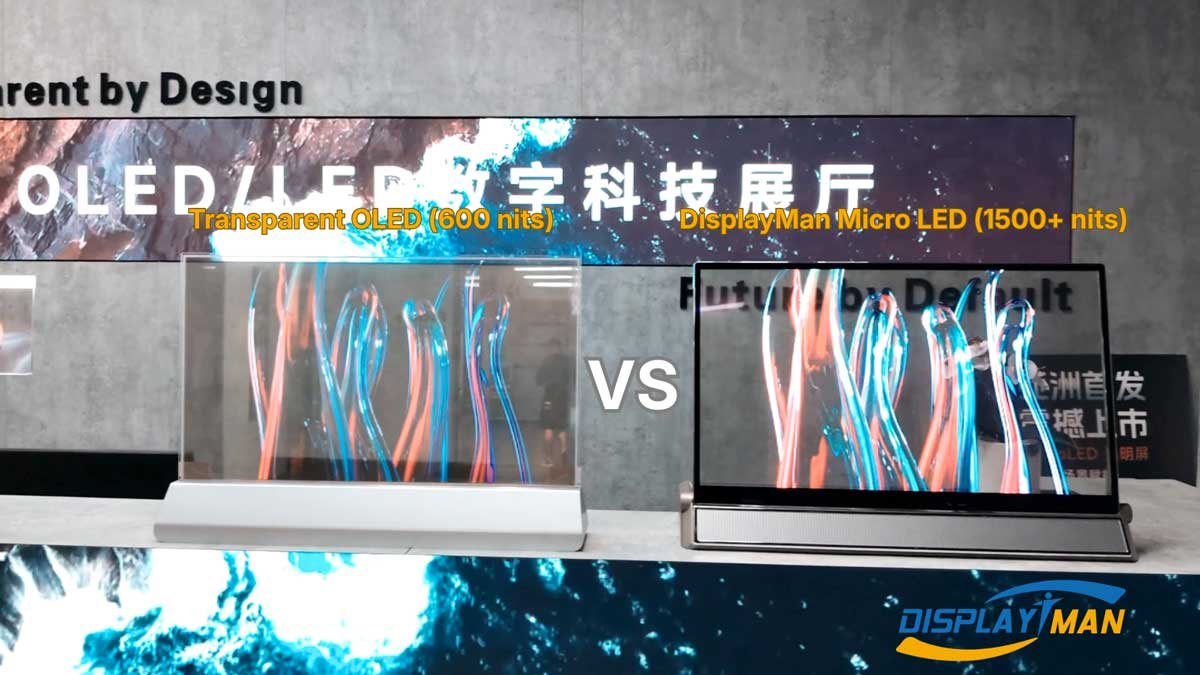
Why This Article Is Different. At DisplayMan, we work on display integration for projects including medical equipment, retail and other OEM applications. To move beyond specification sheets, we arranged a side-by-side demonstration of a 30-inch transparent OLED and a 30-inch transparent Micro LED. The video below shows the visual comparison; it is a demonstration of these two units rather than a calibrated laboratory benchmark for every product in either technology family.
In this guide, I share the practical differences behind those images—including why a Micro LED quotation can be substantially higher, how brightness and transparency affect the result, and why the best choice depends on the environment and the complete system.
Part 2: Technical Foundations – How “See-Through” Actually Works
To choose the right technology, you first need to understand the physics of the glass. Not all “transparency” is created equal.
Transparent LCD (T-LCD): The Managed Environment
Think of transparent LCD as a light-modulating display. It does not emit its own image light. It needs suitable illumination behind the panel—often LED lighting and a light interior integrated into a product cabinet—to make the image visible. The lighting arrangement and the goods behind the screen must be designed together.
- The reality: More light can improve image visibility, but it does not automatically increase the panel’s optical transmittance. Do not treat “60%+ transparency” as a universal transparent LCD specification. Ask for the selected panel’s measured transmittance and the finished assembly’s optical stack.
- The trade-off: Lighting adds depth and thermal requirements. This can work well in luxury product showcases where the cabinet accommodates illumination, but it differs from a slim, freestanding sheet of luminous glass. See our transparent display cabinet engineering guide for the structural comparison.
Transparent OLED (T-OLED): The Organic Standard
Transparent OLED uses organic self-emissive pixels, so the display image does not need a separate backlight. Its transparent structure allows the background to remain visible. Product lighting may still be needed behind it: “no display backlight” does not mean “no lighting design.”
- Standard sizes: Transparent OLED is generally selected from available panel formats. LG has documented 30-inch and 55-inch transparent OLED products; confirm the exact model before treating other OLED diagonals, such as 48 or 77 inches, as transparent-panel options.
- Tint, haze and reflections: The visible glass appearance depends on electrodes, encapsulation, substrate, coatings, cover glass and touch layers. Compare finished assemblies under the intended lighting rather than attributing every optical difference to organic materials alone.
Micro LED: The “Industrial Miracle” & The Iron Man Reality
Transparent Micro LED combines tiny inorganic emitters with an optically open structure. Selected configurations in DisplayMan’s proposed range target 70%+ transparency, subject to the model and finished optical stack. This is a project specification to verify, not a threshold that defines a “hologram,” nor a figure that applies to every Micro LED display.
- The micron advantage: Small inorganic LED chips leave space for light to pass through. Chip size, pixel pitch, conductor routing and packaging together determine clarity, resolution and how visible the pixel structure is at a given distance. Small chips alone do not make the grid invisible.
- Built for demanding projects: Micro LED avoids the organic emitter aging mechanism of OLED, but its emitters, drivers and other components still age. A 100,000-hour figure must state the luminance-degradation criterion, operating conditions and scope; it is not a promise of unchanged brightness or a complete-system warranty. Compare the selected model’s documented life and service plan.
- Beyond a single panel: DisplayMan’s modular approach uses compact building blocks, described in this portfolio as 9.4-inch and 16.1-inch modules. Confirm the module part number, active area and mechanical drawing before design approval. Larger arrangements are feasible within module geometry, controller, seam, mounting and thermal limits.
Part 3: The 30-inch Showdown – Reality vs. Spec Sheets
A Head-to-Head Visual Comparison. We placed our 30-inch transparent Micro LED beside a 30-inch transparent OLED to show why a specification sheet alone does not describe the experience. The demonstration helps assess brightness, color impression and background visibility. It does not isolate every variable or establish a universal winner.
1. Luminance and Ambient Light. Brightness is a major factor near windows and in strongly lit interiors. Transparent OLED brightness varies by model, average picture level (APL) and optical stack; 600 nits is not a universal maximum. As a documented example, LG lists its 55EW5G-V at 150 / 400 nits at APL 100% / 25%, without glass. These figures describe that model, not the 30-inch demonstration unit.
- The Micro LED option: DisplayMan can review configurations in a proposed 600–3,000-nit range. This is a range of engineering options, not proof that the unit in the video was measured across that range. Confirm sustained and peak luminance, APL, power, temperature and optical layers for the selected model.
- What the video helps show: A brighter emissive image can remain more prominent against a bright background. Actual readability also depends on reflections, content, pixel pitch and viewing distance. A high nit value alone does not qualify an assembly for direct sun or outdoor use.
2. Viewing Angle: Judge the Finished Assembly. We compare frontal and oblique views, including approximately 45° and 60° viewing positions. Color impression at an angle depends on the panel, optical stack, reflections and camera settings. Evaluate the intended viewing corridor, not only the frontal image.
- Demonstration impression: The OLED can appear less saturated in some captured views, while the Micro LED retains a strong color impression. Treat this as an observation of the particular setup, not proof that OLED generally has poor viewing angles.
- Engineering acceptance: Do not interpret “178°” as a guarantee of unchanged color and luminance across that angle. For a critical retail or public installation, agree on viewing positions, brightness measurements and color-shift criteria. “100% color integrity” requires a defined measurement and cannot be established from video alone.
3. Contrast and the Floating-Image Effect. The demonstration shows bright colored objects with the background visible around them. On both transparent OLED and transparent Micro LED, black video regions generally mean that the emitters are off; they do not produce an opaque black backdrop. Perceived contrast depends strongly on what is behind the screen and on ambient light.
- The experience: A bright image against an open background can resemble a floating digital object—the “Iron Man” visual direction that inspires many projects. This is an optical presentation effect on a physical display plane, rather than a true volumetric hologram. Cover glass, wiring and module boundaries may still be visible.
Part 4: The Price of Innovation – Why It Costs What It Costs
The “Elephant in the Room”: The Price Gap. Micro LED can command a substantial premium. A 10–15× gap may occur in particular quotations, but it is not a universal market ratio. Compare the same diagonal, resolution, brightness, controller, cover glass, quantity, warranty and installation scope. A bare panel price and a complete terminal price are not equivalent.
1. The Tooling and Manufacturing Story. Developing compact transparent Micro LED modules requires substantial investment in process development, precision equipment, tooling and yield improvement before saleable assemblies can be supplied. These costs help explain the premium. The amount attributable to a particular module platform depends on the production program; it should not be confused with a customer’s project-specific development charge.
- The complexity: Placing and connecting large numbers of micron-scale LED chips demands high process accuracy, inspection and repair capability. The emitter count depends on resolution and pixel architecture. Yield management matters; “without a single error” is not a substitute for an agreed inspection and defect specification.
2. Established Modules vs. New Development. The practical DisplayMan approach is to start with a suitable existing module platform wherever possible. A customer choosing that route can avoid commissioning a completely new display platform, while paying for the actual product and agreed integration work.
- Amortized value: Existing-platform costs are reflected in the product price. Custom mechanics, cover glass, touch, control electronics, firmware, testing or a new panel design may still require non-recurring engineering charges or an MOQ. Availability, validation status and delivery time must be confirmed in the quotation; not every size is ready to ship.
3. Tailored Brightness: Reviewing 600–3,000-Nit Options. A Micro LED configuration can be selected around the project’s brightness needs. This is engineering selection within a supported platform, not a promise that every panel can provide every brightness level.
- Custom brightness: A subtle indoor gallery and a window-facing installation may need different drive settings, power budgets and cooling. Confirm the achievable brightness, uniformity and operating life together. Transparent OLED also has brightness controls, within its model-specific limits.
- The logic: Why specify maximum brightness in a dim gallery, or accept insufficient image prominence in a bright window? Match the display to measured site conditions. For outdoor projects, weather protection, thermal design, condensation and UV exposure need separate review.
Part 5: Scalability & The Future-Proof Portfolio
Beyond the Prototype: A Nine-Size Portfolio Direction. A major hurdle in transparent display projects is finding a size that fits the architectural intent. DisplayMan’s portfolio covers nine diagonal sizes, from compact OEM concepts to larger retail and lobby installations. The range includes 60-inch, 64-inch and 83-inch configurations. See the product pages for configuration details.
The modular approach provides a route to broader formats, but the required resolution, viewing distance, seams, interface and mounting must be checked for each arrangement. Review the product pages for the specifications and integration details of each size.
The DisplayMan Transparent Micro LED Portfolio:
- Compact directions: 9.4-inch, 16.1-inch and 20-inch—candidates for desktop interfaces, appliances and selected OEM projects. Automotive HUD and medical use require application-specific optical, safety and qualification work.
- Mid-range directions: 30-inch, 42-inch and 54-inch—formats to discuss for retail presentation and interactive installations, with exact dimensions and integration scope confirmed per model.
- Larger formats: 60-inch, 64-inch and 83-inch—for larger retail presentations and corporate installations. See the transparent Micro LED product range for configuration details.
The “Lego” Advantage: Modular Customization. Compact modules can provide a route to wider or taller arrangements. A proposed 120-inch panoramic format or a four-meter installation needs a module layout, controller and bandwidth review, mechanical design, service access and thermal assessment. Module boundaries and transparent wiring may remain visible: “modular” does not automatically mean optically seamless, unlimited size or zero development cost.
Conclusion: Which Tech Leads the Next Generation?
The winner of the “Transparency Race” isn’t decided by a spec sheet; it’s decided by the environment.
- Choose transparent LCD when a controlled cabinet can accommodate illumination and cost is a priority.
- Choose transparent OLED when a slim, available panel format suits the indoor environment and the content and operating schedule fit the selected model.
- Evaluate transparent Micro LED when higher brightness, a highly open optical structure and modular format options justify a larger investment. Confirm the actual transparency, resolution, sustained brightness, seams and service plan.
At DisplayMan, more than 10 years of display-industry experience informs our project reviews. Our aim is to match the technology to the real installation—not to promise that one technology removes every engineering trade-off.
Ready to compare the options? Watch our 30-inch side-by-side video, then share your requirements with our engineering team. We can review which portfolio direction and level of integration fit your project.
Transparent LCD, OLED and Micro LED: Engineering Comparison
Use this table to frame the selection. Final values must come from the exact model and finished assembly.
| Decision factor | Transparent LCD | Transparent OLED | Transparent Micro LED |
|---|---|---|---|
| Image light | Requires illumination behind the panel | Organic self-emissive pixels | Inorganic self-emissive LEDs |
| Optical transparency | Check panel transmittance and lighting design | Model and optical-stack dependent | Chip layout, routing and optical-stack dependent |
| Bright surroundings | Evaluate the complete lit cabinet | Check APL-dependent brightness and reflections | Higher-brightness options may help; verify sustained output |
| Resolution and viewing distance | Confirm available panel resolution | Confirm available panel resolution | Check pixel pitch and layout; smaller chips do not guarantee higher resolution |
| Static content and aging | Retention and component aging still need review | Assess differential organic pixel aging | No organic emitter aging; LED and system aging still matter |
| Formats and seams | Available panels; resizing only where feasible | Available panel formats; tiled joints need design | Modular options; seams and controller limits need review |
| Budget | Often economical for suitable cabinets | Compare panel and complete-system scope | Typically a premium; no universal price multiplier |
| Best starting point | Illuminated product showcase | Slim indoor see-through presentation | Higher-brightness premium or modular project |
Before Requesting a Quotation
Send DisplayMan the active image dimensions and orientation, target resolution or viewing distance, site photos and lighting conditions, daily operating hours, content samples, touch requirements, quantity and required delivery date.
- Optical acceptance: agree how transparency and haze will be measured, with or without protective glass and touch layers.
- Brightness acceptance: distinguish peak from sustained output and state APL, temperature and test content.
- Mechanical integration: approve module drawings, visible joints, cable exits, mounting and service access.
- Commercial scope: confirm controller, enclosure, software, NRE, MOQ, freight, warranty exclusions and spare parts.
For related detail, read our OLED burn-in and prevention guide and transparent LCD vs OLED cabinet engineering guide.
From guide to product
Explore Related Display Products
Review the three product families against the same installation requirements.
Transparent Micro LED Displays
Review compact modules and larger configurations for premium see-through display projects.
Explore product options →
Transparent OLED Displays
Compare slim self-emissive options with model-specific brightness and content requirements.
Explore product options →
Transparent LCD Displays
Explore illuminated showcase formats and review cabinet lighting, dimensions and integration.
Explore product options →Project review
Plan Your Transparent Display Project
Share your target size, lighting conditions, content, operating schedule and quantity. DisplayMan can review the technology, integration scope and quotation requirements together.
Prefer to open the enquiry form here?
Specification references: LG 55EW5G-V model specifications; LG’s documented 30-inch and 55-inch transparent OLED examples. External model figures are illustrative and do not identify the settings of the units in the DisplayMan video.