DisplayMan Technical Guide · Quick Answer
How Did LCD Technology Develop?
LCD evolved from the discovery of liquid crystals in 1888 through electronic display demonstrations in the 1960s, portable numerical displays in the 1970s and subsequent advances in graphic, TFT and wide-viewing-angle panels. It was a sequence of discoveries and engineering developments, not a single invention.
Today, that development supports different product directions: monochrome interfaces, color TFT modules, transparent displays and high-brightness assemblies. The right choice depends on the information and installation environment.
LCD History at a Glance
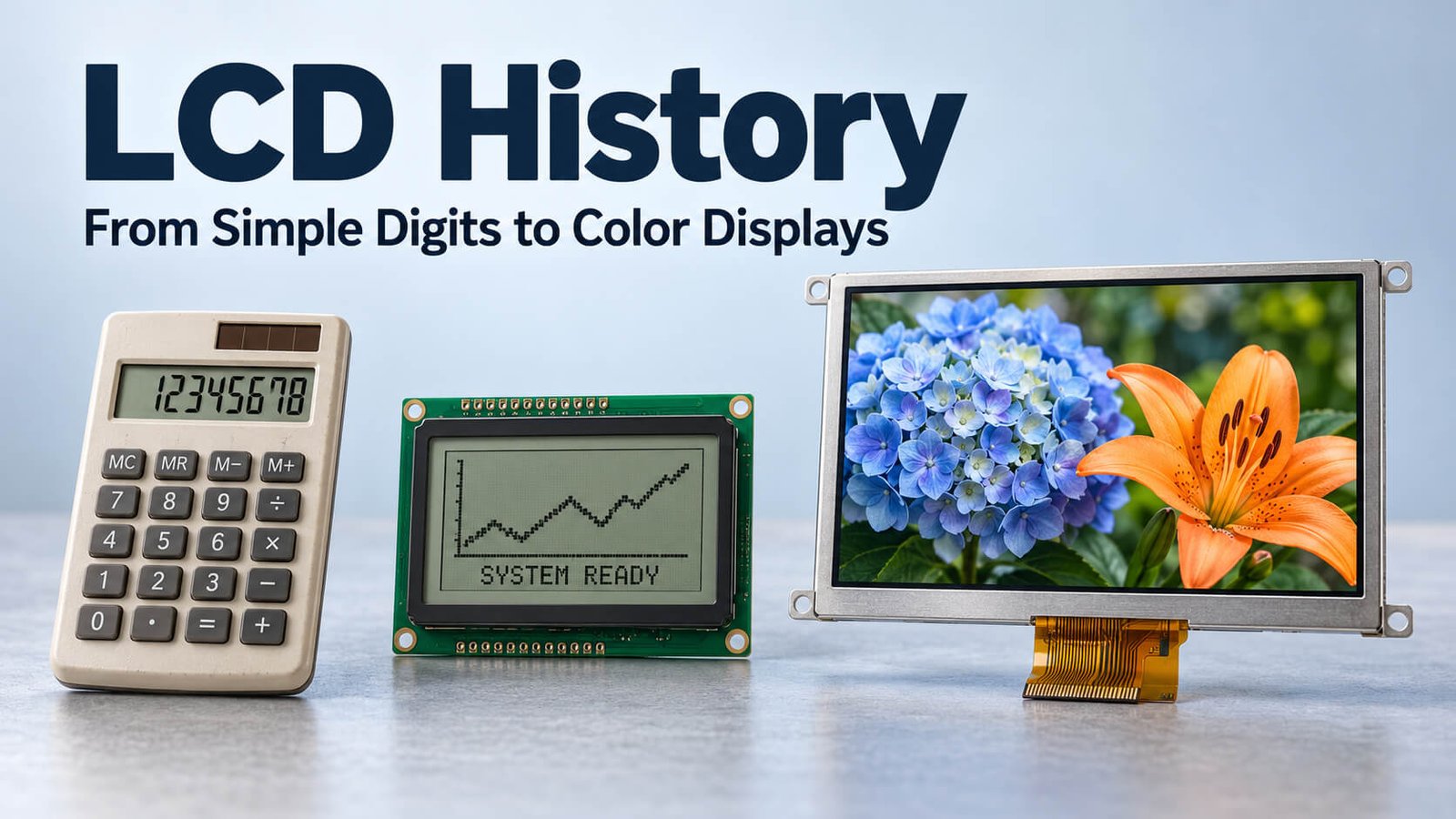
LCD history is a series of advances in materials, optical effects, electronic addressing and manufacturing. Liquid crystals were discovered in 1888, long before engineers could turn them into practical electronic displays. Research in the 1960s demonstrated controlled light modulation; subsequent developments brought low-power numerical displays, graphic modules and color active-matrix panels into useful products.
The timeline below identifies selected milestones. A laboratory demonstration, a patent, a prototype and a commercial product are different events. They should not be combined into one universal claim about when LCD was “invented.”
| Date or period | Selected development | Why it matters |
|---|---|---|
| 1888 | Friedrich Reinitzer observed the unusual phase behavior associated with the discovery of liquid crystals. [1] | Established the scientific starting point, rather than a working electronic screen. |
| 1964–1968 | George Heilmeier and colleagues at RCA developed electronic control of light using liquid crystals; the 1968 achievement is recognized by an IEEE Milestone. [2] | Demonstrated a practical direction for electronic displays. |
| 1970–1971 | Schadt and Helfrich filed a TN patent in 1970 and published their results in 1971. [3] | Helped establish a field-effect approach important to practical LCD development. |
| 1973 | Sharp introduced the EL-805 LCD calculator. [4] | A concrete example of LCD reaching portable consumer products. |
| 1988 | Sharp developed a prototype 14-inch color TFT LCD. [5] | Demonstrated progress toward larger active-matrix color displays. |
| 1995 | Hitachi demonstrated an IPS TFT-LCD prototype at Asia Display. [6] | A notable milestone in improving off-axis image performance. |
These milestones do not imply that one organization developed every part of the technology. LCD became useful through contributions from researchers, materials companies, semiconductor engineers and display manufacturers.
1888: Liquid Crystals Before Electronic Displays
Reinitzer’s observations introduced an unusual material state between familiar crystalline solids and ordinary liquids. Liquid-crystal molecules can retain ordered arrangements while the material has fluid properties. That combination later became useful for controlling light. [1]
Discovery alone did not produce a display. Engineers still needed suitable materials, repeatable alignment, transparent electrodes, reliable sealing and a way to control an optical effect electrically. Understanding this gap helps explain why LCD history spans much more than the age of television or computer screens.
For a detailed explanation of the finished device, see What Is an LCD Display?. This history focuses on how the technology reached those devices.
The 1960s: Turning Materials Research into Displays
The IEEE recognizes the work of Heilmeier, Zanoni and Barton at RCA between 1964 and 1968 as a milestone in electronic control of light using liquid crystals. [2] This was a foundational demonstration, rather than a modern high-resolution color panel.
Early liquid-crystal approaches included dynamic scattering, which changes how the material scatters light. It is important not to describe those early devices as if they already used the same optical mode and transistor backplane as today’s IPS modules.
A lesson runs through this period: an interesting optical effect becomes a product only when it can be manufactured, driven and packaged consistently. Modern displays still depend on that combination of optical, electrical and mechanical engineering.
The 1970s: TN and Portable Numerical Displays
The twisted-nematic field effect was another important development. Martin Schadt and Wolfgang Helfrich filed their Swiss TN patent in December 1970 and published their results in February 1971. [3] The historical record also includes other researchers and independent contributions; the entire LCD industry should not be attributed to a single invention.
Sharp’s 1973 EL-805 provides a documented commercial milestone. [4] A calculator needs clear numerals and modest display power rather than photographic images. This suited the strengths of early LCD products.
Why Segmented LCDs Remain Useful
A segmented display uses shaped electrodes for predetermined numbers, symbols or icons. It does not need a complete pixel matrix when the information is fixed. That can remain a sensible engineering choice for meters, controllers and instruments.
Reflective LCDs can use ambient light, so an LCD does not inherently require a backlight. The total product power still depends on the driver, electronics, update behavior and any optional illumination. “LCD is low power” is a starting point for evaluation, not a complete power specification.
From Fixed Segments to Graphic LCDs
More complex interfaces require letters, menus, diagrams or variable symbols. A matrix of pixels offers more flexibility than a set of fixed segments. Character and graphic LCD modules made that flexibility available in many embedded products.
Passive-matrix designs address pixels through row and column electrodes. As the amount of information increases, multiplexing and electro-optical behavior become important design constraints. Super-twisted-nematic, or STN, technology became part of this progression; compensation approaches such as FSTN help manage the optical appearance.
For a buyer, the useful distinction is the required information. A measurement display may need a few large digits. An industrial controller may need a monochrome menu. A visual touchscreen interface may justify a color TFT module. The newest display architecture is not automatically the best fit for every interface.
TFT: An Active-Matrix Route to Color Images
TFT means thin-film transistor. In a TFT LCD, transistors associated with the pixel structure provide active-matrix addressing. TFT describes how pixels are controlled; it is not a synonym for IPS and it does not specify brightness or resolution by itself.
Sharp’s 14-inch color TFT prototype in 1988 is a useful documented milestone in scaling this technology. [5] A prototype of that size should not be mistaken for the first LCD monitor or for the start of all commercial TFT production.
Color TFT modules allow designers to build interfaces with photographs, animation, detailed graphics and changing layouts. Their integration requires attention to the panel interface, timing, power sequence, backlight drive and mechanics. A matching diagonal size alone does not establish electrical compatibility.
Explore TFT LCD displays for the product direction, or use the LCD fundamentals guide to review the terminology before comparing specifications.
IPS and the Importance of Viewing Angle
A screen that looks acceptable directly in front of the viewer may show changes in contrast, grayscale or color from another direction. That becomes significant when the display is mounted above eye level, used in portrait orientation or viewed by several people.
Hitachi’s IPS TFT-LCD prototype attracted attention at Asia Display in 1995. [6] IPS belongs to the development of liquid-crystal modes designed to improve viewing performance. It works within a TFT LCD architecture rather than replacing the concept of TFT.
TN and IPS modules can look relatively similar from the front. Their differences often become more apparent at oblique angles. However, an IPS label does not guarantee identical performance across every panel: polarizers, optical films, backlight and assembly design also matter.
Read TN vs IPS vs VA LCD panels for the selection implications. Verify the actual module in its intended orientation instead of choosing from the technology name alone.
Backlight Development: CCFL, LED and Local Dimming
The LCD layer modulates light rather than generating the image light itself. A transmissive display therefore needs illumination behind the panel. Backlight development is a related engineering history, separate from the development of liquid-crystal modes.
CCFL backlights were used in earlier generations of many LCD products. LED backlights subsequently gave designers different options for packaging, electrical drive, dimming and light distribution. Edge-lit and direct-lit assemblies have different mechanical and optical constraints.
Mini-LED backlighting uses smaller LEDs and can support more local dimming zones in suitable designs. It remains an LCD system: the LCD panel forms the image, while the backlight supplies illumination. It should not be confused with an emissive Micro LED display.
For an OEM project, the important questions are sustained brightness, uniformity, dimming behavior, power, heat and serviceability. A high initial brightness figure does not establish the complete display’s performance in its enclosure.
Modern LCD Directions: Different Problems, Different Assemblies
LCD development has produced multiple useful branches. Transparent LCD, high-brightness LCD and reflective LCD answer different optical requirements; they are not successive generations that universally replace one another.
| Direction | Main purpose | Light and integration requirement | Key selection question |
|---|---|---|---|
| Transparent LCD | Show digital content while allowing a view of a physical object behind the panel | Needs a planned light path and adequate illumination; cabinet designs commonly use a bright interior | Can the object and digital image both remain readable? |
| High-brightness LCD | Improve visibility in strong ambient light | Brighter illumination must be evaluated with reflections, cooling and power | Is the complete assembly readable under actual site lighting? |
| Reflective LCD | Use ambient light for readable information | Depends on available light and viewing geometry; may need auxiliary illumination in darkness | Does the environment provide enough useful light? |
| Transflective LCD | Combine reflected ambient light with transmitted illumination | Balances the two optical paths, with performance specific to the panel | Does it meet both daytime and low-light requirements? |
Transparent LCD: The Cabinet Is Part of the Optical System
A transparent panel alone does not guarantee a successful showcase. Interior lighting, object placement, background, content and viewing distance all affect the result. Dark image areas can obscure what is behind the panel, while bright content and physical objects compete for attention.
See transparent LCD displays and the transparent LCD vs OLED cabinet engineering guide for integration considerations.
High-Brightness LCD: Evaluate More Than Nits
Increasing backlight output is only part of visibility engineering. Cover-glass reflections, glare, thermal design and dimming range can be just as important to the installed result. A module brightness value must not be treated as an unconditional outdoor readability guarantee.
For module options, review high-brightness TFT LCD displays. Complete outdoor products additionally need environmental and enclosure engineering.
What LCD History Teaches OEM Buyers
The practical value of this history is understanding why multiple display types coexist. A mature monochrome design can still suit a stable instrument interface. A color IPS module can suit a richer user interface. A transparent assembly requires a different optical plan from a conventional monitor.
Before requesting a quotation, identify the following:
- Information: fixed digits, text, graphics, photographs or video.
- Viewing conditions: indoor or outdoor light, distance, mounting direction and off-axis use.
- Mechanical limits: viewing area, outline, thickness, mounting and cable exit.
- Electronics: available interface, supply rails, driver and backlight requirements.
- Project needs: quantities, customization, expected production life and sample validation.
For a legacy replacement, record the original interface, pinout, timing, dimensions and appearance. A newer panel with the same size is not necessarily a drop-in replacement. Mechanical and electrical compatibility must be checked together.
DisplayMan uses these requirements to review the display direction and integration scope. The LCD fundamentals and selection guide provides a fuller checklist.
Frequently Asked Questions About LCD History
When Was LCD Invented?
There is no single date that describes the entire development. Liquid crystals were discovered in 1888; the IEEE recognizes RCA’s display work culminating in 1968; later field-effect, materials and manufacturing advances supported practical products. [1][2]
Who Invented the LCD?
The answer depends on the milestone. Heilmeier and colleagues contributed early electronic display demonstrations; Schadt and Helfrich contributed the TN field effect. Many additional researchers and manufacturers contributed to the display systems used today. [2][3]
Were Early LCDs Color Displays?
The numerical LCD products associated with early portable applications were very different from modern full-color TFT modules. A documented large color TFT milestone is Sharp’s 14-inch prototype in 1988. [4][5]
Are LED Displays and LCD Displays the Same?
A product described as an “LED monitor” may be an LCD with an LED backlight. A direct-view emissive LED display forms images with light-emitting pixels instead. Identify the architecture rather than relying on the marketing label.
Does Every LCD Need a Backlight?
No. Reflective LCDs use ambient light, transmissive LCDs use illumination behind the panel, and transflective designs combine both paths. Glass substrates and polarizers are also different components; the glass sheets should not be described as polarizers.
From guide to product
Explore Related Display Products
Choose the product direction that matches the content and viewing environment.

TFT LCD Displays
Explore color modules for OEM interfaces, with mechanical, electrical and optical requirements reviewed together.
Explore product options →
Transparent LCD Displays
Review see-through display directions for showcases, refrigeration and other engineered systems.
Explore product options →
High Brightness TFT LCDs
Compare brighter module options while checking reflection control, power and thermal constraints.
Explore product options →Project review
Find the Right LCD Direction for Your Product
Send your application, content, dimensions, interface, lighting conditions and quantity. DisplayMan can review whether your project needs LCD glass, a standard module, a customized assembly or a complete display system.
Prefer to open the enquiry form here?
Sources and Further Reading
- Merck: Liquid crystals and their discovery
- IEEE Milestone: Liquid Crystal Display, 1968
- Martin Schadt: Liquid crystal displays, LC-materials and LPP photo-alignment (2017)
- Sharp: 1973 EL-805 LCD calculator
- Sharp: 1988 14-inch color TFT LCD prototype
- Information Display (SID): Second Annual Display of the Year Awards (1996)
This is a selective technical history, not an exhaustive patent or priority chronology. OEM selection comments are practical guidance rather than claims from the historical sources.