Transparent OLED Video Wall · Four Upright 55-Inch Panels

55-Inch Transparent OLED Video Wall — 2×2 Portrait

Tall Interactive Four-Panel Display with Infrared Touch

Create a tall transparent presentation from four upright 55-inch panels arranged in two rows and two columns. The TX-55S-010 combines infrared touch with an external computer reference for portrait product visuals, digital presenters and exhibit interpretation. Choose this configuration when vertical composition and installation height suit the venue better than a wide landscape wall.

4 × 55-Inch Panels2×2 Portrait LayoutInfrared TouchExternal PC Options2840 mm Height Reference
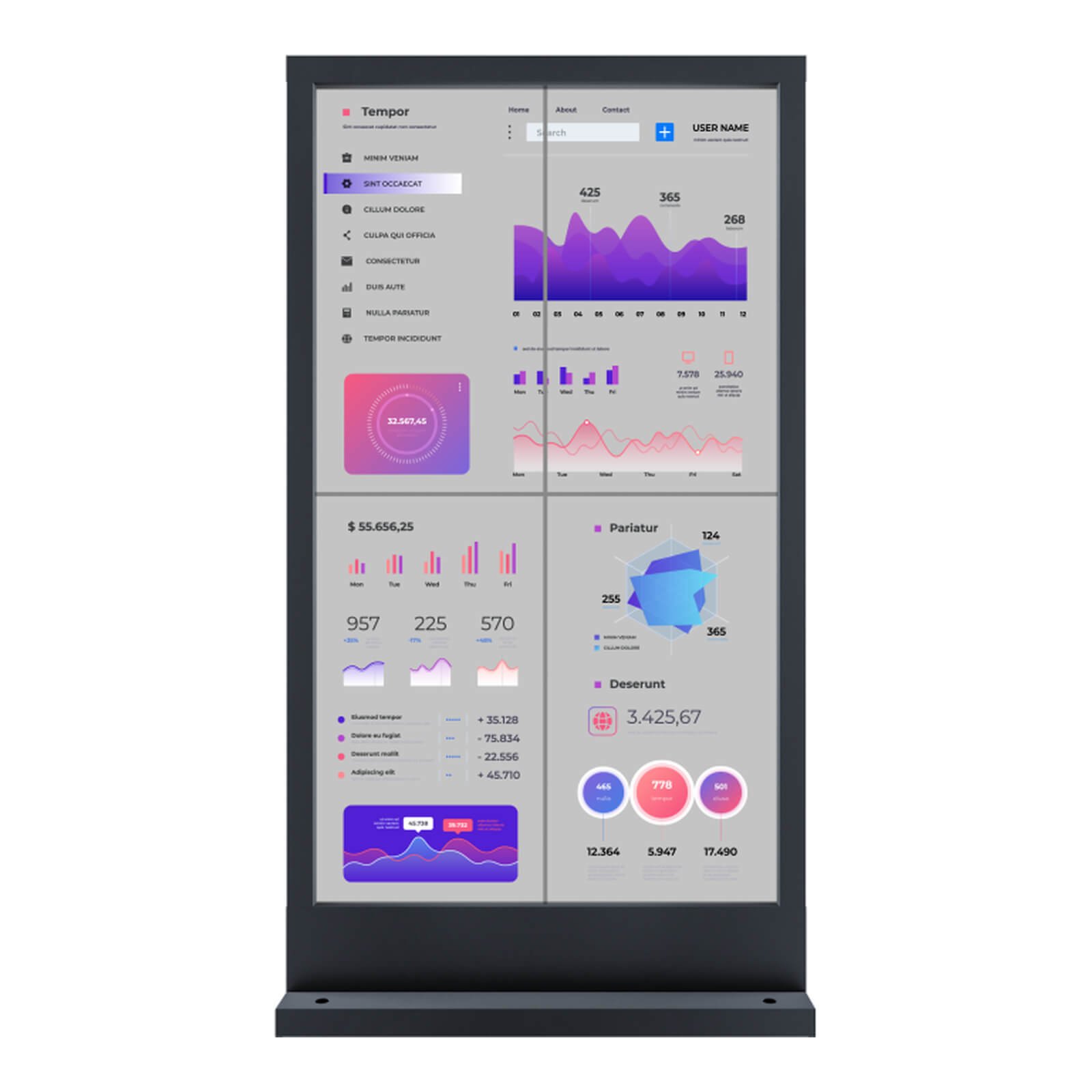
Four upright 55-inch transparent OLED panels in a tall 2 by 2 portrait video wall, front view
Product Overview

Choose Vertical Scale for Tall Transparent Content

This four-panel arrangement extends the presentation upward. Two columns of upright panels create a tall display for portrait compositions, with one vertical join and one horizontal join. Plan the upper visual content and the lower interactive controls around the actual viewing distance and visitor reach.

Portrait Composition

Use the tall format when the content benefits from vertical space, such as a digital presenter, full-height product visual or layered exhibit story. The 55-inch size refers to each panel, not the complete assembly.

Installation Height

The drawing shows approximately 2840 mm overall height, 1531 mm width and 500 mm base depth. Check ceiling clearance, delivery access and the complete support arrangement before choosing the location.

External Computer Reference

This model lists an external computer rather than the OPS configuration used by the landscape reference. Plan its location, cabling, ventilation and service access together with the wall controller.

Product Gallery

2×2 Portrait Transparent OLED Video Wall Views

Technical Specifications

2×2 Portrait Transparent OLED Video Wall Specifications

ItemReference configuration
Reference modelTX-55S-010
Display4 × 55-inch transparent OLED panels arranged upright in a 2×2 portrait assembly
Native resolution3840 × 2160 listed in the source; confirm portrait rotation and the final combined pixel mapping
Aspect ratio16:9 listed in the source panel coordinates; the installed portrait presentation is tall. Confirm the corresponding 9:16 content mapping
Display dimensions listed2424.86 × 1369.14 mm in landscape order; drawing shows approximately 1369.1 mm width × 2424.9 mm height for the upright opening
Source outline reference1531 × 2840 × 60 mm; 60 mm describes the thin display housing, not the floor base depth
Full assembly drawing referenceApproximately 1531 mm width × 2840 mm height, with a 500 mm base depth; confirm final approved dimensions
Portrait mapping target2160 × 3840 is the expected rotated mapping of the listed pixel canvas; validate actual controller outputs, rotation and source format
Transparency45% typical reference, marked TBD in the source; confirm final configuration
Luminance200–600 cd/m² reference; automatic adjustment listed
Panel refresh rate120 Hz reference; confirm controller and source input timing
Viewing angle178° horizontal / 178° vertical reference
Contrast ratio100,000:1 reference
Response time0.1 ms G-to-G reference
Color depth10-bit / 1.07 billion colors reference
Touch screenInfrared touch reference; confirm frame, touch points, calibration and required interactive area
HousingPainted sheet-metal frame with a lower support and floor base
Host configurationExternal computer, 6th-generation Intel Core i5 reference; configurable by project
CPU referenceIntel Core i5-6500T, four cores; maximum frequency of 2.5 GHz listed in the source
Memory and storage8 GB RAM + 128 GB storage reference
Operating systemWindows 10 listed in the original specification; confirm supplied operating system
Video inputsHDMI and VGA mentioned in the source; confirm fitted inputs and controller
Host connections4 × USB, microphone, DC input, Ethernet and COM listed; confirm final port layout
Network10/100 Ethernet, Wi-Fi and Bluetooth 4.2 listed
Supply input100–240 VAC, 50/60 Hz
Operating environment0–40 °C; 20–80% humidity reference
Daily operation7–12 hours listed; confirm the required playback schedule
Rated service life30,000 hours reference; operating conditions and end-of-life criteria to be confirmed

Based on the supplied TX-55S-010 specification. The source retains landscape-order pixel and display dimensions despite the upright product layout. The proposed 2160 × 3840 portrait mapping is the rotated interpretation of that reference and must be checked with the selected controller. The listed 3840 × 2160 pixel count is not conventional FHD.

Engineering Drawings

Check Full Height, Floor Support and Delivery Access

Use the approved complete assembly drawing for installation and transport planning. Review ceiling height, doorways, lift access, handling route, base support and any required fixing. Confirm rear service clearance, external computer location, final weight and packed dimensions.

Portrait System Integration

Coordinate Panel Rotation, Touch Reach and the External PC

Four-Panel Portrait Mapping

Confirm the top/bottom and left/right panel order, rotation and controller outputs. Test a portrait alignment grid and the final source format before producing the complete application.

Touch at a Comfortable Height

Place commonly used controls in a reachable lower zone. Use the upper area for presentation rather than assuming every part of a 2.84 m assembly can be touched comfortably. Test coordinate mapping across both joins.

Structure and External Equipment

Review floor support, stability, cabling, power distribution and service access with the installation drawings. Provide an accessible, ventilated location for the external PC and any video-wall controller.

Applications

Tall Product Visuals and Vertical Exhibit Stories

Full-Height Brand Presentations

Use portrait artwork, prepared digital presenter footage or tall product compositions to make use of the vertical format. Position key features away from the horizontal and vertical joins.

Museum and Gallery Interpretation

Arrange an exhibit story vertically, with presentation above and visitor selections below. Coordinate the physical exhibit, rear scene and lighting with the transparent content.

Showroom Feature Installations

Choose a tall presentation when wall width is limited and the venue has suitable height and support. Check the complete base and delivery route rather than just the display housing thickness.

Portrait Content Preparation

Separate the Upper Presentation from the Lower Controls

Agree the portrait canvas and mapping with the controller. The source lists 3840 × 2160 in landscape coordinates; 2160 × 3840 is the expected rotated layout, subject to the actual output configuration.

Design around the horizontal and vertical joins. Keep faces, small labels and touch targets away from their intersection, and place frequent controls within comfortable reach. Test text size from the intended viewing distance, especially near the upper screen area.

Choose this portrait format for vertical compositions and available installation height. For a broad 16:9 scene, compare the 2×2 landscape transparent OLED video wall. For a smaller near-square assembly, review the two-panel configuration.

FAQ

2×2 Portrait Transparent OLED Video Wall Questions

How are the four panels arranged?

Four 55-inch transparent OLED panels are installed upright in two columns and two rows. The complete display has a tall portrait presentation with horizontal and vertical joins.

What are the complete assembly dimensions?

The source and drawing list approximately 1531 mm width and 2840 mm overall height. The drawing shows a 500 mm base depth. The listed 60 mm display housing depth is not the complete footprint.

What resolution should portrait content use?

The source lists 3840 × 2160 in landscape coordinates. A 2160 × 3840 canvas is the expected rotated mapping, but confirm the actual controller rotation, output arrangement and source format before producing final content.

Does this version include touch?

The reference lists infrared touch. Confirm the touch frame, touch-point count, coordinate calibration and required interaction area. Place frequent controls within comfortable reach rather than relying on the upper area.

Does it use an OPS computer?

This portrait specification lists an external computer reference with Intel Core i5-6500T, 8 GB RAM, 128 GB storage and Windows 10. Confirm supplied hardware, operating system and the location of the external computer and wall controller.

Are there visible seams?

The four-panel assembly has horizontal and vertical joins. Confirm their actual widths and review content at the intended distance. Keep critical details and touch controls away from the joins.

Can it show a digital human or full-height product visual?

Prepared portrait presenter footage, product artwork and an interactive application can be configured for the canvas. Live AI conversation or other application functions need to be specified as part of the project.

When should I choose portrait instead of landscape?

Choose portrait when the content benefits from vertical space and the venue accommodates the full height, base and service requirements. Choose landscape for a broad 16:9 composition; compare the complete installation and control scope.

Does 120 Hz guarantee the whole wall accepts that input rate?

No. The source panel refresh reference does not establish supported input timing, combined output mapping or multi-panel synchronization. Confirm these with the selected controller.

What should I send for a quotation?

Send available height, width and base depth, floor/support drawings, delivery route, viewing distance, portrait content sample, touch workflow, external computer location, quantity, destination and daily operating schedule.

Review Your Transparent Video Wall Project

Plan Your 2×2 Portrait Transparent OLED Video Wall

Send your available height, floor plan and portrait content sample. We will review the frame, base support, four-panel mapping, infrared touch and external computer arrangement.

Include the intended panel count, signal source, daily operating schedule, service access and delivery destination.

Send Your Display Requirement

Please share your application, display size, quantity and project background. We will review the most practical display direction.