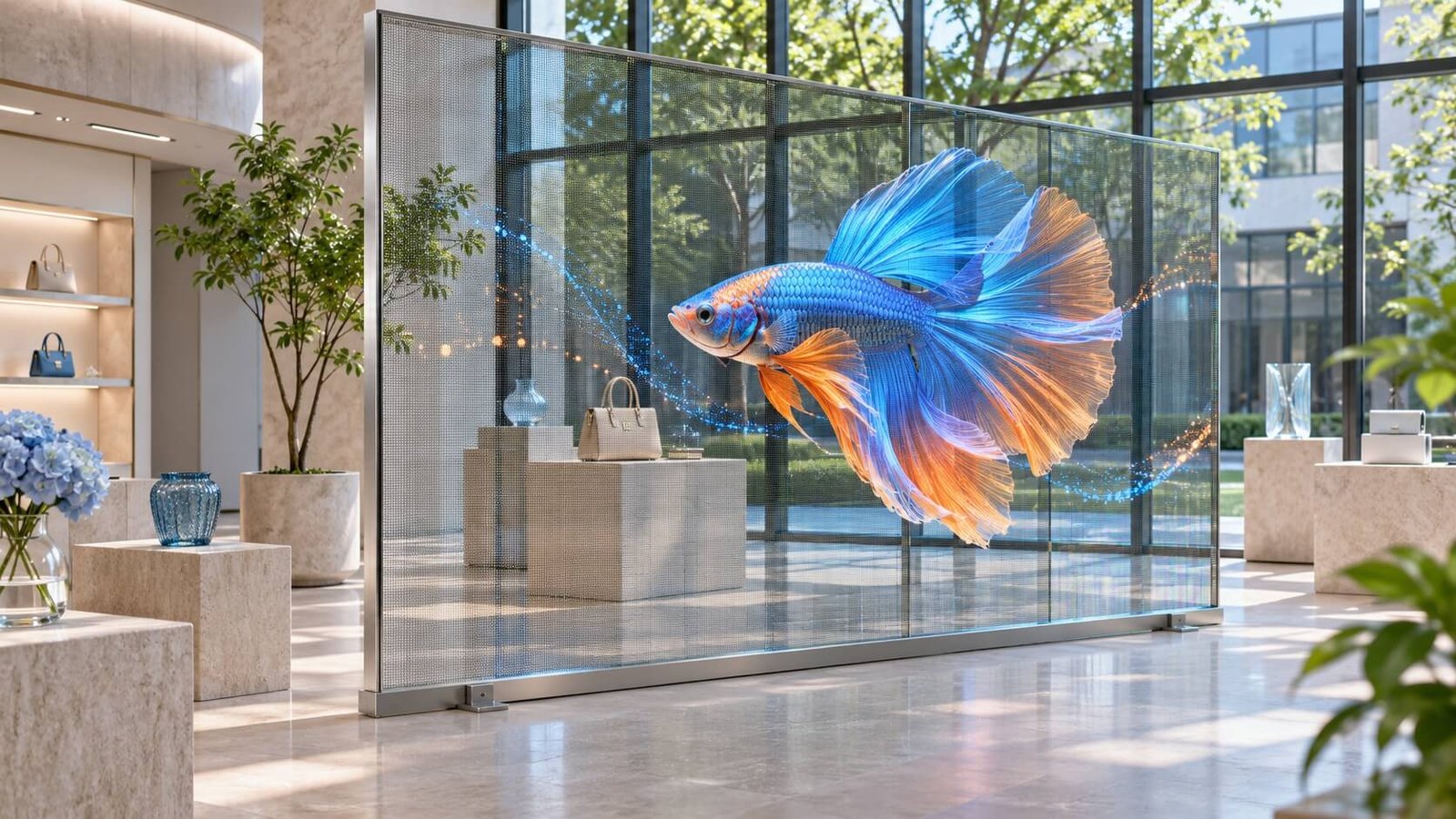
A transparent LED display is a self-emissive screen that shows images, video, and text while allowing people to see through it. Instead of using an opaque display surface, it combines light-emitting pixels with open spaces or transparent materials that preserve a view of the background.
The term covers several different products. A framed transparent LED screen suspended in a shopping mall is structurally different from an LED film attached to a shop window. A lightweight holographic transparent LED screen uses an open circuit structure to keep the background visible.
The broad term transparent LED can also include Transparent Micro LED. DisplayMan treats it as a separate technology and product family. Conventional transparent LED is used for applications such as storefront windows, suspended signage, and large display surfaces. Transparent Micro LED uses microscopic emitters integrated into a transparent panel for applications such as close-view product presentation and interactive displays.
Understanding these differences helps you choose a display that suits your viewing distance, content, installation surface, and budget.
At a glance: Transparent LED combines self-emitting pixels with a see-through structure. Start by distinguishing framed LED, film, and holographic LED, then compare the image detail and physical appearance at the intended viewing distance. For ordinary window projects, we normally work with the customer’s existing glass.
How Does a Transparent LED Display Work?
A transparent LED display performs two functions at the same time: its pixels emit light to create an image, while the areas around those pixels allow background light to pass through.
LED Pixels Create the Image
Red, green, and blue light-emitting elements combine to produce colors. A control system adjusts their brightness to display video, graphics, animation, and text.
The LEDs generate their own light, so the screen does not require the conventional backlight used in an LCD.
Spaces or Transparent Materials Preserve the View
Different transparent LED products achieve their see-through appearance in different ways.
Some use spaced LED strips within a frame. Others use a perforated circuit structure, a transparent flexible film, or a transparent panel substrate.
The visible result depends on more than the advertised transparency percentage. Circuit lines, LED packages, film layers, frames, wiring, and reflections all affect how clearly you can see the background.
Black Content Leaves the Background Visible
When a transparent LED display receives a black image area, the corresponding pixels normally stop emitting light. The background remains visible through the screen.
This is why bright objects and animations on a black background can appear to float in front of the surrounding space.
However, the screen does not create an opaque black surface that hides objects behind it. Dark image details can become difficult to distinguish against a bright or visually busy background.
Main Types of Transparent LED Displays
For practical project selection, three common transparent LED constructions provide a useful starting point:
| Type | Basic Construction | Typical Project Fit |
|---|---|---|
| Framed or grid-type transparent LED | Spaced LED strips or bars assembled into framed modules | Large suspended screens, atriums, and advertising viewed from a distance |
| Transparent LED film | LEDs and circuits carried on a transparent flexible film | Existing glass windows and selected curved glass installations |
| Holographic transparent LED | Lightweight, highly open circuit structure with distributed LEDs | Retail windows, showrooms, exhibitions, and displays emphasizing a floating visual effect |
These are useful purchasing categories rather than a universal technical classification. Product names can overlap, so the actual construction and specifications deserve more attention than the label alone.
1. Framed or Grid-Type Transparent LED Displays
Framed transparent LED displays use spaced LED strips or bars assembled into modules. The spaces between the strips allow people to see through the screen.
Their supporting frames provide a practical way to assemble a large display and connect it to a suitable mounting structure.
Where they make sense
A large screen suspended across several floors of a shopping mall is a typical example. The audience often watches from a distance, and the screen occupies an open space without an existing glass surface available for attachment.
For this kind of project, a framed system can provide an economical and practical construction.
Common applications include:
- Shopping mall atriums.
- Large indoor advertising displays.
- Suspended exhibition screens.
- Stage and event installations.
- Selected building facade projects.
What to consider
The frame and LED strips remain part of the physical appearance. They can become more noticeable at close range or when viewed from behind.
Pixel pitch also matters. A configuration suited to a large advertisement seen across an atrium may be unsuitable for small text viewed from two meters away.
Choose this type around the required image detail, viewing distance, installation structure, and cost.
Explore framed indoor transparent LED displays →
2. Transparent LED Film Displays
Transparent LED film displays place LEDs and conductive circuits on a transparent flexible film. They are commonly installed onto glass, allowing an existing window to become a display surface.
The glass provides the installation surface, while the film adds the display function.
Typical applications include retail windows, showroom glazing, glass partitions, and selected curved glass surfaces.
Conventional and COB film structures
Transparent LED film includes both conventional constructions and COB constructions. They should not be treated as identical products.
Conventional film products use their own LED packaging, circuit layout, substrate, and protective layers. Their appearance and performance vary by model.
COB film products use chip-on-board packaging. The COB crystal-chip film described in our product documentation combines flip-chip COB technology, a flexible PET substrate, separate emitting and driving areas, and protective encapsulation.
Its main design features concern:
- Chip attachment and packaging.
- Separation of emitting and driving areas.
- Flexible substrate construction.
- Protection of chips and circuits.
- Power consumption and heat management.
These details deserve a separate technical discussion. For an initial selection, examine the actual sample, film visibility, pixel pitch, brightness, installation requirements, and maintenance method.
Flexible does not mean unrestricted
A flexible film still has limits on bending, cutting, connections, and module arrangement. It should be manufactured and installed according to the permitted design.
Adding it to curved glass requires checking the glass geometry and the product’s allowable bending conditions.
Explore the Flexible Transparent LED Film Display product page for more information.
3. Holographic Transparent LED Displays
Holographic transparent LED displays use a lightweight, highly open structure to reduce the visible presence of the screen.
The conventional and COB holographic products discussed here use bendable, perforated PCB constructions. The COB version specifically uses a multilayer flexible perforated PCB, flip-chip LEDs, and transparent protective encapsulation.
With suitable content and a well-chosen background, the illuminated image can appear to float in the space.
What “holographic” means here
The term describes the visual effect of luminous content on a see-through display. The image is still generated on the physical screen surface.
It should not be understood as a free-space volumetric projection.
Three available routes
Within the holographic transparent LED products we work with, the main options are:
| Route | Relative Price | Relative Stability |
|---|---|---|
| Conventional separate LED and driver design | Lowest | Lowest of these three routes |
| Integrated LED and driver design | Middle | Middle |
| COB design | Highest | Highest |
This is a practical comparison of our available product routes. Image fineness should not be ranked by these three labels: at equivalent pixel pitch and resolution, they can provide comparable detail.
The main purchasing distinction here is the balance between initial cost and operating stability.
Where COB holographic transparent LED fits
Based on our hands-on product experience, COB holographic transparent LED is currently our preferred option for many projects that prioritize a refined transparent appearance and stable operation.
It can suit premium retail windows, exhibition installations, showrooms, and other projects where the physical presence of the display needs to remain subtle.
Installation can include glass mounting, curved surfaces, suspension, or a purpose-designed standing structure. The appropriate method depends on the specific module and project.
Read our COB Holographic Transparent LED guide for a deeper explanation.
Separate two questions: COB describes an encapsulation approach, while LED-and-driver separation describes the circuit arrangement. The COB film discussed above also uses separated emitting and driving areas. Do not use driver placement alone to rank every transparent LED product.
What About Transparent LED Glass?
Transparent LED glass describes a display supplied together with a glass assembly. Depending on the construction, the display layer may be integrated between glass panels, or LEDs and conductive structures may be incorporated into the glass itself.
It is a specialized integration option rather than a necessary starting point for every transparent LED project.
For most window projects, the customer already has glass. In these cases, we generally recommend evaluating a suitable transparent display for installation onto the existing glass.
We normally recommend supplying transparent LED glass when the customer explicitly requires us to provide the glass together with the display. This may apply to a new installation, a replacement glass assembly, or a project with a defined integrated-glass requirement.
Supplying the glass also introduces additional considerations, including dimensions, weight, transport, handling, replacement, and installation coordination.
If your project requires a complete glass-and-display assembly, see our Transparent LED Glass Display page.
What Determines the Actual Viewing Experience?
Choosing a transparent LED display requires more than comparing brightness and transparency figures. The following factors determine whether it will work for your content and space.
Pixel Pitch, Screen Size, and Resolution
Pixel pitch is the distance between adjacent pixels. At a fixed screen size, a smaller pitch generally provides more pixels and allows finer detail.
A useful first calculation is:
Pixels along one dimension ≈ active display dimension ÷ pixel pitch
For example, a display area measuring 1,000 × 500 mm with a 5 mm pitch provides approximately 200 × 100 pixels.
That may suit simple animation or a large logo, but it offers limited room for detailed product imagery or multiple lines of small text.
Final resolution depends on the actual module arrangement and active dimensions.
Viewing Distance and Content
A display that looks effective from across a shopping mall can look visibly coarse at close range.
Evaluate the screen using the actual content and intended viewing distance. A large moving logo is much easier to reproduce than a menu, a detailed product photograph, or small scrolling text.
Ask to see representative content rather than relying only on a promotional video.
Transparency and Image Density
More open space can improve the view through a screen, but it also affects the distribution of light-emitting pixels.
Advertised transparency values may describe different things: geometric open area, material light transmission, or a manufacturer’s visual transparency figure.
These values should not automatically be compared as if they used the same measurement method.
The installed appearance also includes frames, wiring, power connections, glass, and any protective layers.
Ambient Light and Background
A transparent display shares the viewer’s sightline with its background.
A bright window, illuminated shelving, or a busy shop interior can compete with the displayed content. Increasing brightness can help, but content design and placement remain important.
Bold shapes, larger text, and bright objects on black backgrounds often work well. Dark, low-contrast images need more careful evaluation.
Installation and Maintenance
Check where the display will attach, how power and signal cables will run, and how a module can be accessed or replaced.
For glass-mounted projects, confirm the condition and geometry of the existing glass. For suspended projects, determine the mounting structure and complete installed weight.
A thin display layer still requires a complete installation plan.
Rated transparency and perceived transparency are different. The three-state illustration shows the same screen with different content. Bright full-screen imagery attracts attention across more of the surface; isolated bright objects leave more of the background visually prominent. The hardware’s physical transparency has not changed. The illustrations explain the concept and are not optical measurements.
When a display sits behind tinted or coated glass, the glass can also reduce the light reaching the viewer or add reflections. Compare the complete installed view, ideally using representative content and the actual glazing, rather than assuming that the module specification alone predicts the result.
Which Type Fits Your Project?
Use the table below as an initial guide, then evaluate a specific model with your actual content.
| Project Requirement | Starting Point | Main Check |
|---|---|---|
| Large suspended advertisement viewed from a distance | Framed or grid-type transparent LED | Cost, viewing distance, frame appearance, and mounting |
| Add a display to an existing glass window | Transparent LED film or holographic transparent LED | Glass compatibility, visual appearance, pixel pitch, and access |
| Premium transparent presentation with stability as a priority | COB holographic transparent LED | Suitable pitch, installed appearance, and budget |
| Curved glass installation | An approved flexible film or flexible holographic model | Permitted bend radius and module layout |
| Display supplied together with glass | Transparent LED glass assembly | Glass specification, weight, delivery, and installation |
There can be more than one suitable solution. For example, both framed and holographic transparent LED products can be suspended. The decision depends on the desired appearance, budget, viewing conditions, and mounting design.
Frequently Asked Questions
Can a transparent LED display play video?
Yes. A suitable controller and media source can display video, animation, images, and text. Input connections and playback functions depend on the selected control system.
Can it display solid black and hide the background?
A conventional transparent LED display does not create an opaque black area. Black content normally turns the relevant pixels off, leaving the background visible through the screen.
If hiding the background is essential, the project needs an additional optical or mechanical solution.
Can transparent LED displays be used outdoors?
Some models are designed for outdoor use; others are intended for indoor installation.
A display mounted inside a window and facing outdoors has different requirements from a screen directly exposed to rain and weather. Confirm the protection of the complete system, along with sunlight, temperature, moisture, and structural requirements.
Is holographic transparent LED a real hologram?
It creates a floating visual impression through transparent display construction and suitable content. It does not project a volumetric image into empty space.
How is transparent LED different from transparent OLED?
Both are self-emissive display technologies, but their construction, available formats, pixel density, brightness, transparency, and installation options differ.
The appropriate choice depends on the required image detail, display size, viewing environment, and budget. You can explore these differences in our Micro LED or Transparent OLED comparison.
Do I need to replace my existing glass?
Usually, replacing the glass is not the starting assumption. We first evaluate whether a suitable display can be installed onto your existing glass.
A complete transparent LED glass assembly is considered when you specifically need us to supply the glass as part of the project.
Explore the Right Transparent LED Technology
Start with the content you need to show, the available display dimensions, the viewing distance, and the installation surface. These four details help narrow the options before comparing individual specifications.
If you would like DisplayMan to assess a project, share your intended content, active display size, viewing distance, and installation photos. We can then help identify a suitable technology and configuration.
Explore eight product options in the DisplayMan Transparent LED Displays range.
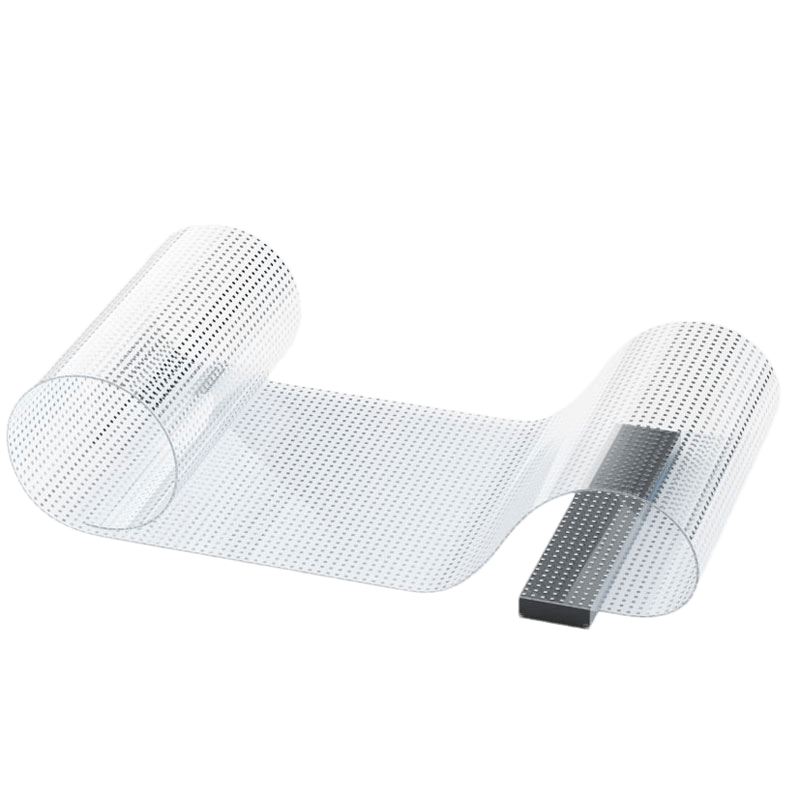
Flexible Transparent LED Film Display
View product details →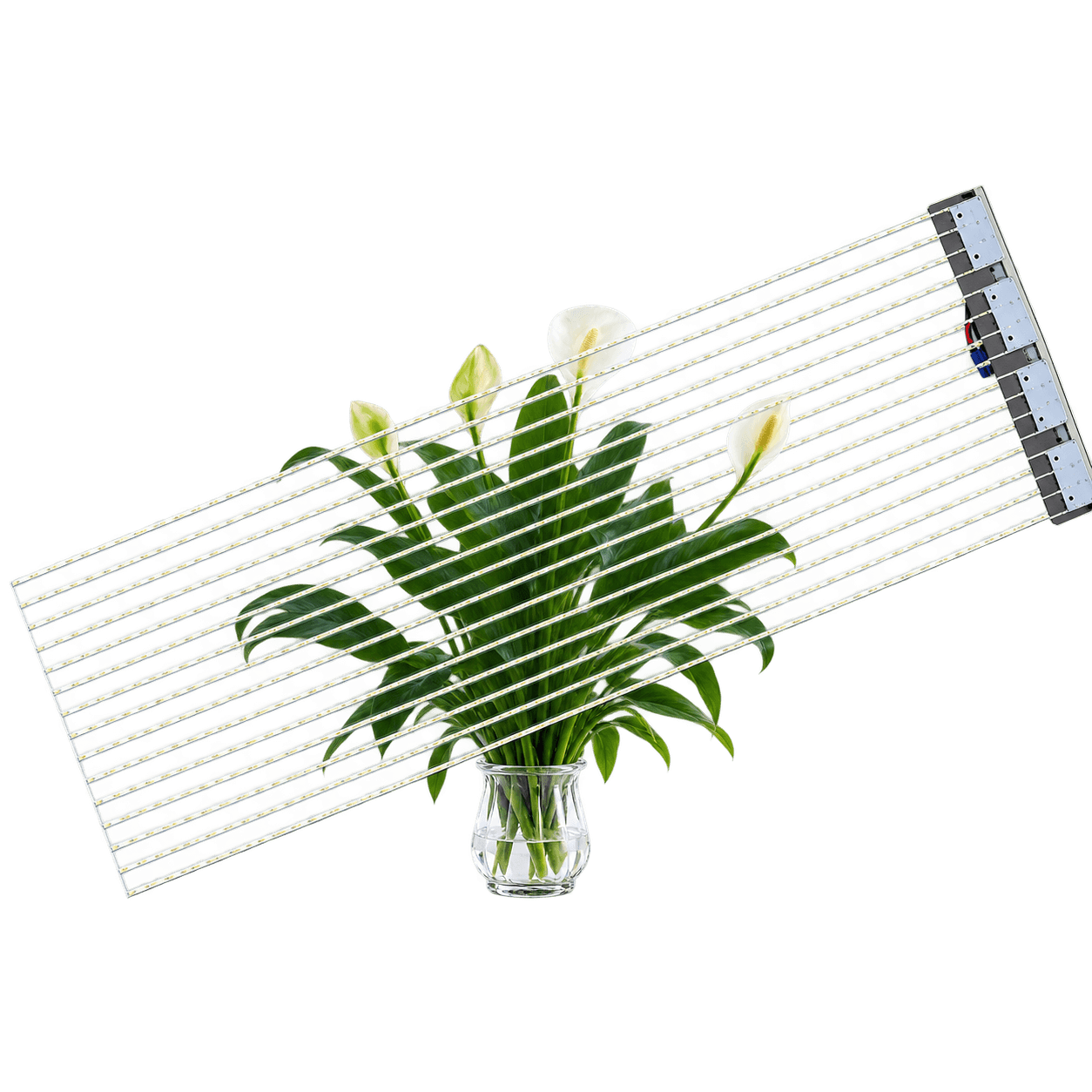
Transparent LED Film Display
View product details →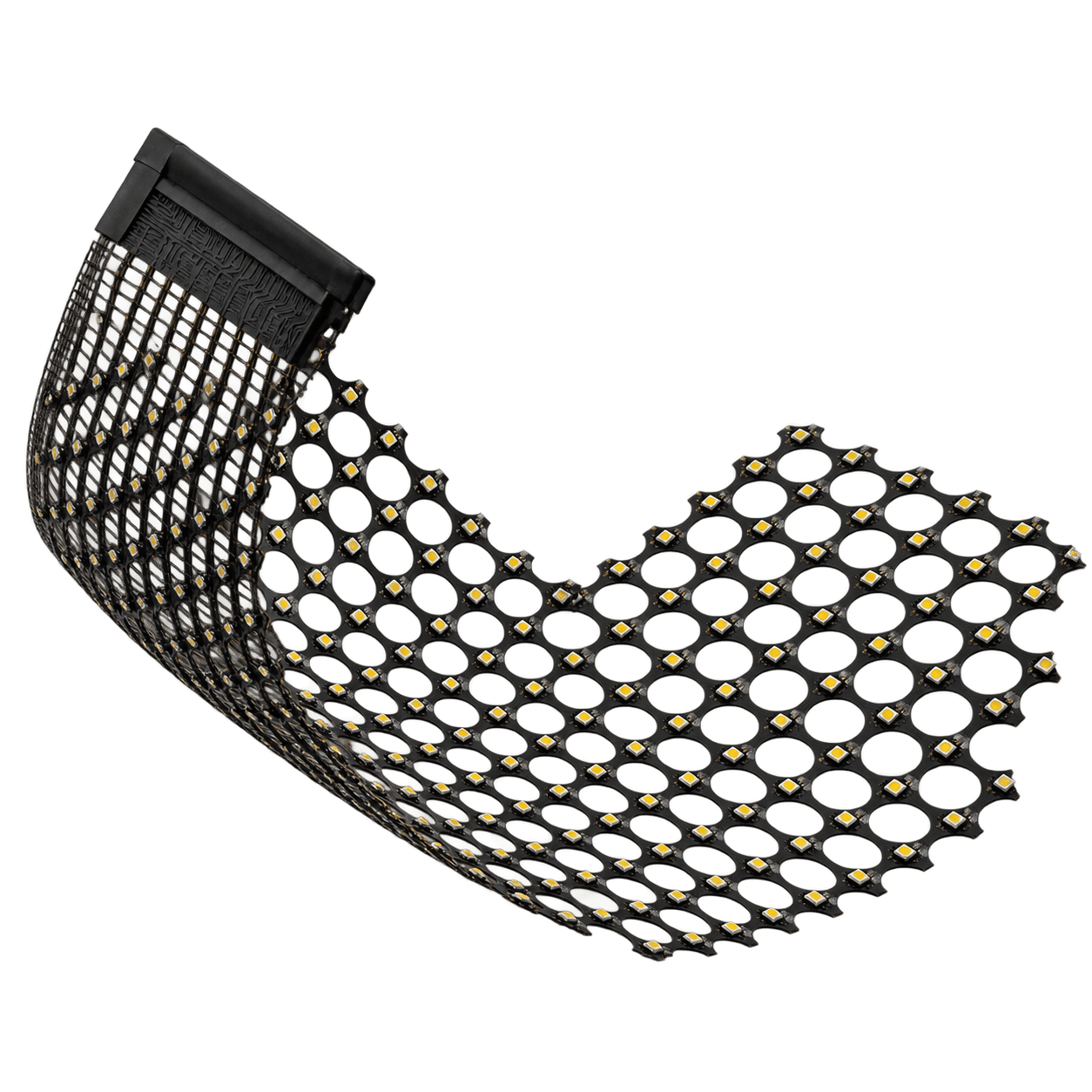
Holographic Transparent LED Display
View product details →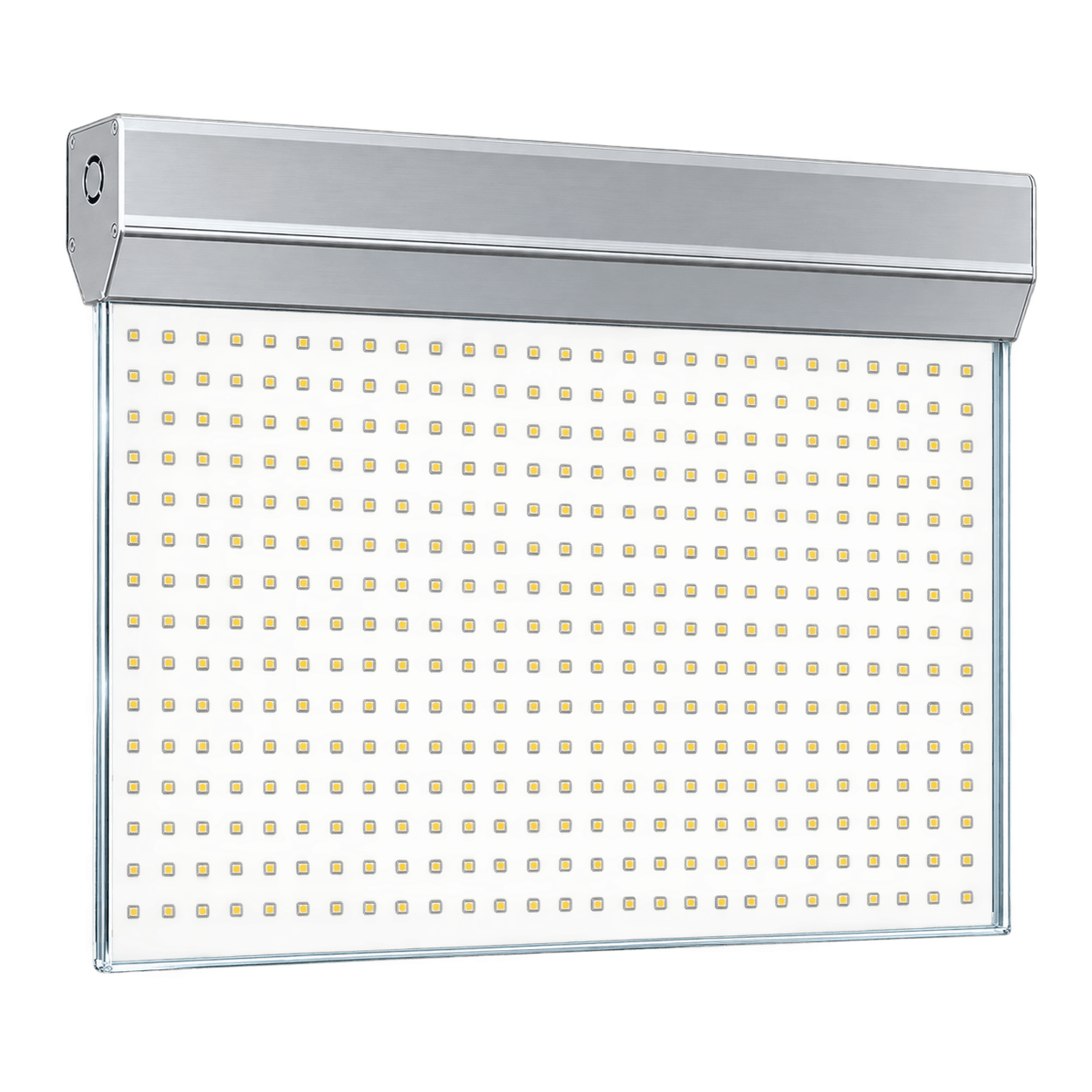
Transparent LED Glass Display
View product details →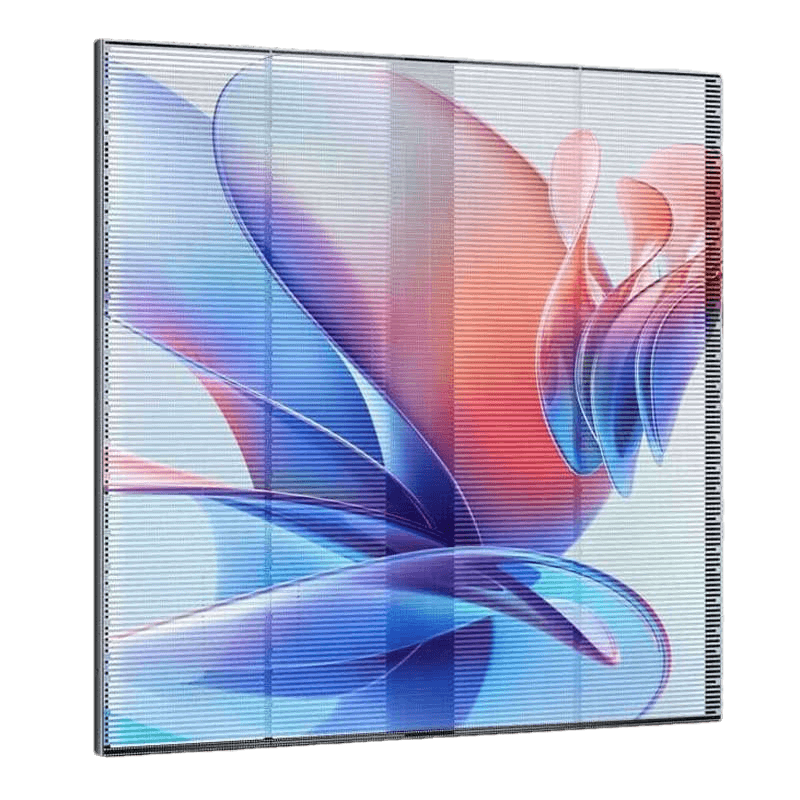
Indoor Transparent LED Display
View product details →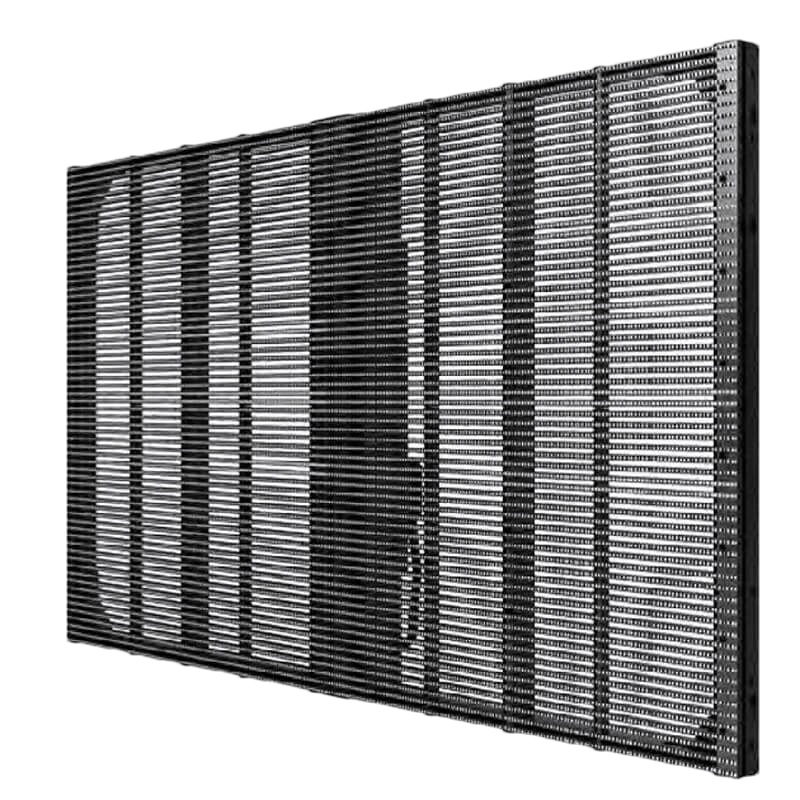
Outdoor Transparent LED Mesh Display
View product details →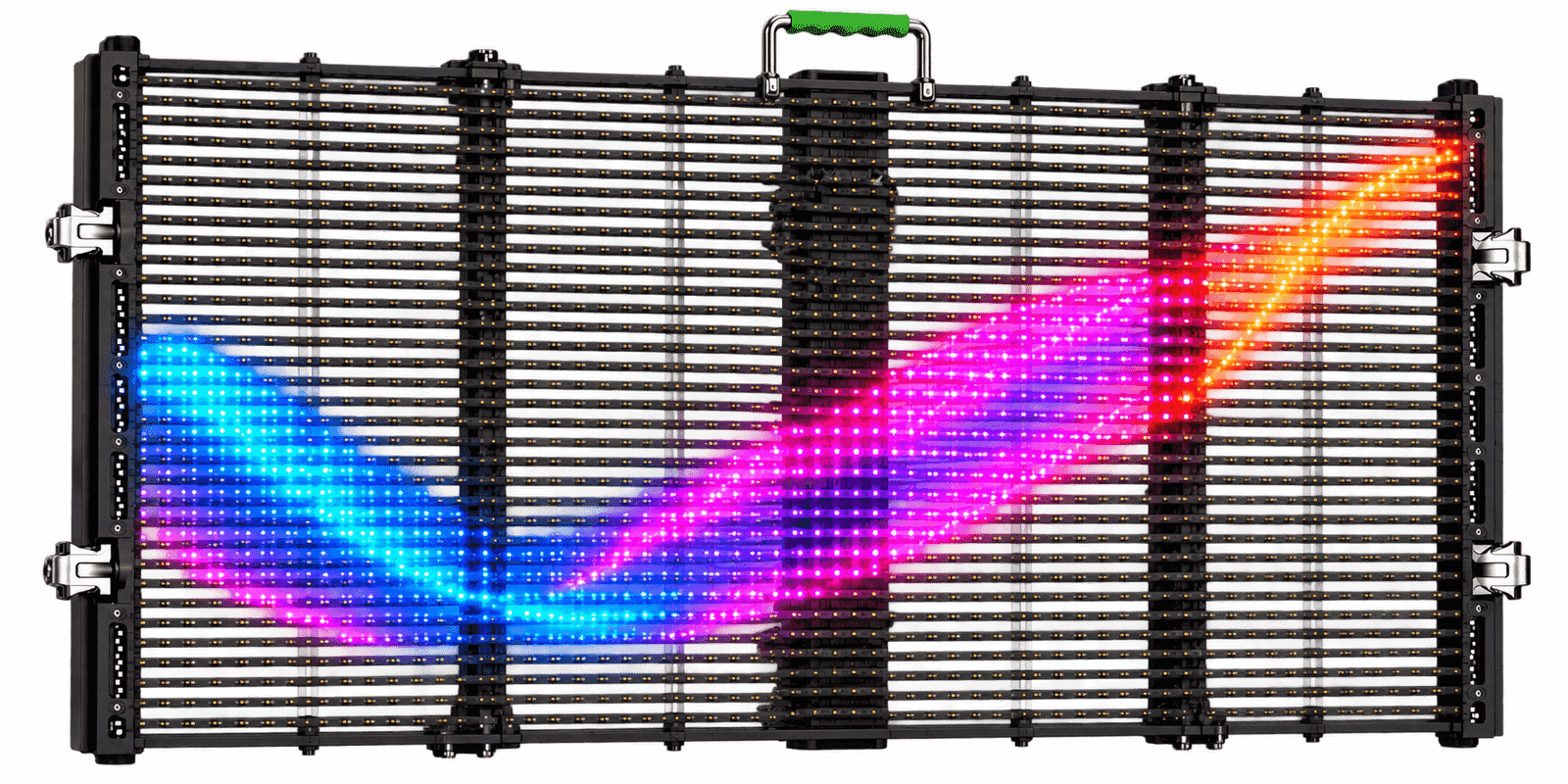
Rental Transparent LED Display
View product details →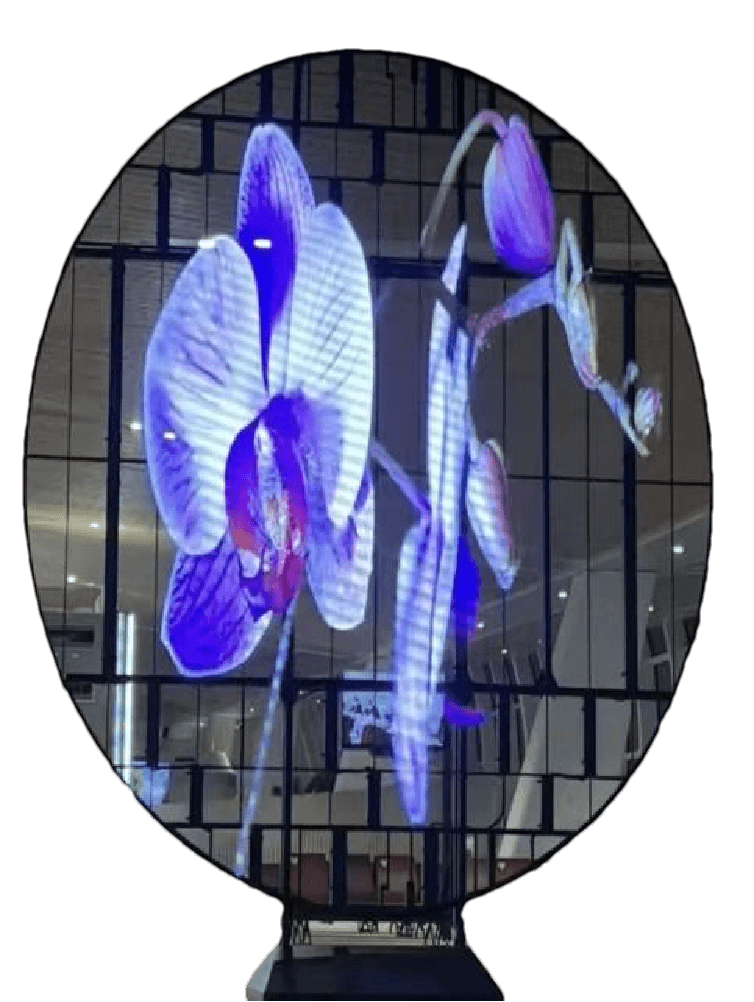
Custom Transparent LED Displays
View product details →Featured Product: Transparent Micro LED Displays
Transparent Micro LED is a distinct display technology for applications such as close-view product presentations and interactive exhibits. It integrates microscopic inorganic LED chips into a transparent panel.
In DisplayMan’s 16.1-inch model, each Micro LED chip measures 20 × 40 μm (0.02 × 0.04 mm). The individual chips cannot be distinguished with the naked eye.
P0.692 mm is the center-to-center spacing between adjacent pixels on that model. A conventional P3.75 transparent LED module has a 3.75 mm pixel pitch. Both P values describe pixel spacing. The 20 × 40 μm figure describes the physical size of an individual chip.
For buyers, an important distinction is the relationship between physical screen size and image resolution. Projects involving product information, interfaces, or detailed graphics require enough pixels within the available display area.
A large-format transparent LED installation designed for distant viewing should therefore be evaluated differently from a smaller transparent Micro LED panel intended for closer observation.
Transparent Micro LED can be considered for:
- Product presentation and premium retail displays.
- Interactive exhibits.
- Equipment and system integration.
- Detailed graphics within a limited screen area.
Selection should consider resolution, pixel pitch, transparency, brightness, panel dimensions, controller integration, and cost. Touch requirements should also be discussed separately.
Explore the Transparent Micro LED Displays range to compare available formats.
Tell Us About Your Display Project
Share your application, display dimensions, viewing distance, and quantity. Installation photos help us understand the space.
Send Your Display Requirement →