
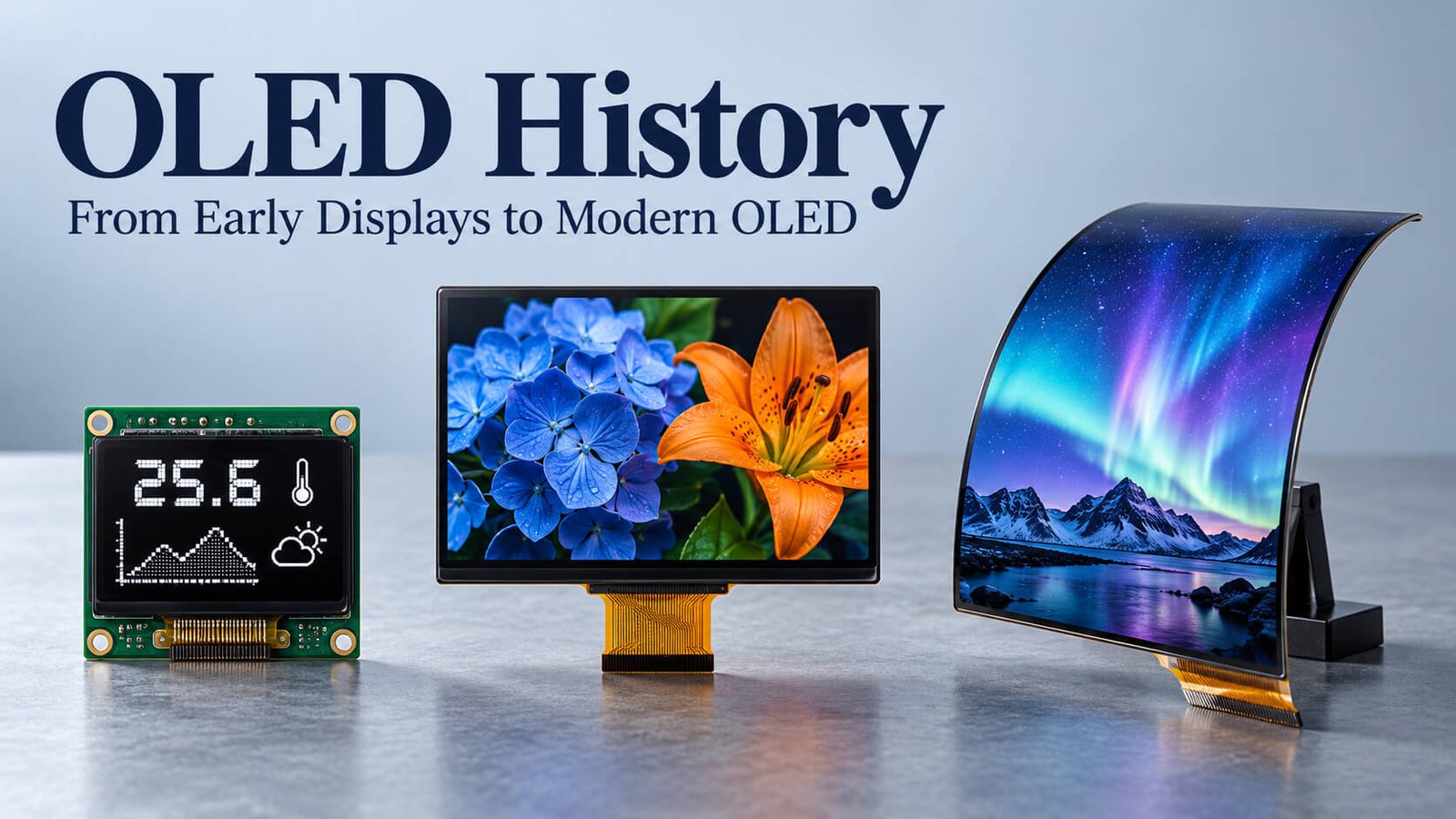
DisplayMan Technology History · Quick Answer
How Did OLED Develop into Today’s Displays?
OLED evolved from organic electroluminescence research into practical thin-film devices, early passive-matrix interfaces and active-matrix panels, then expanded into flexible and transparent formats. Tang and VanSlyke’s 1987 device paper was a foundational breakthrough, not the first discovery that organic materials could emit light.
For today’s projects, AMOLED describes pixel addressing, flexible OLED describes mechanical construction, and transparent OLED describes optical behavior. These characteristics can overlap. DisplayMan uses the application, integration limits and production requirements to identify the right product direction.
View the OLED history timeline →
Compare today’s product directions →
OLED History: The Key Milestones
OLED stands for organic light-emitting diode. Its history connects organic-semiconductor research with the engineering needed to make reliable, addressable display panels. A light-emitting laboratory device, an active-matrix panel and a complete commercial product are different milestones.
The table below selects documented events rather than assigning the whole technology to one invention or company. Research publications establish device breakthroughs; manufacturer records establish particular product launches.
| Year | Selected milestone | Significance |
|---|---|---|
| 1963 | Pope, Kallmann and Magnante published research on electroluminescence in organic crystals. [1] | Organic electroluminescence was being studied well before the 1980s. |
| 1987 | C. W. Tang and S. A. VanSlyke published a thin-film, double-layer organic electroluminescent device. [2] | A foundational low-voltage device breakthrough associated with modern OLED development. |
| 1990 | Burroughes and colleagues published a conjugated-polymer light-emitting diode in Nature. [3] | Established an important polymer-based route to organic light emission. |
| 1997 | Pioneer introduced the GD-F1 car FM tuner with a monochrome organic EL display. [4] | A documented early commercial application beyond the laboratory. |
| 2007 | Samsung began mass-producing AMOLED panels, as documented in the Society for Information Display’s industry history. [5] | An important scaling milestone for active-matrix OLED manufacturing. |
| 2007 | Sony announced the 11-inch XEL-1 OLED television on October 1, with a December launch in Japan. [6] | A specific television product milestone, rather than the first appearance of OLED technology. |
| 2019 | LG announced the U.S. commercial launch of its 55-inch-class transparent OLED signage at InfoComm. [7] | A documented commercial transparent-display application, not a claim that transparency was first researched that year. |
These dates describe different stages of development. They do not mean OLED was discovered in 1987, all OLED products began in 2007, or every later display uses the same materials and construction.
Before Modern OLED: Organic Electroluminescence Research
Electroluminescence means light generated through electrical excitation. The organic materials in OLEDs are carbon-based electronic materials; “organic” does not mean a display is biodegradable or automatically less harmful to the environment.
Research on organic-crystal electroluminescence predates practical thin-film OLED displays. The 1963 paper by Pope and colleagues is one documented example. [1] This distinction matters because observing light in a material is different from producing a manufacturable display with controlled pixels, useful lifetime and a suitable driving voltage.
Progress required more than brighter emitters. Electrode design, charge injection, thin-film processing, encapsulation and electrical control all contributed. The history is best understood as connected advances rather than a single moment when an entire screen was invented.
1987: A Thin-Film Device Breakthrough
Tang and VanSlyke’s 1987 paper described an organic device made with two thin-film layers and suitable electrodes. Its architecture enabled efficient charge injection and visible emission at comparatively low driving voltage. [2]
This was a device result, not a demonstration of a modern smartphone panel. Turning such devices into screens required pixel patterning, driving electronics, reliable packaging and repeatable production. Those tasks explain the gap between a research milestone and a consumer or industrial product.
The paper is attributed to its published authors, C. W. Tang and S. A. VanSlyke. A broader historical account can recognize many additional contributors without attaching an unsupported third co-author to that particular publication.
1990: The Polymer LED Research Branch
Burroughes and colleagues reported light emission from a conjugated-polymer diode in 1990. [3] This was another significant materials and processing direction in organic electronics. It should not be described as the first OLED prototype in 1991.
Small-molecule and polymer approaches concern the emitting materials and fabrication route. They are not the same classification as passive-matrix versus active-matrix addressing. A helpful history keeps these subjects separate instead of treating every new acronym as a replacement generation.
For OEM buyers, the important consequence is that “OLED” identifies a broad technology family. The available module, interface, optical performance and qualification data matter more than a general claim about the family.
Early Commercial OLEDs and the PMOLED Era
Early commercial OLED development should not be viewed only through later smartphones and television panels. Small displays for text, symbols and simple graphics were an important part of the product story. Passive-matrix OLED became a practical route for these kinds of interfaces before AMOLED reached larger-scale manufacturing.
PMOLED means passive-matrix OLED; it does not mean segmented OLED. A fixed-segment display uses predetermined electrode shapes for digits or icons, while a dot-matrix display uses pixels to form variable text and graphics. Addressing method and image layout are different classifications. The early market should therefore not be described as a universal sequence in which every OLED began as a segment display.
Pioneer’s original GD-F1 announcement specifically identifies an organic EL dot-matrix display, with the product introduced in November 1997. [4] That is a useful, specific example of commercial adoption. It avoids the ambiguous claim that “the first OLED display” appeared in 1998 without explaining what kind of product is meant.
PMOLED Remains a Relevant Product Direction
For a compact instrument, status panel or simple embedded interface, PMOLED can still be worth evaluating. Resolution, scan duty, brightness, interface, content and operating schedule determine whether the exact module fits. A mature display architecture is not automatically an obsolete product.
Explore DisplayMan PMOLED displays for passive-matrix OLED modules. For a custom digit or icon layout, provide the artwork and electrical requirements so the appropriate drive arrangement and development scope can be reviewed.
From Passive-Matrix Interfaces to Active-Matrix Panels
By 2007, active-matrix manufacturing had reached an important scaling stage. SID’s industry account identifies Samsung’s mass production of AMOLED panels that year. [5] The wording matters: an AMOLED manufacturing milestone is not the beginning of all commercial OLED products.
Sony’s October 2007 announcement of the XEL-1 provides a separate television milestone. The announced model had an 11-inch display and a December launch date in Japan. [6] A named product and source are more useful than unsupported claims about the first OLED smartphone.
Commercial expansion also depended on production yield, consistency and supply economics. For an equipment maker, a spectacular prototype is not equivalent to a module with confirmed availability, documentation and production support.
How OLED Produces Light
In an OLED device, charge is injected through electrodes into organic layers. Recombination can create excited states that release energy as light. The emitting structure provides image light, so a separate LCD-style backlight is not required.
A display additionally needs a way to control its pixels and protect its sensitive layers. The complete module can include a backplane, driver IC, encapsulation, optical layers, touch sensor, cover glass and flexible interconnects.
Color construction varies. Some designs use patterned red, green and blue emitters; others use different emission and color-management structures. It is inaccurate to state that every OLED forms color by passing its light through the same set of filters.
Self-emission supports strong dark-scene performance in appropriate conditions. It does not establish every aspect of image quality. Brightness behavior, ambient reflections, content, optical coatings and driving conditions still affect the installed result.
For a wider technology comparison, read LCD display vs OLED display. Reflective LCDs use ambient light, so not every LCD depends on a backlight.
PMOLED and AMOLED: Two Addressing Approaches
PMOLED means passive-matrix OLED; AMOLED means active-matrix OLED. These terms describe pixel addressing, rather than whether a panel is flexible or transparent.
| Direction | Basic distinction | Practical selection focus |
|---|---|---|
| PMOLED | Uses a passive row-and-column addressing arrangement | Often considered for smaller text, status or simple graphic interfaces; evaluate actual resolution, duty and power requirements. |
| AMOLED | Uses an active-matrix backplane to control pixel drive | Suitable options exist for richer color interfaces and higher information content; evaluate the exact module and host compatibility. |
Neither label guarantees a particular size, lifetime or brightness. Similarly, AMOLED does not automatically mean flexible, and a flexible OLED can itself be an AMOLED panel.
AMOLED for Modern OEM Interfaces
The active-matrix route connects naturally with products that need detailed graphics, touch interfaces, animation or video. Selection still starts with the application: content, viewing distance, dimensions, operating schedule and electrical platform.
A bare module may use MIPI DSI or another panel-specific interface; a finished evaluation assembly may expose HDMI through a controller. Connector appearance alone does not establish compatibility. Review the pinout, timing, initialization, power sequencing and required controller together.
Explore AMOLED displays for available product directions. For passive-matrix alternatives, see PMOLED displays and the AMOLED vs PMOLED guide.
Flexible OLED: From Flat Panels to Curved Integration
OLED can be manufactured on rigid or flexible substrates. Universal Display describes flexible OLED structures built on non-rigid substrates such as plastic or metal foil. [8] The flexible substrate is only part of the engineering: electrodes, encapsulation, interconnects and the assembled support also need to tolerate the intended shape.
A curved display, a panel bent during installation and a display qualified for repeated folding are different products. A bendable module must not be assumed to survive a sharp crease or continuous folding cycles.
DisplayMan’s flexible OLED product direction is curvable or bendable, not a general-purpose foldable-screen offering. Review the permitted bend radius, bending axis, direction, static or dynamic use, FPC routing and mounting support for the actual module.
Flexible construction also does not mean the screen can be cut to an arbitrary outline. Panel geometry, active area, edge sealing and driver placement remain defined design constraints.
See flexible OLED displays for curved modules and integration directions. Provide an enclosure drawing and the intended curvature before committing to the mechanical design.
Transparent OLED: Combining Images with a View Behind the Screen
Transparent OLED takes the self-emissive display into another optical setting: the viewer sees emitted content together with physical objects or a scene behind the panel. LG’s 2019 U.S. signage launch is one documented commercial milestone in this direction. [7]
Transparency changes the meaning of contrast. Turning a pixel off reduces its emitted light, but it does not create an opaque black surface that hides the scene behind the screen. A bright background can therefore reduce the apparent contrast of graphics and text.
A successful installation considers background lighting, content composition, viewing distance and object placement together. Transparency and brightness figures must be checked for the actual panel; they are not universal OLED properties.
For showcases, also evaluate cover glass, touch integration, cable concealment, ventilation and service access. The display panel is one component of the completed cabinet or installation.
Explore transparent OLED displays and transparent OLED display cabinets. The transparent LCD vs OLED cabinet guide explains the lighting and structural differences between those approaches.
OLED Progress Does Not Remove Engineering Trade-Offs
The history of OLED includes improvements in materials, drive control and packaging. It does not justify treating every OLED as brighter, more efficient or longer-lived than every competing display.
| Topic | What to evaluate |
|---|---|
| Power | Representative content, average picture level, brightness, refresh behavior and supporting electronics. OLED does not always consume less power than LCD. |
| Lifetime | The manufacturer’s definition, luminance decay, color shift, temperature and operating duty. A family name is not a lifetime rating. |
| Burn-in | Differential aging from persistent content; distinguish it from temporary image retention. |
| Motion | Pixel transitions, refresh rate, processing and input latency are different measurements. |
| Mechanical design | Rigid, curved, bendable and foldable assemblies have different constraints. |
| Environment | Verify temperature limits, moisture protection, brightness and reflected-light performance for the completed product. |
A fast pixel transition does not guarantee high refresh rate or low system latency. Likewise, removing the backlight does not remove thermal limits, moisture sensitivity or the need for protective engineering.
For persistent menus, logos or status graphics, plan content and brightness management early. Read the OLED burn-in causes and prevention guide before specifying a long operating schedule.
What Comes Next: Separate Demonstrations from Available Products
OLED development continues across emitting materials, panel structures, encapsulation and manufacturing methods. Flexible and transparent formats expand design options, but a research demonstration should not be presented as an immediately available standard product.
Before specifying a new feature, ask whether the panel is a laboratory sample, a development platform or a supported production module. Confirm sample availability, drawings, interface documentation and the intended supply period.
That distinction is particularly important for custom outlines, repeated folding and unusual transparent configurations. Feasibility, tooling, development charges and production quantities depend on the actual design; a visually appealing concept is not a confirmed manufacturing offer.
Choose an OLED Direction for Your Project
AMOLED, flexible OLED and transparent OLED are useful entry points, but they describe different dimensions of a display. AMOLED concerns addressing, flexible concerns mechanical construction, and transparent concerns optical behavior. A particular panel can have more than one of these characteristics.
| Project requirement | Useful starting point | Information to prepare |
|---|---|---|
| Detailed color interface for an OEM device | AMOLED | Size, resolution, host interface, touch, brightness and operating schedule. |
| Curved product surface or shaped installation | Flexible OLED | Curvature drawing, bend radius, support structure, cable exit and bending conditions. |
| Digital content over a physical object or open background | Transparent OLED | Viewing geometry, ambient light, background, content and mounting arrangement. |
DisplayMan can review the module and integration direction around the application. Send your active-area and outline requirements, electrical platform, intended content, environment, quantities and sample schedule. Existing modules should be assessed before assuming a new panel design is necessary.
Frequently Asked Questions About OLED History
Who Invented OLED?
There is no single answer covering every stage. Earlier researchers studied organic electroluminescence; Tang and VanSlyke’s 1987 thin-film device paper is a foundational modern OLED milestone. Polymer LEDs, backplanes, materials and commercial products involved additional contributors. [1][2][3]
Was OLED First Discovered in 1987?
No. Organic electroluminescence research predates that year. The significance of the 1987 paper is its thin-film device architecture and performance, rather than the first observation of all organic light emission. [1][2]
When Did OLED Become Commercial?
The answer depends on the product category. Pioneer’s monochrome organic EL car tuner appeared in 1997; AMOLED manufacturing and Sony’s XEL-1 television provide separate 2007 milestones. [4][5][6]
Are All OLED Displays Flexible?
No. OLEDs can use rigid or flexible substrates. Even a flexible module must meet its specified bending and mounting limits; bendable does not automatically mean foldable. [8]
Is Transparent OLED a Different Technology from AMOLED?
The terms answer different questions. Transparent describes the optical function; AMOLED describes active-matrix addressing. They should not be treated as mutually exclusive families.
Is OLED Always the Best Choice?
No. The application decides. Compare the actual modules for visibility, power, content duty, lifetime, electrical fit and mechanical requirements. A history article explains the development; sample evaluation establishes whether a particular product meets your project.
From guide to product
Explore Related Display Products
Start with the OLED product direction that matches your interface, structure or optical requirement.
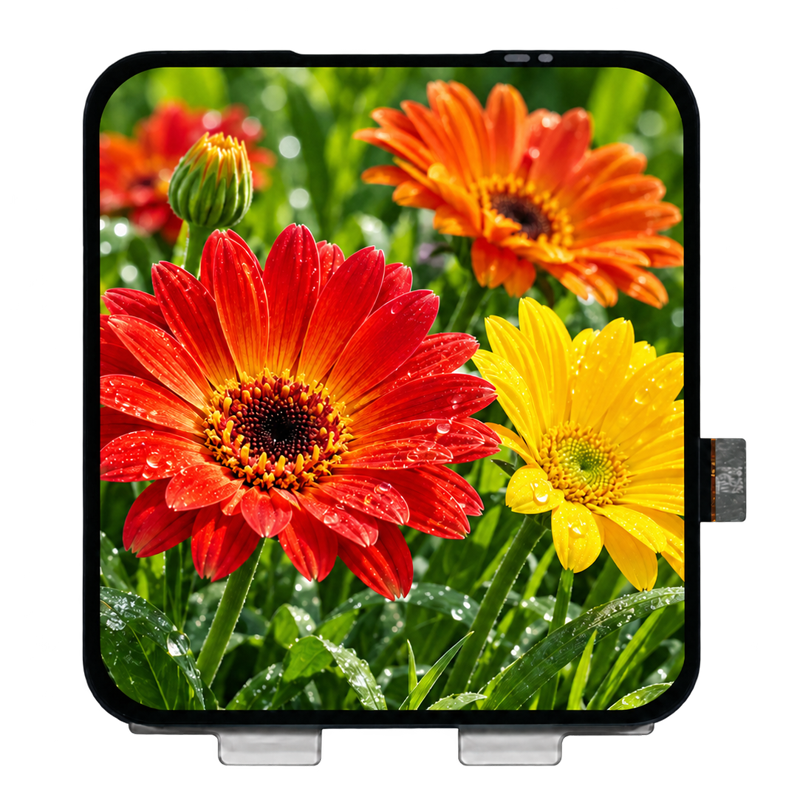
AMOLED Displays
Explore active-matrix OLED modules for detailed color interfaces, touch integration and OEM products.
Explore product options →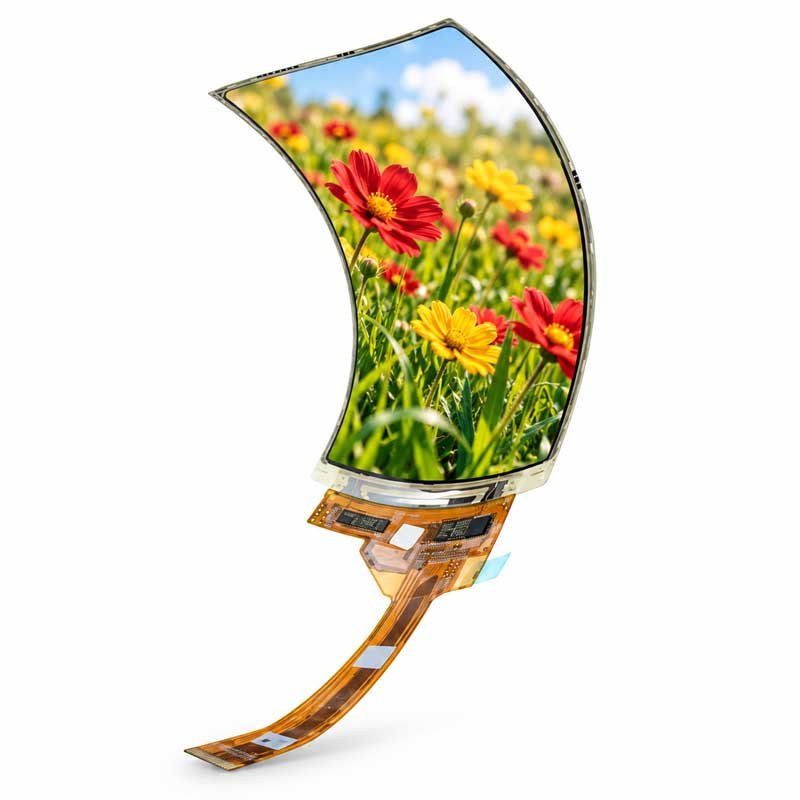
Flexible OLED Displays
Review curvable and bendable OLED options with defined radius, support and mounting requirements.
Explore product options →
Transparent OLED Displays
Explore see-through OLED panels and systems for showcases, signage and other planned installations.
Explore product options →Project review
Find the Right OLED Direction for Your Project
Share your application, dimensions, content, interface, brightness, operating schedule and quantity. DisplayMan can review AMOLED, flexible OLED or transparent OLED options and the required touch, cover glass, cable and controller integration.
Prefer to open the enquiry form here?
Sources and Further Reading
- Pope, Kallmann and Magnante (1963): Electroluminescence in Organic Crystals, J. Chem. Phys. 38, 2042–2043
- Tang and VanSlyke (1987): Organic electroluminescent diodes; publication record and abstract
- Burroughes et al. (1990): Light-emitting diodes based on conjugated polymers, Nature 347, 539–541
- Pioneer (September 30, 1997): GD-F1 launch announcement identifying an organic EL dot-matrix display
- Society for Information Display (2013): AMOLED Production, documenting the 2007 manufacturing milestone
- Sony (October 1, 2007): XEL-1 OLED television announcement
- LG (June 11, 2019): U.S. transparent OLED commercial display launch
- Universal Display Corporation: Flexible OLED substrates and construction
This selective history distinguishes research publications, production milestones and named product launches. Practical selection comments describe engineering considerations; use the current specification for the exact module and assembly.