Sphere LED Display FAQ
Why is a fully custom Sphere LED Display expensive?
A true sphere may require several uniquely shaped PCB and LED module types, dedicated masks or carriers, precision structural sections, a project-specific pixel map and prototype validation. If the diameter or pitch is new, tooling and NRE can represent a significant part of the first project cost.
Does every new sphere diameter require new LED modules?
Not always, but often the diameter and pixel pitch are directly linked to the sphere module geometry. If an existing mature module/tooling combination cannot be reused, a new diameter can require new PCB/module designs and revised frame segmentation.
Can you make a Sphere LED Display smaller than 1.5 meters?
Very small spheres are only practical when a suitable existing module and tooling system already exists. For new fully custom Creative LED development, DisplayMan treats around 1.5 m as a special compact review size and normally recommends approximately 2 m or larger.
What module shapes are used for Sphere LED Displays?
Depending on the project, the sphere may use triangular, trapezoidal, abdomen-shaped, multi-zone curved or other project-specific LED module geometries. The objective is to achieve the required roundness with a practical number of unique module types.
Is front maintenance available?
Front-service maintenance can be considered when the selected sphere module and fixing system support external module removal. For fully custom spheres, the maintenance method must be confirmed during engineering rather than assumed as a universal feature.
How is a large Sphere LED Display shipped?
Large spheres are commonly divided into structural sections for transport and then assembled and aligned on site. The exact split strategy depends on diameter, shipping access, lifting conditions and the final installation structure.
Can you make a hemisphere instead of a full sphere?
A hemisphere or dome-like form can be reviewed as a related Creative LED geometry when full 360-degree viewing is not required. Its structure, module segmentation and content mapping should be engineered specifically for that geometry.
What is a Sphere LED Display?
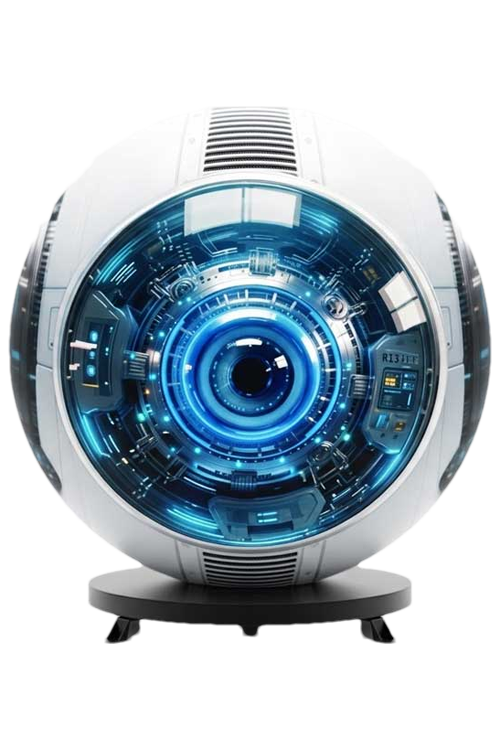
A Sphere LED Display is a custom 360° LED display built around a spherical frame using segmented LED modules and sphere-specific content mapping.
Is a Sphere LED Display the same as a curved LED screen?
No. A curved LED screen normally bends along one main axis. A sphere has compound curvature and converges toward the top and bottom, which requires different module geometry and mapping.
What is the difference between a Sphere LED Display and a Cylindrical LED Display?
A cylinder has a constant-radius wrap and simpler panoramic mapping. A sphere curves in every direction and normally requires more complex surface segmentation and spherical media mapping.
What pixel pitch should I choose?
Choose pitch from viewing distance, sphere diameter, content detail and environment. Smaller pitch is useful for close indoor viewing; larger architectural spheres do not automatically need the smallest pitch.
What sphere diameters are available?
For fully customized DisplayMan Sphere LED projects, approximately 2 m and above is the normal project direction. Around 1.5 m can be reviewed as a special compact configuration. Smaller sizes should only be considered when an existing mature sphere module/tooling set already matches the required diameter and pitch.
Can a Sphere LED Display show a digital Earth?
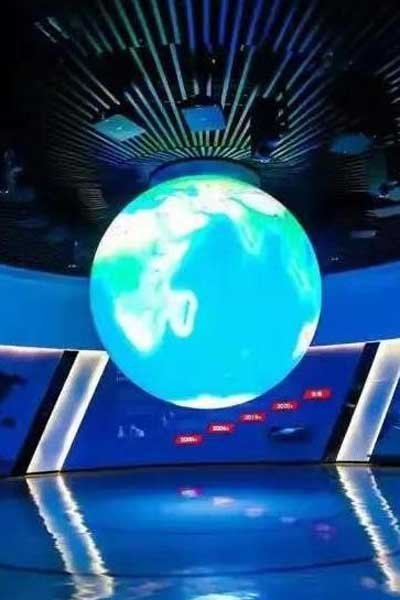
Yes. Planetary and geographic content are among the most natural applications because the physical display geometry already matches the subject.
How is normal video displayed on a sphere?
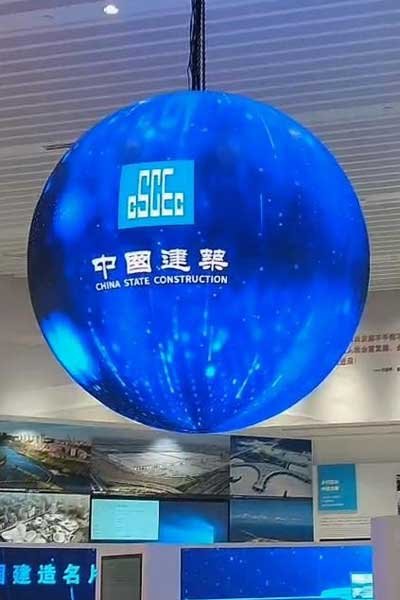
Content is adapted using a sphere-specific pixel map. Important logos, text and focal points should be positioned with the main audience directions and polar convergence in mind.
Can the Sphere LED Display be interactive?
Yes. Interaction is normally provided through an external touchscreen, sensor, gesture system or control interface that changes the content shown on the sphere.
Can the sphere be suspended from a ceiling?
Yes, subject to diameter, weight, building structure, cable routing and service-access review.
Can it be floor-standing?
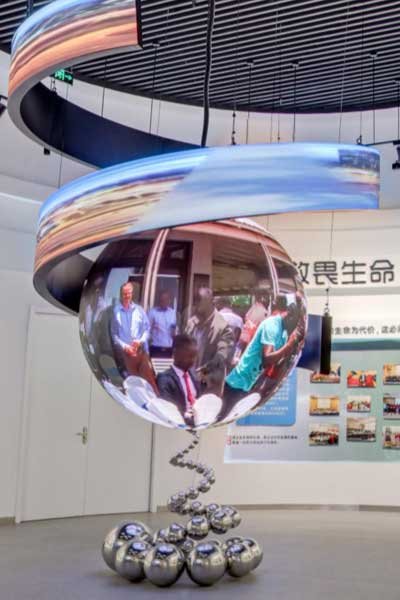
Yes. A floor-standing base is practical for retail, exhibition and showroom projects and can simplify installation and maintenance.
Can Sphere LED Displays be used outdoors?
Outdoor sphere projects can be reviewed, but they require a dedicated outdoor module, brightness, waterproofing, cable protection, structural and wind-load design.
Do you provide a pixel map for content creation?
Sphere projects should include a project-specific pixel-map or media-mapping reference so the content team can prepare graphics for the final geometry.
Is the LED surface touch-sensitive?
Normally no. Direct touch on the LED sphere is not the preferred interaction method; an external touch display or sensor system is more practical.
What information is needed for quotation?
Provide target diameter, indoor/outdoor environment, viewing distance, installation method, preferred pitch if known, quantity, site photos or drawings, content type and project schedule.
Is Sphere LED one of DisplayMan’s Custom LED Display products?
Yes. Sphere LED is one featured Custom / Creative LED direction. DisplayMan also develops other geometric, product-replica, branded and free-form LED shapes according to project requirements.