Frequently Asked Questions
Transparent OLED Sliding-Rail Display FAQ
What is a Transparent OLED Sliding-Rail Display?
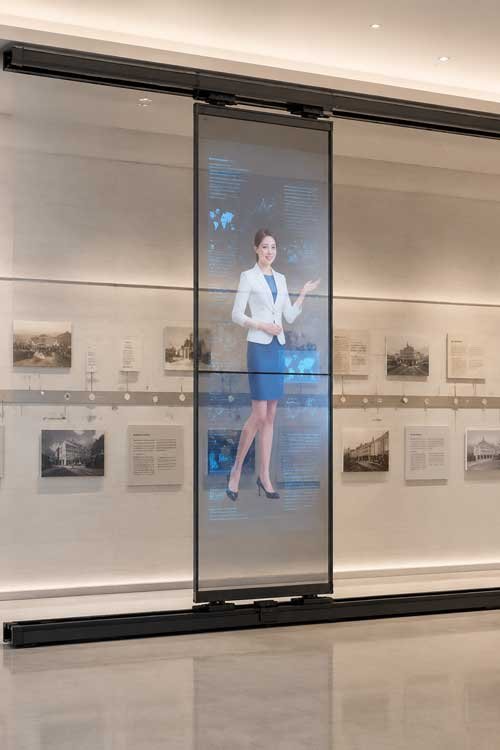
It is based on a floor-standing transparent OLED display. Wheels are added beneath its fixed base and connected to a motorized rail so the complete display can move horizontally while the physical background remains visible.
Which Transparent OLED sizes can be customized?
30-inch, 48-inch, 55-inch and 77-inch Transparent OLED Sliding-Rail Displays can be customized. Touchscreen integration can also be evaluated for all four sizes according to the panel, frame, moving cable path and project structure.
Why is 55 inches the most commonly selected size?
The 55-inch Transparent OLED provides the best balance of display area, availability, structure and cost, so it is the most practical and cost-effective choice for most sliding-rail projects.
When should a project use one 77-inch OLED or two 55-inch OLED panels?
A 77-inch OLED provides approximately twice the display area of one 55-inch OLED. However, most large-format projects select two 55-inch panels because the 55-inch configuration usually offers better cost performance and greater structural flexibility.
When are upper and lower rails required?
A mainstream single 55-inch display normally uses only the bottom motorized rail. Upper and lower rails are normally used when two 55-inch portrait displays are stacked vertically and the complete moving assembly becomes exceptionally tall.
Does a fully framed display require two rails?
No. Full perimeter framing and rail quantity are separate design decisions. A fully framed single 55-inch display can still operate on one bottom rail.
Can the displayed content change at different rail positions?
Yes. The controller can associate programmed positions with different videos, graphics, labels or application states. The exact control logic depends on the project.
Is the rail length fixed?
No. Rail length and travel distance are reviewed according to the exhibition wall, number of subjects, screen load, stopping positions, maintenance space and transportation conditions.
Can the display move automatically?
Yes. It can operate in an automatic presentation loop or respond to an operator, button, sensor, touchscreen or project-specific software.
Can visitors still see the product behind the screen?
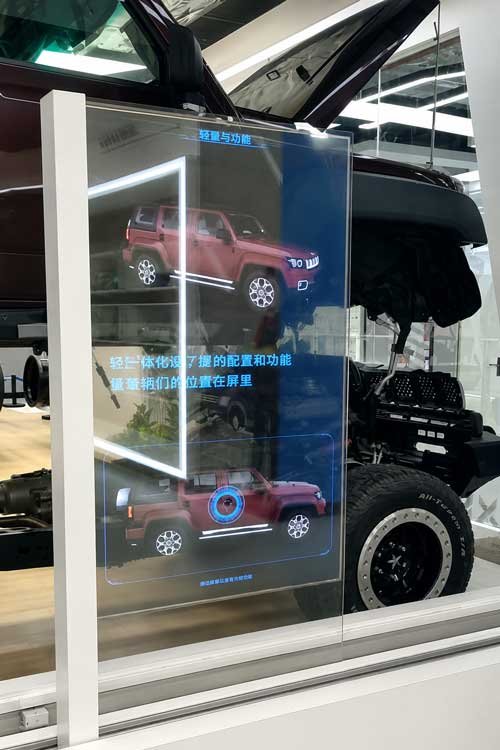
Yes. Maintaining visibility of the real product or background is the core advantage of Transparent OLED. Content must be designed with transparent areas and suitable contrast.
What is the difference between a Transparent OLED and an LCD sliding display?
Transparent OLED allows the exhibit behind the screen to remain visible. Conventional LCD is opaque and produces a complete rectangular image but covers the background directly behind it.
Can touch interaction be added?
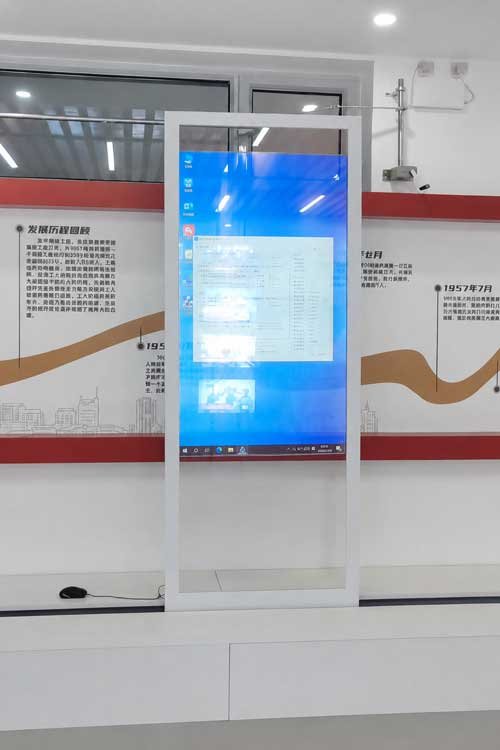
Optional touch, buttons, sensors or software interaction can be evaluated, but the moving cable path, added weight and control logic must be reviewed together.
What information is needed for a quotation?
Please provide the application, installation dimensions, rail length, travel distance, objects behind the display, preferred screen orientation, stopping positions, control method, content requirement, quantity and project schedule.