
Display Tech & Engineering · Cover Glass Selection
Choose the Treatment Around the Problem You Need to Solve
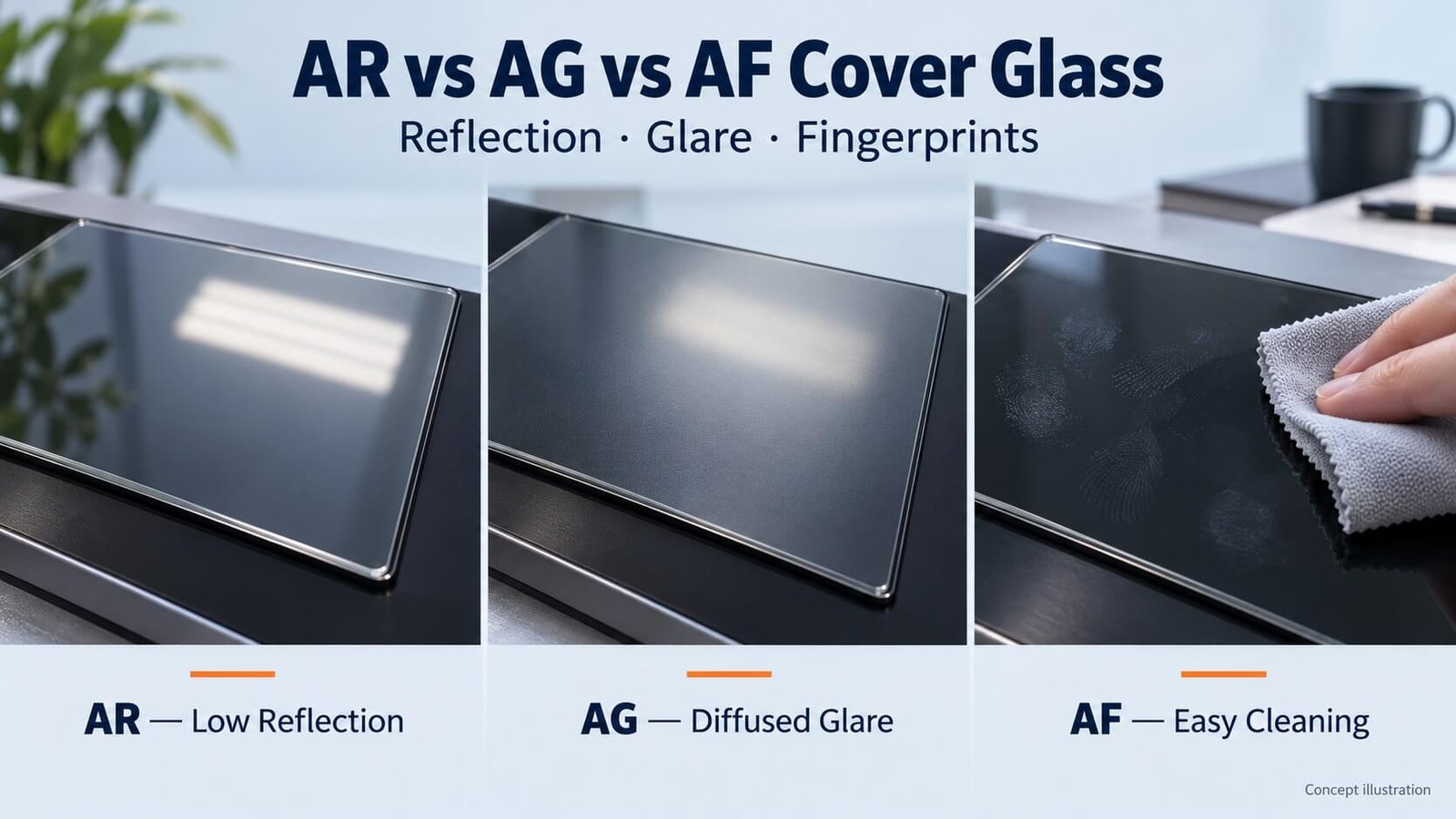
Choose AR to reduce surface reflection, AG to soften sharp reflected light, and AF to improve fingerprint cleanability. These functions are different, and compatible combinations may be appropriate.
For an OEM project, approve the complete glass, touch and display stack. DisplayMan can review the optical finish, touch integration and installation conditions together before quotation.
1. AR vs AG vs AF: The Practical Difference
AR reduces surface reflection, AG spreads reflected light, and AF makes fingerprints and oily residue easier to remove. They address different problems and may be combined in a qualified cover-glass stack.
| Treatment | Main mechanism | What it helps with | What to check |
|---|---|---|---|
| AR — anti-reflective | Optical thin-film design reduces reflection over a specified wavelength and angle range | Reflected images, clarity and ambient contrast | Reflectance, transmission, reflected color, angle dependence and coating durability |
| AG — anti-glare | An etched or coated microtexture scatters light | Sharp, distracting reflected light sources | Haze, gloss, clarity, sparkle and performance on the actual pixel structure |
| AF — anti-fingerprint / easy-to-clean | A low-surface-energy treatment changes wetting and adhesion behavior | Fingerprint visibility, cleanability and touch feel | Oil removal, contact angle, wear and compatibility with cleaning agents |
A matte appearance does not prove low total reflection. A clean-looking surface does not prove AR performance. Ask for separate optical and durability specifications rather than approving the treatment name alone.
2. AR Glass: Reduce Reflections While Preserving Clarity
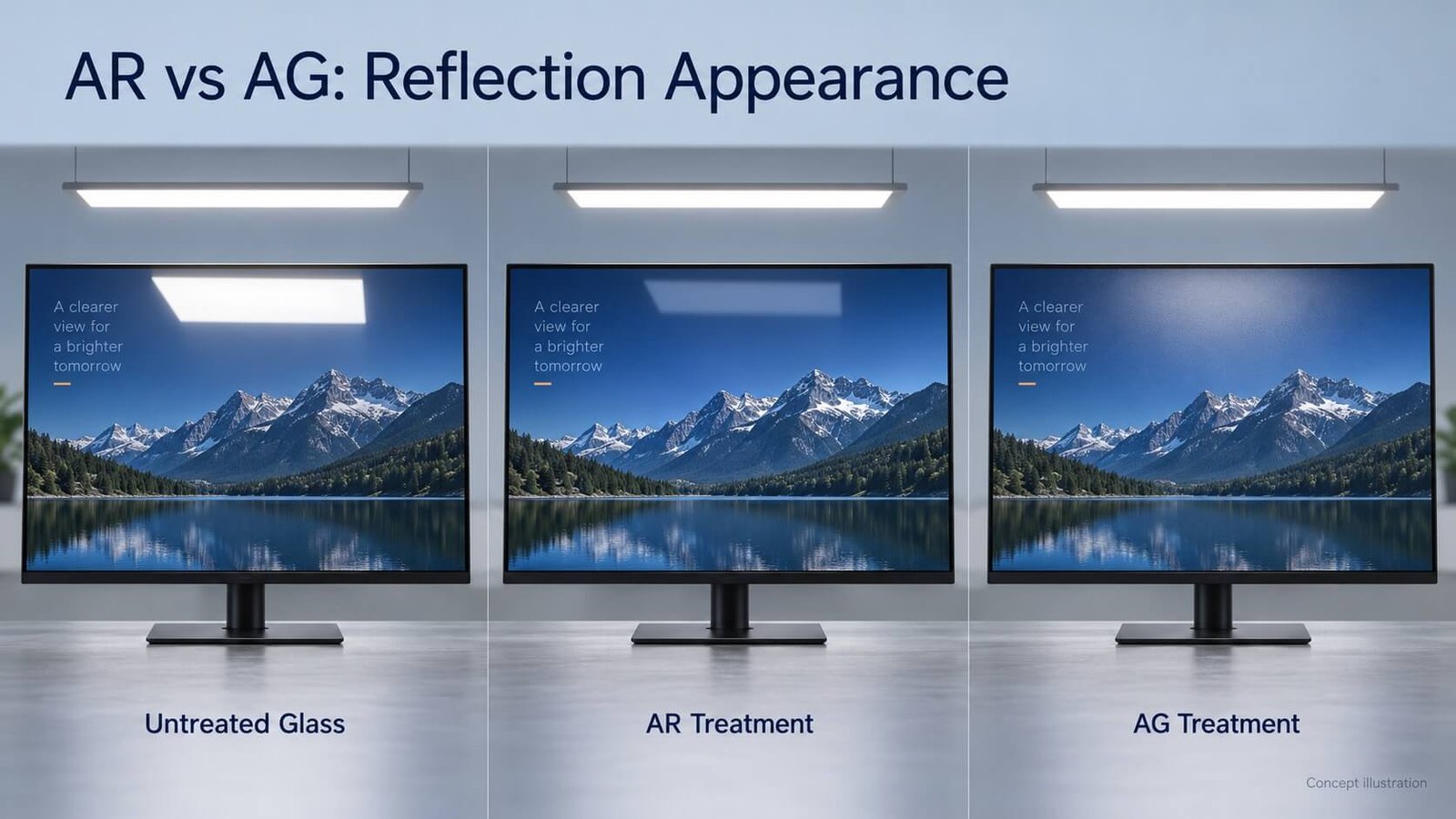
An untreated glass surface reflects part of the incident light. In a display, those reflections can compete with the image, particularly when the screen shows dark content near a window or bright lighting.
AR treatments commonly use optical coatings whose layer thicknesses and refractive indices are engineered to suppress reflected light through interference. Performance depends on wavelength, angle and the coated surfaces. Specify whether the reported reflectance applies to one surface, the complete glass sheet or the assembled display.
AR is useful for image-critical displays, transparent display cover glass and high-brightness systems where reflected surroundings obscure content. It can preserve a glossy, clear appearance, although residual reflections and reflected color remain possible.
AR is not automatically scratch-resistant, fingerprint-resistant or suitable for every outdoor installation. Those properties need separate qualification. Do not apply a supplier’s percentage reduction to another coating or an entire display assembly.
3. AG Glass: Soften Sharp Reflections, Check the Trade-Offs
AG surfaces use microscopic texture to spread reflected light over a wider range of angles. A sharply defined lamp reflection becomes less distinct. Etched AG glass and AG-coated glass are different constructions, with different appearance and durability considerations.
This scattering can also affect transmitted display light. Depending on the treatment, users may notice haze, reduced perceived sharpness, a brighter-looking black background or sparkle. Sparkle is a granular appearance arising from interaction between the surface texture and the display’s pixel structure; it cannot be evaluated fully using a glass sample over a blank sheet.
For high-resolution displays, fine text, medical equipment interfaces or close viewing, evaluate the proposed AG grade on the actual panel. Use white, gray and black backgrounds as well as normal application screens. Test the intended viewing distance and angles.
More haze is not always better. Choose the lightest treatment that controls the relevant reflections while retaining acceptable image quality. AG alone does not establish sunlight readability or eliminate the need for suitable brightness and installation design.
4. AF Glass: Easier Cleaning, Not a Fingerprint-Free Screen
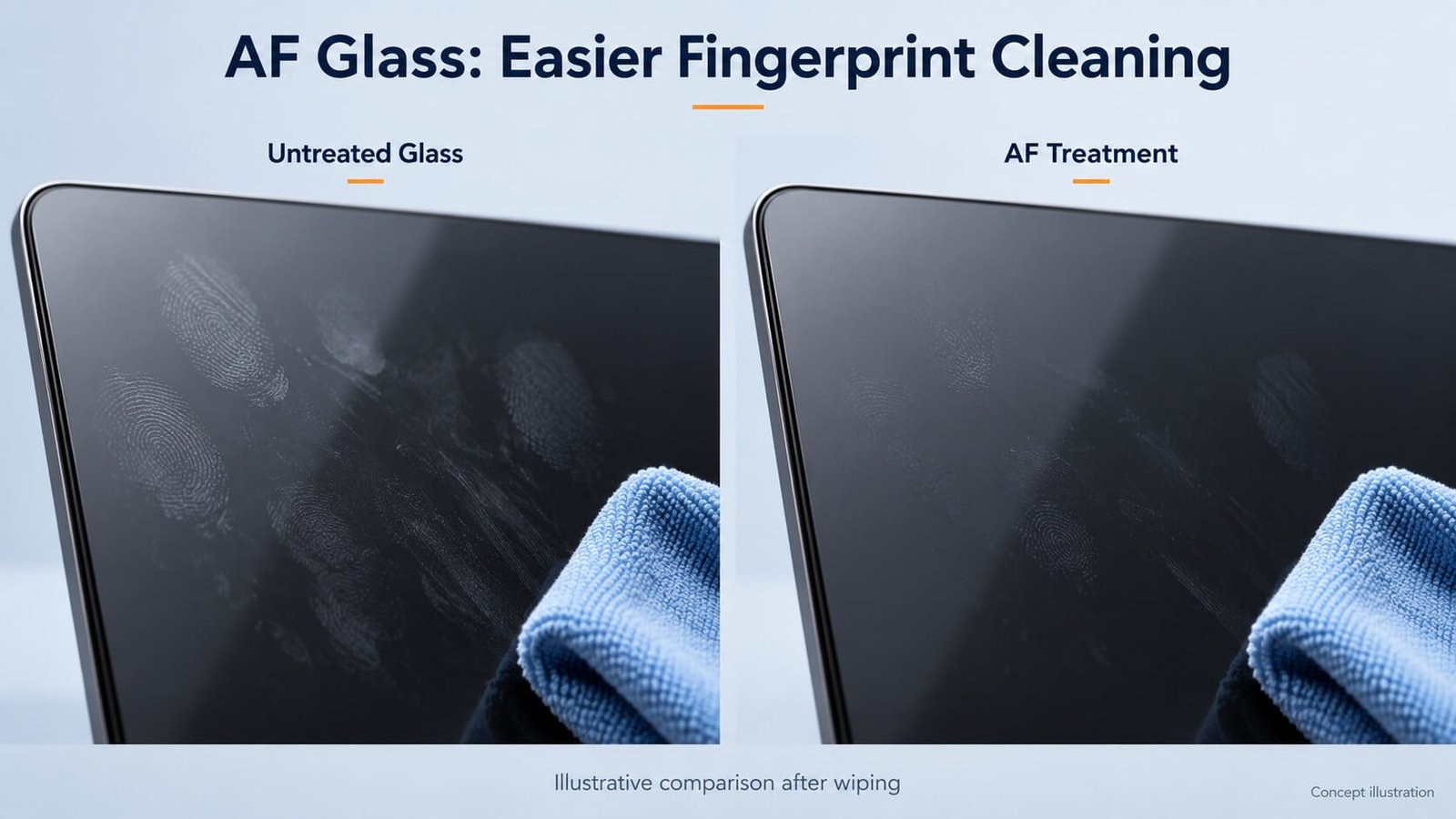
AF is often described as anti-fingerprint, anti-smudge or easy-to-clean. The exact terminology varies by supplier. It usually refers to a surface treatment designed to reduce adhesion or improve removal of oily contamination, often with hydrophobic and oleophobic behavior.
Fingerprints can still appear. Their visibility depends on lighting, skin oil, surface finish and cleaning history. AF coatings also wear through repeated touching, wiping and exposure to unsuitable chemicals.
For kiosks, industrial interfaces and shared touchscreens, approve a repeatable cleaning test. Compare fingerprint visibility and removal before and after the agreed wear procedure. Water contact angle can be a useful process indicator, but it does not describe every aspect of oil repellency, touch feel or real-world cleanability.
AF is not an antibacterial treatment, a waterproof enclosure specification or permission to use any disinfectant. Confirm the actual cleaning products, concentrations, exposure time and wiping materials with the supplier.
5. Can AR, AG and AF Be Combined?
Yes, compatible combinations can address multiple requirements. Examples include AR plus AF for clarity and cleanability, AG plus AF for glare control on a frequently touched interface, and AG plus AR plus AF for a more demanding optical stack.
These are engineering options, not interchangeable labels. Coating order, surface preparation, etched texture, strengthening process and adhesive compatibility must be qualified together. Do not assume that adding each treatment independently will preserve every original property.
| Candidate stack | Starting objective | Sample approval focus |
|---|---|---|
| AR + AF | Clear image with easier cleaning | Residual reflection, reflected color and AF wear |
| AG + AF | Softer reflected light on a shared touch surface | Haze, sparkle, touch feel and cleanability |
| AG + AR + AF | Combined glare, reflection and contamination control | Full-stack optics, durability and actual display appearance |
| Untreated or standard glass | Controlled lighting and a simpler cost target | Confirm that reflections and maintenance remain acceptable |
6. Match the Treatment to the Application
| Application | Main question | Direction to evaluate |
|---|---|---|
| Transparent OLED or Micro LED cover glass | Will added glass introduce reflections or obscure the background? | Low-reflection, low-haze options; verify transmission, tint and complete assembly appearance |
| Window-facing or outdoor display | Is readability limited by reflections, brightness or both? | AR and/or suitable AG alongside brightness, bonding and thermal design |
| Floor-standing touch kiosk | Can users read and operate the interface under installed lighting? | AG or AR with AF where repeated touching makes cleaning important |
| Industrial control panel | Will cleaning, gloves, cover thickness and temperature affect use? | Qualified surface finish with a matched PCAP sensor and controller |
| Interactive flat panel | How do lighting, writing feel and high-resolution content interact? | AG grade and optional treatments approved on the complete large-format unit |
DisplayMan can review the cover glass as part of the touch and display assembly. A treatment that looks attractive on a small loose sample may behave differently across a large screen or in the final enclosure.
7. Surface Treatment, Optical Bonding and Brightness Solve Different Problems
Surface treatments mainly address the relevant glass surface. Optical bonding addresses an internal interface by replacing an air gap with an appropriately matched adhesive system. A front-surface AR coating does not remove reflections at every internal interface.
Increasing panel brightness can improve visibility in some conditions, but it also affects power and thermal requirements. It does not remove reflected images. Similarly, matte AG does not compensate automatically for an underpowered display.
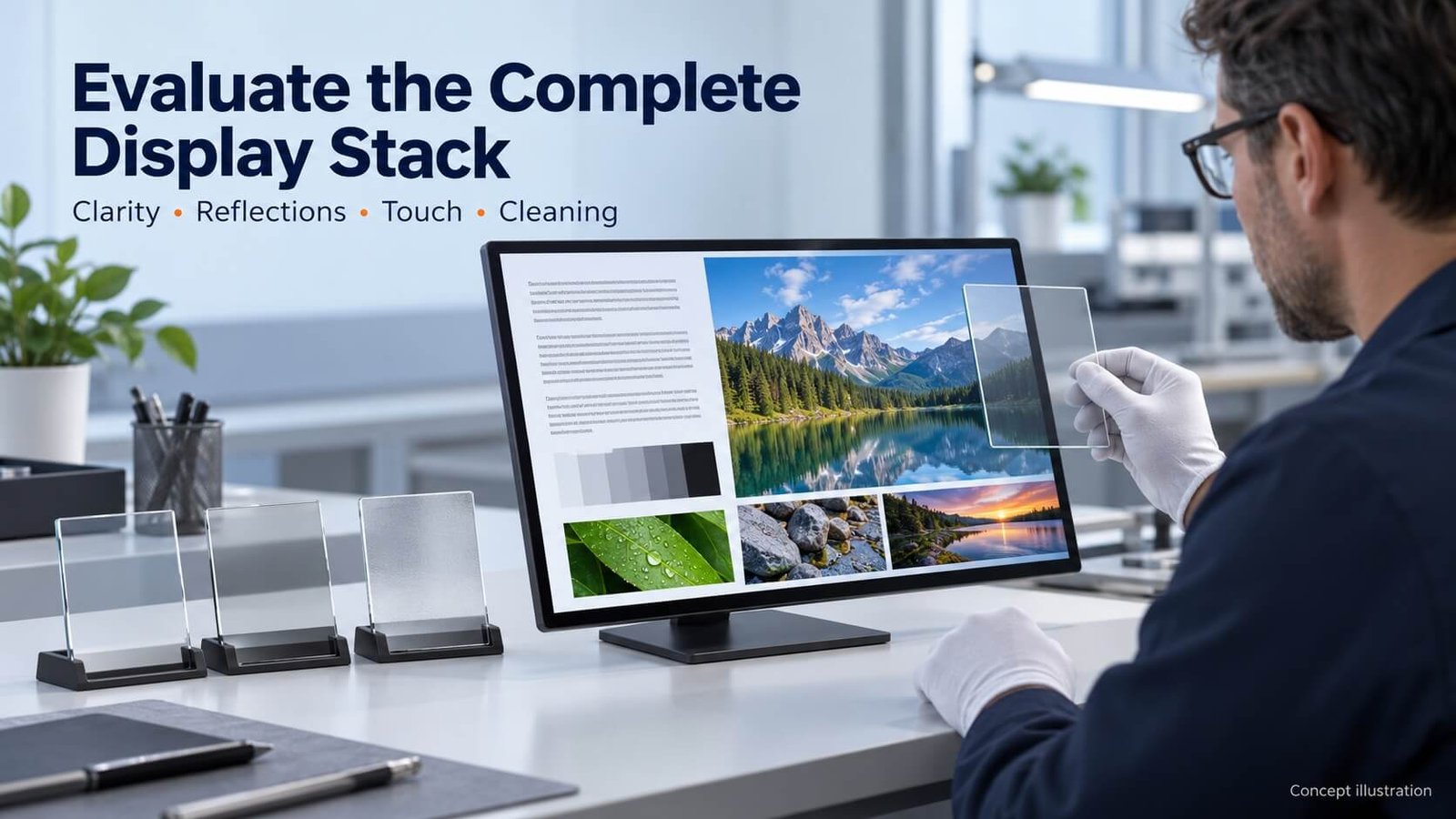
Review the complete optical stack: front glass, printing, touch sensor, adhesive or air gap, display surface and enclosure. Read the optical bonding vs air gap guide and compare the actual assembly under the intended lighting before freezing specifications.
For transparent displays, include the view through the screen, not only the displayed image. Evaluate background objects, tint, haze, added reflections and the appearance of printed borders. Mechanical protection and optical transparency need to be balanced together.
8. What to Specify and Measure Before Approval
| Item | Requirement to agree | Common approval mistake |
|---|---|---|
| Reflectance | Spectral or luminous method, angle, surface scope and sample configuration | Comparing one-surface data with whole-sheet or assembled-display data |
| Transmission and haze | Test method, instrument and complete stack | Treating transmission and clarity as the same measurement |
| Gloss and sparkle | Measurement geometry plus visual review on the intended panel | Approving an AG sample without powering the display |
| Reflected color | Lighting and viewing-angle conditions | Reviewing only directly in front of the sample |
| AF performance | Initial and post-wear wetting/cleaning criteria | Using an initial water-drop result as a lifetime claim |
| Durability | Abrasion tool, load, cycles, chemicals and acceptance limits | Calling a surface “scratch-proof” without a test definition |
| Touch function | Cover thickness, controller, gestures, gloves and wet conditions if required | Assuming the finish alone determines touch performance |
There is no single universal specification that makes every AR, AG or AF product suitable for every project. Record the exact test conditions and the supplier’s acceptance limits in the approved specification.
9. Sample Tests: Approve the Assembly, Not Only the Glass
- Compare samples under the same lighting, content and viewing angle. Keep display brightness settings consistent.
- Use text, fine lines, photographs, gray fields and dark scenes. Include the customer’s real user interface.
- Review near-window or outdoor conditions where relevant, including reflections of actual light sources.
- Test touch with the final glass thickness, printing, adhesive stack and controller settings. Include the required gloves or wet conditions only when part of the project scope.
- Run agreed cleaning and abrasion procedures. Recheck optical appearance, AF performance and touch operation afterward.
- Approve a reference sample and drawing revision. Document which side faces the user, treatment coverage, cosmetic inspection conditions and allowable defects.
Avoid pressing tools against a finished screen or experimenting with unapproved chemicals. Use the agreed sample procedure rather than an improvised demonstration that may damage the coating or glass.
10. Information to Send Before Quotation
- Application and installation environment, including sunlight, lighting and cleaning practices.
- Glass outline, thickness, visible area, edge finishing, holes, cutouts and mounting method.
- Required strengthening and impact requirements, specified separately from surface treatment.
- Border printing, logo artwork, color references and treatment coverage areas.
- Target optical performance, including AR reflectance scope and AG appearance requirements.
- AF expectations, cleaning agents and required wear or chemical-resistance tests.
- Touch sensor, controller, display model, bonding structure and required operating conditions.
- Sample quantity, forecast production quantity, destination market and drawing revision.
If exact optical targets are not available, send photographs of the installation and explain the problem: sharp reflected lamps, washed-out outdoor content, fingerprint marks or poor text clarity. That is more useful than requesting “the best glass” without a defined use case.
11. Frequently Asked Questions
Is AR better than AG?
AR and AG address reflections differently. AR is often a starting point when low reflection and high clarity matter; AG can be useful when sharp reflected images are distracting. The right choice depends on the panel, lighting, viewing distance and acceptable haze or sparkle.
Does AF prevent all fingerprints?
No. AF can improve fingerprint visibility or removal, but marks can remain and performance changes with wear and cleaning. Approve the required cleaning result rather than expecting a permanently clean surface.
Does AG make a display dimmer?
Some treatments affect transmission and perceived clarity. Scattering can also alter how the image looks under ambient light. Check measured performance and the assembled display instead of assuming either zero loss or a fixed brightness reduction.
Are these treatments the same as tempered glass?
No. Surface treatments address optical or cleaning behavior; thermal or chemical strengthening concerns mechanical behavior. Specify both when needed, including processing sequence and compatibility.
Does a coating guarantee outdoor readability?
No. Evaluate display brightness, surface and internal reflections, installation orientation, thermal design and the complete enclosure. Start with the outdoor touch display range when the whole system must operate outdoors.
Will AF work forever?
No coating should be assumed permanent without a service-life definition. Agree on wear and chemical-exposure tests and a practical maintenance procedure.
Explore Related Display Products
Choose a touch component, integrated display module or complete terminal according to your project scope.
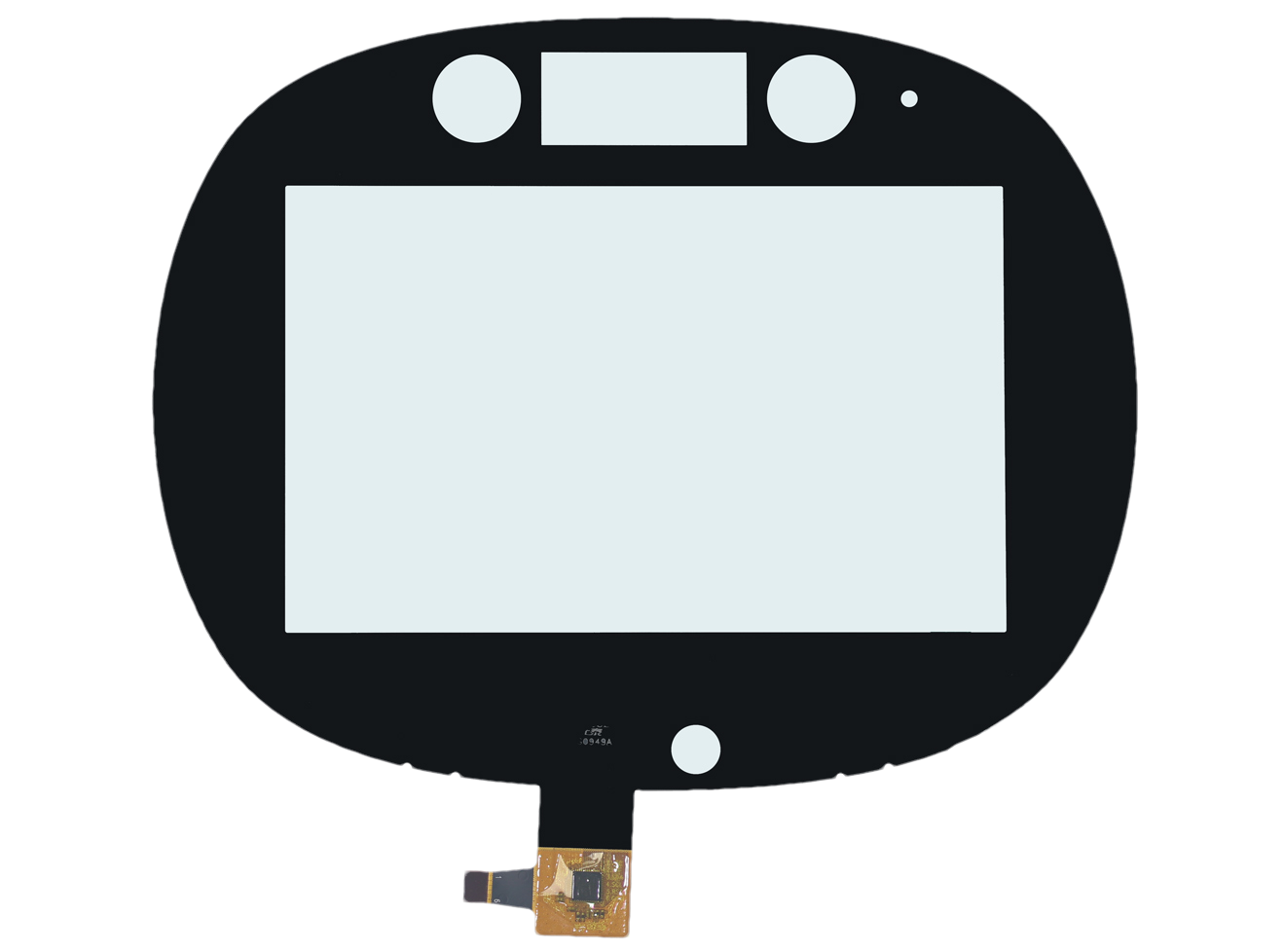
Capacitive Touch Panels
Review sensor construction, cover glass, controller and input requirements.
Explore product options →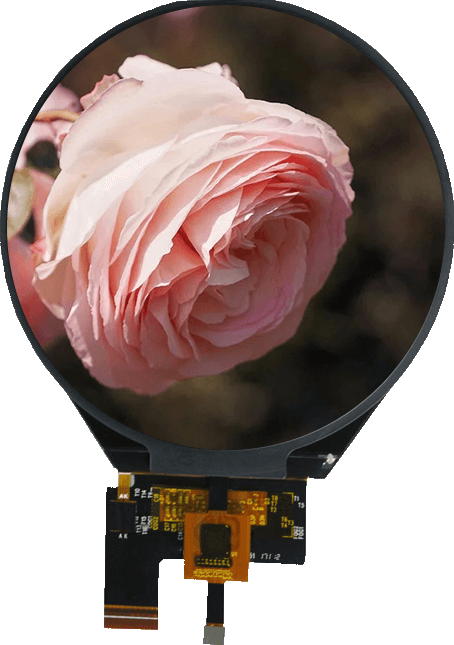
Touch Screen TFT LCD Displays
Select the display and touch assembly together around your host system.
Explore product options →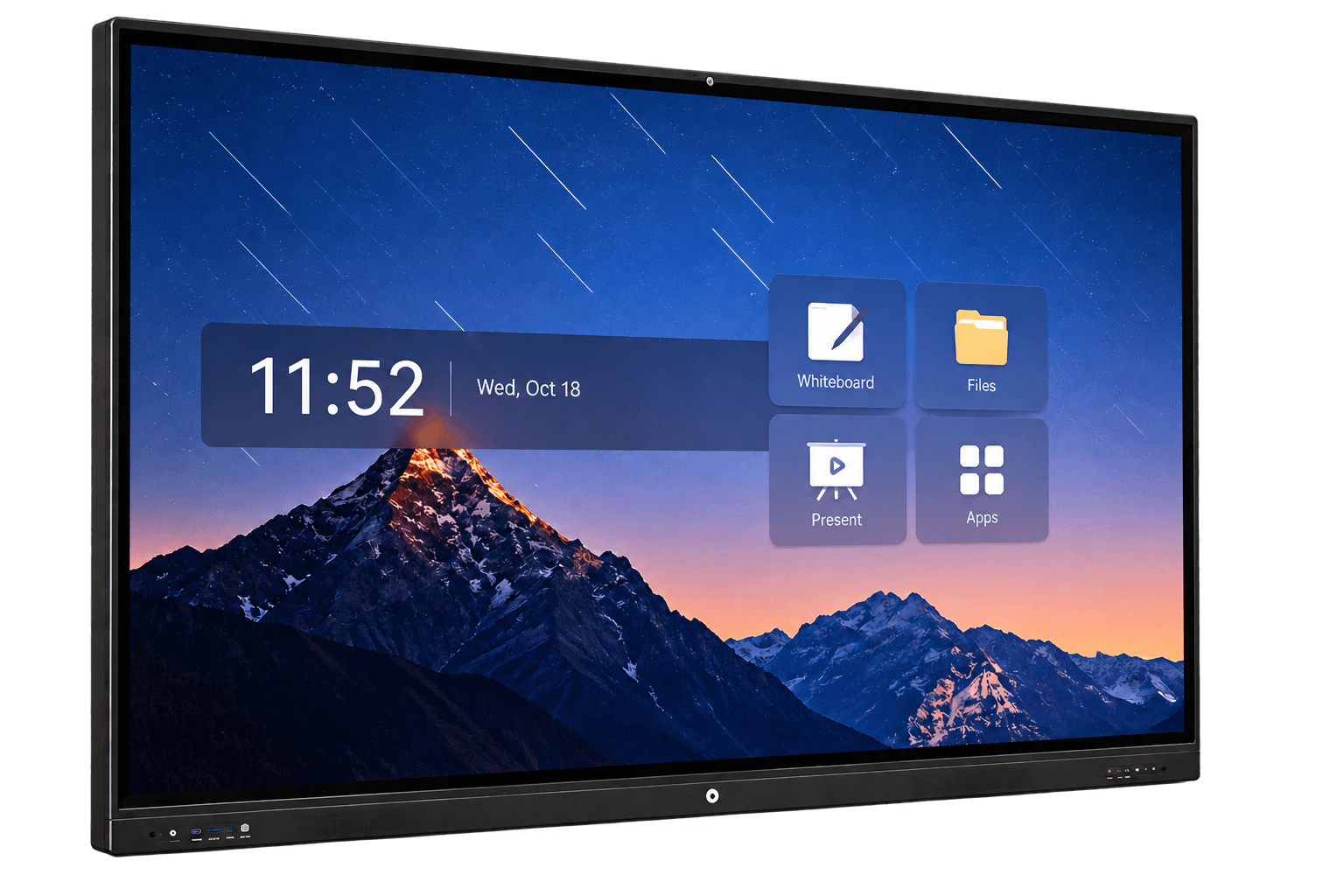
Interactive Flat Panels
Review complete large-format collaboration and terminal requirements; touch technology depends on configuration.
Explore product options →Project review
Review Your Cover Glass Requirements
Send your glass dimensions, surface-treatment requirements, display and touch stack, installation environment, cleaning conditions and quantity. DisplayMan can review a practical integration direction.
Prefer to open the enquiry form here?
Technical References
Corning: anti-reflective glass and interference · AGC: display-screen glass, AG finishes and AF options · AGC: balancing glare, clarity and sparkle on high-definition displays
These references explain technology principles. They do not establish specifications for a DisplayMan quotation; approve the selected materials, stack and test conditions for your project.