
Part 1: Introduction – Beyond the Hype of Transparency
The “Wow” Factor vs. Engineering Reality In the world of high-end display technology, “Transparency” has long been the ultimate frontier. We’ve all seen the sci-fi concepts of floating interfaces in movies like Iron Man or Minority Report. Today, that future has arrived, but it has brought a wave of misinformation with it. If you search for “Micro LED vs. Transparent OLED” on Google, you will find plenty of charts and specs. However, as an engineer who has spent over 10 years in the display industry, I can tell you: most of that data is either outdated or purely theoretical.
The Clash of Titans Currently, the market is divided into three main paths: the cost-effective but bulky Transparent LCD, the mainstream Transparent OLED (T-OLED), and the “industrial miracle” known as Micro LED. While T-OLED has dominated the conversation for the past few years, a new leader is emerging for those who refuse to compromise on brightness, clarity, and longevity.
Why This Article is Different At DisplayMan, we don’t just sell panels; we engineer solutions for the automotive, medical, and luxury retail sectors. We’ve invested millions of dollars in R&D and tooling fees to bring the latest Micro LED technology to life. To cut through the noise, we recently conducted a side-by-side test between a 30-inch Transparent OLED and our 30-inch Micro LED.
In this guide, I’m going to share the raw, unpolished truth about these technologies—including why one costs 10 times more than the other, and why the “best” choice depends entirely on your environment.
Part 2: Technical Foundations – How “See-Through” Actually Works
To choose the right technology, you first need to understand the physics of the glass. Not all “transparency” is created equal.
Transparent LCD (T-LCD): The Managed Environment
Think of T-LCD as a “Passive” transparent display. It doesn’t emit its own light. Instead, it relies on a powerful external light source—usually a white Light Box behind the screen—to make the image visible.
- The Reality: In a high-light environment, T-LCD can achieve a transparency of 60%+.
- The Trade-off: Because it needs that external box, it is bulky. It’s perfect for luxury product showcases where you can hide the lighting inside a cabinet, but it’s not the slim, “floating” glass you see in Iron Man.
Transparent OLED (T-OLED): The Organic Standard
T-OLED was the first tech to truly ditch the light box. It uses organic self-emissive pixels that are so thin they allow light to pass through the gaps.
- The Limitations: However, T-OLED is a “standardized” product. You are restricted to a few fixed sizes (30, 48, 55, and 77 inches).
- The “Haze”: Because of the organic encapsulation layers, the glass often has a slight “tint” or “haze.” It’s transparent, but you can still feel the presence of the screen.
Micro LED: The “Industrial Miracle” & The Iron Man Reality
This is where we enter the realm of the elite. Micro LED is the only technology that truly achieves the 70%+ transparency required for that “holographic” effect.
- The Micron Advantage: How do we get it so clear? We use Micron-level inorganic LED chips. These beads are so incredibly small that unless you are inches away, they are invisible to the naked eye. This leaves massive physical gaps for light to pass through.
- Built to Last: Unlike OLED, which uses organic materials prone to “burn-in” and decay, Micro LED is inorganic. It’s industrial-grade, offering 100,000 hours of life without losing its brilliance.
- Beyond the Grid: While OLED is fixed, Micro LED is modular. At DisplayMan, we’ve developed a “Lego-like” system using 9.4-inch and 16.1-inch modules. This allows us to build any size—from a 20-inch cockpit display to a massive 83-inch transparent wall—without the limitations of traditional manufacturing.
Part 3: The 30-inch Showdown – Reality vs. Spec Sheets
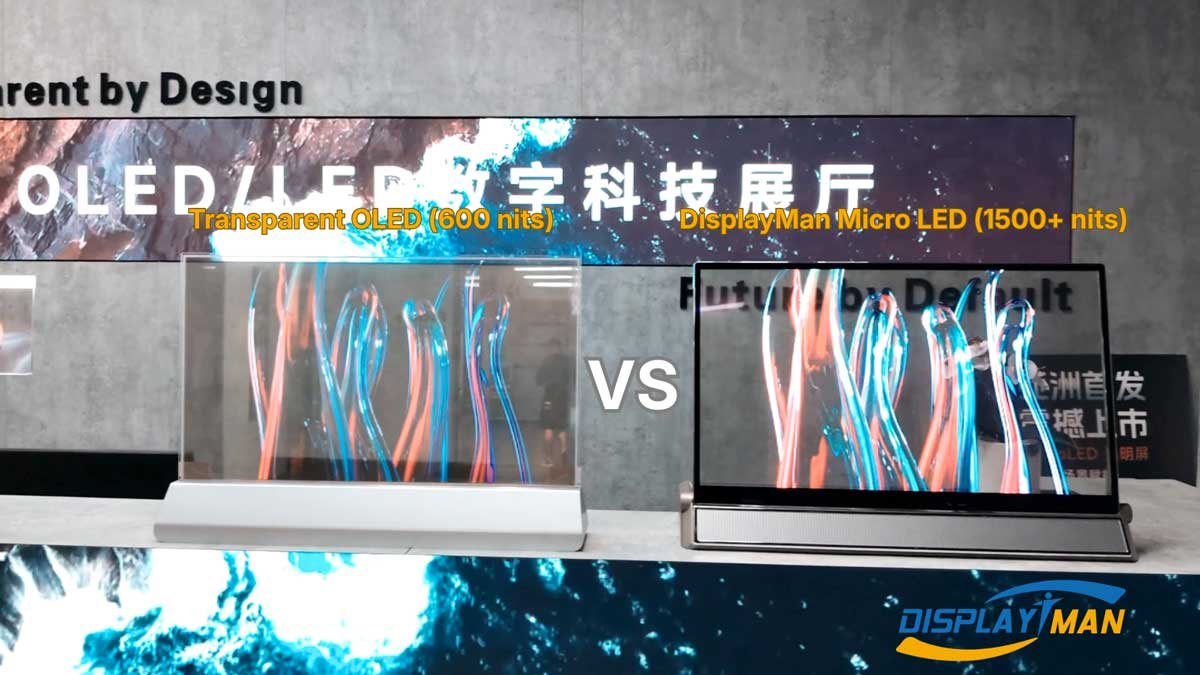
A Head-to-Head Visual Duel To prove that specs on paper don’t tell the whole story, we put our 30-inch Micro LED side-by-side with a 30-inch Transparent OLED. While the T-OLED is a respected industry standard, the moment we hit the power switch, the gap became a canyon.
1. Luminance & Ambient Light Dominance Brightness is where the battle is won or lost. T-OLED typically maxes out at 600 nits, which looks great in a dim showroom but “fades” under bright office lights or near a window.
- The Micro LED Advantage: Our unit delivers 600 to 3,000 nits. It doesn’t just display an image; it commands the space. Even with strong studio lights hitting the glass, the Micro LED maintains a vivid, solid image that remains perfectly readable.
2. The Viewing Angle: Color Without Compromise Most transparent screens suffer from “color shift” when viewed from the side. In our test, we moved the camera to 45° and 60° angles.
- The Result: The T-OLED began to lose saturation, showing a slight “washout” effect.
- The Micro LED Mastery: Our Micro LED maintained 100% color integrity. Whether you are standing directly in front of it or viewing it from a sharp corridor angle, the reds remain deep and the blues remain piercing. It offers a near-perfect 178° viewing experience, which is critical for high-end retail and public installations.
3. Contrast & The “Hologram” Effect This is the hardest part to describe, but the easiest to see in the video. Because the Micro LED has 70%+ transparency and much higher peak brightness, the “black” areas of the video are literally invisible, while the “colored” areas are incredibly punchy.
- The Experience: The image feels like it has physical weight in the air. While the OLED looks like a transparent screen, the Micro LED looks like a digital ghost—a true holographic presence that doesn’t obstruct the background, but enhances it.
Part 4: The Price of Innovation – Why It Costs What It Costs
The “Elephant in the Room”: The 10x Price Gap Let’s be honest: if you ask for a quote, you’ll find that a Micro LED display can cost 10 to 15 times more than a Transparent OLED. In the world of business, a price gap that large needs a very good explanation. Here is the “behind-the-scenes” truth that you won’t find on a standard spec sheet.
1. A Manufacturing Miracle (The “Tooling” Story) To create the 16.1-inch and 9.4-inch modules that we use at DisplayMan, the initial investment is staggering. We are talking about over 10 million RMB (millions of USD) just in tooling and molding fees before a single screen is even produced.
- The Complexity: Transferring millions of micron-sized LED beads onto a single glass substrate without a single error is a “manufacturing miracle.” It requires specialized cleanrooms, high-precision robotics, and massive R&D expenditure.
2. We Pay for the Risk, You Pay for the Product Here is the DisplayMan difference: We have already paid those millions. The heavy lifting—the R&D, the failed prototypes, the marketing, and the massive tooling fees—has already been absorbed by us.
- Amortized Value: We don’t ask our clients to pay for our research. We’ve amortized all those “invisible costs” into our unit price. When you buy from us, you aren’t funding a science project; you are investing in a mature, high-class industrial product that is ready to ship.
3. Tailored Brilliance: 600 to 3,000 Nits Unlike “off-the-shelf” OLEDs that come with fixed specs, our Micro LED is an engineering platform.
- Custom Brightness: Because we control the LED array, we can customize the brightness to fit your specific needs—anywhere from 600 nits (perfect for subtle indoor luxury) to 3,000 nits (for high-impact visibility in sun-drenched environments).
- The Logic: Why pay for 3000 nits if you are in a dim gallery? Or why settle for 600 nits if you are in a flagship store window? We tune the technology to your project.
Part 5: Scalability & The Future-Proof Portfolio
Beyond the Prototype: 9 Standard Sizes for Any Vision One of the biggest hurdles in transparent display projects is finding a size that actually fits the architectural intent. While our competitors might offer one or two “take-it-or-leave-it” options, we have built a comprehensive ecosystem.
Because of our modular engineering, we’ve standardized a range that covers everything from a compact medical device interface to a massive luxury storefront wall.
The DisplayMan Micro LED Standard Lineup:
- The Compacts: 9.4-inch, 16.1-inch, 20-inch (Perfect for HUDs, smart appliances, or desktop tech).
- The Mid-Range: 30-inch, 42-inch, 54-inch (The “Sweet Spot” for retail shelving and interactive kiosks).
- The Grand Vision: 60-inch, 64-inch, 83-inch (Designed for flagship facades and high-class corporate lobbies).
The “Lego” Advantage: Infinite Customization Remember, these aren’t just standalone panels. Because our technology is based on the 9.4-inch and 16.1-inch “Master Modules,” we can tile them seamlessly. If your project requires a 120-inch ultra-wide panoramic window or a vertical 4-meter digital pillar, our modular approach makes it possible without the multi-million dollar risk of new tooling.
Conclusion: Which Tech Leads the Next Generation?
The winner of the “Transparency Race” isn’t decided by a spec sheet; it’s decided by the environment.
- Choose Transparent LCD if you have a controlled environment with a light box and a tighter budget.
- Choose Transparent OLED if you need a slim, standard-sized screen for indoor, low-light applications.
- Choose Micro LED if you demand the “Iron Man” reality: 70%+ transparency, 3,000-nit brilliance, and a lifespan that will outlast the building itself.
At DisplayMan, we’ve spent 10+ years and millions of dollars to ensure that when you’re ready to step into the future, the technology is already perfected.
Ready to see the future clearly? [Watch our 30-inch Side-by-Side Comparison Video] or Contact our engineering team today to discuss which of our 9 standard sizes is right for your premium project.