Some of my customers have sent me inquiries about LCD panels and asked for quote. They only gave me the information about the screen size, for example, segment LCD screen 36 x 22 mm & 57 x 22 mm & 77 x 25 mm or 128 * 32 pixel. I had to explain to them why we cannot give a quote. Here is a summary of the necessary information that we need before we can offer quotes:
1. What are you really looking for?
Do you only need a LCD screen or LCD module (including LCD screen, LED backlight, IC, PCB, Plastic shell)? If you only need a LCD screen, is it a segment LCD or a dot matrix LCD? We have a lot of experience in the LED and LCD industries and give the best quote.
2. Quantity.
Please give me the quantity you want before you ask me for a quote. There is definitely a difference between purchasing 100,000 and 1,000 pieces. The more you order each buy, the cheaper the unit price and shipping cost will be.
3. Exterior size and viewing area of LCD screen.
Does 36 x 22 mm & 57 x 22 mm & 77 x 25 mm mean outer dimension or view area? As for 128*32 pixel, we don’t know the size of LCD screen, so we are unable to give a quote.
I have been asked this question by my customers many times: what is your MOQ (minimum order quantity)? There are different MOQ for different sizes of LCD screens. For example: The MOQ of 36 x 22 mm segment LCD is 5000 pieces, and the MOQ of 113.5 x 62mm segment LCD is 1,000 pieces. So please tell me the size of your LCD first before you ask me for the MOQ.
4. Display graphic.
Dot matrix LCD can display any graphic, so it doesn’t need it. But segment LCD does and we are going to need it for the official blueprint we are about to make.
5. Display type.
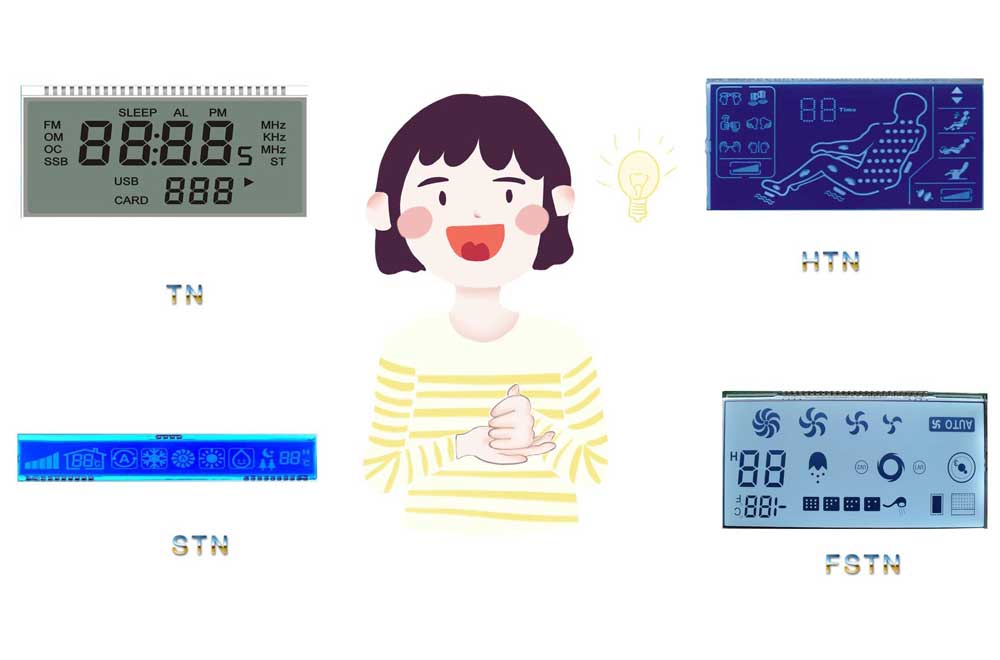
There are four main display types of LCD display: TN, HTN, STN and FSTN. You can see their differences here: The Comparison Of TN, HTN, STN, FSTN LCD
6. Operating Temperature and Storage Temperature.
| Operating Temperature | Storage Temperature | |
| First grade | 0℃~+50℃ | -10℃~+60℃ |
| Second grade | -10℃~+60℃ | -20℃~+70℃ |
| Third grade | -20℃~+70℃ | -30℃~+80℃ |
The higher the temperature is, the higher the unit price will be
7. Operating voltage.
We can make custom operating voltage according to our clients’ requirements. Typical voltage ranges from 2.5v to 4.5v. The most commonly used operating voltages are 3.0v, 4.5v and 5.0v.
8. DRIVE MODE.
We can simply divide LCD Drive mode into static drive mode and dynamic drive mode. For example:
If we make a 17 segment LCD display that adopts static drive mode, there will be 18 feet (each segment has one foot and one common foot). If it adopts a dynamic drive mode whose duty is one-third, there will be 9 feet (17/3=6 feet and 3 common feet).
Static drive mode needs more feet, so it costs a little more than dynamic drive, but the display effect of static drive is a little better. If it is a dot matrix LCD, it must adopt dynamic drive, otherwise, the feet will be too many. For example, 128 * 32 pixel LCD screen adopts static drive, it will be (128 * 32+1) 4097 feet. If the duty of 128 * 32 pixel LCD screen is 32, there will be (128 * 32/32+32) 160 feet.
9. View direction and positive and negative display.
Please see my blog: Positive and Negative Display and Viewing Direction of LCD display
10. Connection type.
Please see my blog: The Connection Type Of LCD
11. Polarizer type.
Please see my blog: Viewing modes of LCD panel· Transmissive LCD vs Reflective LCD vs Transflective LCD
As you can see from the 11 points, there is no fixed price list because of the various factors listed above. Please review the 11 points before asking for a quote. This will make everything easier for all parties concerned.