Greg’s engineering experience
When Do I Recommend Monochrome VA LCD?
I usually recommend monochrome VA when a project needs illuminated digits or icons on a deep black background. I then check the viewing direction, backlight, 5 V drive platform and operating temperature before recommending a design.
This guide preserves my original sample comparisons and practical observations from more than ten years of display work. It focuses on custom monochrome segment LCDs and explains where TN, STN or FSTN may be the more suitable route.
What I Mean by Monochrome VA LCD
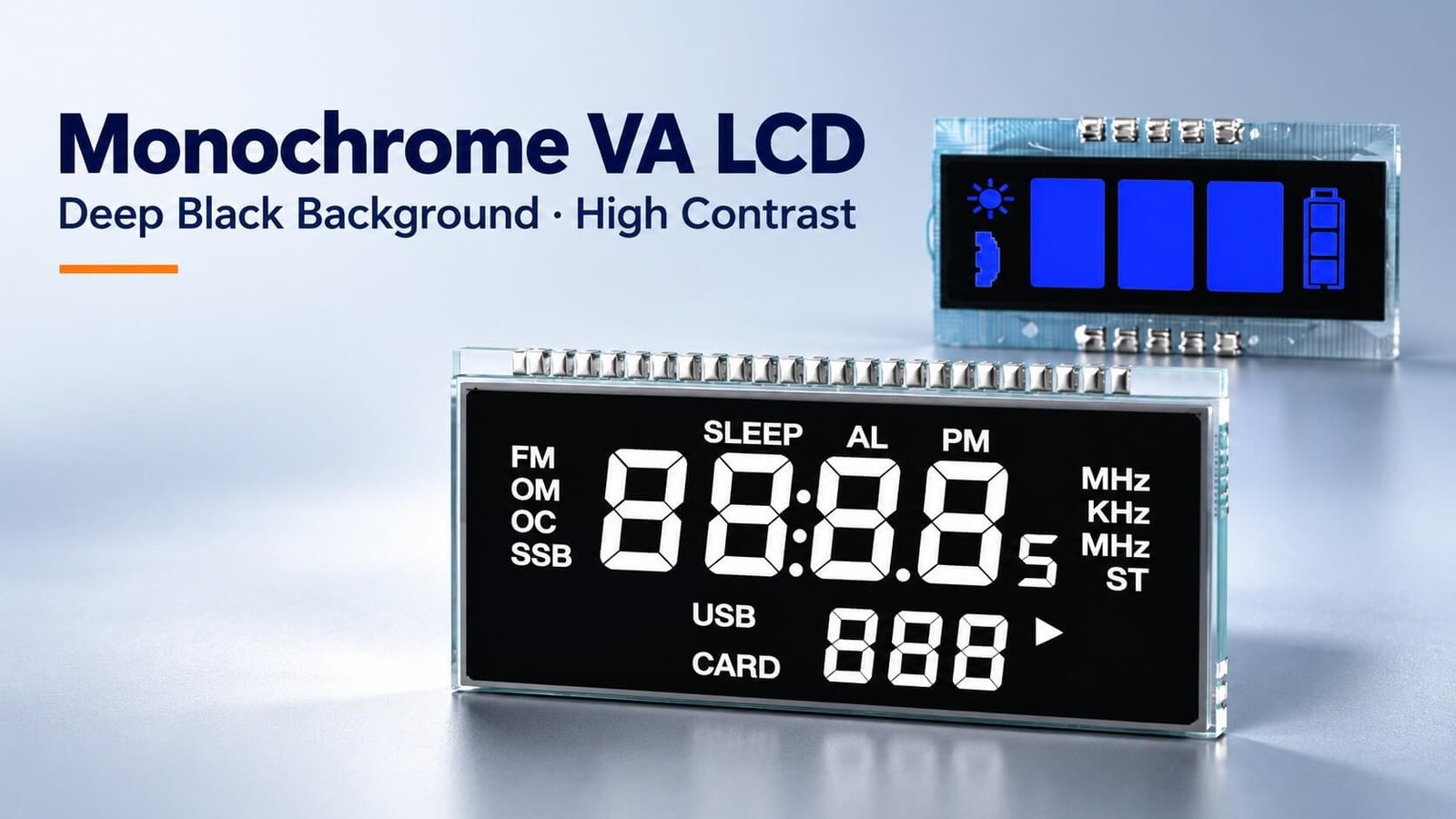
In my monochrome LCD projects, VA is a useful option when a customer wants bright digits or icons on a deep black background. VA means vertical alignment. It describes the liquid crystal alignment, rather than the way a module connects to a PCB.
This article is based on my own sample comparisons and project experience. It concerns custom monochrome segment displays. The VA panels used in color monitors and TVs are a different product discussion; see our TN vs IPS vs VA guide for that comparison.
I previously described VA as an upgraded TN display because that was a convenient way to explain the visual improvement to customers. For engineering selection, however, TN and VA should be treated as different LCD modes, with their own optical and drive requirements.
Comparing Positive TN, Negative TN and Black-Background VA
For a simple instrument, positive TN can be an economical and practical choice. In a reflective configuration, dark characters appear against a light or gray background. A transmissive positive design can use a backlight to produce a lighter illuminated background.


A negative TN display reverses the visual effect: the characters transmit more light than the background. In the samples I have compared, the dark area can look gray rather than the deeper black customers expect from a premium control panel.

That is where I often recommend monochrome VA. The samples below show the black-background appearance that originally made this technology attractive in my projects. The backlight determines the intended illuminated color; photographs are examples, rather than calibrated contrast measurements.
| Selection point | Positive TN | Negative TN | Monochrome VA in our segment projects |
|---|---|---|---|
| Typical appearance | Dark digits on a lighter background | Illuminated digits on a darker background | Illuminated digits and icons on a deep black background |
| Common reason to choose it | Simple, economical readout | Negative appearance within a TN design | Strong black-background visual presentation |
| Lighting review | Reflective, transmissive or transflective design as specified | Backlight and ambient conditions matter | Evaluate the complete backlit assembly |
| Content | Custom fixed segments and icons | Custom fixed segments and icons | Custom fixed segments and icons |
| Decision check | Readability, viewing direction and cost | Background appearance and contrast | Viewing direction, uniformity, voltage and cost |
VA is not the only LCD arrangement capable of a dark background. My recommendation is that it is a strong candidate for the black-background monochrome appearance customers bring to us, rather than a rule that every black-background LCD must be VA.
Backlight Color and the Finished Appearance
A black background does not require white characters. Our original examples include blue, orange, purple, white and yellow illumination. The desired color should be evaluated with the actual glass, polarizers, backlight and cover window together.


For this kind of negative VA design, I normally start with a backlight matched to the application, including higher-output lighting when sunlight readability is required. Without a suitable light source, the attractive bright-character effect is lost. The backlight therefore belongs in the initial specification, rather than being added after the glass is designed.
Check the appearance at the intended operating brightness. A good-looking photograph does not show whether the final product has acceptable brightness uniformity, dark-area leakage or readability through its cover lens. Ask for a sample with the intended color and enclosure stack.
If you are developing the lighting at the same time, use our custom LED backlight quotation guide to prepare dimensions, thickness, electrical requirements and illumination targets.
How We Improve the Black Background of Monochrome VA LCD
What We Mean by “Pure Black”
In everyday project discussions, we often call the VA background “pure black.” That describes its visual appearance, but it is not a precise statement that the liquid crystal blocks every trace of light. With a conventional continuously illuminated LED backlight, an LCD can still transmit some light in its black state. This applies to both monochrome and TFT LCDs; the amount depends on the design.
Black-state transmission through the active area should also be distinguished from localized edge leakage or assembly-related bright patches. Our LCD vs OLED comparison explains the difference between a backlit LCD and self-emissive OLED, while our LCD backlight bleeding guide discusses uneven leakage and assembly checks.
Colored Silk Printing for a More Refined Interface
Monochrome VA can also be combined with multicolor silk printing. The massage-chair panel below is one of our product examples: its deep black background is combined with colored symbols, status bars and a custom chair illustration. In my experience, this treatment adds visual richness and a more refined finish to the control interface.
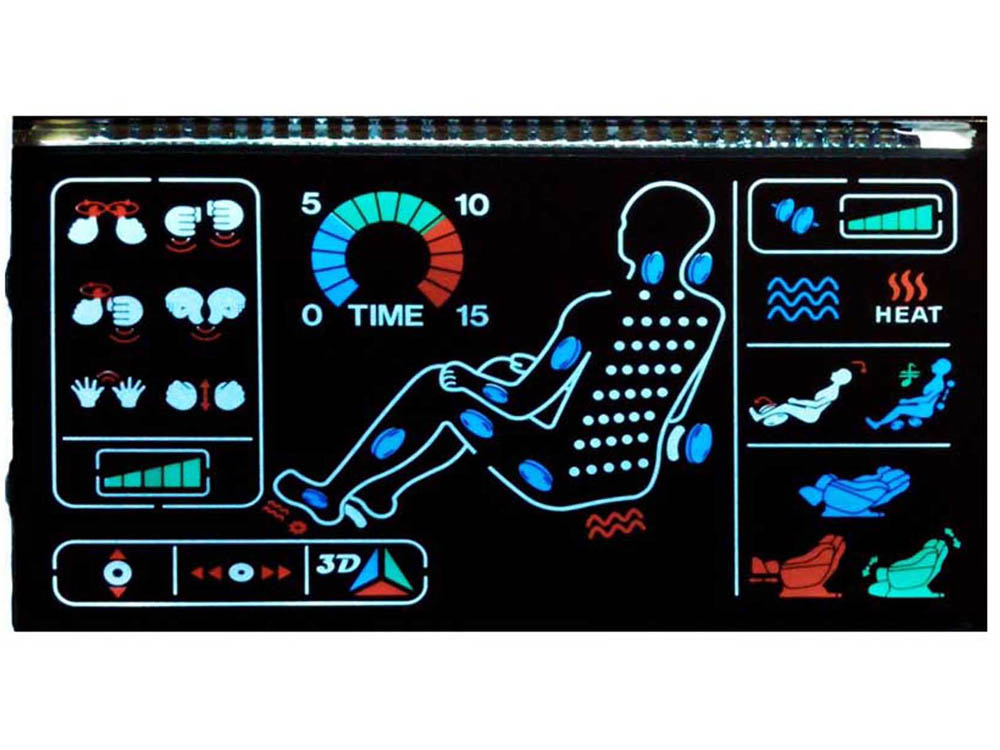
The printed colors belong to the defined artwork. The LCD controls the designed segments; it does not become a full-color pixel-addressable TFT display. Send the intended color artwork and explain which symbols must switch independently so we can review the print layout, segment pattern and backlight together.
This colored printing serves a different purpose from the black masking described below: colored artwork improves visual identity and makes functions easier to distinguish, while the black mask blocks light in covered background areas.
Our Practical Method: A Black Screen-Printed Mask
For monochrome VA projects, we can add a black screen-printed masking layer over the fixed background areas that do not need to display information. In my experience, this produces a solid, deep-black background that makes the illuminated digits and icons stand out. It is a useful approach for premium instruments, control panels and elevator indicators.
The mask blocks light in the covered background. The character and icon openings remain available for the LCD to control. This improves the fixed background appearance; it does not change the liquid crystal’s black-state transmission in the unmasked display areas. The print pattern and opacity should be approved with the actual segment artwork, backlight and finished panel.
For Color LCDs: Mini LED with Local Dimming
For color TFT applications, Mini-LED backlit LCD displays offer another way to improve black levels and contrast. With independently controlled local-dimming zones, the backlight can be reduced or switched off behind dark parts of the image instead of illuminating the entire panel continuously.
The improvement comes from the complete local-dimming system, not just smaller LEDs. Zone count, optical design and control algorithms all matter. Small bright objects against a dark background can still produce halos or blooming because a backlight zone generally covers multiple LCD pixels. Mini LED can substantially improve black levels and image contrast, but it does not guarantee zero leakage or zero blooming in every scene.
| Method | What it improves | What to confirm |
|---|---|---|
| Black screen-printed mask for monochrome VA | Blocks light through covered fixed-background areas and sharpens the visual separation of characters | Mask artwork, registration, opacity and the appearance of unmasked segments |
| Mini LED with local dimming for color TFT LCD | Reduces or switches off illumination behind dark image regions | Zone control, black levels, halos, brightness and thermal performance |
Why This Changed My View of LCD’s Future
Before Mini LED local dimming developed, I sometimes wondered whether LCD would eventually be replaced because of its black-level and contrast limitations. Its progress changed my view. LCD already has a mature supply chain and a strong cost foundation, while improved backlighting can address a major weakness in its visual performance.
I now see more reasons to choose the display around the application rather than assume LCD must disappear. A simple premium indicator may benefit from monochrome VA and a black mask; a full-color display may benefit from Mini LED local dimming. Neither needs to imitate every feature of another technology to be the practical choice for the project.
Viewing Direction: Traditional and Full-Viewing-Angle VA
Monochrome VA quality has improved considerably in my recent projects, while prices have become increasingly affordable. The viewing-angle limitation I described in my earlier sample comparison should therefore not be treated as a limitation of every VA design available today.
Traditional 12 O’Clock VA
With the traditional 12 o’clock design, the display is clear from the 12, 3 and 9 o’clock directions. Readability from the 6 o’clock direction is more limited. This remains a practical and economical choice when the product has a known viewing position.
Upgraded Full-Viewing-Angle VA
We can also offer an upgraded full-viewing-angle monochrome VA design. In my project experience, it can be read from all viewing directions, with viewing-angle performance comparable to STN. This is useful when users approach the display from different sides or the installed viewing position changes.
The full-viewing-angle option has higher tooling fees and a higher unit price than the traditional directional VA design. It should be specified at the quotation stage so we can compare both options against the actual application.
| Selection point | Traditional 12 o’clock VA | Full-viewing-angle VA |
|---|---|---|
| Viewing directions | Clear from 12, 3 and 9 o’clock; more limited from 6 o’clock | Readable from all viewing directions in the upgraded designs we supply |
| Typical selection reason | Known user position and economical implementation | Users view the display from multiple directions |
| Tooling and unit price | Lower-cost starting point | Higher tooling fees and unit price |
| Sample approval | Check the intended viewing direction | Check all required viewing directions |
Tell us whether the user looks down at a tabletop device, up at a wall-mounted instrument, or from several positions around the product. Ask for traditional or full-viewing-angle VA explicitly, then approve the sample through the intended cover window at the required voltage and temperature. “Full viewing angle” describes readability from different directions; it does not mean looking along the edge of the glass at a literal 90° angle.
Premium Elevators and Sunlight-Readable VA Projects
Why I Recommend VA for a Premium Black-Background Appearance
High-end elevator indicators are a good example from my experience. For an upscale office building, when the project does not need a TFT LCD, a monochrome VA LCD is often an attractive choice. Its deep black background and bright, sharply defined digits create a particularly refined appearance with strong visual contrast.
For this kind of simple indicator, I often find a well-made VA display more premium-looking than a conventional TFT LCD. That is my judgment of the finished visual effect: the clean black background, illuminated characters and integration into the panel. A TFT remains the appropriate direction when the application needs full-color graphics, video or a more complex interface.
VA Can Also Be Designed for Sunlight Readability
Monochrome VA is not limited to indoor use. I have worked with several customers who needed sunlight-readable VA displays and requested a very bright backlight. With sufficient backlight brightness and a suitable finished optical assembly, VA can be a workable direction for these applications.
In my projects, a backlight brightness of around 500–600 nits is normally sufficient for ordinary applications. For some sunlight-readable projects, customers have specified 2,500–3,000 nits at the backlight. The higher brightness is a project requirement, rather than the default for every VA display.
| Application direction | Backlight starting point from my experience | Selection priorities |
|---|---|---|
| Ordinary indoor instruments and control panels | Around 500–600 nits is normally sufficient | Comfortable character brightness, uniformity and black-background appearance |
| Premium elevator indicators | Select for the actual lobby or cabin lighting | Deep black appearance, crisp digits, viewing direction and panel integration |
| Sunlight-readable VA projects | Some customers have requested 2,500–3,000 nits | Readability under the intended sunlight, reflections, power and heat |
These figures describe backlight luminance, not a guaranteed luminance measured through the complete LCD. The glass, polarizers and cover window reduce transmitted light. We therefore confirm the measurement position and approve readability on the finished assembly in the intended environment.
A higher-output backlight also needs the appropriate LED drive, power supply, thermal design and dimming range. For equipment used both outdoors and at night, specify both daytime readability and a suitable lower night brightness.
Transmissive, reflective and transflective describe how the display uses light, while VA describes the liquid crystal alignment. For the backlit VA projects discussed here, increasing the backlight output is one practical route to review. If power consumption is the priority, we can also compare an appropriate reflective or transflective monochrome design. See our custom monochrome LCD requirements guide and custom LED backlight quotation guide.
Segment Content, Driver Voltage and Assembly
Modern monochrome VA quality is very good in my project experience, and pricing has become increasingly competitive. This makes it worth comparing with other monochrome options rather than automatically treating VA as an expensive premium choice.
For our normal monochrome VA projects, I recommend segment digits and custom icons. If the customer needs changing text, multiple languages or a graphic dot matrix, I usually route that requirement to STN or FSTN instead. This is our practical product-selection approach, not a claim about every experimental VA structure.
Our usual VA platform requires 5.0 V. Confirm what a quoted voltage refers to: the host supply, logic interface and effective LCD drive are not interchangeable. A customer with a 3 V controller should tell us before the glass and driver are selected.
The number of COM lines also matters. COM means common electrode. Fewer COM lines generally give us more drive margin in the segment designs we evaluate. For a small number of segments, a static, one-COM design is worth discussing. LCD drive still requires the appropriate alternating waveform; “static” does not mean applying a permanent DC voltage across the cell.
| Requirement | Information to provide |
|---|---|
| Display artwork | All digits, icons, decimal points and independently controlled elements |
| Drive | Supply and logic levels, proposed driver IC, duty and bias |
| Viewing position | User position, tilt and required directions |
| Connection | Available contact edge, PCB position and assembly method |
| Lighting | Backlight color, brightness, dimming and uniformity expectations |
| Mechanical stack | Glass size, visible area, cover lens, mounting and permitted thickness |
COB and COG describe driver assembly. Pins, conductive rubber, heat-seal connectors and FPC describe connection choices. They should be selected with the actual module architecture, rather than assumed from the VA label alone. Our custom LCD requirements guide explains those options in more detail.
Operating Temperature: Confirm a Paired Range
I often encounter VA enquiries for higher-specification equipment, but the name VA does not guarantee a particular temperature rating. The operating and storage ranges must be stated and verified for the actual design.
| Common quotation starting point | Operating temperature | Storage temperature |
|---|---|---|
| First grade | 0°C to +50°C | −10°C to +60°C |
| Second grade | −10°C to +60°C | −20°C to +70°C |
| Third grade | −20°C to +70°C | −30°C to +80°C |
These are useful project starting points from my experience, rather than mandatory grades for every manufacturer. A wider range needs a separate review of liquid crystal material, voltage, drive and acceptable optical performance.
For special projects, +80°C operating temperature is already beyond the usual ranges above. In our experience, an upper operating limit of +85°C or +90°C can be feasible with a lower limit such as −10°C or −20°C. If the requirement instead reaches −40°C, an upper limit around +50°C or +60°C may be the workable direction. These examples explain the trade-off; they are not an automatic rating for a VA module.
Specify a paired range. Do not combine the lowest temperature from one design and the highest from another into a single assumed specification.
Prepare a Monochrome VA LCD Enquiry
Before asking for a quotation, send:
- The product application and expected indoor or outdoor environment.
- Segment artwork, icons and the required illuminated color.
- Glass outline, visible area, thickness and enclosure drawing.
- Installed viewing position and acceptable off-axis appearance.
- Host supply, logic level, driver proposal and COM requirements.
- Backlight requirements and connection or PCB arrangement.
- Paired operating and storage temperature ranges.
- Sample quantity, expected order volume and target schedule.
My recommendation is to approve the appearance and drive performance on a representative sample before committing to production. Test it through the intended cover window and from the actual user position. That is more useful than selecting a panel only because it is called “high contrast.”
Frequently Asked Questions
Is monochrome VA the same as a VA computer monitor?
No. This article discusses custom monochrome segment LCDs. A color VA TFT monitor has a different pixel and module architecture, even though vertical alignment is part of the technology description.
Can a monochrome VA display show colored characters?
Yes. The examples in this article use several backlight colors. These are illuminated segment appearances, rather than a full-color graphic display with independently selectable pixel colors.
Is VA always better than TN or FSTN?
No. I often choose VA for its black-background appearance. Modern monochrome VA has improved quality and increasingly affordable pricing. Traditional directional VA is the lower-cost starting point; full-viewing-angle VA offers viewing performance comparable to STN in my projects, with higher tooling fees and unit price. STN or FSTN can be the better direction for our dot-matrix requirements. Lighting and the actual application still matter.
Can I use a VA sample without its backlight?
For the negative VA appearance discussed here, we normally specify a backlight. Confirm readability in the actual environment rather than expecting the same bright-character effect with the lighting removed.
Does a black mask make every part of a VA LCD completely black?
The screen-printed mask blocks light in the fixed background areas it covers. The segment openings remain controlled by the LCD, so this should not be interpreted as eliminating black-state transmission across the entire active display.
Can a monochrome VA LCD be readable in sunlight?
Yes. I have worked on customer projects using high-brightness backlights for this purpose. Some requested 2,500–3,000 nits at the backlight, compared with the 500–600 nits normally sufficient in our ordinary applications. Confirm readability through the complete LCD and cover window under the actual lighting conditions.
Can I specify a 3 V monochrome VA module?
Our normal VA platform requires 5.0 V. Tell us about a 3 V system at the enquiry stage so the driver, supply and feasible module architecture can be reviewed together.
From guide to product
Explore Related Display Products
Choose the product direction that matches the visible content, hidden assembly and integration needs.
VA LCD Glass Panels
Discuss a black-background segment design, viewing direction and matched drive requirements.
Explore product options →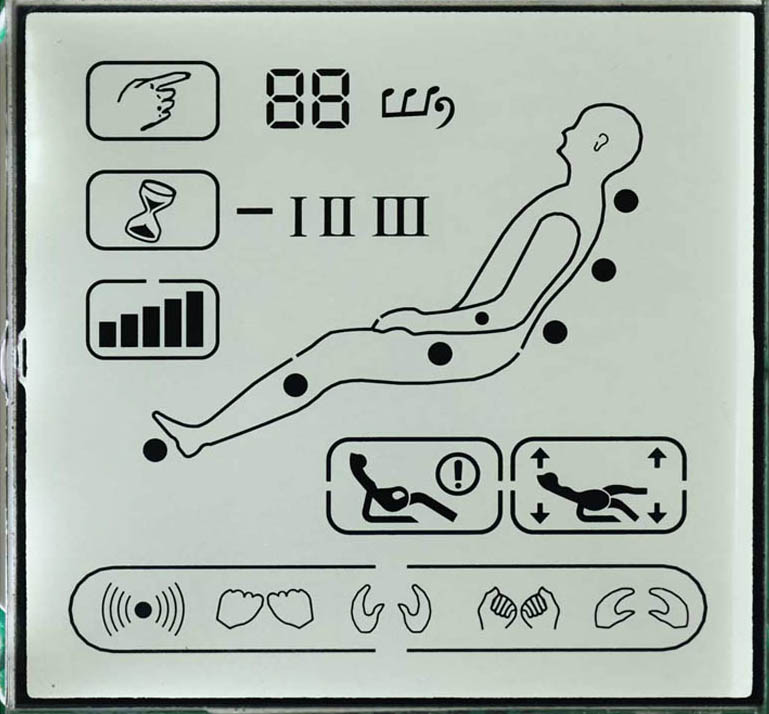
Segment LCD Displays
Develop fixed digits and custom icons for your instrument or control panel.
Explore product options →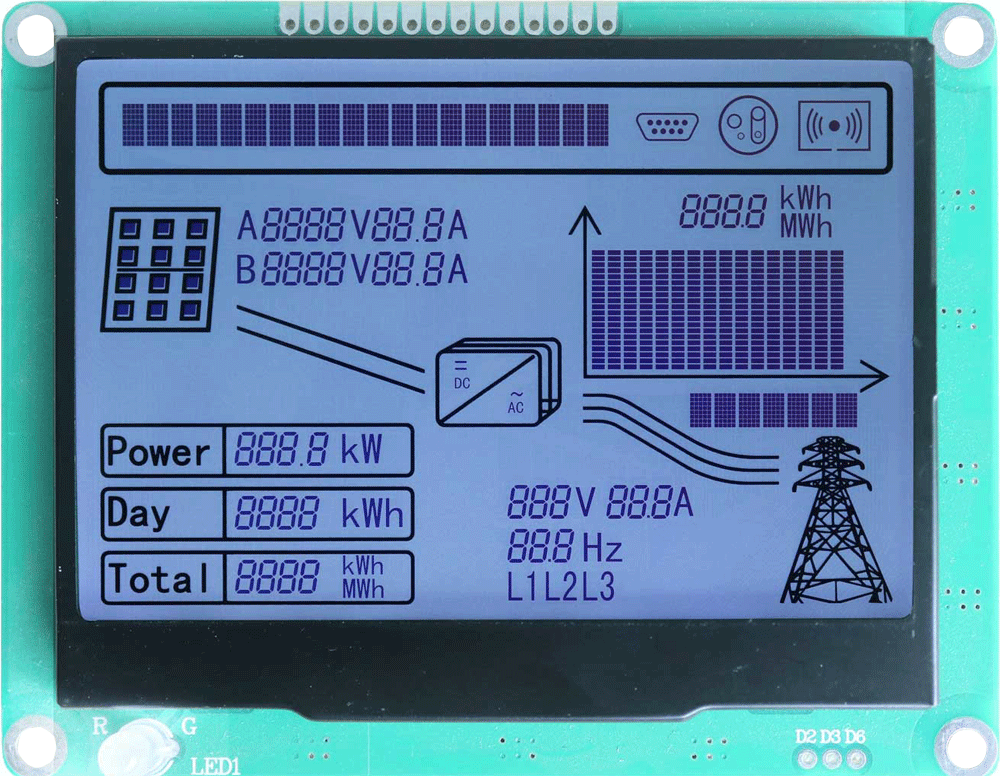
Monochrome LCD Displays
Compare segment and dot-matrix module directions for your application.
Explore product options →Project review
Review Your Monochrome VA LCD Requirements
Send your segment artwork, dimensions, viewing position, backlight color, voltage, temperature range and quantity. DisplayMan can review a suitable monochrome LCD direction.
Prefer to open the enquiry form here?
Further Reading
Apple: Mini LED local dimming and reduced blooming — technology overview
Custom Monochrome LCD: Requirements Before Quotation · TN vs IPS vs VA for TFT LCD Selection
Written from Greg’s monochrome LCD project experience. Photographs retain the original sample comparisons. New projects require their own confirmed optical, electrical and temperature specifications.